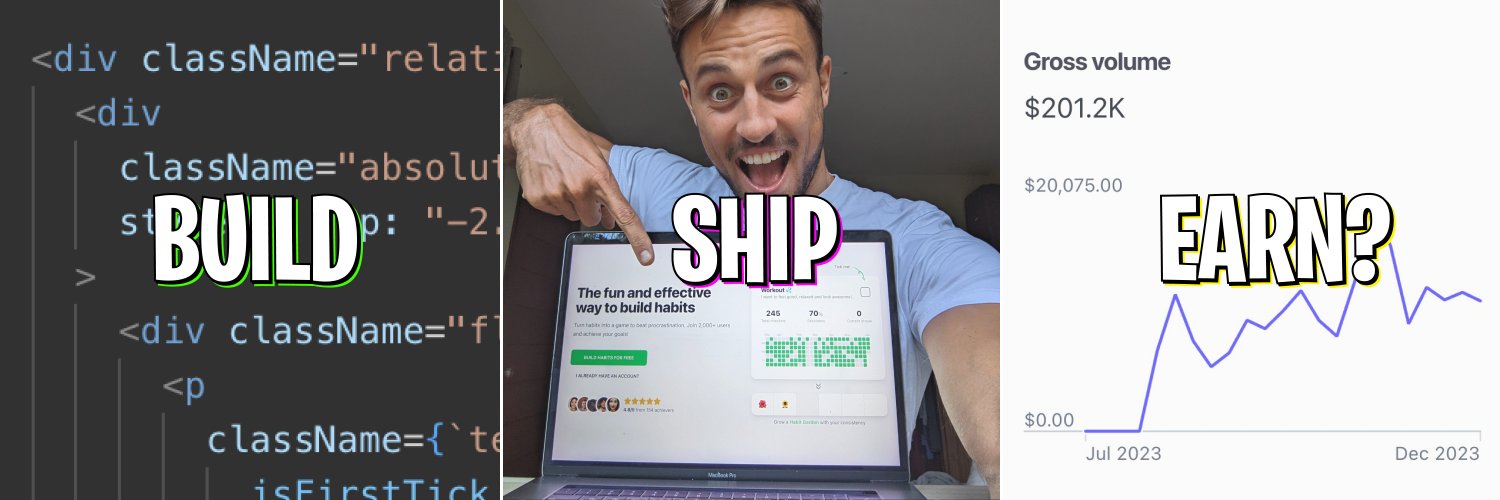
Today is a special day for me.
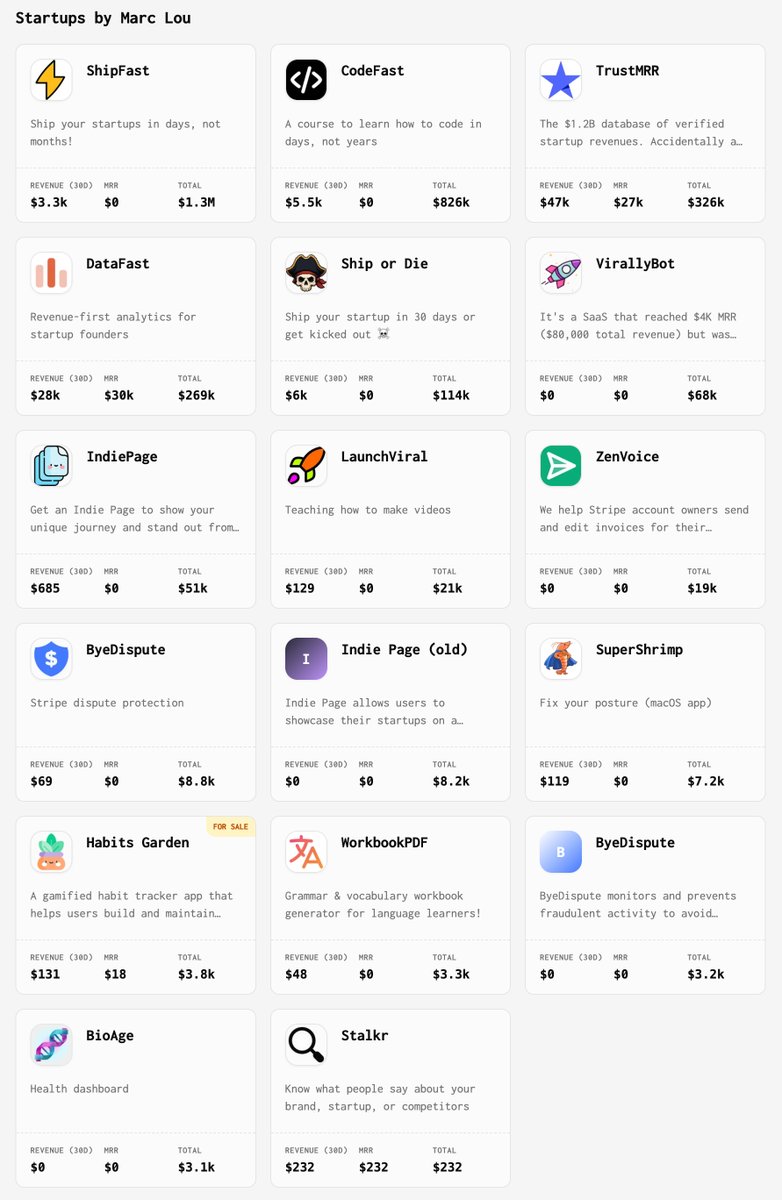
I've made $3M with my 36 startups.
Solo.
85% margin.
Bootstrapped.
It took 10 years, and I loved every second of it.
After failing as an entrepreneur for 5 years, I got a job in 2021.
That's when I discovered @levelsio's journey and decided to try again.
"If he can do it, maybe I can too?"
So I started building tiny startups and writing about it.
2021 and 2022 were quiet, but I was having fun.
Everything changed in 2023 when I launched ShipFast and made my first million.
Building something people finally paid for and enjoyed made me so happy.
My first 5 years of failures taught me not to get emotionally attached to a project, because everything goes to 0 eventually.
So I just kept shipping.
It's 2026, and I've launched 36 startups.
50% never made money.
Only 11% made decent money.
Back in 2016, when I started, I believed I would make it.
If I had known it would take 7 years of failure, I probably would never have started.
That's why I'm stupidly optimistic.
I don't think in years. I don't dream big.
I think in weeks. I build tiny projects fast. And I quit even faster.
That's how I wake up happy, enjoy the journey, and eventually build life-changing projects.
If you've been following the journey, thank you. You've given my posts a sense of purpose, which has kept me going, and I'm very grateful for this. ❤️
Running a newsletter business (MailCheap — $3,500 MRR) is so different from running a web analytics business (DataFast — $28,000 MRR).
Web analytics are perceived as “nice.” I beg my users to spend enough time to get to the “aha” moment and stick with my product. Adoption takes time. Conversion rate is low.
On the other hand, a newsletter is someone’s business backbone. If the user can’t send emails, they don’t make money. I reject ~50% of senders to protect deliverability on MailCheap, and every day I get users on support begging me to reinstate their accounts. Conversion rate is much higher.
It took DataFast 10 months to get where MailCheap got in 1.5 months.
@TontonJars Idealement il faut que tu cree un compte Stripe par startup (c'est ce que Stripe recommande)
Si tu fais pas ca, tkt je regarderai en detail quand on evaluera les vainqueurs
I just shipped this to https://t.co/D3PMnJqNa5:
🔀 Yes/no branches
🔗 UTM tags on links
📈 Gmail pace per domain
📋 Multiple signup forms
🎨 Colored boxes in emails
✨ Personal links per reader
🌗 Light or dark for everyone
🪟 Popup and slide-in signup forms
🕐 Schedule in your readers' time zone
🤖 Automations on a drag-and-drop canvas
Yeah, sorry.
When I was first considering MailChimp, I saw that the automations were limited to something like twenty or twenty five if-thens, if that makes sense. MailChimp allows for something like 250 actions within a single automation. Is this something that you can cater to as well?
this guy made $16k in 4 days with a brand new business
even though we kicked him out of our hackathon last week
he was #1 but had code from before the start, so we told him to start over with something new
he did. he's #1 again.
still 21 days left to beat him
This is how I went from €0 MRR to building a SaaS that pays my bills.
A lot of people asked what happened in early 2025 that finally made this graph move.
So here's the story.
It actually started with a random video on X.
At the time, I was working a full time sales job after going back to employment from being self employed.
I had never heard of build in public and never seriously considered building a SaaS myself.
I knew how to code a little PHP, which I had taught myself back in 2020. But that was about it.
Then one day, @marclou's ShipFast launch video showed up on my timeline.
It was a Navy CIS style parody, and I thought it was hilarious.
I started following Marc, watched his livestreams, and eventually bought ShipFast.
His content was packed with practical advice, and watching him build products live helped me understand how this whole SaaS thing worked.
Remember, this was before AI coding tools became what they are today.
I was literally copying code into ChatGPT whenever I got stuck. (Instead of searching on Stack Overflow)
And I had never touched Next JS before.
But I wanted to learn.
So I started building.
My first project was a little website about children's books that I made with my girlfriend, who worked in childcare.
Nothing commercial. Just something to practice with.
Then I started building a vitamin.
I got pretty far before realizing I had absolutely no interest in the topic.
So I abandoned it.
Next, I tried building a SEO keyword research tool.
SEO tools were getting a lot of attention at the time, and I had some experience with SEO from my previous self-employment.
But while building it, I realized something.
I knew the basics of SEO, but nowhere near enough to build a genuinely good product in that space.
I would have needed to spend months learning the industry before even knowing what to build.
That's when I finally asked myself what I actually knew better than most people.
And the answer was obvious.
Affiliate marketing.
I'd been working in affiliate marketing since around 2011.
Over a decade of experience, recruiting affiliates, managing programs, working with different brands.
For the first time, I had an idea where my existing knowledge could actually give me an unfair advantage.
So I started researching the affiliate software market.
I noticed that SaaS founders were mostly using the same handful of platforms.
And I thought I could build something that made getting started with affiliate marketing easier and more affordable.
That's how Affonso started.
Around August or September 2024, I started building the first version.
The hardest part was Stripe.
I had never worked with Stripe before, and building reliable tracking for subscriptions, payments, and all the different edge cases took countless evenings.
The other nightmare was the landing page.
I'm terrible at design, but somehow still have pretty high standards. Not the greatest combination when you're building everything yourself. 😂
After roughly two months of working on it alongside my full-time job, I finally had something I could launch.
And it was VERY basic.
You could connect Stripe, create an affiliate program, generate tracking links, and see some basic analytics.
The affiliate portal was basically a link and a tiny chart.
There wasn't even a payout system yet.
And that was intentional.
One thing Marc kept repeating was to launch with the bare minimum.
I knew that even if someone signed up immediately, it would take time before their affiliates generated sales and commissions became payable.
So I decided to build payouts when someone actually needed them.
Which is exactly what I did.
I launched without a paywall. Anyone could sign up and use Affonso for free.
And then absolutely nothing happened.
I had a few users, but nobody was paying.
For weeks, I kept improving the product while trying to find people who might actually need it.
I had no testimonials, no reputation in the SaaS space, and no real audience.
And I refused to put fake testimonials on the landing page.
So I did the only thing I could think of.
I started talking to people.
I used X Pro to monitor conversations about affiliate software and SaaS affiliate programs.
Whenever someone had a question I could help with, I joined the conversation.
I wasn't pitching Affonso. I was trying to be useful.
And when someone showed genuine interest or mentioned a problem I knew I could solve, I'd reach out.
Sometimes we'd chat for a while before I even mentioned that I was building affiliate software.
Then I'd offer them free access and ask for feedback.
It was completely manual.
No automation, no AI outreach, no fancy growth strategy.
Just finding people with a relevant problem and talking to them.
But even with all that effort, getting the first paying customer took months.
By January 2025, I was seriously considering giving up.
I had already set myself a deadline. If nobody was willing to pay by then, I'd move on.
Around that time, I introduced something called the Revenue Pass.
Instead of offering a lifetime deal, I wanted to create an offer that was almost impossible to say no to.
For just $49, you could use Affonso until your affiliates had generated $10,000 in revenue.
The Revenue Pass gave customers a huge potential return for a tiny upfront investment while keeping the model sustainable.
And then it happened.
My first paying customer.
I actually reached out to him afterward.
He told me he loved the offer and wanted to secure it, even though he wasn't ready to actively work on affiliate marketing yet.
That one purchase meant so much to me.
After months of building and wondering whether anyone would ever pay, someone finally had.
And it gave me a reason to keep going.
About a week later, another purchase came in.
Then another.
At some point, I was getting two sales a week, then three, then four.
Eventually, people were buying Revenue Passes almost every day.
I gradually increased the price and eventually stopped selling them.
Meanwhile, more customers started choosing the regular subscription, which started at just $9/month.
And slowly, word of mouth started doing its thing too.
People were recommending Affonso to other founders.
The same people I had spent hours helping were now helping me grow.
Looking back at this chart, I think the biggest lesson is how unexciting the beginning actually was.
There was no big launch that changed everything.
I didn't have a huge following.
I didn't spend money on ads.
I didn't rank on Google.
I spent my evenings building a very basic product and my free time talking to potential customers.
And I kept doing that until something finally worked.
Today, Affonso pays my bills, supports my family, and allows me to work on something I genuinely enjoy full-time.
And it all started because a random video appeared on my timeline.
Funny how things work out.
If you're currently sitting at €0 MRR, don't underestimate how far you can get by simply talking to people and solving a problem you actually understand.
2nd person to reach $10K+ revenue for the $100K Hackathon!! 👏👏
And 122 people have made $1+. Up 34% since yesterday.
Leaderboard → https://t.co/5XIpga2stf