A research institute & Deemed University for Natural Sciences, Mathematics, Computer Science & Science Education, under the Department of Atomic Energy.
Twist in light enhances chiral discrimination
Researchers from IIT Bombay led by Prof. Gopal Dixit, Department of Physics; Tata Institute of Fundamental Research (TIFR) and IIT Hyderabad have developed a novel optical technique to distinguish between mirror-image molecules, known as enantiomers, using specially structured “twisted” laser light. Published in Science Advances, the study demonstrates that laser beams carrying orbital angular momentum interact differently with chiral molecules depending on their handedness.
The researchers directed ultrashort twisted laser pulses onto gaseous samples of R- and S-camphor. The interaction ionized the molecules, causing them to fragment into charged particles that were analyzed using a time-of-flight mass spectrometer. They observed that the number of fragments produced varied according to the combination of the molecule’s handedness and the light’s twist, enabling direct discrimination between enantiomers.
Unlike conventional chirality-detection methods that require complex measurements, this approach relies on simple ion-counting signals, offering enhanced sensitivity and experimental simplicity. The technique could provide a powerful new tool for chemical, biological, and pharmaceutical analysis.
The full paper can be accessed here: https://t.co/Udip9bCuAW
#IITHyderabad #Chirality #Optics #Laser #MassSpectrometry #ScienceCommunication #PopularScience
@IITHyderabad@paniitindia@TIFRScience
Thank you, JD @jd1278 🙏for visiting our Department today. Your lecture on “A Temporal Framework for Photoactivating C-H bonds in Water” was Illuminating & informative👏. Please do visit us again!
@TIFRScience; @iiscbangalore
What if your immune defense becomes your vulnerability! Read our latest work on microbial exploitation of host factors to enhance their survival. @TIFRScience@TIFR_Bio Supported by @DBTIndia@DAEIndia
https://t.co/v8L1JZbWLy
The Ooty observatory's 22-year journey to map the upper atmosphere with muons
For 22 years, the #GRAPES-3 muon telescope in Ooty, India, tracked billions of subatomic particles. An international team analysed this data to simultaneously measure variations in Earth’s upper-atmosphere temperature and the Sun’s interplanetary magnetic field, creating a powerful real-time monitoring tool.
For a deep dive, check out:
https://t.co/k8RqppveME
@TIFRScience | @CUSATU1971
#ooty #astrophysics #monitor #science #sciencecommunication #IndianScience #ScienceinIndia
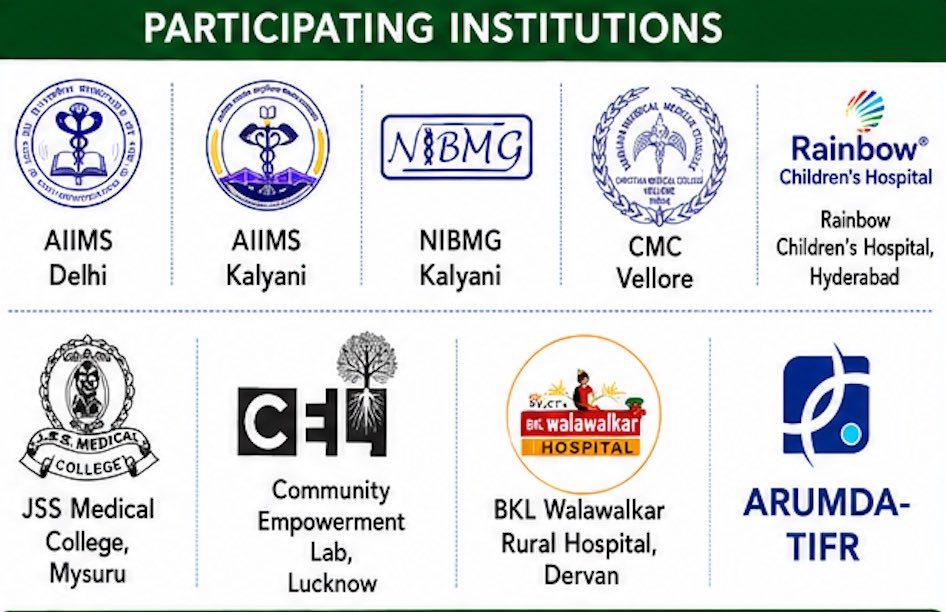
AROHAN: a multi-site, ICMR-supported initiative
Establish rigorous normative data on growth, body composition, & metabolic health among Indian children & adolescents across diverse regions & socio-economic contexts
@ICMRDELHI@TIFRScience@DAEIndia@PMOIndia@TIFRH_buzz
#AwardAlert Three faculty members from @tifrscience, Dr. Prayush Kumar (@ictstifr), Dr. Prasad Perlekar (@TIFRH_buzz), and Dr. Bahadur Singh (TIFR, Mumbai), have been recognised with the 2026 Dr. A.P.J. Abdul Kalam HPC & AI Award for their contributions to high-performance computing across gravitational physics, fluid dynamics, and quantum materials, respectively.
Their work exemplifies how high-performance computing drives discovery across disciplines.
This recognition by @HPE and the Kalam Foundation underscores the importance of HPC and AI in advancing fundamental and applied science.
#TIFRScience #HPC #AI #ScienceAndEngineering #ComputationalScience #QuantumMaterials #FluidDynamics #GravitationalPhysics
#AwardAlert Dr. Girish Kulkarni (faculty, DTP, @tifrscience) has been awarded the Laxminarayana & Nagalaxmi Modali Award (2025) by the Astronomical Society of India.
The award recognises outstanding research contributions carried out primarily in India over the past decade.
Dr. Kulkarni’s work has significantly advanced our understanding of the first billion years of the Universe, covering landmark epochs such as cosmic dawn, reionisation, and the emergence of early supermassive black holes.
More about what his group works on: https://t.co/p88dhHFsIj
#TIFRScience #ASI #blackholes #cosmology
95% of the universe is invisible.
We know dark matter exists, but we still don't know what it is.
What if the clue is hidden in the oldest light in the universe?
In this conversation, TIFR researchers Harsh Mehta and Prof. Suvodip Mukherjee explain how tiny distortions in the Cosmic Microwave Background—the afterglow of the Big Bang—could reveal the presence of elusive axion-like particles, one of the leading dark matter candidates.
Their work, which proposes a new way to search for these particles using a diffuse signal spread across the microwave sky, was awarded Third Prize at the Buchalter Cosmology Prize 2025.
🎥 Watch to discover how scientists are using the universe itself as a laboratory to search for the invisible.
💬 If you could ask one question about dark matter, what would it be?
#TIFRScience #DarkMatter #Cosmology #ALP #CMB
Prof. Vidita Vaidya @ViditaVaidya opened today's scientific session of 3rd BRICS Neuroscience symposium hosted by SGBC (@iitmadras). She talked about manifold effects of serotonergic psychedelics in a rodent model @TIFR_Bio@TIFRScience
#AwardAlert Dr. Amitesh Anand (faculty, @TIFR_Bio) has been selected as an INSA Associate Fellow in Molecular and Cellular Biology, and Dr. Shilpi Jain (faculty, DHEP, @TIFRScience) has been selected as an INSA Young Associate in Physics.
Instituted by the Indian National Science Academy in 2024, these fellowships recognise exceptional researchers across disciplines for their promise and contributions to Indian science and leadership.
Read more: https://t.co/hz32qJQVql
#TIFRScience #INSA #IAF #IYA
#AwardAlert Prof. Vivek Polshettiwar (faculty, DCS, TIFR) has been awarded the PIFI Distinguished Scientist by the Chinese Academy of Sciences (CAS).
This prestigious award recognizes internationally renowned scientists (including Nobel laureates) for their outstanding contributions and supports them in developing collaborative ties with research institutions across China.
More about his work: https://t.co/dHwKrDOQDv
#TIFRScience #PIFI #CAS #Nanocatalysis
June 1, 1945, the Tata Institute of Fundamental Research came into existence in a simple room at IISc, Bangalore.
What followed is one of the most consequential chapters of modern India's story. TIFR became the cradle of India's atomic energy programme. It built the pilot model of India's first digital computer in 1957. Discoveries and innovations like a new class of superconductors, and the GMRT telescope built under its aegis remains one of the finest of its kind in the world.
From its corridors came a league of scientists, educators, and institution-builders who shaped independent India's relationship with research and information management. TIFR was never just a research institute. It was a belief that India deserved to be at the frontier of human knowledge.
81 years on, that argument holds.
@TIFRScience
#TIFR #FoundingDay #TataTrusts
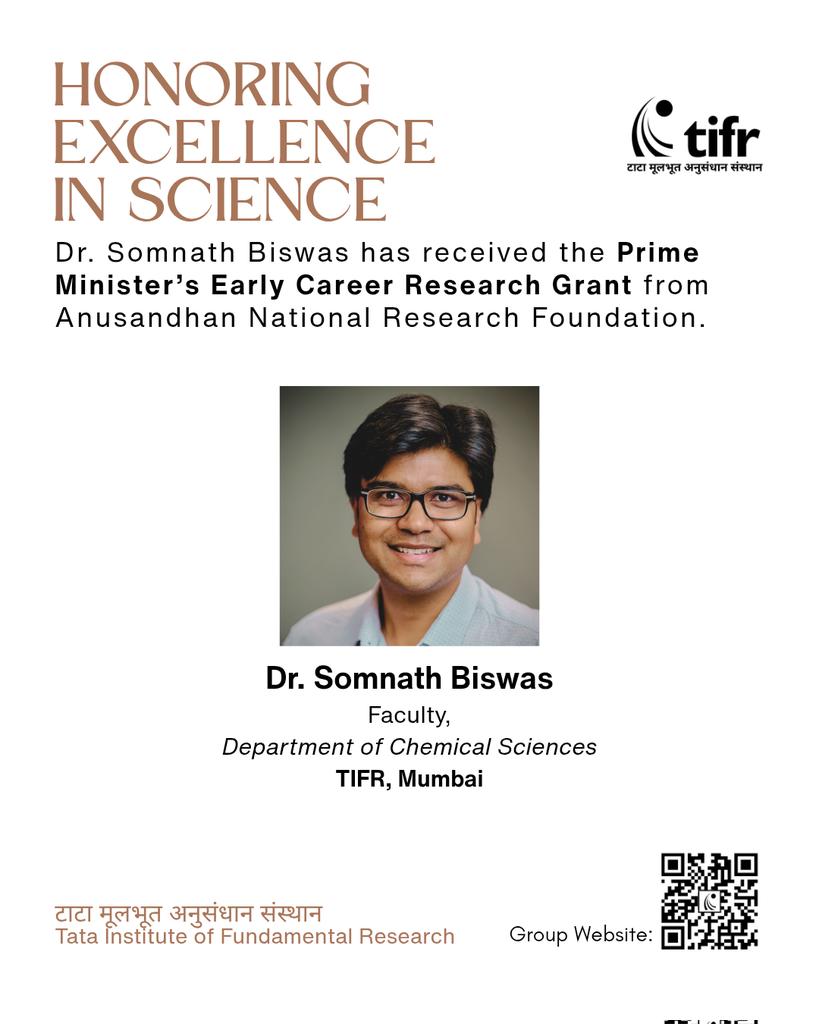
Dr. Somnath Biswas (Dept of Chemical Sciences, TIFR, Mumbai) has received the Prime Minister’s Early Career Research Grant by @ANRF_India.
His research on coherent wavepacket spectroscopy aims to decode how electronic & structural dynamics govern properties and function in quantum & energy materials.
More about his group's work: https://t.co/rA9xCEK8e6
#TIFR #ANRF #PMECRG #PhysicalChemistry #QuantumMaterials
#Spectroscopy
#UltrafastScience
#EarlyCareerResearch