A research institute & Deemed University for Natural Sciences, Mathematics, Computer Science & Science Education, under the Department of Atomic Energy.
Your next chapter in fundamental research could start here.
Applications are now open for TIFR Graduate School GS-2027, the nationwide entrance examination for PhD and Integrated MSc-PhD programmes at TIFR centres across India.
From understanding living systems to exploring the laws of nature, building intelligent systems and advancing mathematical sciences, GS-2027 offers research opportunities across a wide range of disciplines.
Programmes include:
Biology | Chemistry | Computer Science | Learning, Information & Data Sciences (LIDS) | Mathematics | Physics | Applied Computational Math | Physics of Life | Science Education
📝 Exam on 13 Dec 2026
🗓️ Apply by 25 Oct, 11 PM
Fee Waiver Deadline: Oct 11, 11 PM
Ready to apply?
Scan the QR code or visit: https://t.co/FNhmty8VKd
Explore the programmes, eligibility requirements and FAQs before applying.
#TIFRGS2027 #GraduateSchool #PhD #Research #Science #HigherEducation #ScienceCareers #Admissions
The Department of Theoretical Physics at the Tata Institute of Fundamental Research (TIFR), Mumbai, offers opportunities for aspiring researchers to pursue a PhD and investigate fundamental questions in physics through theoretical research.
From the fundamental constituents of matter to the deeper principles governing the universe, discover the research possibilities that could shape your scientific journey.
Explore research opportunities and apply for GS-2027: https://t.co/4ciMdlYvLO
Have a question about the universe? Take the next step towards answering it.
#TIFR #TheoreticalPhysics #TIFRGraduateSchool #GS2027 #PhDAdmissions #PhysicsResearch
Some questions take years to answer. They’re worth pursuing.
Ready to take the next step in research? TIFR Graduate School 2027 offers opportunities for aspiring students to pursue graduate studies across disciplines in the sciences and mathematics.
Explore research opportunities at the Tata Institute of Fundamental Research (TIFR), discover programmes relevant to your interests, and find the eligibility criteria and application details for GS-2027.
🔗 Explore programmes and admissions: https://t.co/4ciMdlYvLO
Your research journey could start with a question. Find out where it could take you.
#TIFR #TIFRGraduateSchool #GraduateAdmissions2027 #PhDAdmissions
The School of Technology and Computer Science (STCS) at the Tata Institute of Fundamental Research (TIFR), Mumbai, offers opportunities to pursue graduate research in theoretical computer science and related areas.
Curious about the questions shaping the future of computing? Explore research opportunities, check the eligibility criteria and admission requirements, and take the next step towards your research journey.
Explore STCS and apply for GS-2027: https://t.co/4ciMdlYvLO
Your next big question could start here.
#TIFRScience #STCS #TIFRGraduateSchool #GS2027 #PhDAdmissions
"One of the most exciting aspects of science is the possibility of unexpected discoveries."
What does it take to pursue those discoveries?
Somnath Biswas, faculty at TIFR's Department of Chemical Sciences, shares his research, outlook and advice for aspiring scientists in The Journal of Physical Chemistry Letters’ special issue featuring Future Leaders in Physical Chemistry.
Explore his insights into ultrafast science, scientific curiosity and the value of persistence: https://t.co/y8Rqhh0PB8
#TIFRScience
What if every particle is a vibrating string?
Prof. Ashoke Sen explains why.
Electrons, photons and quarks aren't fundamentally different, they're different vibrations of the same string.
Interesting part is that the universe might not be built from particles, instead it may be built from vibrating strings.
The Office of the Principal Scientific Adviser to the Government of India congratulates Dr. Ashoke Sen, @ictstifr-Infosys Madhava Chair Professor, Bengaluru, on receiving the Oskar Klein Medal for 2026. He is the first Indian physicist to receive this prestigious honour.
Prof. Sen is globally recognised for his pioneering contributions to string theory, particularly his work on S-duality, the precision counting of black hole entropy and string field theory. His research has played a significant role in advancing modern string theory and deepening our understanding of fundamental physics.
Jointly awarded by @Stockholm_Uni and the Nobel Committee for Physics of the Royal Swedish Academy of Sciences, the Oskar Klein Medal recognises distinguished contributions to physics. This recognition adds to Prof. Sen’s distinguished achievements, which include the Breakthrough Prize in Fundamental Physics (2012), the Dirac Medal (2014), the Padma Shri (2001) and the Padma Bhushan (2013).
My PhD student Dr. Nishant Narayanasamy has been awarded this year's TAA-Zita Lobo Memorial Award for the Best Thesis in Biology within the @TIFRScience. Nishant did some impactful (and beautiful!) work on the physics of the origins of multicellular life: https://t.co/wMUuVSivZW
Ashoke Sen has been awarded the prestigious Oskar Klein Medal for 2026, becoming the first Indian physicist to receive the honour.
Previous recipients include Nobel laureates Chen-Ning Yang, Steven Weinberg and Hans Bethe, who received the medal in its first three years.
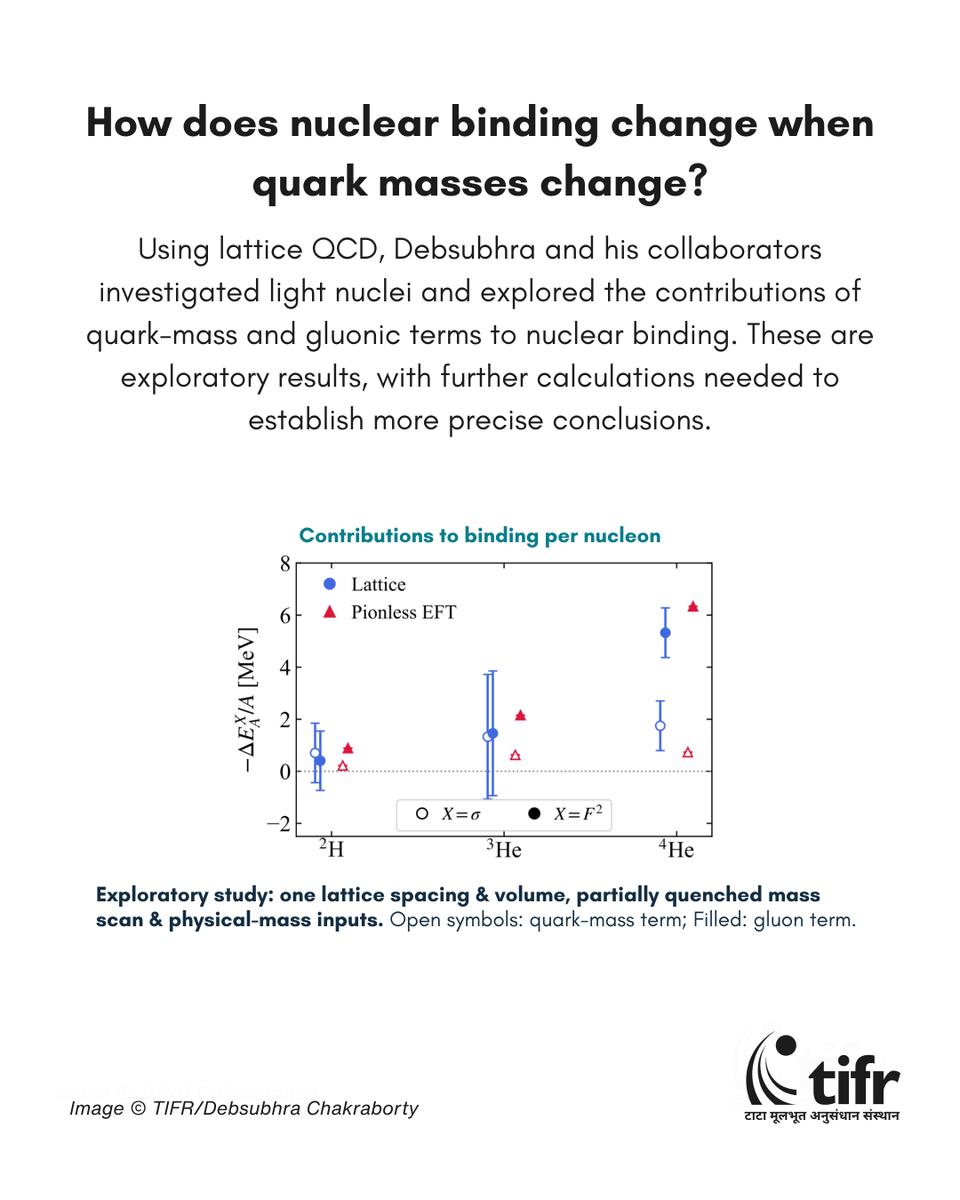
(2/2) These tools also enabled investigations into how the binding of light nuclei changes with quark masses, and how quark-mass and gluonic contributions enter nuclear binding—an exploratory question that requires further study.
The broader goal is to understand how the properties of atomic nuclei emerge from the fundamental theory of the strong interaction.
Congratulations, Debsubhra, on completing your PhD at TIFR! He will continue his research as a postdoctoral associate at the MIT Center for Theoretical Physics – A Leinweber Institute.
#TIFRScience #PhDinPerspective
#PhDinPerspective (1/2) How do protons and neutrons, and the nuclei they form, emerge from the fundamental physics of quarks and gluons?
This is one of the challenges at the intersection of nuclear physics and quantum chromodynamics (QCD). Although QCD describes the strong interaction, calculating the properties of multi-particle nuclear systems directly from the theory is computationally demanding.
In his PhD at TIFR’s Department of Theoretical Physics, Debsubhra Chakraborty, supervised by Prof. Nilmani Mathur, developed and explored computational methods to make these calculations more efficient and their results more reliable.
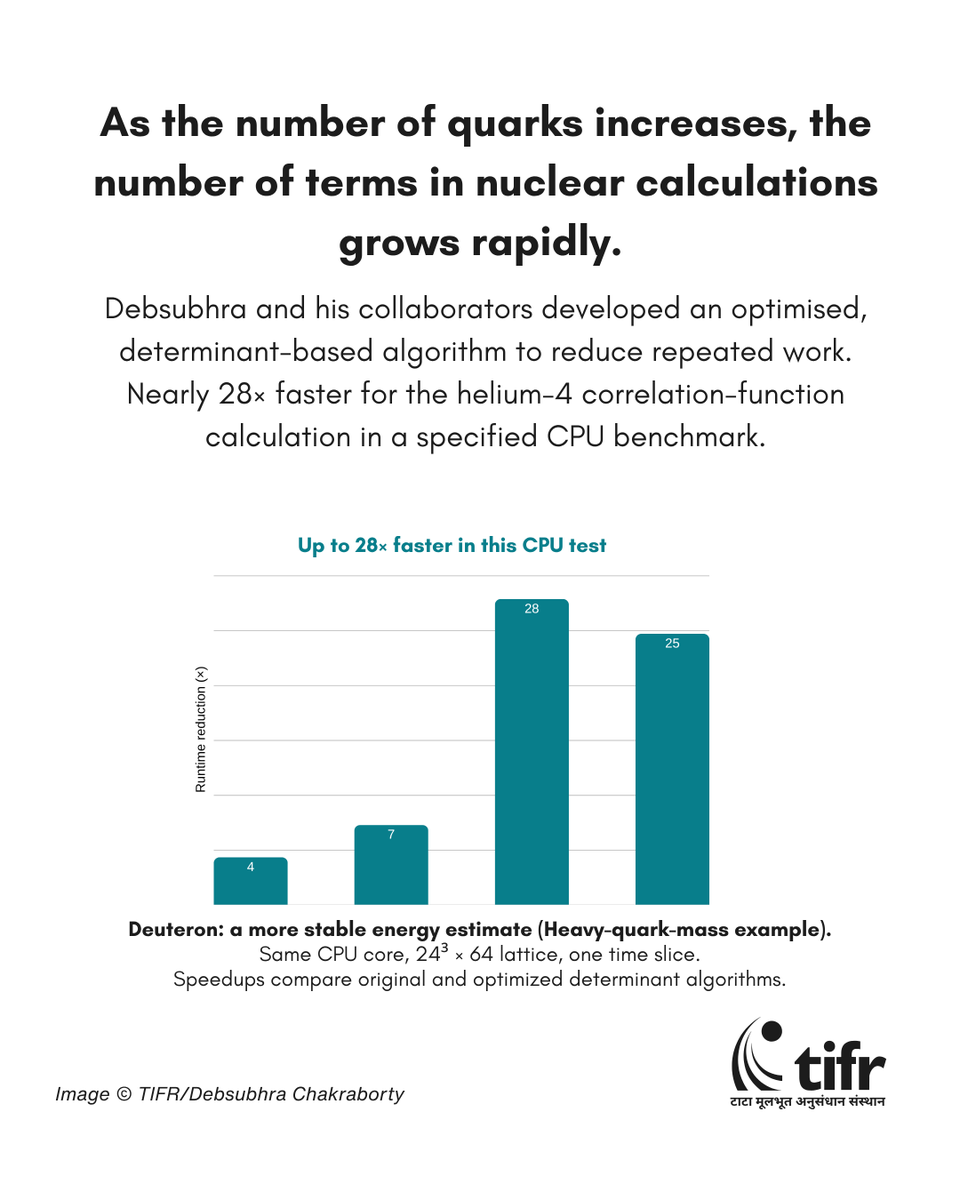
His work tackles several connected challenges: reducing the enormous number of repeated calculations in lattice QCD, extracting energy levels from noisy simulation data, and using wavelet methods to organise spatial information more efficiently.
In one benchmark, an optimised algorithm reduced the time needed for a specific nuclear correlation-function calculation by nearly 28× compared with the original method.
#TIFRScience
𝐕𝐢𝐠𝐲𝐚𝐧 𝐃𝐡𝐚𝐫𝐚 | 𝐌𝐒𝐕-𝟐𝟎𝟑𝟓: 𝐀 𝐒𝐧𝐚𝐩𝐬𝐡𝐨𝐭 𝐏𝐚𝐫𝐭 𝟐 | 𝐌𝐞𝐠𝐚 𝐒𝐜𝐢𝐞𝐧𝐜𝐞 𝐕𝐢𝐬𝐢𝐨𝐧-𝟐𝟎𝟑𝟓 (𝐇𝐢𝐠𝐡 𝐄𝐧𝐞𝐫𝐠𝐲 𝐏𝐡𝐲𝐬𝐢𝐜𝐬): 𝐀 𝐐𝐮𝐞𝐬𝐭 𝐓𝐨𝐰𝐚𝐫𝐝𝐬 𝐔𝐧𝐝𝐞𝐫𝐬𝐭𝐚𝐧𝐝𝐢𝐧𝐠 𝐍𝐚𝐭𝐮𝐫𝐞 𝐚𝐭 𝐢𝐭𝐬 𝐒𝐦𝐚𝐥𝐥𝐞𝐬𝐭
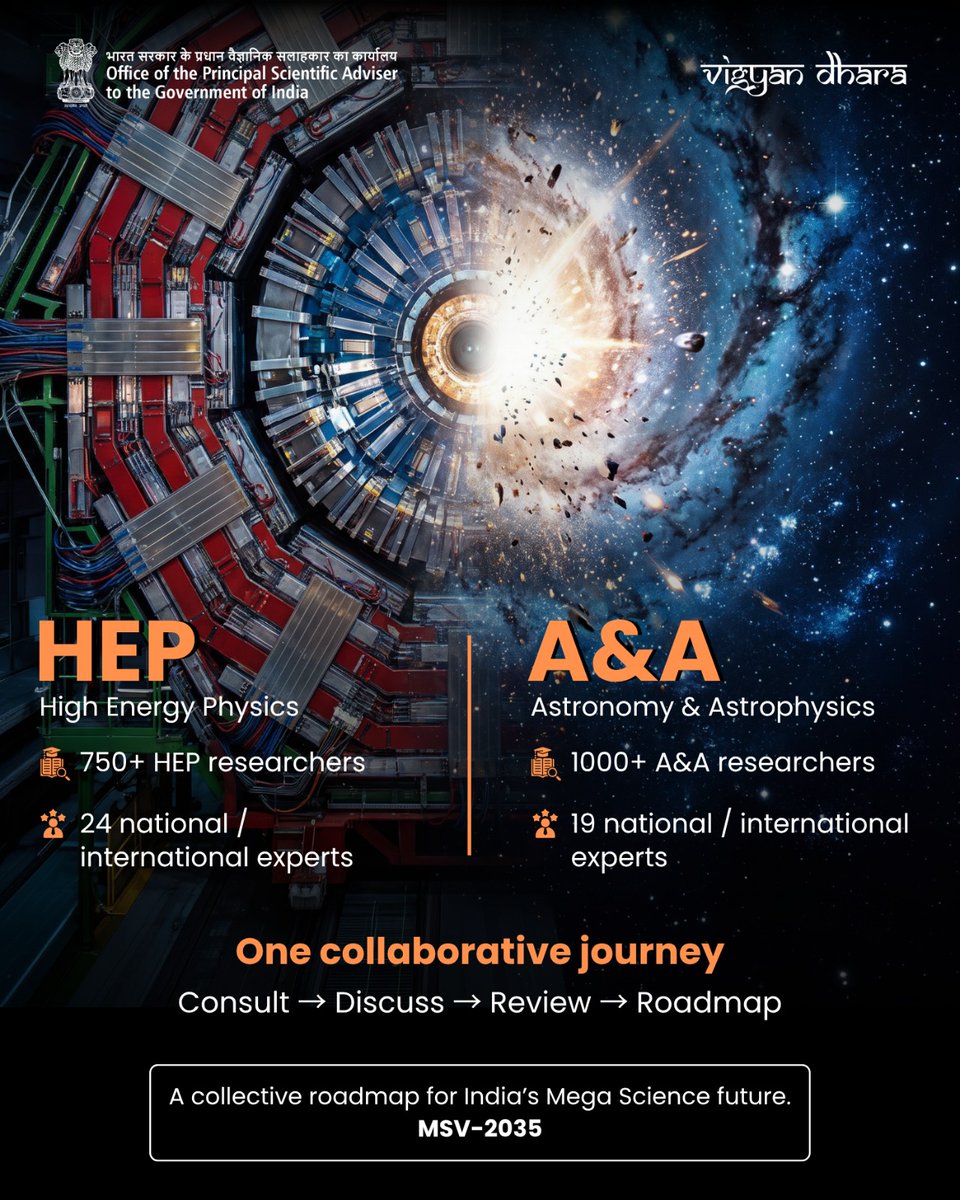
The second article of this edition presents the Mega Science Vision-2035 (MSV-2035) report on High Energy Physics (HEP), which provides an overview of the mega science report on high energy physics. It focuses on key questions such as the nature of dark matter and dark energy, the origin of masses and the matter-antimatter asymmetry in the Universe, and sets out pathways to address them through experiments at the energy, intensity and cosmic frontiers.
The article also highlights the contributions of Indian scientists to experiments such as CMS, ALICE and Belle II, and recommends priority Mega Science Projects across collider, underground, neutrino and astroparticle experiments. It further suggests administrative measures, such as a Mega Science Coordination Unit and a dedicated MSP budget, and calls for building infrastructure in India so that future MSPs hosted in the country can attract the international community.
📖 Explore more in the article by Dr @amol_dighe, Professor, Department of Theoretical Physics, Tata Institute of Fundamental Research (@TIFRScience) and access the full magazine here: https://t.co/3xE1DFqkqi
#VigyanDhara #MegaScienceVision2035
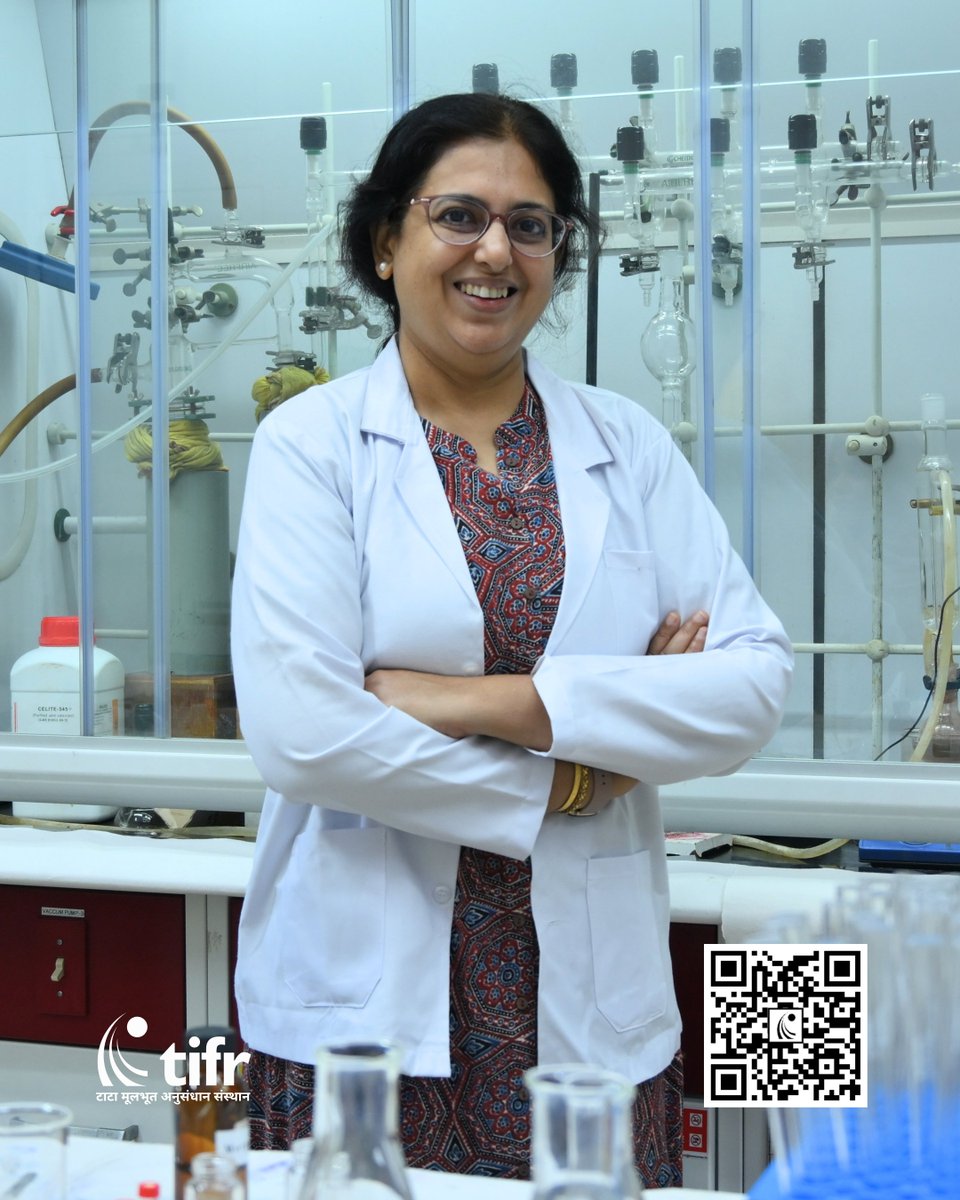
Ankona Datta, faculty at the Department of Chemical Sciences @tifrscience has been awarded the James Hoeschele AsBIC Award, which recognises outstanding mid-career researchers in biological inorganic chemistry across the Asia-Pacific region.
The award recognises Ankona's work in pushing the frontiers of molecular imaging and metal ion sensing by strategic and elegant employment of bio-mimetic and coordination chemistry, acheiving research excellence in the field.
Prof. Datta will be honoured at the 12th AsBIC Conference in Jaipur, where she will also deliver an award lecture.
𝐕𝐢𝐠𝐲𝐚𝐧 𝐃𝐡𝐚𝐫𝐚 | 𝐌𝐒𝐕-𝟐𝟎𝟑𝟓: 𝐀 𝐒𝐧𝐚𝐩𝐬𝐡𝐨𝐭 𝐏𝐚𝐫𝐭 𝟐 | 𝐌𝐞𝐠𝐚 𝐒𝐜𝐢𝐞𝐧𝐜𝐞 𝐚𝐧𝐝 𝐌𝐒𝐕-𝟐𝟎𝟑𝟓 | 𝐀𝐧 𝐈𝐧𝐭𝐫𝐨𝐝𝐮𝐜𝐭𝐢𝐨𝐧
The first article of this edition introduces Mega Science Projects (MSPs), which are large and technologically complex experimental facilities requiring considerable human, capital, and financial resources. MSPs are essential in fields such as High Energy Physics (HEP), as scientists investigate matter at extremely small, sub-nuclear scales, which requires accelerators, advanced detectors and powerful computing systems. Modern research in Astronomy & Astrophysics (A&A) also employs large experimental facilities to advance the frontiers of knowledge. The Higgs boson and gravitational waves are among the landmark discoveries made possible by MSPs that the global scientific community built together.
India’s Mega Science Vision-2035 (MSV-2035) covers six disciplines: Nuclear Physics; High Energy Physics; Accelerator Science and Technology and Applications; Astronomy & Astrophysics; Climate Research; and Ecology & Environmental Science.
📖 Explore more in the article by Dr Praveer Asthana, PSA Fellow, OPSA, and read the September 2026 edition of the MSV-2035 magazine at: https://t.co/gnwnu599cm
#VigyanDhara #MegaScienceVision2035
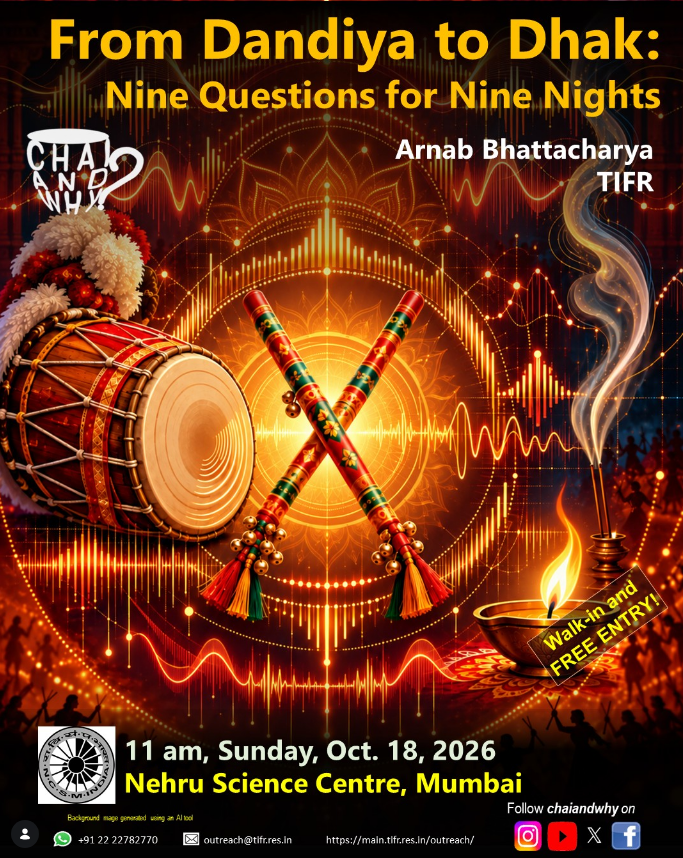
This Navratri, we’ll chase nine fun questions, dipping into some physics, mathematics, chemistry and perhaps even biology along the way. No special knowledge needed, just your ears, eyes, curiosity, and perhaps a willingness to clap along!
In this conversation with @knowtimetofly, Prof. G. Ravindra Kumar, a leading experimental laser physicist at @TIFRScience and 2015 Infosys Prize laureate in Physical Sciences, discusses the science behind lasers, nonlinear optics, and high-energy-density physics.
He also shares his thoughts on science education in India, making a case for curiosity, questioning, and hands-on experimental research over rote learning. As he points out, building India's technological capabilities depends on investing in strong scientific research.
The conversation also covers the history of the race to invent the laser and the impact of laser technology on scientific research and its applications. Prof. Kumar discusses the importance of experimental physics and the need for a science education system that encourages students to question, investigate, and develop a deeper understanding of the world around them.
Watch the full interview: https://t.co/7jg1prW7NV
#physics #scientificresearch #laserphysics #scienceeducation #experimentalphysics #TIFR #infosysprize #ravindrakumar #youtubevideo
🔬 Interested in biological research? NCBS-TIFR’s 2-year MSc (by Research) programme offers research from Day 1, interdisciplinary training and a monthly scholarship. August 2027 intake applications open soon!
📩 [email protected]@TIFRScience
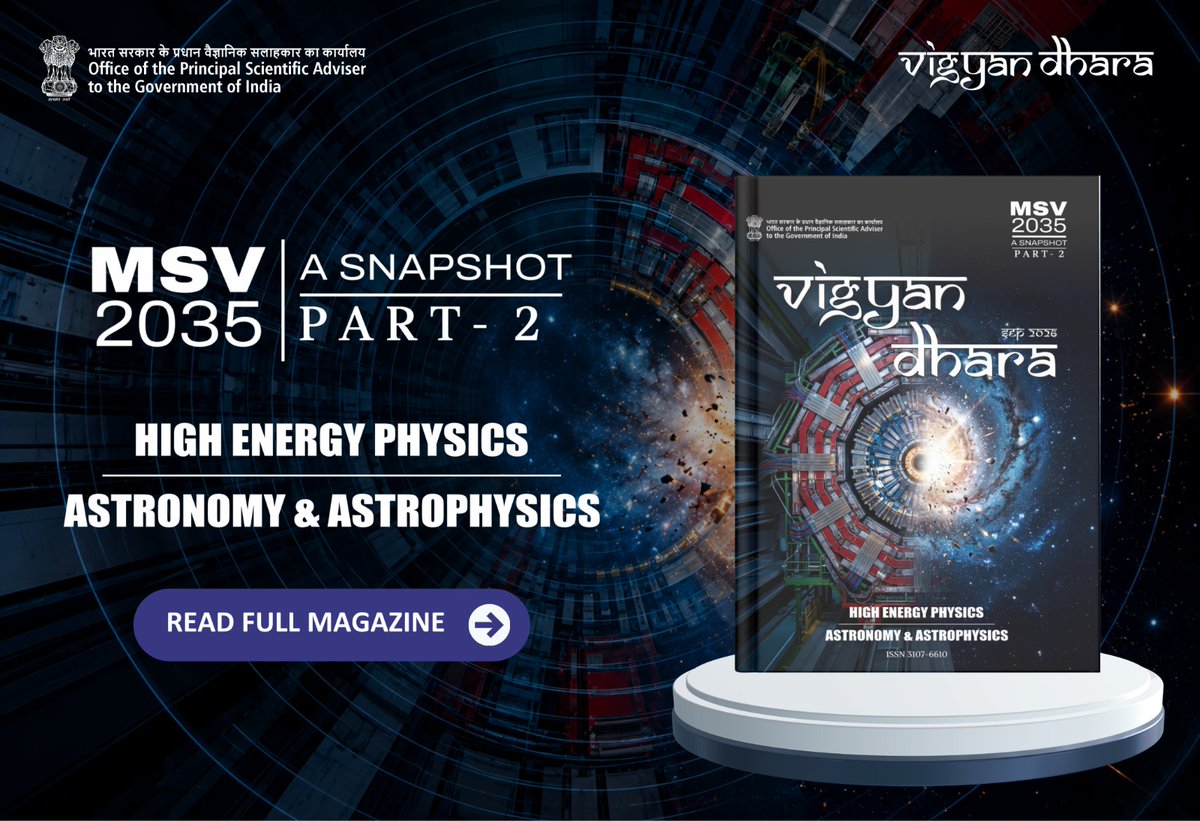
𝐕𝐢𝐠𝐲𝐚𝐧 𝐃𝐡𝐚𝐫𝐚 | 𝐌𝐒𝐕-𝟐𝟎𝟑𝟓: 𝐀 𝐬𝐧𝐚𝐩𝐬𝐡𝐨𝐭 𝐏𝐚𝐫𝐭 𝟐: 𝐇𝐢𝐠𝐡 𝐄𝐧𝐞𝐫𝐠𝐲 𝐏𝐡𝐲𝐬𝐢𝐜𝐬 𝐀𝐬𝐭𝐫𝐨𝐧𝐨𝐦𝐲 & 𝐀𝐬𝐭𝐫𝐨𝐩𝐡𝐲𝐬𝐢𝐜𝐬
The September 2026 edition of Mega Science Vision-2035 (MSV-2035) exercise, brings together the highlights of the MSV-2035 reports (HEP and A&A). It showcases the role of Mega Science Projects, the challenges, and the scientific and technological benefits they bring. This edition includes:
🔹 Foreword by the PSA, Prof. Ajay Kumar Sood, outlines how High Energy Physics (HEP) gave rise to Mega Science, its extension to astronomy and astrophysics (A&A). It traces the shift from the LHC to large-scale astronomy projects.
🔹 Mega Science and MSV-2035: An Introduction by Dr Praveer Asthana, explains why various Mega Science research facilities are needed and explores how the MSV-2035 exercise, covering six disciplines, came about.
🔹 Mega Science Vision-2035 (HEP): A Quest Towards Understanding Nature at its Smallest by Prof. Amol Dighe, summarises the HEP report and brings key scientific questions, pathways and recommendations for future HEP projects.
🔹 Mega Science Vision-2035 (A&A): From the Sun to the Cosmic Horizon by Prof. G. C. Anupama summarises the A&A report and explores science priorities and national and international facilities shaping Indian astronomy.
🔹 Featured Interview: Glimpses into the World of High Energy Physics with Prof. Atul Gurtu discusses India's journey from cosmic rays to the LHC. (https://t.co/hJmf9LsKc4)
🔹 Featured Interview: Unlocking the Frontiers of the Celestial World with Prof. Ajit K. Kembhavi discusses astronomy's heritage, its role in AI and big data, and a message for young scientists. (https://t.co/elQxGv0ABF)
🔹 A Brief History of High Energy Physics in India by Prof. Sreerup Raychaudhuri gives a glimpse into the history of HEP; from early pioneers to India's contribution to the Higgs boson discovery.
🔹 Landscape of Astronomy & Astrophysics in India by Prof. Jasjeet Singh Bagla covers the different forms of asttronomy, India's observatories, important discoveries and major facilities; from Kodaikanal to AstroSat.
🔹 Perspectives presents views from the @DAEIndia , Department of Space (@isro) and @IndiaDST chiefs on managing mega science projects in India.
📖 Read the magazine at: https://t.co/gnwnu59H1U
#VigyanDhara #MegaScienceVision2035