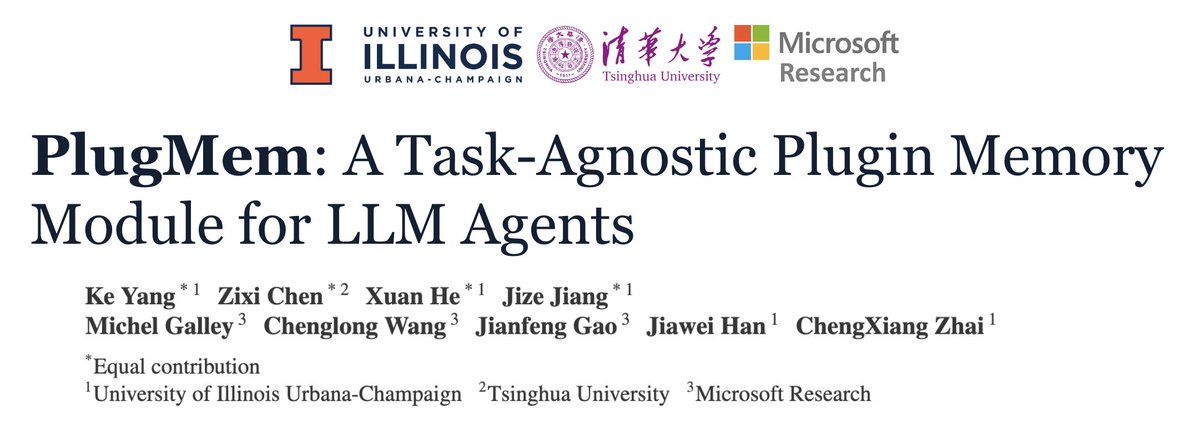
🎉Our project PlugMem is accepted to ICML 2026.
🤖We build a plug-and-play memory module that transforms raw trajectories into a reasoning-ready knowledge graph.
🤩Huge thanks to the team for the incredible collaboration!
See more detail here.👇
Updates for the project PlugMem:
🎉Accepted to ICML!
💡Support integration for OpenClaw🦞, claude code🐙 and other framworks!
See more details in the paper
Big thanks to everyone on the team and our mentors 🌟
I’m thrilled that PlugMem has been accepted to ICML 2026. This is a big milestone for our work on memory for evolving agents.
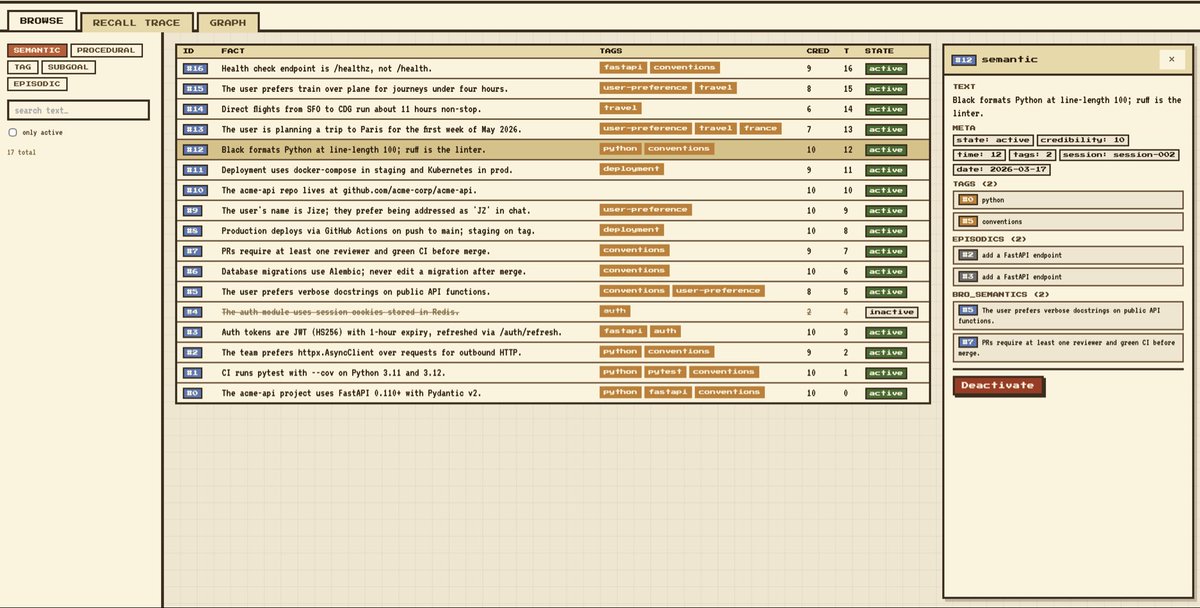
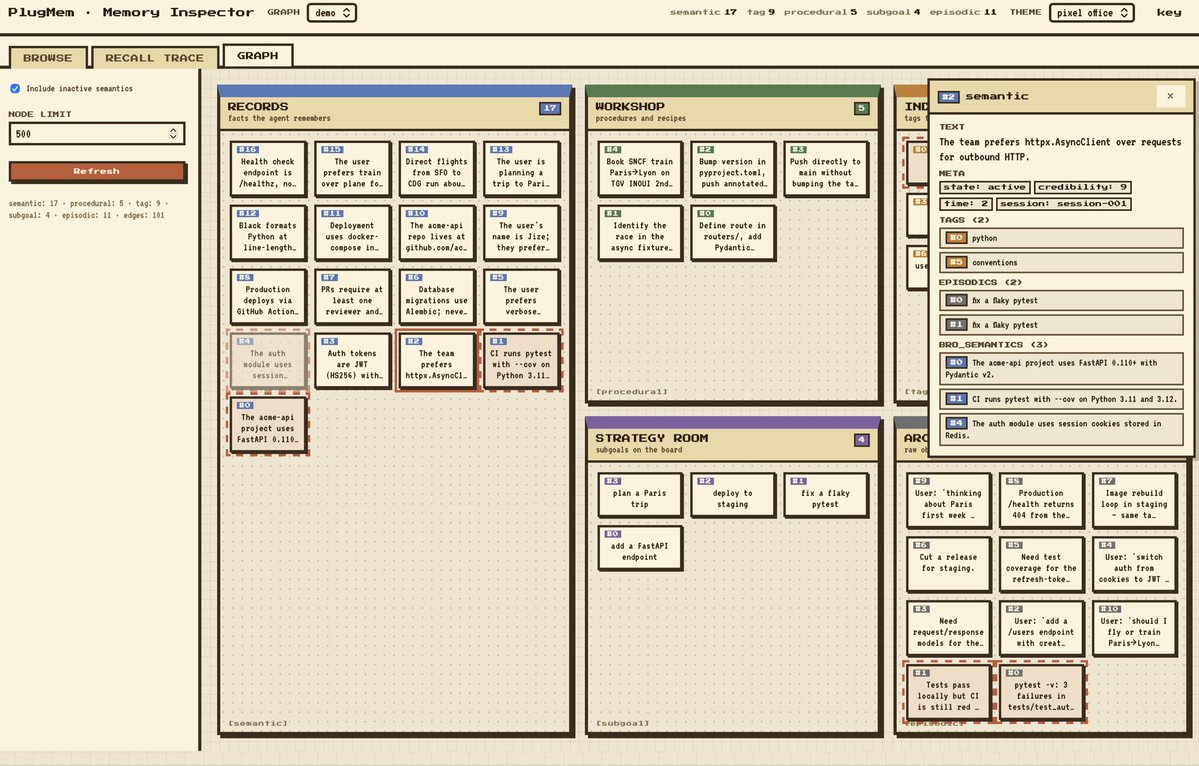
What excites me just as much is we are turning PlugMem into something people can actually build with, a truly plug-and-play memory module that works across real agent runtimes and interpretable through visualization interfaces.
Making research accessible is part of pushing the frontier 🎆
@EmpathYang@chenzixi23@XuanHe21@JizeJiang Congratulations to the team on the great work! Memory is a key component of any intelligent agent, and the idea of a plug-and-play memory module is not only theoretically interesting but also practically useful. It's so exciting that the new technology can now be used by people!
Big PlugMem update 🧠
A plug-and-play memory module for LLM agents — turns raw trajectories into a knowledge graph your agent actually reasons over.
🎉 Accepted to ICML 2026
🔌 Drop it into OpenClaw 🦞, Claude Code, and other agent runtimes
🔍 Visualize memory · test retrieval · replay sessions
🥇 SOTA backbone on LongMemEval & HotpotQA — general enough to build on
Paper: https://t.co/9IKkUUYeaV
Code: https://t.co/3HlfVzWPgZ
#ICML2026 #LLM #Agents
🤔Hold on, I can answer better.
🔗New preprint on LLM multi-turn performance drop and recovery [https://t.co/eqcbzQoZXP]. 💡We identify a hidden tension in multi-turn reasoning: hold vs. lure.
⌛️Models can hold their intent to answer until sufficient evidence is observed, avoiding premature errors. ☔️But this ability is fragile—salient information can lure models to answer.
⬇️Even with the same information, performance drops significantly when moving from single-turn to multi-turn reasoning.
❓We ask: is this due to an overly strong intent to answer early?
🧑⚕️This is especially critical in medical diagnosis, a high-stakes setting with low tolerance for error, where a wrong answer at any turn can have serious consequences.
🎯To study this, we introduce MINT (Medical Incremental N-Turn Benchmark). MINT is:
✔ Information-preserving: decomposed cases can be concatenated to recover original single-turn performance, isolating the effect of interaction
✔ High-fidelity: clinically structured evidence (e.g., history, labs) with controlled turn granularity
💡Our key findings:
🏃1. Strong early-answer intent:
Over 55% of answers are given within the first 2 turns, leading to a 20–50% accuracy drop from single-turn to multi-turn.
⏰2. Holding unlocks self-correction:
When models are instructed to WAIT, the performance drop is greatly reduced. Incorrect→correct revisions occur up to 10.6× more often than the reverse, revealing a latent self-correction ability suppressed by early commitment.
🦴3. Strong lures override control:
Clinically salient signals (e.g., lab results) trigger premature answers—even when models are explicitly told to wait.
👇4. Actionable implications:
• Deferring the diagnostic question improves first-answer accuracy by up to 62.6%
• Delaying salient evidence prevents up to 23.3% catastrophic accuracy drop.
Thanks to all our coauthors for their amazing support! @ Jinrui Fang @ Runhan Chen @ Xu Yang @ Jian Yu @ Jiawei Xu @ Ashwin Vinod @WenqiShi0106@TianlongChen4@hengjinlp @ Chengxiang Zhai @TIMANUIUC@ying000
@MSFTResearch Code & data available: https://t.co/TzN23j4NEU. PlugMem supports automatically organizing facts and skills for AI agents. Plug and play.
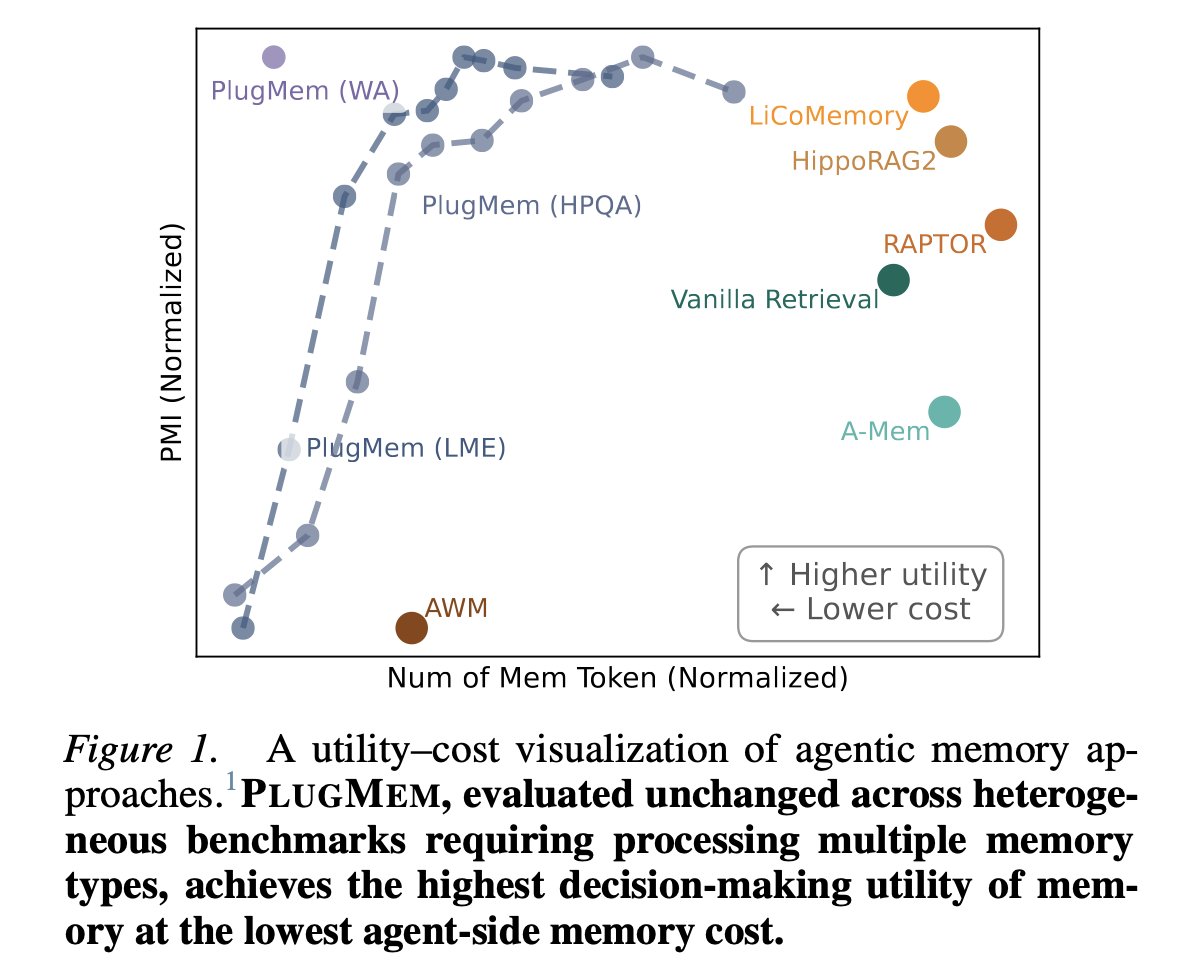
PlugMem transforms AI agents’ interaction histories into structured, reusable knowledge. It integrates with any agent, supports diverse tasks and memory types, and maximizes decision quality while significantly reducing memory token use: https://t.co/girJeCrr6p
📰New preprint: How can we build a task-agnostic plug-and-play memory module for LLM agents that supports multiple memory types?
We present PlugMem🔌🧠, a plugin memory module that works across tasks by turning heterogeneous experience into knowledge.
Evaluated unchanged on long-term dialogue🗣️, multi-hop QA🕵️, and web agents🕸️🤖, PlugMem improves performance while using far fewer memory tokens.
📜Paper: https://t.co/A8tNQjkCCb
🔨Code: https://t.co/mt1aJKxQIz
We’ve been building a task-agnostic memory module for LLM agents — PlugMem.
While running experiments across long-horizon QA, multi-hop retrieval, and web agents, we found several unexpected patterns about how memory actually helps (or hurts) decision-making.
Code: https://t.co/mt1aJKxQIz
Work with an amazing team: @chenzixi23, @XuanHe21, @JizeJiang, the deep learning group @MSFTResearch, @dmguiuc, and @TIMANUIUC.
Thread ↓
👏👏Join us for a talk by Yuji Zhang @Yuji_Zhang_NLP on Developing Robust and Trustworthy Foundation Models on this Saturday@9 pm!
⏲️Event Registration here: https://t.co/KzWbFtNcEf
Yuji is a postdoctoral researcher at UIUC working on robust and trustworthy foundation models, with publications at ACL, EMNLP, ICLR, and more.
We will learn about:
🔍 Making model knowledge explicit, testable, and reliable
🧠 Understanding and addressing hallucination and knowledge overshadowing
🔧 Diagnosing and repairing model failures with minimal side effects
⚛️ Representing knowledge as interpretable, composable "atomic skills"
🎯 Aligning model reasoning with real-world decision value
🇬🇧 We’re excited to announce our first participant in the UK!
Paul, who is paralyzed due to motor neuron disease, received his Neuralink implant at @uclh earlier this month and was able to control a computer with his thoughts just hours after surgery.
Introducing GEN-0, our latest 10B+ foundation model for robots
⏱️ built on Harmonic Reasoning, new architecture that can think & act seamlessly
📈 strong scaling laws: more pretraining & model size = better
🌍 unprecedented corpus of 270,000+ hrs of dexterous data
Read more 👇
We’re building tools to support research in the life sciences, from early discovery through to commercialization.
With Claude for Life Sciences, we’ve added connectors to scientific tools, Skills, and new partnerships to make Claude more useful for scientific work.
Check our research team website at https://t.co/YgwHSBdM22! 🍁 (picture taken near the meadow brook park in Urbana, IL) @siebelschool@uofigrainger@UofIllinois




![Yuji_Zhang_NLP's tweet photo. 🤔Hold on, I can answer better.
🔗New preprint on LLM multi-turn performance drop and recovery [https://t.co/eqcbzQoZXP]. 💡We identify a hidden tension in multi-turn reasoning: hold vs. lure.
⌛️Models can hold their intent to answer until sufficient evidence is observed, avoiding premature errors. ☔️But this ability is fragile—salient information can lure models to answer.
⬇️Even with the same information, performance drops significantly when moving from single-turn to multi-turn reasoning.
❓We ask: is this due to an overly strong intent to answer early?
🧑⚕️This is especially critical in medical diagnosis, a high-stakes setting with low tolerance for error, where a wrong answer at any turn can have serious consequences.
🎯To study this, we introduce MINT (Medical Incremental N-Turn Benchmark). MINT is:
✔ Information-preserving: decomposed cases can be concatenated to recover original single-turn performance, isolating the effect of interaction
✔ High-fidelity: clinically structured evidence (e.g., history, labs) with controlled turn granularity
💡Our key findings:
🏃1. Strong early-answer intent:
Over 55% of answers are given within the first 2 turns, leading to a 20–50% accuracy drop from single-turn to multi-turn.
⏰2. Holding unlocks self-correction:
When models are instructed to WAIT, the performance drop is greatly reduced. Incorrect→correct revisions occur up to 10.6× more often than the reverse, revealing a latent self-correction ability suppressed by early commitment.
🦴3. Strong lures override control:
Clinically salient signals (e.g., lab results) trigger premature answers—even when models are explicitly told to wait.
👇4. Actionable implications:
• Deferring the diagnostic question improves first-answer accuracy by up to 62.6%
• Delaying salient evidence prevents up to 23.3% catastrophic accuracy drop.
Thanks to all our coauthors for their amazing support! @ Jinrui Fang @ Runhan Chen @ Xu Yang @ Jian Yu @ Jiawei Xu @ Ashwin Vinod @WenqiShi0106 @TianlongChen4 @hengjinlp @ Chengxiang Zhai @TIMANUIUC @ying000](https://pbs.twimg.com/media/HFZ-FRyXAAAr4q6.jpg)
![Yuji_Zhang_NLP's tweet photo. 🤔Hold on, I can answer better.
🔗New preprint on LLM multi-turn performance drop and recovery [https://t.co/eqcbzQoZXP]. 💡We identify a hidden tension in multi-turn reasoning: hold vs. lure.
⌛️Models can hold their intent to answer until sufficient evidence is observed, avoiding premature errors. ☔️But this ability is fragile—salient information can lure models to answer.
⬇️Even with the same information, performance drops significantly when moving from single-turn to multi-turn reasoning.
❓We ask: is this due to an overly strong intent to answer early?
🧑⚕️This is especially critical in medical diagnosis, a high-stakes setting with low tolerance for error, where a wrong answer at any turn can have serious consequences.
🎯To study this, we introduce MINT (Medical Incremental N-Turn Benchmark). MINT is:
✔ Information-preserving: decomposed cases can be concatenated to recover original single-turn performance, isolating the effect of interaction
✔ High-fidelity: clinically structured evidence (e.g., history, labs) with controlled turn granularity
💡Our key findings:
🏃1. Strong early-answer intent:
Over 55% of answers are given within the first 2 turns, leading to a 20–50% accuracy drop from single-turn to multi-turn.
⏰2. Holding unlocks self-correction:
When models are instructed to WAIT, the performance drop is greatly reduced. Incorrect→correct revisions occur up to 10.6× more often than the reverse, revealing a latent self-correction ability suppressed by early commitment.
🦴3. Strong lures override control:
Clinically salient signals (e.g., lab results) trigger premature answers—even when models are explicitly told to wait.
👇4. Actionable implications:
• Deferring the diagnostic question improves first-answer accuracy by up to 62.6%
• Delaying salient evidence prevents up to 23.3% catastrophic accuracy drop.
Thanks to all our coauthors for their amazing support! @ Jinrui Fang @ Runhan Chen @ Xu Yang @ Jian Yu @ Jiawei Xu @ Ashwin Vinod @WenqiShi0106 @TianlongChen4 @hengjinlp @ Chengxiang Zhai @TIMANUIUC @ying000](https://pbs.twimg.com/media/HFZ-AigXQAAamkt.jpg)
![Yuji_Zhang_NLP's tweet photo. 🤔Hold on, I can answer better.
🔗New preprint on LLM multi-turn performance drop and recovery [https://t.co/eqcbzQoZXP]. 💡We identify a hidden tension in multi-turn reasoning: hold vs. lure.
⌛️Models can hold their intent to answer until sufficient evidence is observed, avoiding premature errors. ☔️But this ability is fragile—salient information can lure models to answer.
⬇️Even with the same information, performance drops significantly when moving from single-turn to multi-turn reasoning.
❓We ask: is this due to an overly strong intent to answer early?
🧑⚕️This is especially critical in medical diagnosis, a high-stakes setting with low tolerance for error, where a wrong answer at any turn can have serious consequences.
🎯To study this, we introduce MINT (Medical Incremental N-Turn Benchmark). MINT is:
✔ Information-preserving: decomposed cases can be concatenated to recover original single-turn performance, isolating the effect of interaction
✔ High-fidelity: clinically structured evidence (e.g., history, labs) with controlled turn granularity
💡Our key findings:
🏃1. Strong early-answer intent:
Over 55% of answers are given within the first 2 turns, leading to a 20–50% accuracy drop from single-turn to multi-turn.
⏰2. Holding unlocks self-correction:
When models are instructed to WAIT, the performance drop is greatly reduced. Incorrect→correct revisions occur up to 10.6× more often than the reverse, revealing a latent self-correction ability suppressed by early commitment.
🦴3. Strong lures override control:
Clinically salient signals (e.g., lab results) trigger premature answers—even when models are explicitly told to wait.
👇4. Actionable implications:
• Deferring the diagnostic question improves first-answer accuracy by up to 62.6%
• Delaying salient evidence prevents up to 23.3% catastrophic accuracy drop.
Thanks to all our coauthors for their amazing support! @ Jinrui Fang @ Runhan Chen @ Xu Yang @ Jian Yu @ Jiawei Xu @ Ashwin Vinod @WenqiShi0106 @TianlongChen4 @hengjinlp @ Chengxiang Zhai @TIMANUIUC @ying000](https://pbs.twimg.com/media/HFZ968bWMAAf11q.jpg)





![Yuji_Zhang_NLP's tweet photo. 🤔Hold on, I can answer better.
🔗New preprint on LLM multi-turn performance drop and recovery [https://t.co/eqcbzQoZXP]. 💡We identify a hidden tension in multi-turn reasoning: hold vs. lure.
⌛️Models can hold their intent to answer until sufficient evidence is observed, avoiding premature errors. ☔️But this ability is fragile—salient information can lure models to answer.
⬇️Even with the same information, performance drops significantly when moving from single-turn to multi-turn reasoning.
❓We ask: is this due to an overly strong intent to answer early?
🧑⚕️This is especially critical in medical diagnosis, a high-stakes setting with low tolerance for error, where a wrong answer at any turn can have serious consequences.
🎯To study this, we introduce MINT (Medical Incremental N-Turn Benchmark). MINT is:
✔ Information-preserving: decomposed cases can be concatenated to recover original single-turn performance, isolating the effect of interaction
✔ High-fidelity: clinically structured evidence (e.g., history, labs) with controlled turn granularity
💡Our key findings:
🏃1. Strong early-answer intent:
Over 55% of answers are given within the first 2 turns, leading to a 20–50% accuracy drop from single-turn to multi-turn.
⏰2. Holding unlocks self-correction:
When models are instructed to WAIT, the performance drop is greatly reduced. Incorrect→correct revisions occur up to 10.6× more often than the reverse, revealing a latent self-correction ability suppressed by early commitment.
🦴3. Strong lures override control:
Clinically salient signals (e.g., lab results) trigger premature answers—even when models are explicitly told to wait.
👇4. Actionable implications:
• Deferring the diagnostic question improves first-answer accuracy by up to 62.6%
• Delaying salient evidence prevents up to 23.3% catastrophic accuracy drop.
Thanks to all our coauthors for their amazing support! @ Jinrui Fang @ Runhan Chen @ Xu Yang @ Jian Yu @ Jiawei Xu @ Ashwin Vinod @WenqiShi0106 @TianlongChen4 @hengjinlp @ Chengxiang Zhai @TIMANUIUC @ying000](https://pbs.twimg.com/media/HFZ-L0cXoAAdPdC.jpg)