@tostadisto La gente actualmente no se modera en criticar y educarse, lamentablemente no son conscientes de que los artistas son seres humanos como cualquiera pero les puede más sus inseguridades y las avientan a los artistas con odio. Que pena que el mundo se esté llenando de personas así
LOS COMENTARIOS DE HOSEOK A ALGUNOS DE SUS MOMENTOS ESPECIALES, SOY LLANTO😭💜
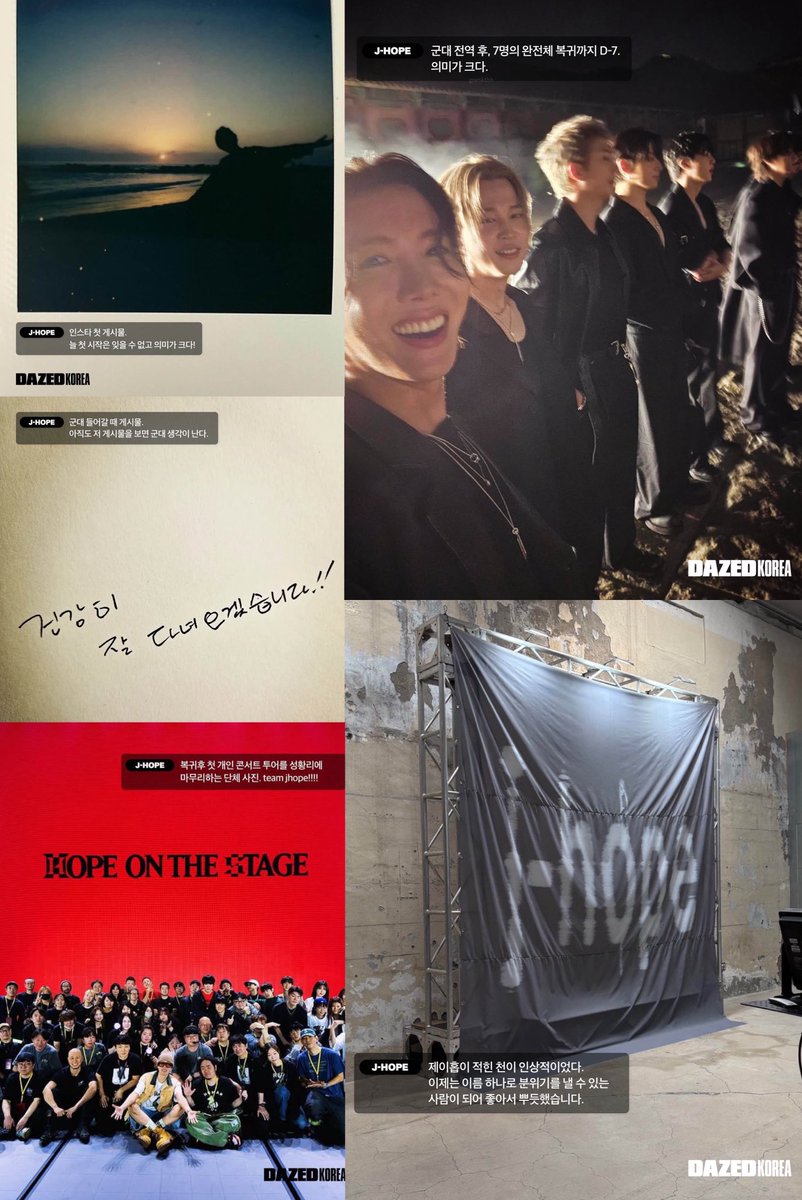
“🐿️: Mi primera publicación en Instagram. Todo primer momento es inolvidable y especial.
🐿️: La publicación que hice cuando me alisté en el servicio militar. Hasta hoy, cuando veo esa publicación, me hace recordar mis días en el ejército.
🐿: Una foto grupal para celebrar el cierre exitoso de mi primera gira en solitario después de regresar del servicio militar. ¡Team j-hope!
🐿: D-7, los siete se reunirán nuevamente después de completar el servicio militar. Este momento significa mucho para mí.
🐿: El tejido con el nombre 'j-hope' escrito en él fue impactante. Me sentí feliz y orgulloso de haberme convertido en alguien que puede crear una atmósfera solo con su propio nombre.”
J-HOPE FOR DAZED KOREA
J-HOPE X DAZED
#jhopexDazed #jhopexDazedKorea
LO HERMOSO QUE ES ESTO OBSERVEN! Se dan cuenta que tenemos Gemini x BTS, la esfera mostrando lo hermoso de esta colaboración y las voces de los tannies con cada representación siendo tan ellos, ES DEMASIADO LINDO TODO ESTO 😭✨
- COMENTEN 👇
BTS X GOOGLE GEMINI
BTS FOR GOOGLE GEMINI
#BTSxGoogleGemini
#BTSforGoogleGemini
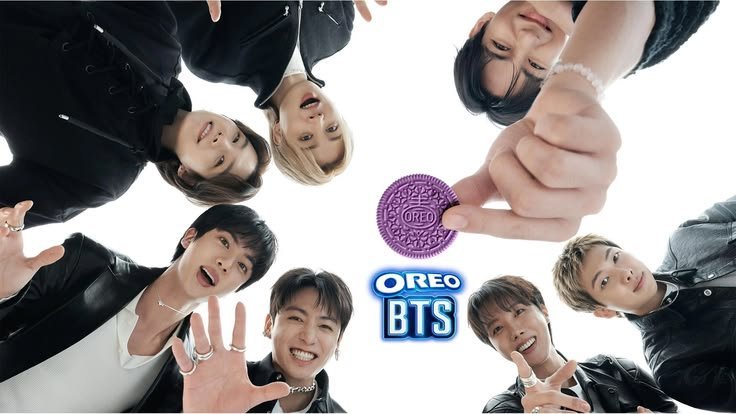
Supermercados donde estarán disponibles las Oreo x BTS 🇪🇨🍪💜
-Coral Hipermercados: 6 de Agosto
-Mi Comisariato: sin fecha
-Supermaxi/Megamaxi: ya disponibles
-Almacenes tía: sin fecha
Todo esto a nivel nacional ‼️
[Rolling Stones] Anton Hur, one of Korea's most prominent authors and literary translator, who is also the first Korean member of the International Booker Prize Jury expressed his support for #BTS's withdrawal from the Grammys in the face of racial segregation. “I love what BTS did, this was the right decision. I often count the number of POC/Asian nominees in a book prize longlist, and when I see just one, I can tell immediately it was the token pick."
"BTS was always being used to shore up viewer numbers for the Grammys. Now they’re telling the Grammys to f***off. Good for them. I hope the rest of Korea learns from this."
#ArtHasNoAliens #GeographyIsNotAGenre
https://t.co/wwfQBUtxPg
ARMYs, this is one of the most interesting and trenchant takes on BTS's Grammys decision, even digging into America's history of "Separate but Equal."
Kim Ou-joon, one of Korea's most influential public figures and its most prominent progressive voice (I recently wrote a seven-part article about him in the Articles section), devoted a lengthy segment to the BTS-Grammys controversy on his program, Gyeomson News Factory. It is the most-watched live political and current affairs program on YouTube in Korea (and in the world), drawing more than 200,000 live viewers and averaging around 1.2 million views per day.
Kim was sick last Friday, so he wasn't there to host the show when three music critics appeared and made the most misguided arguments about BTS's decision:
1. This is just a Korean inferiority complex. It may feel emotionally satisfying, but it wasn't the right decision.
2. HYBE probably realized BTS had little chance of winning a major Grammy category anyway, so they made a calculated business move before the Grammys could reject them. This is basically a power game.
3. Now that the Grammys have created an Asian Pop category, future artists may dream of winning in that category. So we can't say BTS's decision was entirely the right one.
4. Didn't BTS work so hard to learn English and Japanese in order to break into the U.S. and Japanese markets? Now that there's an Asian Pop category, artists might not have to do that anymore. They could stay in their own language and still be nominated in the Asian Pop category. Isn't that actually a good thing?
Here is Kim Ou-joon's commentary from today's show. I translated them as faithfully as possible. Because of his short, conversational style of speaking, I added a few words here and there for context so that his intended meaning would come across accurately. And I omitted the exchanges between Kim and the announcer during Kim’s commentary.
—----------------------------
“I think the Grammys created the new Asian Pop Music category because they were planning to give that award to BTS. But then BTS refused to submit their music, and it became a global controversy.
Media outlets around the world started pouring out articles. From The New York Times onward, pretty much every major international media outlet we know covered it. And, for the most part, they viewed BTS's boycott positively.
They called it "a gentle but powerful criticism" (The Guardian). “Refusing was the right thing to do” (Cosmopolitan). "A declaration of independence" (Sportal Korea). “BTS had captured the spirit of the times" (The Economic Times)
Now, last Friday, the music critics who appeared on our program seemed to say that this new category could have become a stepping stone for Asian-language music to succeed in the global market, so they felt a little disappointed by BTS's decision.
Yes, I understand that point of view. There's some validity to it. But I think differently.
If I had been there, I probably would have argued against them pretty strongly. Since I wasn't, let me add my thoughts now, even if it's a little late.
Because I don't think this is something we should just let pass. I think this is a significant event, one that deserves to be recorded not only in Korean cultural history but also in the history of world culture.
Let me briefly explain why. To understand this, we have to look at it not from our perspective, but from the Western perspective. Using their way of thinking. Because it's a Western award show. It was their decision. We have to understand why they did it from their point of view. That's how you understand their intention.
Now, there's a precedent for this. I think it was 2019. MTV became the first major music award show to create a Best K-Pop category. It should have just been called Pop. Instead, they created a separate Best K-Pop category.
At the time, The Washington Post used a particular expression. They said this was America's "separate but equal" rule in music awards.
That phrase is extremely important in the history of the American civil rights movement. For Americans, just hearing those three words is enough. They immediately understand what's being implied.
This goes back to around 1890. Louisiana was one of the places where racial discrimination was especially severe. The state passed a law requiring separate railroad cars for white people and Black people. Black and white passengers had to ride in different train cars. Civil rights activists wanted to challenge that law as unconstitutional, as racial discrimination.
At that time, there was a man named Plessy. By appearance, he looked white. But he was one-eighth Black. His great-grandmother was Black.
At the time, America had what was called the one-drop rule. If you had even one drop of Black blood, no matter how white you looked, you were legally classified as Black.
So this man boarded a whites-only train car. Then he deliberately announced that he was Black. He wanted to be arrested.
That's how the lawsuit began. The case eventually reached the U.S. Supreme Court. The Louisiana judge's name was Ferguson, so in America it's known as “Plessy v. Ferguson.”
It's a very famous case. One of the most famous rulings in American history came out of that case. That's where the phrase "separate but equal" comes from.
The Court ruled that separating railroad cars was constitutional because, although they were separated, they were supposedly equal. In the end, it was a ruling that justified racial discrimination. This was at the end of the nineteenth century.
After that decision, segregation spread far beyond railroad cars. Because racial segregation had now been accepted under the Constitution, separation spread into every part of society. Schools. Hospitals. Parks. Buses. Theaters. Restrooms. Eventually even cemeteries. People were separated from birth until death.
But the facilities for Black people received less than one-tenth of the funding that white facilities received. Because the people making those decisions were all white. So the facilities for Black people were in terrible condition.
That's why the phrase "separate but equal" really meant separation, inequality, and exclusion. But those words were used to hide racial discrimination. That system continued for nearly seventy years.
That's exactly what The Washington Post meant when it described MTV's decision as "separate but equal." By creating a K-pop category, it looked as though K-pop was being treated equally. But in reality, it excluded K-pop from competing in the main categories while hiding that exclusion.
At the time, there was another expression people in the West used to describe MTV's decision. Ghettoization. During Nazi Germany, Jews were confined to ghettos. So people said K-pop had been ghettoized. It had been placed in its own separate space.
That expression also has a precedent. When Black music began to rise in America, award shows grouped Black artists into R&B and Rap categories. Black artists would receive those awards, while the major awards continued to go to the mainstream. People called that the ghettoization of Black music.
So MTV received that criticism. After that, MTV nominated BTS in the regular Pop category. And BTS won.
At the time, Billboard wrote that BTS had entered through the side door, and that it had taken a long time before they were finally allowed to use the front door like everyone else. After MTV, the other award shows adapted to that criticism.
The Grammys were the last one left. The Grammys see themselves as the most prestigious music awards because, unlike other shows, there is no fan voting. Like the Academy Awards, only industry professionals vote.
So they created a side door, just like MTV. This was basically saying, "Asia, come in through the side door. Separate but equal."
When MTV did this, BTS still attended despite the controversy. But this time, BTS declared to the American mainstream music industry, "We're not using the side door anymore." And they refused.
That's why Western media, who understand this context exactly, praised BTS. They said, "Well done." They called it the spirit of the times.
That's how I see it too. I think this will remain a landmark in world cultural history for a long time.
An artist from outside the mainstream boycotted the most prestigious award in the mainstream and declared, "You are out of step with the times."
It's contextually similar to Black Americans demanding racial equality and human equality.
That's why western media call it the spirit of the times. Some in Korea don't immediately understand why it's being called that. They think, "Wouldn't this have been a good opportunity for Asian artists?"
That Friday's comment comes from not seeing how people in America think about this issue. That's all I wanted to add.”
—--------------------------
For those who understand Korean, you can watch the video of his commentary here. (I wish I knew how to add English subtitles, but unfortunately I don't.)
https://t.co/bsgO5X8KwA
La ARMY a la que #JUNGKOOK le dió sus lente en Nueva Jersey cuenta su experiencia 🤍
👤 Jungkook se acercó y sonrió al ver mi cartel que decía "¡Préstame tus gafas de sol!". Miró hacia otro lado por un momento y, cuando volvió a mirarme, rápidamente le(+)
@pjmIesviu Felicidades por el éxito del álbum y que arte más asombroso con ustedes 💜🥳
CONGRATULATIONS BTS
ARIRANG 4 BILLION ON SPOTIFY
ARIRANG ALBUM OF THE YEAR
BTS PAVED THE WAY
BTS HISTORY MAKERS
#ARIRANG4Billion#Arirang4BillionOnSpotify
ARMY, thank you for your incredible support over the past couple of months. 💜 ⁷
From the very first day, you’ve showed up in full force, helping amplify the FIFA Global Citizen Education Fund and our mission to expand access to quality education and sport for children all around the world. ⚽ 📚
INFO | 📰
El inversor de capital riesgo coreano-estadounidense Ian Park comparó la situación de #BTS con el Premio Nobel otorgado a Han Kang*:
El Comité Nobel no le concedió a Han Kang el "Premio Literario Asiático", sino el Premio Nobel de Literatura. Esta diferencia, aparentemente insignificante, es la clave de la actual controversia de los Grammy.
BTS declinó presentar su trabajo para los Grammy de 2027. El motivo fue la creación de una nueva categoría: "Mejor Interpretación Pop Asiática". El grupo declaró: "Queremos que nuestra música se escuche por lo que es, sin divisiones por región o idioma".
A primera vista, esto podría parecer un signo de reconocimiento. Pero en realidad, podría significar división. Crear una categoría aparte para la música asiática podría marginarla de las nominaciones principales. A medida que el debate cobraba fuerza, el director ejecutivo de la Academia de la Grabación aclaró personalmente: "Nuestro objetivo no es dividir, sino empoderar. Esta categoría se creó para destacar el desarrollo de la música pop asiática y descubrir nuevos artistas, no para aislarlos".
A primera vista, esto suena convincente. Pero la idea de "dividir en nombre de la igualdad" ya ha demostrado su inconsistencia. En la historia de Estados Unidos, los espacios separados nunca han sido verdaderamente iguales: las instituciones diseñadas para personas de color han sido sistemáticamente de menor calidad. Por lo tanto, tales explicaciones solo alimentan las críticas. Y, ante todo, la identidad asiática no es un género musical. El jazz, el rock o el country sí lo son. Asia no.
La identidad asiática no es un género musical, sino una raza y una región geográfica. No existe el "pop europeo". No hay categorías como "pop británico" o "pop blanco". Ed Sheeran y Adele no pertenecen a una categoría aparte basada en la raza. Sin embargo, Asia comprende aproximadamente el 60% de la población mundial, decenas de países e idiomas. Y todo esto se combinó en una sola categoría. Es más, uno de los requisitos de nominación era la interpretación de canciones en idiomas asiáticos. Resulta que la división no se basa en la música, sino en el origen y el idioma.
La reacción de los organizadores es aún más extraña. Si bien afirmaban que "no hay exclusión", borraron discretamente las grabaciones archivadas de presentaciones anteriores. Aunque aseguraron que los artistas aún podían ser considerados para las categorías principales, sus acciones contradecían sus palabras. Como si dijeran: "¿Cómo se atreven?". Primero, demostraron su autoridad borrando el video. Esta es precisamente la reacción que suelen recibir quienes se atreven a denunciar la injusticia. Incluso si las intenciones eran buenas, el resultado sigue siendo la división racial. Un escenario aparte no implica necesariamente respeto. Por lo tanto, la negativa era la única respuesta correcta.
Creo que BTS rechazó la oferta de los Grammy no por hipersensibilidad. El problema radica en el sistema mismo. Cuando la raza se convierte en una categoría musical, se convierte en una jaula. Y por muy bellamente decorada que esté, una jaula sigue siendo una jaula.
El verdadero respeto no proviene de crear categorías separadas, sino de poder estar en el mismo escenario y competir en igualdad de condiciones. Esto, en mi opinión, es lo que sucedió con Han Kang.
Han Kang simplemente ganó el Premio Nobel de Literatura. No se trata de un "Premio Nobel Asiático de Literatura" aparte, sino del mismo Premio Nobel que todos los demás. Eso sí es verdadera autoridad.
Y este no es ni mucho menos el primer caso. Tras la triunfal actuación de Bad Bunny en los Grammy de 2026, se creó una nueva categoría: "Mejor Canción Latina". Cada vez hay más intentos de incluir la música en idiomas distintos del inglés en categorías separadas.
Para mí, la conclusión es clara: BTS no necesita los Grammy, pero los Grammy sí necesitan a BTS. Esta historia no hizo sino dejarlo aún más claro.


![rize07addict's tweet photo. [Rolling Stones] Anton Hur, one of Korea's most prominent authors and literary translator, who is also the first Korean member of the International Booker Prize Jury expressed his support for #BTS's withdrawal from the Grammys in the face of racial segregation. “I love what BTS did, this was the right decision. I often count the number of POC/Asian nominees in a book prize longlist, and when I see just one, I can tell immediately it was the token pick."
"BTS was always being used to shore up viewer numbers for the Grammys. Now they’re telling the Grammys to f***off. Good for them. I hope the rest of Korea learns from this."
#ArtHasNoAliens #GeographyIsNotAGenre
https://t.co/wwfQBUtxPg](https://pbs.twimg.com/media/HO4NWmSacAAgzr8.jpg)




![rize07addict's tweet photo. [Rolling Stones] Anton Hur, one of Korea's most prominent authors and literary translator, who is also the first Korean member of the International Booker Prize Jury expressed his support for #BTS's withdrawal from the Grammys in the face of racial segregation. “I love what BTS did, this was the right decision. I often count the number of POC/Asian nominees in a book prize longlist, and when I see just one, I can tell immediately it was the token pick."
"BTS was always being used to shore up viewer numbers for the Grammys. Now they’re telling the Grammys to f***off. Good for them. I hope the rest of Korea learns from this."
#ArtHasNoAliens #GeographyIsNotAGenre
https://t.co/wwfQBUtxPg](https://pbs.twimg.com/media/HO4NWs0aoAA-Vyq.jpg)





