Aviation created global mobility.
But never created liquidity.
That worked while capital was cheap and demand was stable.
Now the cracks are public.
Spirit.
EasyJet.
More to come.
Use it or lose it” belonged to another era.
Now airlines face a simple choice:
Dead inventory,
or moving inventory.
Liquidity will decide who survives.
Airlines still price tickets as if life never changes.
But meetings move.
Trips shift.
Markets crash.
Wars happen.
The world became flexible.
The ticket didn’t.
People still want to fly.
The problem is that airlines burn unused value instead of moving it.
Hotel room? Discount it.
Inventory? Trade it.
Unused ticket? Dead.
That’s not volatility.
That’s structural failure.
First Spirit.
Now EasyJet.
Different airlines. Same fragility.
Fuel and war didn’t create the crack.
They exposed it.
Aviation still runs on thin margins and dead inventory.
Every modern market built liquidity.
Aviation never did.
Airlines are still operating like the world is stable.
Predictable fuel.
Predictable routes.
Predictable demand.
That world is gone.
War changed routes.
Fuel changed pricing.
Passengers changed behavior.
But the system?
Still pretending tickets are static.
“The industry isn’t collapsing because people stopped flying. It’s collapsing because value stopped moving.”
And static systems don’t survive dynamic worlds.
Every airline boardroom talks about fuel.
Almost none talk about dead tickets.
Unused inventory.
Missed flights.
Abandoned plans.
Billions disappear there.
Quietly.
“Aviation didn’t lose control of pricing. It lost visibility into human behavior.”
And no amount of fuel hedging fixes that.
Only a market does.
The industry keeps shouting “AI.”
But let’s be honest.
Most airline AI models do one thing:
Optimize yesterday.
Yesterday’s pricing.
Yesterday’s routes.
Yesterday’s demand.
Meanwhile, the real market moves in real time:
Fear.
Urgency.
Change.
“If your AI can’t see human behavior, it’s not intelligence. It’s accounting.”
And accounting never disrupted anything.
Here’s the uncomfortable truth:
The current system was never built to maximize value.
It was built to control it.
Control inventory.
Control transfers.
Control pricing.
Even if value dies in the process.
“The industry protects the system even when the system destroys the market.”
That’s why disruption isn’t optional anymore.
It’s survival.
Every industry eventually faces the same moment:
The moment the market becomes smarter than the system controlling it.
That moment is happening now in aviation.
Passengers move faster than airlines.
Data moves faster than pricing.
Behavior moves faster than infrastructure.
“The future of aviation won’t belong to airlines with the biggest fleets. It will belong to the platforms that control liquidity.”
And once liquidity exists…
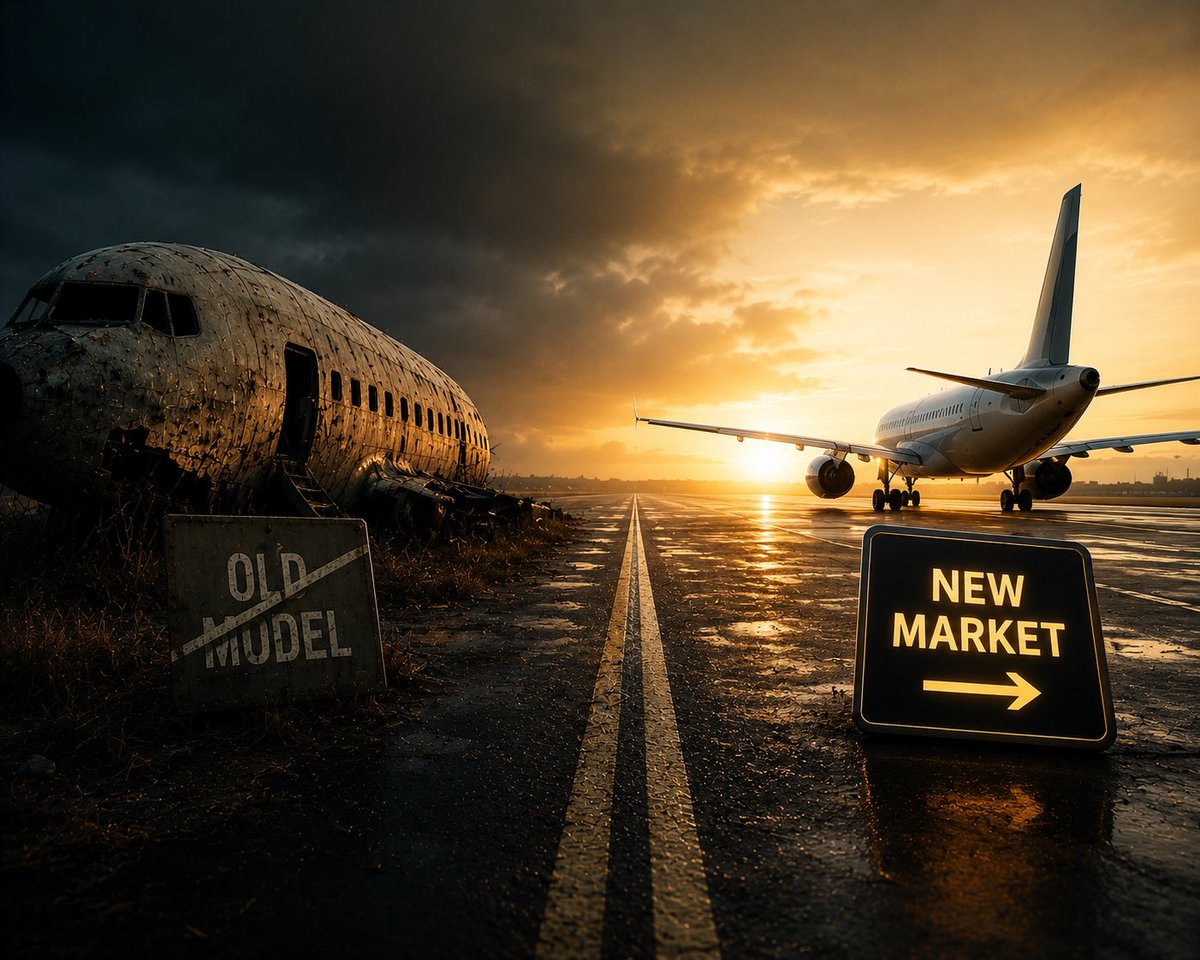
The old model looks prehistoric.
Every mature asset class has a secondary market.
Equities.
Debt.
Commodities.
Real estate.
Even carbon.
Aviation is the exception.
Hundreds of billions in tickets issued annually.
Zero secondary liquidity.
Not because demand is missing.
Because the infrastructure didn’t exist.
TKTZ is that infrastructure.
Airlines lose tens of billions every year
to no-shows and unused tickets.
The industry treats it as a fixed cost.
It isn’t.
It’s the cost of operating
without a secondary market.
In every other industry,
unused inventory clears.
In aviation, it expires.
That changes the moment liquidity exists.
Look at the ratio.
Crude oil: massive derivatives on top of physical.
Equities: multiples of volume over market cap.
Aviation tickets:
Hundreds of billions issued.
No secondary layer.
That gap isn’t normal.
It’s what a market looks like
before price discovery exists.
Until the layer forms.
If this was so obvious, why didn’t it exist?
Because the infrastructure wasn’t there:
Ownership sat with airlines.
Identity couldn’t scale.
Settlement had no rails.
Each problem is now solved.
Together, they create something new:
A market layer.
Markets don’t form when demand appears.
Demand was always there.
They form
when the missing layer becomes buildable.
Equities had the ticker.
Commodities had futures.
Aviation is next.
TKTZ is building that layer.
Everything on top of it
will reprice.
$13B/yr in cancelled tickets. No secondary market. No bid. No price. The most obvious arbitrage in transportation — and Wall Street missed it for 50 years. We didn’t.