Two years ago, a pharma sponsor asked the FDA a simple question: "Can we use AI to identify patients most likely to respond to our therapy?"
The answer was essentially "it depends, and we'll figure it out together.
The joint principles matter just as much. For global sponsors, this ends trying to satisfy two separate regulatory philosophies with two separate strategies. There's now one shared standard to build toward.
Her closing read, worth sitting with:
"They've replaced guesswork with a rulebook. The work now is execution.
Is your org treating AI governance as its own discipline, or still bolting it onto data science?👇
— Shivai Gupta
Continue reading on The Leadership Chronicle → https://t.co/dimAxLnwpW
#FDA #EMA #AIinClinicalTrials #Pharma
AI infrastructure is becoming a distributed systems problem.
Organizations should approach this as one platform spanning a continuum of locations rather than as a collection of isolated AI projects.
Every device, workload, model artifact, and data flow needs an identity that can actually be verified. Remote attestation turns trust into an evidence-based decision instead of an assumption.
"The executive priority is to define the architecture rules before product choices harden into constraints."
Has your org tested its exit path, or is portability still just an assumption?👇
— Ting Zou (Tina Tsou)
Continue reading on The Leadership Chronicle →
https://t.co/wysF5mrO7S
#AIInfrastructure #EdgeComputing #DistributedSystems #AIGovernance
The next major shift in enterprise AI may happen below the model layer.
His argument: an AI system is only as dependable as the data it can discover, govern, and reproduce.
Apache Iceberg, the open table format, is emerging as a consequential part of the answer.
Object storage made it cheap to retain enormous datasets. But files alone don't give you database behavior — concurrent writes, schema evolution, row updates, reproducibility.
The organizations that benefit most will not be those that simply adopt an open format. They will be those that use it to redesign the boundaries between storage, compute, governance, and AI development."
Is your org treating open data formats as a migration, or as an architectural rethink? 👇
— Daksh Dave
Continue reading on The Leadership Chronicle → https://t.co/7uXqCt642L
#ApacheIceberg #DataEngineering #AI #DataGovernance
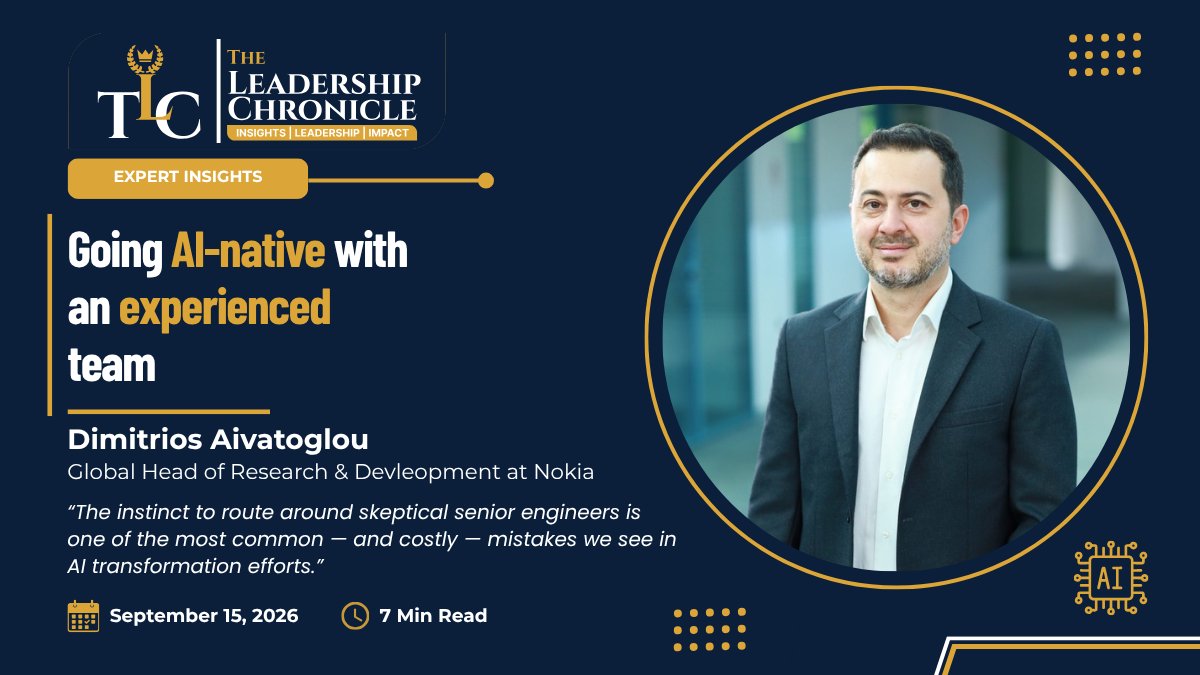
Telco Core software is an unforgiving place to run experiments.
Long-lived C/C++, 3GPP conformance, carrier-grade SLAs, customers who notice network issues within minutes.
On why AI-generated code is dangerous:
"It looks like our code, which is what makes it dangerous."
Correct naming, consistent style, plausible error handling. Review degrades into pattern-matching — and the defects that survive are semantic, not syntactic.
Where has AI widened a gap on your team instead of closing one?👇
— Dimitrios Aviatoglou
Continue reading on The Leadership Chronicle → https://t.co/jhpL0W2MQr
#AI #EngineeringLeadership #AINative #SoftwareEngineering
Most companies hire a CSM, assign a retention target, and expect results.
The org chart, incentives, and unwritten rules about who talks to whom stay exactly the same.
Fabio, has seen this pattern in three companies in a single week.
Before long, the CSM spends more time managing internal relationships than customer ones.
That's not a hiring failure. It's a design failure
Does your CSM or TAM have a clear mandate, or are they still negotiating it six months in?👇
— Fabio Lichinchi
Continue reading on The Leadership Chronicle → https://t.co/dEi5Cyfo0m
For a CEO, the main question should never be "what technology do we need?"
Marcos, argues it should be something else entirely
Most digital transformation projects fail for a simple reason — they start with the solution before anyone's clearly understood the problem.
Ultimately, digital transformation does not mean turning a traditional company into a technology company.
Has your org started transformation with the problem, or with the tool?👇
— Marcos Rodrigues
Continue reading on The Leadership Chronicle → https://t.co/x1hKc0YZHJ
#DigitalTransformation #Leadership #SupplyChain #Logistics
When Sumit reviews an AI deployment, he rarely starts with the model.
He starts with the identity using it.
Who created it? What can it access? What decisions can it make? Where does the data go? Can we see what it did after the fact?
Basic security questions. But this is where control is most often lost.
Does your org actually know every identity — human or machine — with access to your AI systems right now?👇
— Sumit Khadka
Continue reading on The Leadership Chronicle →
https://t.co/yQKp4SWnyZ
#AISecurity #ZeroTrust #CISO #AIGovernance
They treat the same process as perfect the way it is without the need to change at all.
Push Safe Haven too far, and customer feedback gets ignored entirely. The team is so focused on predictable metrics they don't notice they're losing customers.
Understanding different leadership styles enables businesses and teams to know which levers to pull when things start breaking unexpectedly.
Is your team closer to Safe Haven or New Love — and where has that style let you down? 👇
— Amber Lee
Continue reading on The Leadership Chronicle →
https://t.co/xTVZTZE2pw
#AgileLeadership #EngineeringLeadership #ProcessVsAgility
For most of his career, organizational capacity was measured with one metric: headcount.
Need more output? Hire more people.
Need new expertise? Recruit specialized talent.
Need to scale? Expand the team.👇
— Vinod Das Continue reading on The Leadership Chronicle → https://t.co/APzi3WWUZF
#AI #FutureOfWork
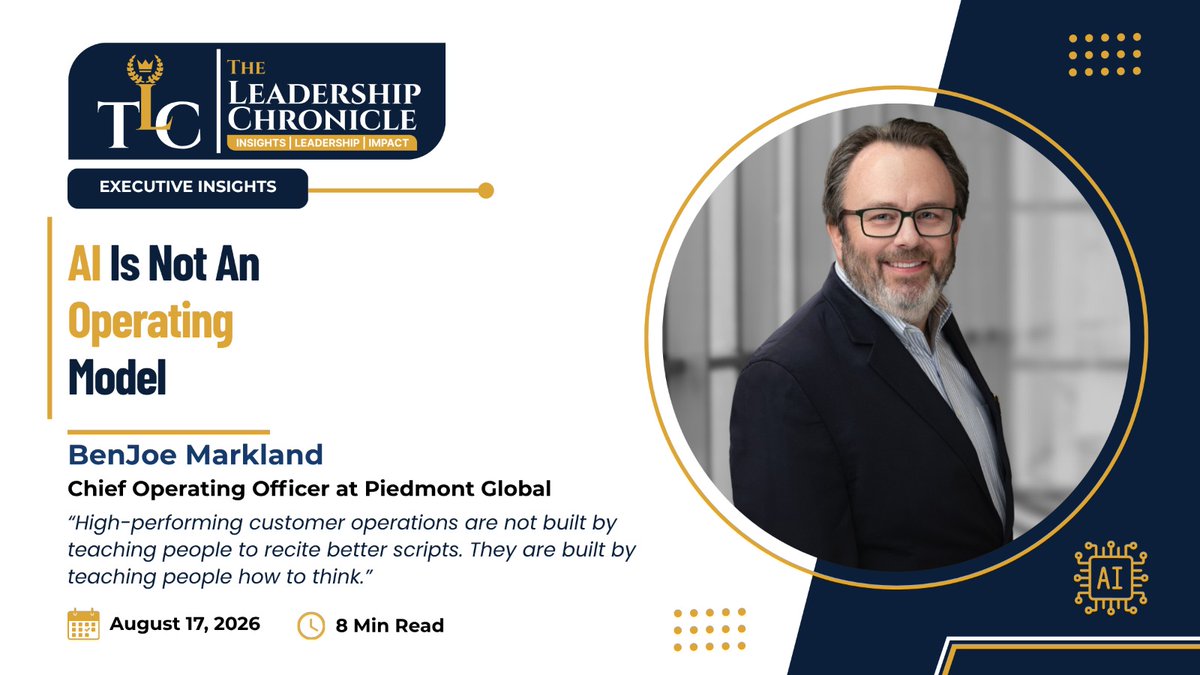
AI doesn't fix a broken operation.
It exposes one.
The most expensive mistake a company can make with AI is treating it as an operating model. It is not one.
AI is not the operating model. It may, however, be the catalyst that finally forces leaders to build a better one.
Where is AI exposing gaps in your own operation right now?👇
— BenJoe Markland Continue reading on The Leadership Chronicle →
https://t.co/FejdogPNz0
#AI #OperatingModel #Leadership
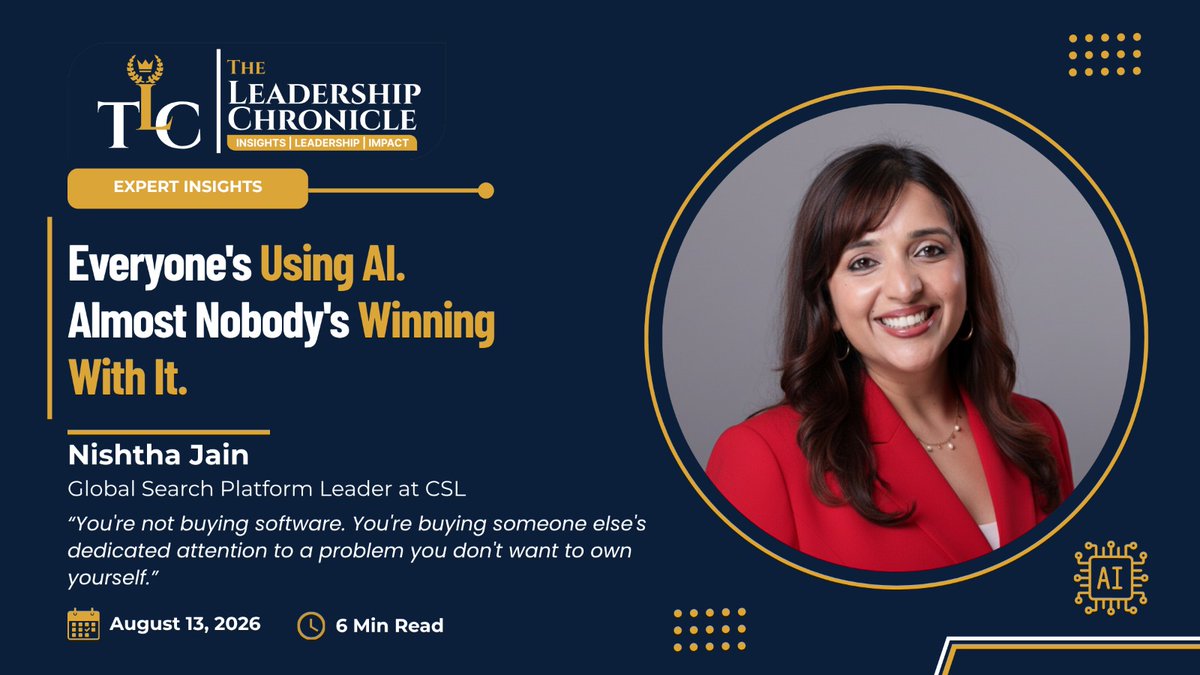
88% of companies use AI.
Only 6% are actually winning with it.
The gap isn't a model problem. It's a decision problem.👇
— Nishtha Jain
Continue reading on The Leadership Chronicle →
https://t.co/VJubWE3XzH
#AI#BuildVsBuy
I ran the same AI agents twice.
Same data. Same tasks. Same everything.
They gave different answers.
The aggregate accuracy looked stable. The individual decisions didn't.
What that means for your CX stack ?👇
— Vittorio Barraja
Continue reading on The Leadership Chronicle →
https://t.co/YuHvoqpRiW
#AgenticAI #AI
The meeting had gone exactly as planned.
The AI demo was polished. Executives were energized. Someone called it a game changer.
Then the questions changed: who's responsible if it's wrong? Who monitors it in 6 months?
A pilot demonstrates possibility. Production demonstrates discipline.
That responsibility can't be outsourced to a vendor or delegated to an algorithm.
What's the one question your leadership team hasn't asked yet about your AI rollout? 👇
— Joshua Arnold
Continue reading on The Leadership Chronicle →
https://t.co/j7HYB5QRaI
#EnterpriseAI #AILeadership #AIGovernance
I spent years building a company most users would never see by name.
Jifiti's tech sat inside a bank's app, invisible by design.
The moment that taught me what marketing is actually for wasn't a launch. It was a bank deciding whether to trust us — knowing our logo would never appear anywhere.
That's not brand awareness. That's a shorter sales cycle wearing a different outfit.
How does your org measure whether marketing builds trust, not just leads? 👇
— Maya Mason
Continue reading on The Leadership Chronicle →
https://t.co/Vxek7SfCxC
#B2BMarketing #MarketingStrategy #CMO
Every boardroom asks: "What's our AI strategy?"
Wrong question.
Technology has never transformed a business. Leadership has.
The internet, cloud, ERP — none of it transformed companies. The leaders who redesigned around it did.
AI will be no different.
Your competitor isn't buying better AI. They're making better decisions.
What's one process in your org that exists purely out of habit? 👇
— Artur Ledowski
Continue reading on The Leadership Chronicle →
https://t.co/NnEoOFuZGI
#AIStrategy #Leadership #DigitalTransformation
You don't need a title to lead.
You need to be the person both sides trust to tell them the truth.
Early in my career, nobody gave me a seat at the table. I made myself worth having in the room.
3 things that changed how I operate:
→ Translate, don't just report
→ Build the trust account before you need to withdraw from it
→ Say no early, so your yes means something
Where have you seen someone lead without the title to back it up? 👇
— Nikhita Habib
Continue reading on The Leadership Chronicle → https://t.co/qwMiEJuFJI
#Leadership #InfluenceWithoutAuthority