The argument about inquiry based learning in English state secondaries is effectively over. But, critically, not because of evidence from an RCT or a meta-analysis or the OECD or whatever. It's over because we tried it, and it didn't work.
Good teachers in good schools tried it. And things were going swimmingly as long as we were interested solely in "engagement". But when we realised that maybe we should be interested in "learning" primarily, we saw that all the busy-ness and activity that had turned our classrooms into buzzing hives of engagement wasn't resulting in any actual learning.
Now, we can try for ourselves. We can implement explicit instruction, and we can watch outcomes soar. And not just results, but sixth form take-up, university progression, year 7 applications and more. People learn things, and that leads to a host of other motivational and affective benefits.
We can look around at the top performing schools in the country. We can see that they are achieving results for disadvantaged students that are eclipsing anything anyone thought was possible. And all that, through the embrace of knowledge rich curriculums and explicit instruction.
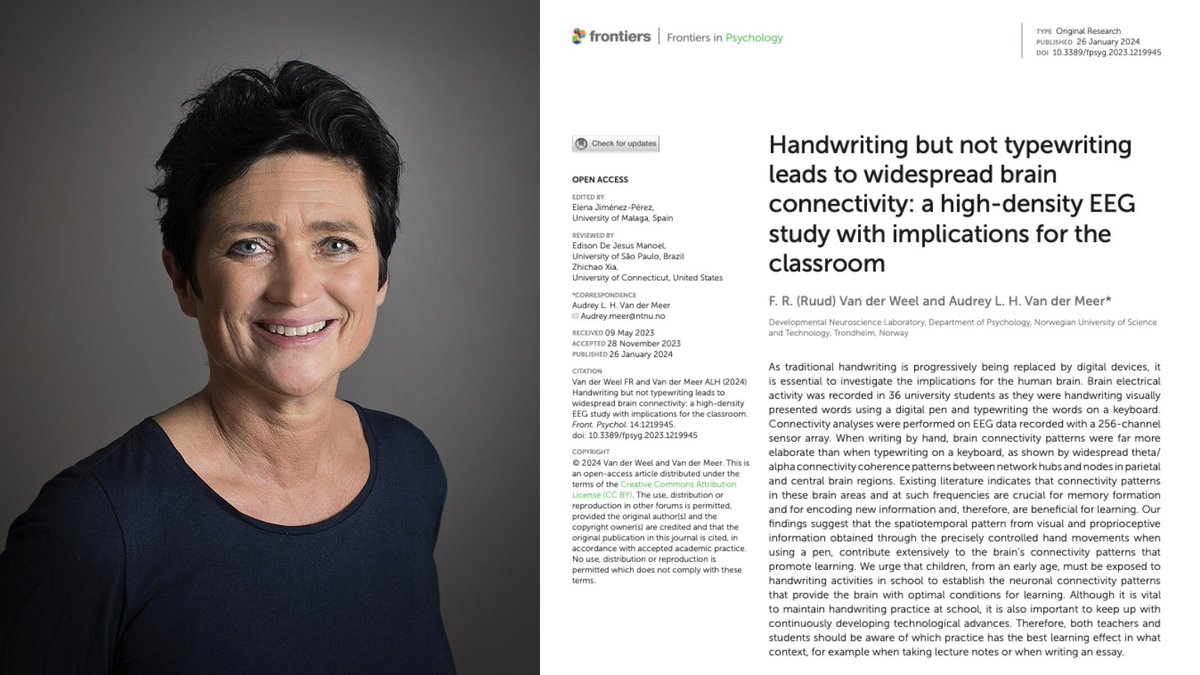
A Norwegian neuroscientist spent 20 years proving that the act of writing by hand changes the human brain in ways typing physically cannot, and almost nobody outside her field has read the paper.
Her name is Audrey van der Meer.
She runs a brain research lab in Trondheim, and the paper that closed the argument was published in 2024 in a journal called Frontiers in Psychology. The finding is brutal enough that it should have changed every classroom on Earth.
The experiment was simple. She recruited 36 university students and put each one in a cap with 256 sensors pressed against their scalp to record brain activity. Words flashed on a screen one at a time.
Sometimes the students wrote the word by hand on a touchscreen using a digital pen, and sometimes they typed the same word on a keyboard. Every neural response was recorded for the full five seconds the word stayed on screen.
Then her team looked at the part of the data most researchers had ignored for years, which is how different parts of the brain were communicating with each other during the task.
When the students wrote by hand, the brain lit up everywhere at once.
The regions responsible for memory, sensory integration, and the encoding of new information were all firing together in a coordinated pattern that spread across the entire cortex. The whole network was awake and connected.
When the same students typed the same word, that pattern collapsed almost completely.
Most of the brain went quiet, and the connections between regions that had been alive seconds earlier were nowhere to be found on the EEG.
Same word, same brain, same person, and two completely different neurological events.
The reason turned out to be something nobody had really paid attention to before her work. Writing by hand is not one motion but a sequence of thousands of tiny micro-movements coordinated with your eyes in real time, where each letter is a different shape that requires the brain to solve a slightly different spatial problem.
Your fingers, wrist, vision, and the parts of your brain that track position in space are all working together to produce one letter, then the next, then the next.
Typing throws all of that away. Every key on a keyboard requires the exact same finger motion regardless of which letter you are pressing, which means the brain has almost nothing to integrate and almost no problem to solve.
Van der Meer said it plainly in her interviews.
Pressing the same key with the same finger over and over does not stimulate the brain in any meaningful way, and she pointed out something that should scare every parent who handed their kid an iPad.
Children who learn to read and write on tablets often cannot tell letters like b and d apart, because they have never physically felt with their bodies what it takes to actually produce those letters on a page.
A decade before her, two researchers at Princeton ran the same fight using a completely different method and ended up at the same answer. Pam Mueller and Daniel Oppenheimer tested 327 students across three experiments, where half took notes on laptops with the internet disabled and half took notes by hand, before testing everyone on what they actually understood from the lectures they had watched.
The handwriting group won by a wide margin on every question that required real understanding rather than surface recall.
The reason was hiding in the transcripts of what the two groups had actually written down.
The laptop students typed almost word for word, capturing more total content but processing almost none of it as they went, while the handwriting students physically could not write fast enough to transcribe a lecture in real time, which forced them to listen carefully, decide what actually mattered, and put it in their own words on the page.
That single act of choosing what to keep was the learning itself, and the keyboard had quietly skipped the choosing and skipped the learning along with it.
Two studies. Two countries. Same answer.
Handwriting makes the brain work. Typing lets it coast.
Every note you have ever typed instead of written went into your brain through a thinner pipe. Every meeting, every book highlight, every idea you captured on your phone instead of on paper was processed at half depth.
You did not forget those things because your memory is bad. You forgot them because typing never woke the part of the brain that would have made them stick.
The fix is the thing your grandmother already knew.
Pick up a pen. Write the thing down. The slower road is the faster one.
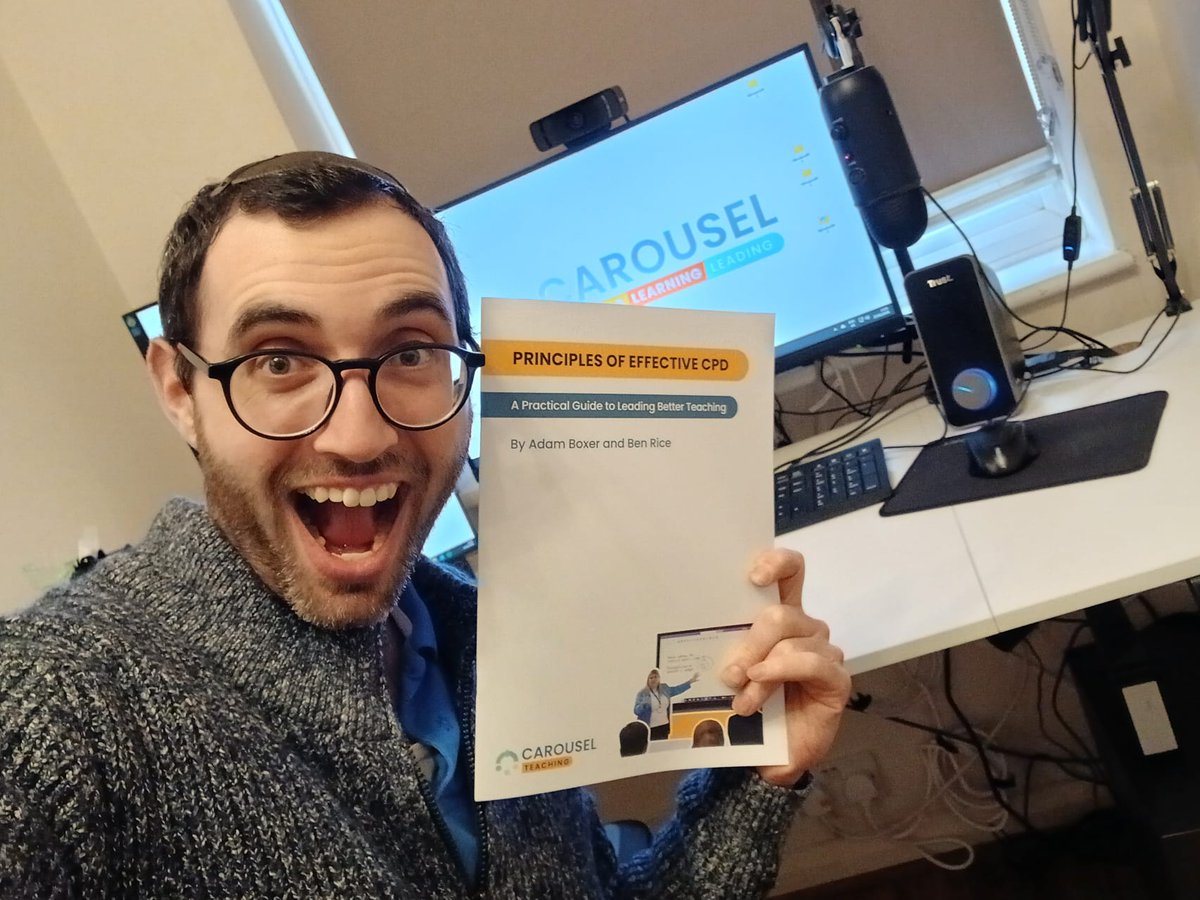
UNBELIEVABLY EXCITING RESOURCE DROP:
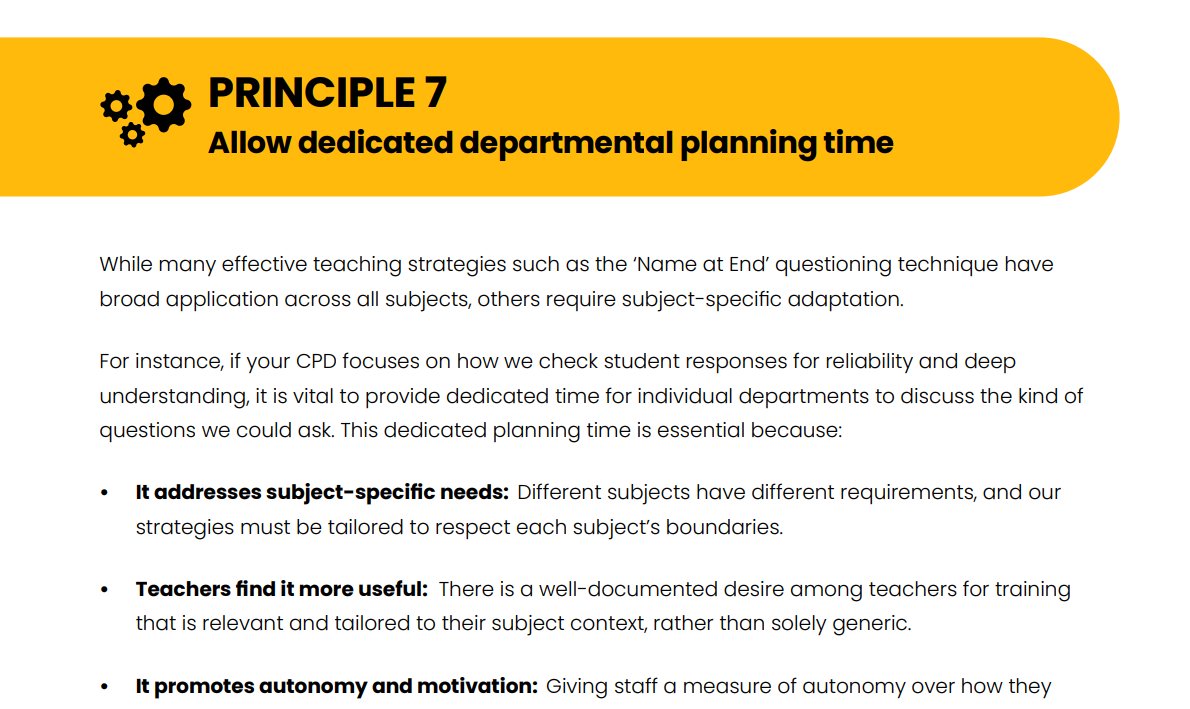
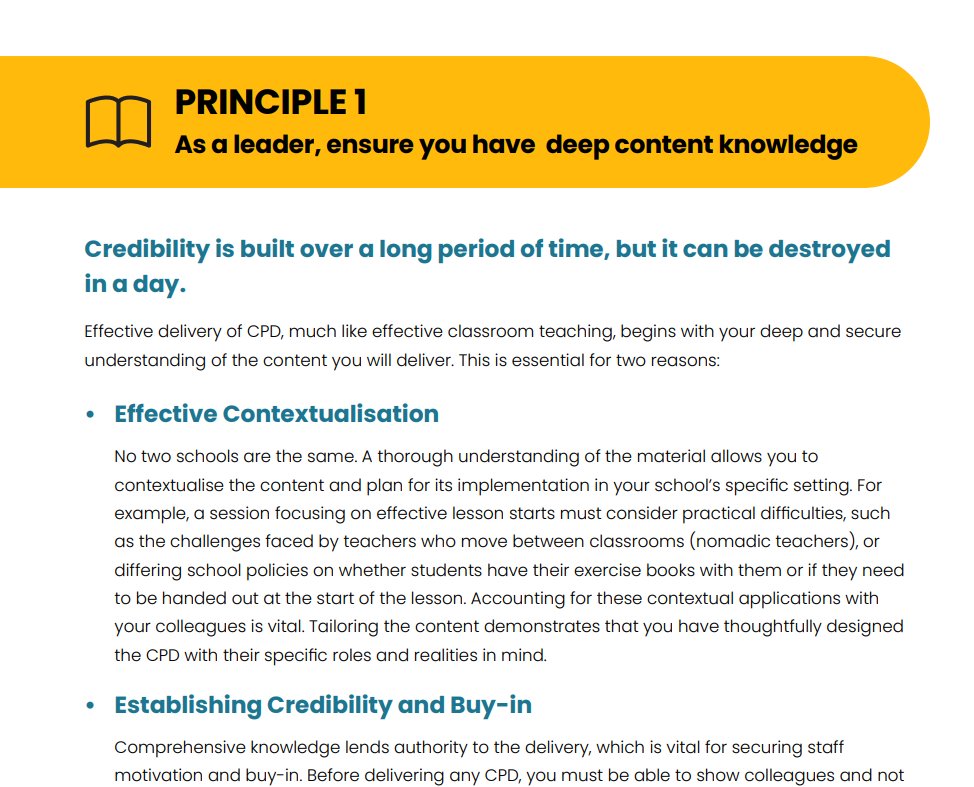
Principles of Effective CPD, by me and @BenRiceTeach
We've been working on this guide for months, and it's a concrete + nitty gritty manual to actually delivering CPD effectively.
Get your copy at the link 👇
https://t.co/sUHlnkJA45
Why am I against screen-based assessments? This change will warp teaching practice for the worse. I guarantee it. More & more lesson time will be devoted to putting classes in front of screens. School leaders will feel pressure to prepare pupils which 1/
The activity fallacy: an obsession with instructional novelty has produced a strange inversion of priorities. Teachers are sent on courses to acquire new “strategies,” to diversify their repertoire of techniques.
Meanwhile, the curriculum they are teaching may be completely incoherent, the sequence arbitrary, the assessment disconnected from both. This is what @Counsell_C calls an “intransitive pedagogy”; a pedagogy without an object.
Natural learning is brutal. Evolution's method: those who fail to learn, perish. The knowledge we transmit in a single sentence ("don't eat that berry") took generations of fatal errors to acquire. Schools exist precisely because natural learning is slow, cruel, and inefficient.
The artificial classroom isn’t a falling away from a natural ideal; it’s an improvement on natural indifference.
This should be how we begin our conversations about school behaviour. It's not the entirety of the subject, but it's where we begin.
Support, consequences, responses, third spaces, incentives, disincentives etc all need to be framed within this idea: *children deserve a safe, calm space where they can learn in dignity*.
This is the Prime Directive of public education.
This is bang on. Inclusion doesn’t mean lowering standards- and when it does mean that, it’s a mistake, and it’s not authentically inclusive. Children with SEND are not a separate group; they’re children with circumstances that may need adjustments and exceptions, but children that also need high standards, high regard, and boundaries with consequences- like everyone.
The best teachers I've seen don't use a wide range of activities.
They do a few things, and they do them well. They hone them, practise them, and know exactly when each one should be used and why. The students become habituated to them, and learning goes through the roof.
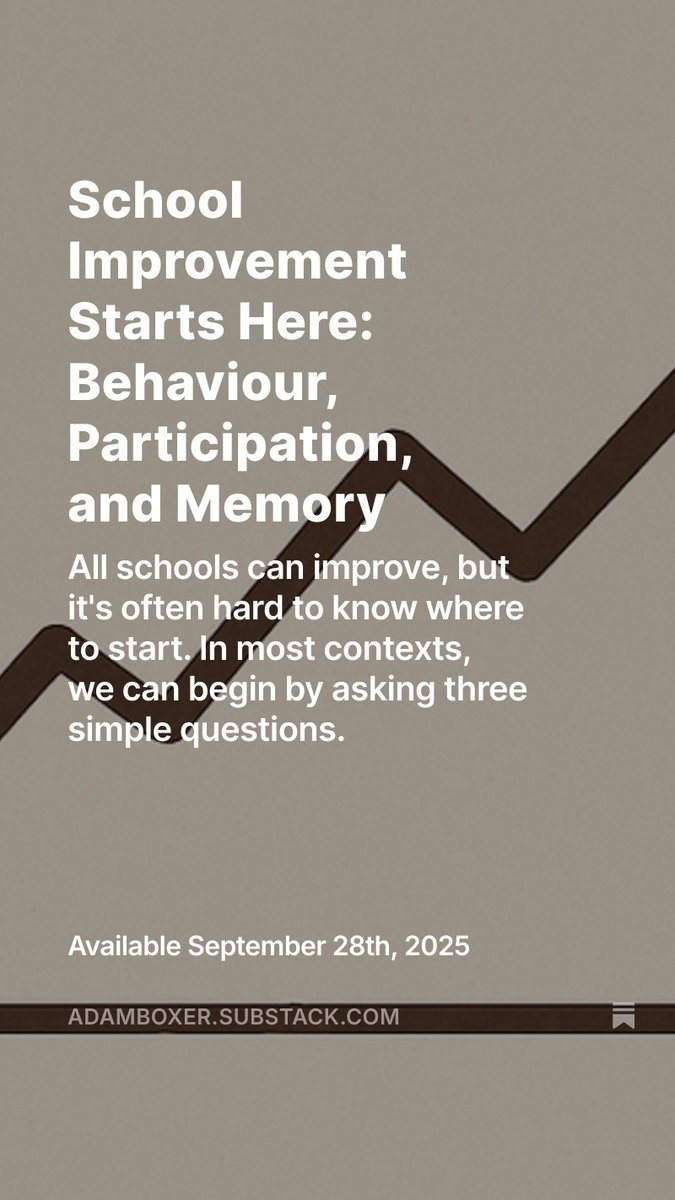
I am blogging again!!!
Like many others, I've moved over to Substack for a bit of a refresh. First entry is on school improvement - where to start, and what things matter.
Link is in the first reply, I'm weirdly a bit nervous about it it's been so long 😭😭
*NEW* We think the teacher crisis is about recruitment.
It’s not.
We train thousands every year then watch a third leave within 5 years. Almost half of trained teachers are not teaching.
The real crisis is retention.
And we’re losing many who could have become great.
Link in reply ⬇
@KateJones_teach@stoneman_claire I think you’ve read that through a very particular lens, Kate - one where you take offence where none was intended and where none was very easy to find! Nobody can make you feel anything but maybe take a beat before taking offence?
I've been blown away by the response to Carousel Teaching, and am honoured that from September schools are going to be using our resources for whole-school CPD 🙏🙏🙏
Check out our new video below, and you can book a demo here: https://t.co/36fy9fpOsu
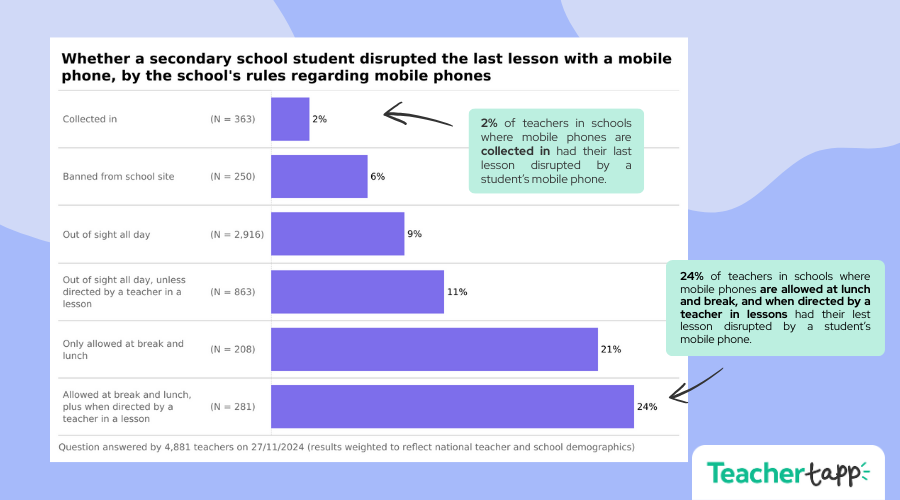
This is one of the great graphics of education policy, and is worthy of deep study.
Phones are a scourge, and if you're running a school that allows them *in any way* you are increasing the chances of disruption massively.
Control the controllables.
@TeacherTapp
IT'S FINALLY HERE
We know CPD doesn't work. Teachers don't enjoy it, and say they don't learn from it.
NO LONGER
...because CAROUSEL TEACHING is now officially here 🥳🥳
...bringing you CPD that works and helps you get better at teaching.
Read on 👇👇
🚨🚨 NEW TODAY
About that viral teaching clip of Pritesh...
It's from a top secret documentary I've been working on for the last 18 mths to capture & deconstruct some of best teaching in UK.
Why We Made It & How To Access It (For Free):
↓
Direct instruction is joyful & leads pupils to success. Here is a *clip* where I use high frequency & high participation questioning in 3 phases:
1. Check for listening
2. Rehearsal
3. Check for understanding
Established routines: all hands up, turn & talk, SLANT & ruler reading