TANKER ESCORTS? #ProjectFreedom
The US Navy literally did this in 1985 for three years in Operation EARNEST WILL. The first mission the escorted tanker struck a mine. Another was struck with cruise missiles. The mine threat was so bad the escorts had to follow the tankers. Now Iran has drones, cruise missiles, Ballistic missiles, suicide drone boats/torpedoes.
I am sure the Navy can fight through to get under the UAE air defense umbrella but fighting will start when US aircraft start attacking small boats and missile sites.
This could restart the war. With open risk, insurance will not let vessels pass through dangerous waters.
This is a desperation move.
So, if I got that right, here's the narrative:
- A US F-15E fighter jet got shot down over Iran, despite Trump saying 2 days beforehand in his nationwide address that Iran has "no anti-aircraft equipment. Their radar is 100% annihilated." (https://t.co/3pnVUGxHyV)
- The plane's weapons systems officer - a "highly respected Colonel," according to Trump - ejected from the plane and got "seriously wounded" (still according to Trump: https://t.co/jUbGiGk9uM)
- He still managed to "hike up a 7,000-foot [2.1km] mountain ridgeline and hide in a crevice" in the Zagros Mountains, despite his wounds (https://t.co/ECTqgUFOZ3)
- U.S. MQ-9 Reaper drones started killing all "Iranian military-aged males believed to be a threat who got within three kilometers of [the American's location]" (https://t.co/86aZgrsXGT)
- To retrieve him the U.S. managed to seize an "abandoned airport," 200 miles deep inside Iran, near Isfahan (https://t.co/rOpRm3mqt9), which happens to be where Iran's largest atomic scientific center is located (https://t.co/jQfmg4zI8t)
- They landed two MC-130 military transport planes in that airport (https://t.co/k0mU0wqnvU) in an operation involving "hundreds of special forces troops and military personnel" (https://t.co/ECTqgUFOZ3)
- Both MC-130 planes got "stuck in the sand" and the U.S. destroyed them themselves "to prevent them from falling into Iranian hands" (https://t.co/k0mU0wqnvU)
- They deployed "three new aircraft to extract all the U.S. personnel" on the ground (https://t.co/k0mU0wqnvU)
- There are videos circulating online of "heavy clashes" with presumably Iranian missiles raining down in Kohgiluyeh County, in the Zagros Mountains during that night (https://t.co/VCeTzcC1vt)
- Iran sent pictures of the aftermath at the "abandoned airport" and it's a sight of utter destruction, with US plane and MH-6 helicopter parts scattered all over the ground, still smoking (https://t.co/mDpYT9qsKC). Iran claims they are the ones who in fact destroyed all the aircraft.
- Meanwhile a second U.S. plane, an A-10 Warthog, also crashed on Friday near the Strait of Hormuz according to two U.S. officials speaking to the NYT (https://t.co/lFs4zERw2t). In that instance too the lone pilot was apparently "safely rescued."
- In all this, after the multiple planes and helicopters destroyed or shot down, the documented heavy clashes, the "hundreds of special forces troops and military personnel" operating deep inside Iran, not a single US soldier was reported killed "or even wounded" (according to Trump: https://t.co/rCgrl6vMpT).
- And the 'highly respected Colonel' this was all for? No name. No photo. No interview. Nobody has spoken to him nor knows who he is.
So to sum up: anti-aircraft equipment that supposedly didn't exist shot down an F-15 (and, apparently, an A-10 Warthog the same day). A seriously wounded man climbed a 2.1km mountain. The US seized an airfield 200 miles inside a country it's at war with, next to one of its most strategic nuclear sites, and deployed hundreds of troops all apparently unimpeded. Lost two planes to "sand" and destroyed their own helicopters. Videos show heavy clashes, missiles raining down - but not a single person got "even wounded". And the man at the center of it all? Nobody knows who he is, completely anonymous, zero pictures, but Trump says he is "SAFE and SOUND." And so is the rescued A-10 Warthog pilot, who also remains anonymous.
Trump concludes this all proves the US has "achieved overwhelming Air Dominance and Superiority over the Iranian skies" (https://t.co/rCgrl6vMpT), despite the whole episode only happening because Iran shot his planes out of the sky.
Basically, the only thing that's "overwhelming" here is the audacity of the storytelling...
Given Trump’s Easter threats to carry out new war crimes in Iran, we should think one or two steps ahead about a coup attempt connected to the war. And then deter it. (1/17)
You think this war is about oil. It is not. Oil is the crisis you can see. The one you cannot see is sulfur. And sulfur is destroying industries that have nothing to do with the Middle East and everything to do with the periodic table.
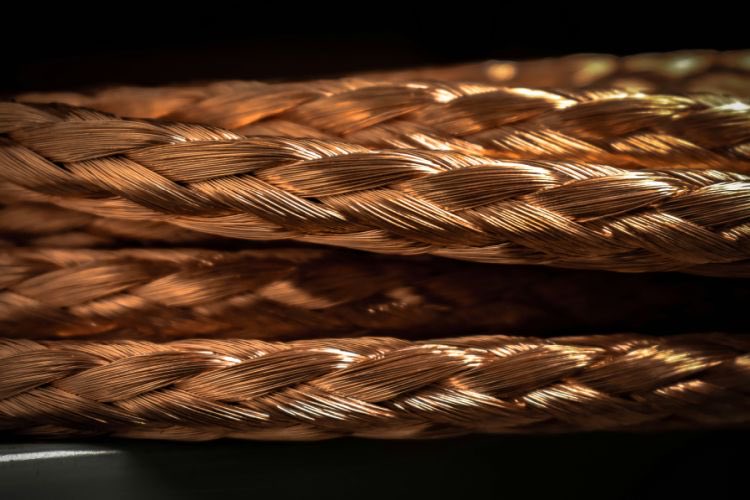
The Strait of Hormuz carries 45 to 50 percent of the world’s seaborne sulfur trade. Sulfur is a byproduct of Gulf oil and gas refining. When the refineries run, sulfur accumulates. When the sulfur ships, it feeds the global sulfuric acid supply chain. When sulfuric acid reaches copper mines in the Democratic Republic of Congo, in Zambia, in Indonesia, in Chile, it is sprayed over heaps of oxide ore in a process called leaching that dissolves copper minerals into solution and produces 99.99 percent pure cathode. Twenty to 25 percent of the world’s copper comes from this acid-intensive process. Each tonne of copper cathode requires 3 to 3.5 tonnes of sulfuric acid. The acid comes from sulfur. The sulfur came through Hormuz. Hormuz is closed.
Sulfur prices have nearly doubled since February 28. The rally is the largest on record for the commodity. African copper miners, the ones who supply the cathode that wires everything from F-35 flight control systems to hospital ventilators to iPhone charging cables, are watching their input costs spike while the ore grade stays the same and the copper price falls on growth fears. The economics of leaching are collapsing at the exact moment the $1.5 trillion US defence budget demands more copper wiring for every weapons system it funds and every data centre the AI race requires.
Forty thousand tonnes of copper cathode per month used to flow through the Jebel Ali hub in Dubai. That flow is disrupted. Insurance premiums for Gulf shipping have surged 300 percent. The cathode is not destroyed. It is stranded, sitting in warehouses connected to a port connected to a strait that the IRGC controls and the United Nations just failed to authorise anyone to reopen.
The mechanism is invisible because sulfur is invisible. Nobody tracks sulfur futures on their trading app. Nobody tweets about sulfuric acid. Nobody writes headlines about heap leaching in the DRC. But the chain is unbroken and unbending: closed strait → halted sulfur → expensive acid → higher copper costs → more expensive wiring in every weapon, every vehicle, every building, every grid, every chip packaging substrate on earth. The war in the Gulf is not just repricing energy. It is repricing the base metal that conducts electricity in every system civilisation operates.
And sulfur is not the only invisible casualty. The strait carried helium for semiconductor cooling. It carried naphtha for petrochemical feedstock. It carried urea for fertiliser. It carried LNG for Asian power generation. Each one feeds a different supply chain. Each supply chain feeds a different industry. Each industry feeds a different population. The war hit one chokepoint and the damage radiated outward through the periodic table like cracks through glass, following the molecular bonds that connect everything to everything.
The last molecule standing was always methane. But methane does not travel alone. It brings sulfur with it. And the sulfur brings the acid. And the acid brings the copper. And the copper wires the world.
Nobody is covering the sulfur crisis. The sulfur crisis does not care.
https://t.co/dAOBBMsgDS
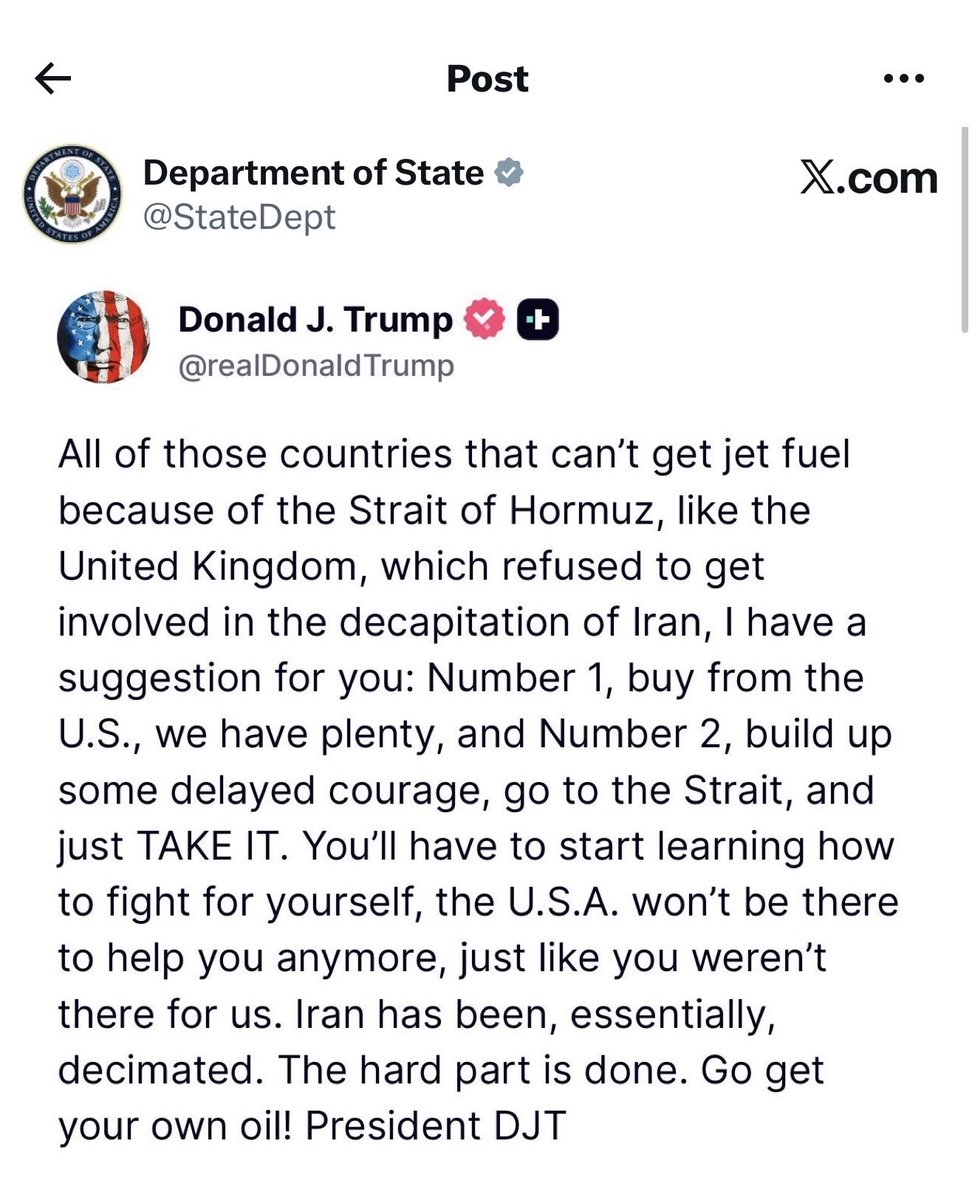
BREAKING: Donald Trump just posted the most revealing statement of the war. Not because of what it says about Iran. Because of what it says about the country that started it.
“All of those countries that can’t get jet fuel because of the Strait of Hormuz, like the United Kingdom, which refused to get involved in the decapitation of Iran, I have a suggestion for you: Number 1, buy from the U.S., we have plenty, and Number 2, build up some delayed courage, go to the Strait, and just TAKE IT.”
Read the architecture of that sentence. The United States launched strikes that killed Khamenei and closed a strait that was open on February 27. The closure created a jet fuel crisis across Europe. And now the President is telling the countries suffering from the crisis his war created to either buy American fuel or send their own navies to reopen the waterway his campaign shut down. He started the fire. He is now selling the water. And he is mocking the neighbours for not helping him light the match.
“Iran has been, essentially, decimated. The hard part is done. Go get your own oil!”
The hard part is done. But the strait is still closed. The IRGC still operates the toll booth. Nine vessels transit per day versus 138. A Kuwaiti supertanker burned off Dubai this morning. Ghalibaf, Iran’s parliament speaker, said it best from the other side: “The enemy that claimed it had destroyed our air force, navy and missile forces has now set its operational ambition to opening the Strait of Hormuz, a strait that was open before the Ramadan War began.” Trump and Ghalibaf are describing the same paradox from opposite ends of the same burning strait.
And now look at what “buy from the U.S., we have plenty” actually means. In January, the United States overthrew Maduro and seized operational control of Venezuelan oil exports. Nine hundred thousand barrels per day, redirected from China to American and European refiners under General License 52, with proceeds flowing to a US Treasury account. The US created alternative supply BEFORE launching the strikes that destroyed the existing supply route. It is now offering to sell that alternative supply to the allies whose energy it disrupted. The arsonist is the fire department. The toll booth operator is the rescue service.
The United Kingdom is in COBRA meetings today because of this. Petrol has risen to 152 pence per litre. Diesel is at 181 pence. Jet fuel prices have doubled. Household energy bills are forecast to rise £300 by July. The OECD has downgraded UK growth to 0.7 percent, the largest cut among G20 economies. Ten-year gilt yields have hit levels not seen since 2008. The Bank of England is frozen at 3.75 percent, unable to cut into an energy-driven inflation rebound. Starmer says he “won’t buckle” and will not send warships. Trump says the UK has “delayed courage.” The special relationship is now a transaction where one side sets the terms and the other absorbs the cost.
“The U.S.A. won’t be there to help you anymore, just like you weren’t there for us.”
This is not a statement about Iran. This is a statement about the post-war order. The United States is explicitly telling its closest ally that the era of guaranteed security is over, that Hormuz is someone else’s problem, and that American fuel is available for purchase at market rates. The country that spent 80 years guaranteeing freedom of navigation through the world’s most important chokepoint is now telling its allies to buy their way out of the crisis or fight their own way through it.
The strait was open before the war. It is closed now. And the country that closed it is selling jet fuel to the countries that cannot get any.
That is the 2026 world order in one Truth Social post.
https://t.co/dAOBBMsgDS
America Celebrates 250 years (and the end of Pax Americana)
This note is about the US and the implications of another war in the Middle East, but first, some history:
In 1956, Britain and France conspired with Israel to seize the Suez Canal from Egypt’s Nasser. It was a classic imperial move, the kind that had worked for a century. Except this time, Eisenhower said no. He threatened to dump U.S. holdings of sterling on the open market, which would have collapsed the pound overnight. Britain folded within days. France folded with it. That moment, more than any other, marks the true end of British imperial primacy. Not the World Wars, not the independence movements, not the Commonwealth. The moment a U.S. president made a phone call and the pound buckled. Reserve currency status doesn’t just reflect economic power. It is economic power, and when it goes, everything goes with it.
It is also worth noting the bitter irony that in 1956 it was Israel’s adventurism that helped expose the limits of British power and accelerate the pound’s decline. History has a way of rhyming.
The pound’s vulnerability at Suez didn’t emerge overnight. It had been building for decades, through two world wars that bled Britain fiscally dry, through the steady accumulation of the world’s gold by the United States, and through the slow recognition that the guarantor of global trade had changed addresses.
Bretton Woods in 1944 formalized what was already true: the dollar was now the anchor of the global monetary system, convertible to gold at $35 an ounce, with every other currency pegged to it. It was an elegant system. It was also a system that required the United States to run perpetual trade surpluses and maintain fiscal discipline, neither of which proved politically sustainable.
By the late 1960s the U.S. was spending heavily on Vietnam and the Great Society simultaneously, and foreign central banks, led by a deeply skeptical De Gaulle, began converting their dollar reserves into gold at an accelerating pace. France literally sent warships to New York to bring gold home. On August 15, 1971, Nixon closed the gold window. The dollar would no longer be convertible. Bretton Woods was dead.
What replaced it was Kissinger’s deal: the petrodollar. The deal struck with Saudi Arabia in 1973 and 1974 was simple and profound. Oil would be priced exclusively in dollars. In exchange, the U.S. would provide security guarantees to the Gulf monarchies. You want energy, you need dollars. You need dollars, you hold Treasuries. You hold Treasuries, you finance American deficits.
The gold standard was replaced not with nothing, but with oil and aircraft carriers. It worked because it rested on one non-negotiable guarantee: America would secure global trade routes, keep the sea lanes open, and ensure the free flow of energy to allies and adversaries alike. The Strait of Hormuz. The South China Sea. The Red Sea. These were never just geography. They were the load-bearing walls of the entire dollar architecture. And this is the thing people consistently fail to appreciate: commodities and geopolitics have always been linked. Most wars throughout history are, at their core, about securing access to resources. Energy. Grain. Metals. The players change. The underlying logic never does.
Fast-forward to February 2022. Russia invades Ukraine. The U.S. and Europe respond by freezing $300 billion in Russian sovereign reserves. Swift expulsion and asset seizures. Just like that, we answered a question every central bank on earth had been too polite to ask out loud: what happens if America decides your dollar reserves are no longer yours?
Biden gave them the answer. Loudly. This was not just a sanctions regime. This was a fundamental break in the trust architecture that underpins reserve currency status. The dollar’s value as a reserve asset was always partly about neutrality, the assumption that it was beyond politics. We torched that assumption. Every non-Western central bank quietly updated its threat model that week. If it can happen to Russia, it can happen to anyone who finds themselves on the wrong side of Washington.
Subsequent uses of financial sanctions against various actors only compounded the damage, each one further eroding the perception that the dollar was a neutral settlement medium rather than a political weapon.
The de-dollarization trend and the de-globalization trend are not separate stories. They are the same story. When the guarantee of free trade breaks down, countries retrench. When the reserve currency gets weaponized, countries diversify. When the hegemon’s will to enforce the rules-based order wavers, everyone starts making contingency plans. We are now deep inside that dynamic.
The Houthis have been attacking commercial shipping in the Red Sea for over a year. Iranian proxies armed with Iranian-supplied missiles. The U.S. response has been airstrikes that changed nothing. Global shipping rerouted around the Cape of Good Hope, adding weeks and billions in costs.
The Strait of Hormuz carries roughly 1/5 of the world’s petroleum liquids and it is now de facto under the control of the IRGC.
When asked about it, the current U.S. administration has been explicit: that’s other countries’ problem. Let that sink in. The Strait of Hormuz, the single most important chokepoint in the entire petrodollar architecture, the physical artery through which the dollar’s claim to reserve status is literally pumped, and the position of the United States government is a shrug. If the U.S. cannot credibly guarantee the Strait stays open, the petrodollar system loses its central physical premise. You cannot price oil in dollars if you cannot guarantee the oil moves.
At the same time, Trump has made clear he wants to withdraw from NATO commitments, remove troops from Germany, and generally signal that the American security umbrella is no longer a given but a transaction. NATO without credible U.S. commitment is just a bureaucracy.
U.S. troops in Germany are not just a tripwire against Russian aggression, they are the physical embodiment of the guarantee that underwrites European confidence in dollar-denominated trade and finance. Remove them and you don’t just weaken European security. You weaken the entire signaling architecture that tells the world the American system is worth buying into.
Meanwhile in the Pacific, the U.S. has drawn down defensive assets across Southeast Asia, leaving Taiwan and Japan increasingly exposed at precisely the moment China is conducting its most aggressive military posturing in decades. Every ally in the region is asking the same question Europe is asking: is the guarantee real? And they are all beginning to arrive at the same uncomfortable answer.
Meanwhile we are signaling to Europe and to Ukraine that support has a political price and an expiration date. Every one of those signals is read by every finance ministry and central bank on the planet. The question they are all asking is whether the guarantee is real. The answer is becoming less clear by the month.
Here is what makes this moment uniquely dangerous and what most mainstream commentary refuses to confront directly. The United States government has, to a degree without modern precedent, allowed its foreign policy in the Middle East to be effectively captured by a foreign government.
The unconditional support for Israel, regardless of the conduct of its military operations, regardless of the cost in American credibility, regardless of the alienation of Arab partners whose cooperation the petrodollar system literally depends upon, has gutted America’s ability to act as a neutral and trusted arbiter of global order. And, to be clear, I am not arguing that American interventionism is the right path forward. But unconditional support of Israel, executed recklessly, is absolutely disastrous.
Eisenhower could call Britain and France off Suez in 1956 because the world believed America was acting in the interest of global stability rather than a particular ally. That credibility is gone. When the U.S. vetoes ceasefire resolutions at the UN while simultaneously claiming to be the guarantor of a rules-based international order, the cognitive dissonance is not lost on the Global South, on Arab oil producers, or on the central banks quietly reducing their Treasury holdings. A hegemon that cannot be trusted to act with even a semblance of neutrality is not a hegemon. It is an Israeli puppet. And puppets do not get to set the terms of global finance.
So what fills the void? Not the yuan. Not yet, anyways. China’s capital account is closed. There is no deep, liquid, freely convertible yuan bond market for the world to park reserves in. The yuan cannot replace the dollar for the same reasons the dollar couldn’t have replaced the pound in 1930, the institutional architecture doesn’t exist yet, and China is not trusted. You don’t replace a weaponized reserve currency with someone else’s weaponized reserve currency.
But here is where it gets interesting: countries that want to transact with each other in oil, in commodities, in bilateral trade, don’t need a reserve currency. They need a settlement medium. And gold, the asset with no counterparty, no issuer, no sanctions risk, is reemerging as exactly that. Central bank gold demand has hit multi-decade highs three years running. Russia and China conduct the overwhelming majority of their bilateral trade in national currencies supplemented by gold reserves. The BRICS have advanced a hybrid digital settlement mechanism backed by physical gold, now in pilot phases for cross-border transactions. India, the Gulf states, and much of the Global South have followed suit in various degrees. This is not theoretical. It is happening. Gold makes structural sense in a fragmented world because it cannot be frozen, it cannot be sanctioned, and it has no political allegiance. It is the asset that sits outside the system, which is precisely why every nation building a parallel financial architecture is accumulating it. The 1970s swap of gold for oil as the dollar’s backing was always a political arrangement. We are watching its reversal in slow motion.
Here is the strategic reality the West refuses to say out loud: Russia, China, and Iran understand supply chain vulnerabilities in ways that Western governments, captured by short-term political cycles and decades of globalization orthodoxy, have consistently failed to. China has spent 20 years building commodity self-sufficiency. Domestic rare earth processing. Long-term oil contracts with Russia, Iran, and Saudi Arabia priced outside the dollar. Port infrastructure from Djibouti to Pakistan to Sri Lanka. Control over the processing of the critical minerals, lithium, cobalt, rare earths, that every advanced weapons system and clean energy technology depends upon. The Belt and Road isn’t an aid program. It’s a parallel trade and settlement architecture being built in plain sight. Russia, despite sanctions, has reoriented its entire commodity export infrastructure eastward and built payment systems that bypass Swift entirely. Iran has spent decades developing asymmetric capabilities specifically designed to threaten the chokepoints the petrodollar depends on. These are not accidents. These are strategies. Coherent, long-horizon, supply-chain-aware strategies pursued by adversaries who understood that the real battlefield was always logistics and monetary architecture, not just military hardware.
And here is the painful corollary: the United States’ ability to respond militarily or industrially to a major conflict is far more constrained than the public appreciates. Decades of offshoring have hollowed out the defense industrial base. Shipbuilding capacity is a fraction of what it was in World War II. Ammunition production, exposed dramatically by the Ukraine war, is running well below what sustained high-intensity conflict would require. And critically, the United States is dependent on China for the processing of the rare earth minerals and critical materials that go into precision munitions, electronics, and advanced weapons platforms. We have, with remarkable lack of foresight, handed our primary strategic adversary leverage over our ability to rearm. If a serious conflict erupts in the Taiwan Strait or the Persian Gulf, the supply chain constraints on the U.S. military response would become visible very quickly, and that visibility itself would be destabilizing in ways that are difficult to fully model.
Now layer on the fiscal reality. The United States is running deficits in excess of $1.8 trillion annually, carrying over $36 trillion in total debt, with interest payments now exceeding the entire defense budget. The Iraq War cost an estimated $2 to $3 trillion over two decades. A serious military confrontation in the Persian Gulf or Taiwan Strait, against a near-peer adversary with the capability to sink carrier groups and disrupt satellite communications, would cost multiples of that, and would need to be financed at interest rates far above the near-zero environment that made the post-2008 debt accumulation painless. There is no fiscal headroom for another generational war. The bond market knows this. Foreign central banks know this. And adversaries who have studied American fiscal trajectories know this too.
The drive toward de-globalization flows from the same source as de-dollarization, as countries unwilling to depend on American guarantees that seem less ironclad than before race to onshore supply chains, secure friendly energy sources, and develop parallel payment rails. China and its partners embraced this with characteristic foresight. The West, still deeply integrated into just-in-time global networks and politically unable to have honest conversations about strategic dependency, is playing catch-up. We are way behind. And we are distracted.
2026 is the 250th anniversary of the United States. This moment may well be remembered not as a celebration of enduring liberty but as the year the long arc of American hegemony reached its visible inflection point.
Previous reserve currency transitions followed a consistent pattern: military overextension, fiscal deterioration, loss of trade route control, erosion of allied trust, and the emergence of a credible alternative architecture. Check, check, check, check, and check.
The American empire was always an empire of systems, financial, military, institutional. Its genius was making those systems feel like global public goods rather than instruments of U.S. power. Free trade. Dollar liquidity. Security guarantees. For a long time they were both. When you start weaponizing the systems, when you subordinate them to the interests of a single foreign ally, when you shrug at the Strait of Hormuz and pull troops from Germany and leave Taiwan exposed, you reveal the seams. And once seen, they cannot be unseen.
The Strait of Hormuz is not a shipping lane. The Red Sea is not a regional conflict. Taiwan is not a sovereignty dispute. NATO is not a relic. They are all load-bearing elements of the same structure. The world is watching whether the guarantees are real. The dollar’s premium, the “exorbitant privilege”, is priced on the assumption that they are. If they’re not, that premium disappears, and with it the ability to run deficits, export inflation, and fund ourselves at the expense of everyone else.
Course correction remains possible. First, the US must start divorce itself from Israel. That will require a regime change here, not overseas. Next comes strategic investment in domestic industrial capacity and critical mineral independence, through a foreign policy that can again be trusted to reflect something broader than the interests of a single lobbying apparatus.
But the momentum toward self-reliance and alternative arrangements gathers strength with each passing disruption. The commodities markets, ever pragmatic, are already casting their votes.
250 years in, the American century may be ending not with invasion or defeat, but with the quiet, devastating withdrawal of trust.
That’s how empires end.
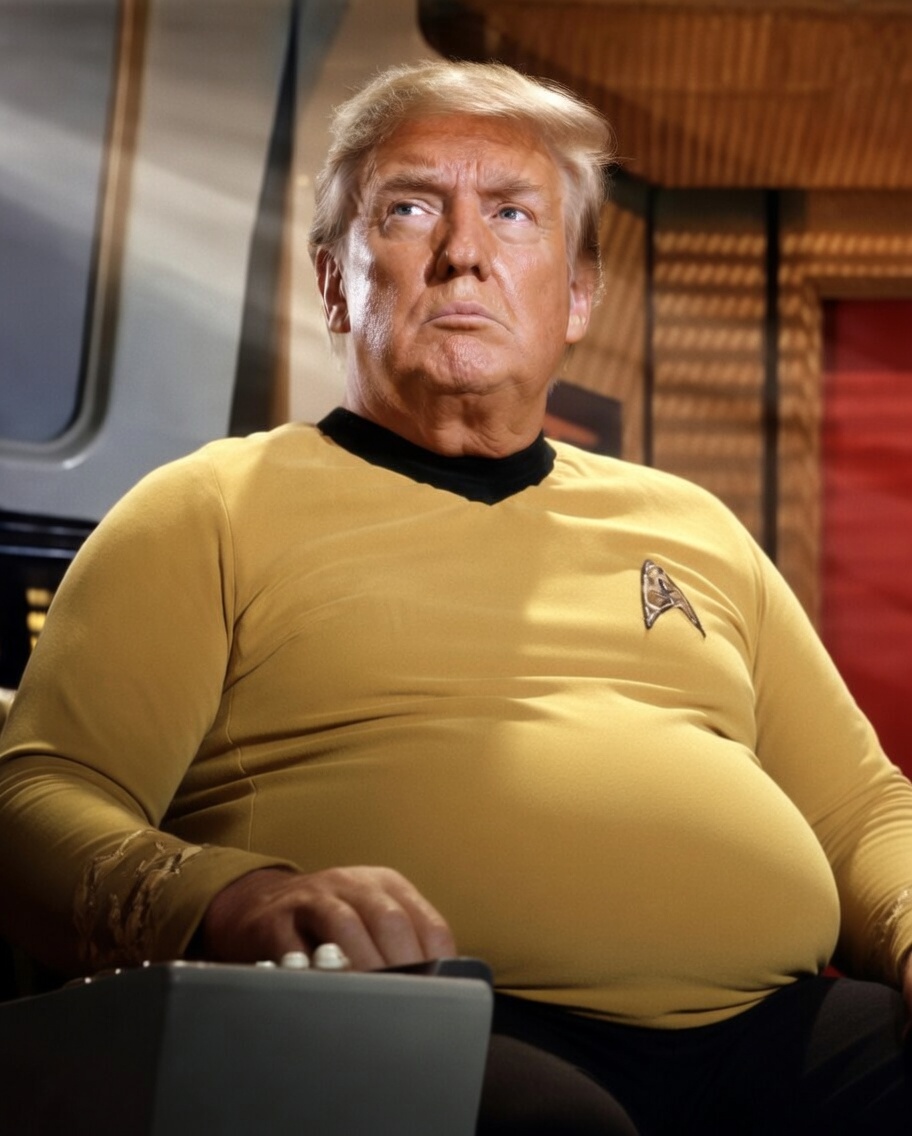
1/ Is the Iran War Donald Trump's Kobayashi Maru? Here's why the classic Star Trek no-win scenario holds lessons for what happens next in the Persian Gulf. ⬇️
Saudi Crown Prince Mohammed bin Salman privately urged Donald Trump to put American ground troops inside Iran and seize the country’s energy infrastructure to force regime change.
The New York Times reported this on March 24 citing people briefed by American officials. MBS told Trump that Iran poses a permanent threat that “cannot be managed through diplomacy but only ended through regime change.” He specifically advocated seizing Kharg Island, the hub through which most of Iran’s oil exports flow.
Then on March 28, Trump stood at the Saudi-backed Future Investment Initiative summit in Miami and said this about MBS: “He didn’t think he would be kissing my ass, he really didn’t. But now he has to be nice to me.”
The man who privately begged America to fight his existential war got publicly humiliated at his own conference. And he cannot respond. Because the alternative is worse.
Saudi Arabia has absorbed over 575 Iranian drone and missile strikes since February 28 per the Saudi Ministry of Defense. Twelve US troops were injured when Iranian missiles hit Prince Sultan Air Base. Iran’s IRGC called MBS’s private push “confirmation that Riyadh is America’s client, not its partner” and warned that any Saudi participation in ground operations would make “every Saudi city a legitimate military target.”
MBS takes the humiliation. He takes the strikes. He takes the IRGC threat. Because if this war ends before the Iranian regime falls, he faces what he told Trump would be an “emboldened and furious” Iran on his border with the capacity to rebuild everything that was just destroyed.
Here is what nobody is connecting.
Kharg Island handles roughly 90 percent of Iran’s oil exports. If the United States seizes it per MBS’s reported advocacy, Iran loses its primary revenue source permanently. Saudi Arabia becomes the unchallenged dominant oil exporter in the Persian Gulf precisely during the transition period when MBS needs maximum oil revenue to fund Vision 2030’s $900 billion transformation. Remove Iran’s barrels from the market and Saudi crude commands higher prices at higher volumes for the exact decade MBS needs to build NEOM, diversify the economy, and consolidate domestic power.
This is not just a security calculation. It is an economic one. The crown prince is asking America to eliminate his country’s largest commercial competitor while framing it as a security necessity.
And the financial architecture is visible. The Saudi Public Investment Fund, controlled by MBS, invested $2 billion in Affinity Partners, the private equity firm of Jared Kushner per the New York Times. Kushner is now one of Trump’s volunteer negotiators on Iran per White House statements. The man negotiating the end of this war received $2 billion from the man pushing to continue it. The Washington Post reported that Saudi and Israeli officials privately pushed Trump to launch the strikes before the war began, even as US intelligence assessed Iran did not pose an imminent threat.
The Wall Street Journal reported that a source said MBS is “close to a decision to join the attacks.” A second source: “It is only a matter of time before the kingdom enters the war.”
MBS funded the negotiator. Lobbied for the invasion. Hosted the summit where he was humiliated. Absorbed 575 strikes. And still needs the war to continue.
The question is not whether this war serves American interests. The question is whose interests started it.
Full analysis: https://t.co/32ixeQpN7N
BREAKING. IRGC General Abdollahi has issued a statement from Central Headquarters declaring Iran is “continuing the path to complete victory.” Day 25 of the war. The Supreme Leader is dead. The SNSC Secretary was killed and replaced today by a hardliner. Dozens of senior commanders are gone. 330 of 470 ballistic missile launchers are destroyed. Fire rate has collapsed from 90 per day to 10. South Pars is offline. Gas exports to Turkey and Iraq have halted. The 504-hour internet blackout continues. Rolling power cuts of 4 to 8 hours hit every major city. And the IRGC’s official communication to its population is: complete victory.
Read the statement as what it is. Not information. Architecture.
The statement acknowledges the losses. It references the Supreme Leader’s death, the strikes on headquarters, the intensity of the enemy campaign. It frames all of it as proof of heroic resilience. It claims Mojtaba Khamenei’s guidance sustains the revolution. It mocks Trump as seeking an “escape” from a quagmire. It promises the path continues. This is the Iran-Iraq War playbook: absorb catastrophic damage, frame survival as triumph, project defiance as strategy. Eight years against Saddam. The same template now.
The propaganda works because the Mosaic Doctrine makes it partially true. The IRGC HAS survived decapitation. Thirty-one provincial commands ARE operating on sealed packets. The toll booth IS collecting yuan. The mines ARE in the water. The launchers, though reduced by 70 percent, ARE still firing cluster munitions at Tel Aviv. The statement is not entirely fiction. It is selectively true. The IRGC chose which facts to amplify and which to omit. What it amplifies: survival, continuity, defiance. What it omits: 88 million people sitting in 4-to-8-hour blackouts while IRGC mining rigs in Kerman consume unmetered electricity to produce $3 billion in sanctions-proof Bitcoin revenue. What it omits: the hashrate has dropped 8 to 12 percent because the strikes degraded the same grid the mining rigs depend on. What it omits: estimated daily mining revenue losses of $200,000 to $400,000. What it omits: the fertiliser that four billion people need is trapped behind a toll booth the IRGC operates, and the planting windows are closing.
The statement tells Iranian citizens they are winning. The grid tells them otherwise. The electricity that should power their homes powers mining rigs. The gas that should heat their water has been diverted from exports to prevent total grid collapse. The internet that should connect them to the outside world has been dark for 504 hours. The “complete victory” is announced to a population that cannot verify it because the regime has cut the tools of verification.
Every side runs an information layer. The IDF announces 50 sites struck. Trump announces “productive conversations” that Iran denies. Ghalibaf threatens bond holders. Araghchi says no talks exist. And Abdollahi declares complete victory from a headquarters that has been relocated because the original was flattened.
The numbers do not issue statements. The numbers are: 330 launchers destroyed. 140 remaining. 10 missiles per day. 4 to 8 hours of blackouts. 77 percent gas futures spike in London. 1,000 mortgage products pulled in Britain. Eight countries rationing. Three nitrogen locks closed. Zero fertiliser transits through the permissioned corridor. $2 million per tanker in yuan. Three ships per day. Four hundred waiting.
The path to complete victory runs through a grid that cannot keep the lights on, a toll booth that denies fertiliser to the planet, and a mining operation that steals electricity from children to fund the patrol boats that collect the toll.
The statement says victory. The molecules say otherwise.
https://t.co/iFmUcarGdV
BREAKING. Eighty-eight million Iranians are experiencing 4 to 8 hours of blackouts per day. The power plants have been struck. The gas processing capacity is damaged. South Pars is offline. And somewhere in Kerman province, a 175-megawatt Bitcoin mining farm connected to IRGC-controlled substations is running on electricity that Iranian families cannot use to keep their lights on.
The IRGC does not pay for its electricity. Independent analysts and Chainalysis on-chain tracking confirm that IRGC-linked mining operations consume gigawatt-scale power through unmetered, priority access while residential neighbourhoods are load-shed for 4 to 8 hours daily. The official government policy bans mining during peak demand. The on-chain data shows persistent IRGC wallet activity during every blackout window. The ban is written on paper. The mining rigs are plugged into substations that do not have meters.
Before the war, Iran’s national hashrate was approximately 920 exahashes per second, roughly 0.8 percent of the global Bitcoin network. IRGC-linked operations generated over $3 billion annually, more than half of Iran’s entire crypto ecosystem. The revenue funded proxy operations, sanctions evasion, oil settlement, and the same Hormuz toll infrastructure that now collects $2 million per tanker in yuan. The mining did not start with the war. It started with sanctions. The war simply revealed what was already happening: a state-within-a-state converting subsidised electricity into sanctions-proof revenue while the civilian grid decayed around it.
The strikes have reduced hashrate by 8 to 12 percent, dropping output to roughly 800 to 850 exahashes. Daily revenue losses are estimated at $200,000 to $400,000. But the IRGC farms retain priority access because they are embedded in military compounds with dedicated substations, backup generators, and fibre connections that the civilian grid does not share. The Mosaic Doctrine that distributes sealed packets to 31 provincial commands also distributes electricity to mining operations that generate the revenue those commands need to function. The mining is not separate from the war machine. It IS the war machine’s power supply.
The arbitrage is elegant and brutal. Iran subsidises domestic electricity at rates far below global market prices. The IRGC converts that subsidised electricity into Bitcoin at global market prices. The difference between the subsidised input cost (effectively zero for unmetered farms) and the Bitcoin output price ($87,000 per coin as of today) is pure profit. Every kilowatt-hour that an Iranian family does not receive is a kilowatt-hour that the IRGC converts into sanctions-proof revenue. The grid is not collapsing because of the war alone. It is collapsing because the IRGC has been mining the grid itself for years, and the war removed the surplus capacity that used to mask the theft.
Chainalysis projects 2026 IRGC mining revenue between $1.8 billion and $3.1 billion depending on war duration and grid recovery. Even the pessimistic scenario funds the toll booth, the proxy networks, the launcher maintenance, and the sealed contingency packets. The mining rigs in Kerman produce the revenue that the patrol boats in Hormuz use to enforce the permissioned corridor. The electricity that Iranian children study without powers the hashrate that funds the IRGC Navy that collects yuan from Chinese tankers. The circuit is closed. The arbitrage is self-sustaining. And the blackouts are the cost.
The regime that controls the darkness profits from the darkness. The molecules of electricity are trapped inside mining rigs while 88 million people wait for the lights to come back on. They will not come back on until the rigs turn off. The rigs will not turn off because the rigs fund the war. And the war will not end because the rigs fund it.
https://t.co/iFmUcarGdV
BREAKING: The Philippines has declared a one-year national energy emergency. President Marcos signed Executive Order 110 today activating the UPLIFT Committee to enforce anti-hoarding measures, mandatory energy conservation, and emergency support for transport, agriculture, and small businesses. A one-year emergency. Not 30 days. Not 90 days. Three hundred and sixty-five days of crisis planning for an archipelago that imports 95 percent of its crude oil from the Middle East.
Every barrel transits the Strait of Hormuz. The strait is mined. The IRGC permissioned corridor denies passage to all but vetted vessels paying $2 million in yuan. Three ships passed in the last 24 hours. Four hundred are waiting. The Philippines is 7,641 islands and 115 million people connected to the global economy by shipping lanes that terminate at a chokepoint controlled by an organisation that the country has no relationship with, no leverage over, and no ability to influence.
The transmission is direct. Hormuz closes. Oil prices spike 50 percent. The Philippines imports virtually all of its energy. Pump prices rise 10 to 15 percent. Diesel that powers fishing boats, jeepneys, tricycles, and agricultural machinery becomes unaffordable for the communities that depend on it. Fertiliser costs surge because the natural gas that produces ammonia and urea originates from the same Gulf that is blockaded. The Bangko Sentral ng Pilipinas projects 4 to 6 percent inflation. Bloomberg models a 1.5 to 2.5 percentage point GDP drag. The country has 90 days of strategic reserves. After that, the arithmetic becomes existential.
The Philippines is the seventh country to implement crisis measures since the war began. Sri Lanka rationed first: Wednesdays off, QR codes, LPG almost vanished. Bangladesh imposed public holidays. Pakistan restricted fuel. India tightened allocations. Slovenia became the first EU country with odd-even plates. South Korea barred government vehicles one day per week. Now the Philippines has declared a full-year emergency. The list is climbing the GDP ladder and spreading across continents. The common denominator is not geography. It is import dependency. Every country on this list sources the majority of its energy from a region whose primary export route passes through 21 miles of water that one organisation now controls.
The nations not on this list are the nations that produce their own energy or have secured passage through the IRGC corridor. The United States produces enough oil domestically to buffer the shock. Russia is earning windfall revenue from the spike. China’s tankers transit freely under yuan tolls. India has negotiated passage. The crisis sorts the world into producers and importers, into nations that can pay the toll and nations that cannot, into countries with leverage and countries with Executive Order 110.
Bangladesh is next. Boro rice transplanting is underway and 85 percent of its fertiliser is imported from sources now blocked. Pakistan is next. Kenya is next. Vietnam is next. Each one imports 75 to 95 percent of its oil from the Middle East. Each one depends on Gulf fertiliser for food production. Each one faces planting windows that close in weeks. None of them have declared emergencies yet. The Philippines just showed them what the declaration looks like.
The war is between Iran and Israel. The strait is between Iran and Oman. The toll booth is run by the IRGC. And the emergency is declared in Manila. Seven thousand kilometres from the nearest mine. One hundred and fifteen million people. Three hundred and sixty-five days.
The molecules do not check passports. They check whether the chokepoint is open. It is not.
Full analysis: https://t.co/iFmUcarGdV
BREAKING. The Strait of Hormuz now has a guest list. And the guest list is redrawing the map of global power.
China passes. Chinese-owned vessels transit with “CHINA CREW” broadcast on AIS. India passes. LPG tankers Shivalik and Nanda Devi cleared and escorted. Pakistan passes. Aframax tankers bound for Karachi approved. Turkey passes. Malaysia passes. Iraq transits on government-to-government terms. Bangladesh receives limited clearance. Sri Lanka was publicly named a “friendly nation” by the Iranian ambassador in Colombo this morning.
The United States does not pass. Israel does not pass. Japan does not pass. South Korea does not pass. Any vessel with US or Israeli beneficial ownership, insurance, or crew is excluded. No toll will buy entry. The gate is not for sale to everyone. It is for sale to a specific coalition: the nations that did not join the war, or that Iran calculates it can pull closer by offering what the strait controls.
Four hundred ships are waiting outside. Three transited in the last 24 hours. The IRGC is selecting the future of global trade one hull at a time. Every vessel that passes under the yuan-denominated toll weakens the petrodollar architecture. Every vessel that waits reinforces it. The strait is not a waterway anymore. It is a sorting mechanism. Friendly nations on one side. US-aligned nations on the other. The water between them is 21 miles wide, priced at $2 million per crossing, and denominated in a currency that is not the dollar.
The United States calls this extortion. CENTCOM has stated it “will not tolerate any restriction on freedom of navigation.” Over 50 missile sites were hit overnight. The US blueprint to demolish the toll system is multi-domain: kinetic degradation of IRGC coastal infrastructure, naval escorts for allied tankers, targeted sanctions on toll intermediaries, and, per the Wall Street Journal, contingency planning for operations against Kharg Island to cut the revenue that funds the gate.
The logic is straightforward. If the IRGC cannot enforce the corridor, the corridor collapses. If the toll revenue disappears, the gate cannot sustain itself. If Kharg is seized or blockaded, Iran loses both its export income and its leverage. The US is not negotiating with the toll booth. It is planning to demolish it.
But here is what the demolition does not solve. Every day the toll booth operates, it proves that global energy trade can settle in yuan through a non-Western chokepoint during a shooting war. That proof of concept does not disappear when the corridor closes. The precedent lives in the transaction records of every tanker that paid. The yuan payment rail built under fire becomes a template for peacetime. The IRGC may lose the strait. It will not lose the demonstration.
China is watching. Beijing’s tankers pass freely. Beijing’s currency collects the tolls. Beijing’s refineries process the crude. And Beijing has not fired a single shot, deployed a single soldier, or risked a single asset. The war that the United States is fighting and funding is simultaneously building the payment infrastructure that China will inherit when the fighting stops. The strait sorts nations into two categories. The category that pays in yuan is growing. The category that waits outside is shrinking. And the distance between the two is measured in a currency that neither Washington nor Jerusalem controls.
Three ships. Four hundred waiting. One guest list. Two currencies. The strait is not just a chokepoint anymore. It is an audition for the next monetary order.
Full analysis:
https://t.co/iFmUcar8on
BREAKING: Iran’s Energy Minister just confirmed the damage. Now count what is broken.
South Pars gas fields struck. Asaluyeh processing complex hit. Gas storage tanks destroyed. Isfahan gas administration building bombed. Isfahan pressure reduction station destroyed. A major pipeline near Khorramshahr severed. Refineries halted. Power plants damaged. Transmission networks collapsed across provinces. Dozens of water treatment and transmission facilities destroyed. Desalination systems offline. Minister Abbas Aliabadi described the damage as “extensive.” The Iranian Red Crescent says 80,000 civilian building units have been damaged. The electricity grid is fractured. And the 5-day power-plant pause is the only thing preventing the rest of it from being hit.
South Pars is not an Iranian gas field. It is one half of the single largest natural gas reservoir on Earth, shared with Qatar’s North Field across the maritime border. Combined, they hold roughly 8 percent of the world’s total proved gas reserves. Qatar already declared Force Majeure on its side after Iranian drones struck Ras Laffan on Day 3. Seventeen percent of global LNG capacity went offline for 3 to 5 years. Now the Iranian side of the same geological formation is being struck by American and Israeli munitions. Both ends of the world’s largest gas field are under attack simultaneously. One by Iranian drones. The other by the countries those drones targeted. The gas that heated European homes, powered Asian factories, produced the fertiliser that feeds South Asia, and supplied the helium that TSMC requires to fabricate every advanced semiconductor on Earth comes from a single formation now being bombed from both directions.
Isfahan is not a peripheral target. Its refinery processes approximately 375,000 barrels per day, one of Iran’s largest. The gas administration building and pressure reduction station that were struck control distribution to central Iran’s power generation and industrial base. Without pressure reduction, gas cannot flow safely through the national grid. Without the grid, the power plants that were paused from targeting cannot operate anyway. The pause protects the buildings. The strikes have already degraded the system that feeds them.
The Khorramshahr pipeline supports southwestern Iran’s export capacity and power generation. Severing it disconnects refineries from feedstock and power stations from fuel. The damage is not a single facility. It is a network. Pipelines feed refineries feed power stations feed the grid feed the water treatment feed the desalination feed the cities. Cut one node and the cascade propagates.
Iran has now publicly confirmed what it has lost. The electricity ledger has been read: hospitals absorbed, schools absorbed, emergency centres absorbed, electricity is the line. The Energy Minister’s statement turns the ledger from a warning into a legal and moral foundation for reciprocity. Iran has established the record. The 140 remaining Khorramshahr-4 launchers, each carrying 1,500-kilogram warheads at Mach 8 to 16 with cluster submunitions, are the instruments of that reciprocity. Every Gulf desalination plant, every Saudi refinery, every Bahraini power station that runs on gas from the same geological basin now sits inside the target set.
Saturday is March 28. The pause expires. The minister just told the world what has already been destroyed. The 140 launchers are the answer to what gets destroyed next.
https://t.co/iFmUcarGdV
Ten things happened overnight that are restructuring the global order. Nobody is holding all ten simultaneously. Hold them now.
One. The IDF dropped over 100 munitions on Tehran, hitting Quds Force command posts, IRGC aerial defence and Ground Forces headquarters, a cruise missile manufacturing site, and multiple ballistic missile and warhead research facilities. This happened while Trump was telling the world he is having “productive conversations” with the country being bombed.
Two. 330 of Iran’s estimated 470 ballistic missile launchers destroyed. Seventy percent. Fire collapsed from 90 missiles per day to roughly 10. Netanyahu then confirmed Israel eliminated two more nuclear scientists “just days ago” and added: “the hand is still outstretched.” Assassination and invitation in the same sentence.
Three. Iran’s Foreign Ministry denied all contact with the United States for the fourth time in 12 hours. Then Reuters reported that direct talks could be held in Islamabad this week, with Vance, Witkoff, and Kushner expected to meet Parliament Speaker Ghalibaf. The same Ghalibaf who hours earlier threatened Treasury bond holders with strikes on their headquarters. Iran denies talks exist while Pakistan prepares the conference room.
Four. Iran published its escalation ledger: “You struck our hospitals, we did not do the same. You struck our emergency centres, we did not do the same. You struck our schools, we did not do the same. But if you strike electricity, we will strike electricity.” Not a threat. Accounting. Every absorbed category banked as moral capital for the one escalation that changes everything.
Five. Trump said Hormuz will be “jointly controlled, maybe by me and the Ayatollah.” Then said “nobody has heard from him, we don’t know if he is living.” CBS confirmed at least a dozen Iranian naval mines in the strait. Maham 3 magnetic-acoustic mines that activate without contact. The strait is not just closed. It is mined.
Six. The IEA declared this the worst energy crisis since the 1970s. Forty assets damaged across nine countries. Eleven million barrels per day offline. Fertilisers, helium, sulfur, petrochemicals interrupted. Hormuz shipping “completely off the charts for the rest of 2026.”
Seven. Ukraine struck Primorsk, Russia’s largest Baltic oil terminal. Fuel tanks burning. Both Primorsk and Ust-Luga suspended. Two wars. Two chokepoints. One planet. Zero spare capacity.
Eight. Trump told 450 million Europeans: ratify my $750 billion trade deal by Thursday March 26 or lose American LNG. Qatar offline. Russia severed. Norway maxed. He spiked oil Saturday to create fear, crashed it Monday to create relief. Thursday is payday.
Nine. Russia signed a deal to build Vietnam’s first nuclear power plant. Rosatom evacuates Bushehr with one hand and sells Ninh Thuan with the other. The disease and the cure ship from the same address.
Ten. Rosatom is preparing “several waves of evacuation” from Bushehr nuclear plant, leaving a skeleton crew. Someone in Moscow calculated that the next phase of this war involves targets that glow in the dark.
Ten events. Three continents. Two wars. One night. The strait is still closed and now mined. The 40 assets are still destroyed. The fertiliser is still blocked. The planting window is still closing. The launchers are still being hunted. The nuclear scientists are still being killed. And the five-day clock is still ticking toward Saturday.
The molecules do not sleep. The molecules wait.
https://t.co/iFmUcarGdV
Yes, the captain intentionally piloted the ship into a huge iceberg, cracking the vessel like an egg.
But the officers insist we'll all greatly benefit from an invigorating midnight swim through Arctic waters.