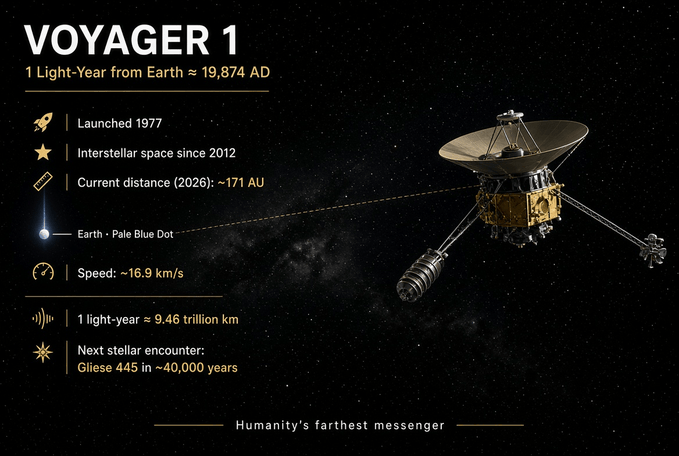
Voyager 1 will be one light-year from Earth around the year 19,874 AD.
That date is not science fiction. It is a straightforward consequence of distance, speed, and time. Humanity’s farthest spacecraft has already spent nearly half a century in flight. Even at its impressive velocity by earthly standards, it will still need almost 18,000 more years to cover the distance light travels in a single year.
From Grand Tour to interstellar space
Voyager 1 launched on September 5, 1977. Its original mission was a flyby of Jupiter and Saturn. Gravity assists from the giant planets flung the probe high above the ecliptic plane and onto a trajectory out of the solar system.
In 1998 it overtook Pioneer 10 and became the most distant human-made object. On August 25, 2012, it crossed the heliopause and entered interstellar space—the first spacecraft ever to do so.
As of late August 2026, Voyager 1 is about 25.65 billion kilometers from Earth (roughly 171.5 astronomical units). A radio signal takes nearly 23 hours and 46 minutes to travel one way.
A speed that looks fast—and is tiny
Relative to the Sun, Voyager 1 travels at about 16.9 km/s, or roughly 61,000 km/h. That works out to about 3.5–3.6 AU per year.
One light-year is 9.46 trillion kilometers. At the probe’s current speed it takes roughly 17,700 years to cover that distance. Counting from launch yields a date around 19,874 AD. Small differences among estimates come from the fact that the spacecraft is still slowly losing speed as it climbs out of the Sun’s gravity well, and Earth’s own orbit makes the Earth-to-spacecraft range oscillate slightly each year.
For perspective: Proxima Centauri, the nearest star, lies 4.24 light-years away. Even if Voyager 1 were headed straight toward it, the journey would take more than 70,000 years.
What happens tens of thousands of years from now
Voyager 1 is not aimed at any particular star. In about 40,000 years it will pass within 1.6–1.7 light-years of the star Gliese 445 (AC +79 3888) in the constellation Camelopardalis. That star itself will be approaching the Sun at the time.
By then the radioisotope thermoelectric generators will have long since exhausted their plutonium-238. Contact with Earth will already have ended in the 2030s. The spacecraft will become a silent messenger carrying the Golden Record—sounds of Earth, music, greetings in dozens of languages, and a map of the solar system’s position relative to nearby pulsars.
Why the milestone matters
One light-year is no longer merely “far.” It is the first truly interstellar distance that a human-built object will reach. Voyager 1 will be the first piece of Earth ever to sit that far from home.
It will still be deep inside the Milky Way. The galaxy is vast, and our probes remain slow by cosmic standards. Voyager 1 is both a triumph of 1970s engineering and a reminder of how slowly we currently travel between the stars.
Eighteen thousand years from now, whatever civilization exists on Earth will be unrecognizable. A small spacecraft launched in 1977 will still be coasting onward—cold, dark, and unimaginably distant—proof that we once dared to leave the solar system.
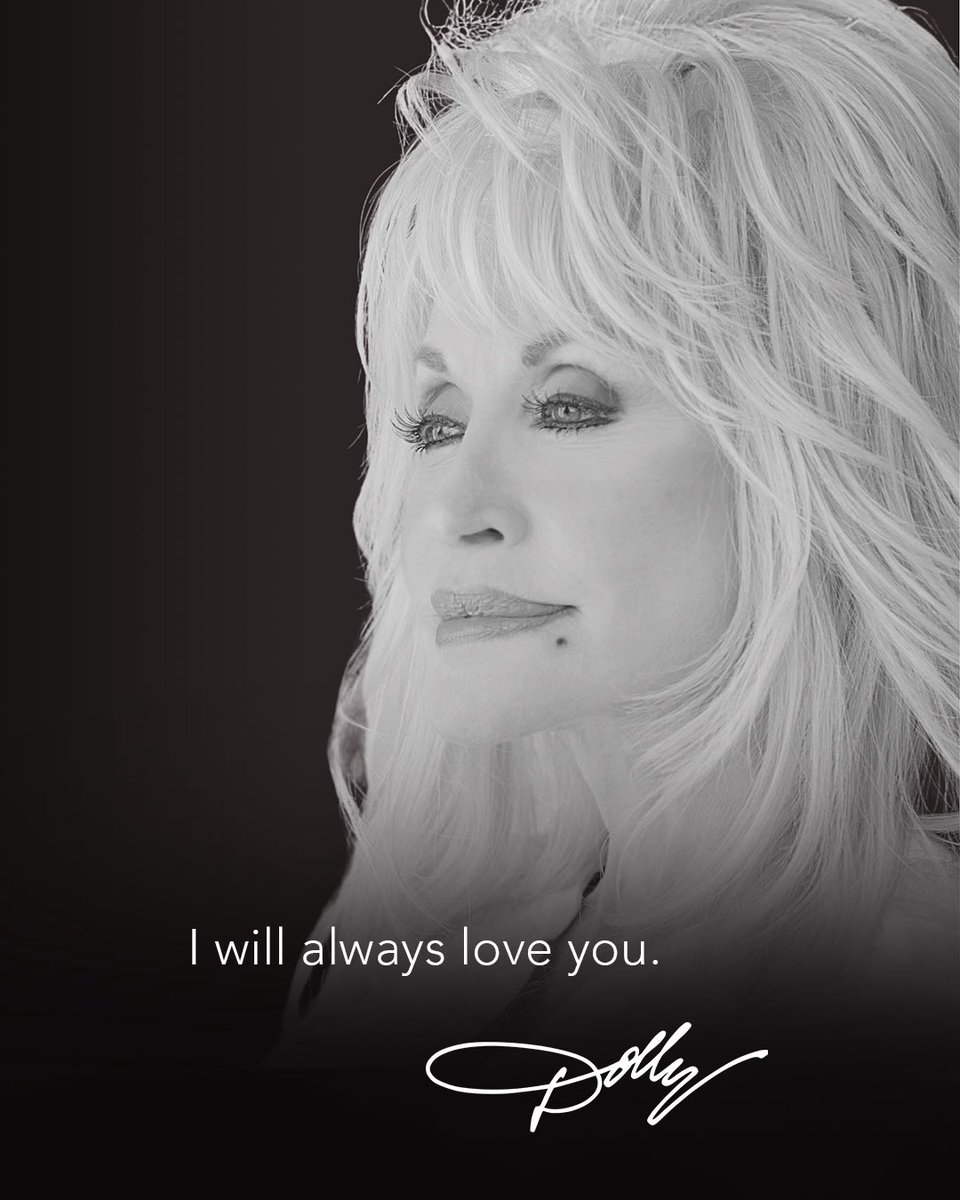
Global icon and humanitarian, Dolly Parton, known to the world as a beloved singer, songwriter, philanthropist, actress, playwright, and author died peacefully today in Nashville, Tennessee. She was 80 years old.
Dolly is preceded in death by her beloved husband of 59 years Carl Thomas Dean (1942 – 2025), her mother Avie Lee Caroline Owens (1923 – 2003), and father, Robert Lee Parton, Sr. (1921 – 2000).
A rhinestone life that shone bright enough for the world to see, Dolly will forever stand as an inspiration not only through her timeless music and prolific songwriting, but also her wit, warmth, and kindness that made us all feel like family. Dolly Parton’s legacy is one of love, compassion, and resilience. With a seven-decade career, she inspired multiple generations of artists and fans with her music and an unwavering commitment to making the world a better place. Her songs will continue to resonate with people of all ages, and her philanthropic work will have a lasting impact.
At Dolly’s request, a small, private service will be held for immediate family. Dolly’s fans and friends from around the world are encouraged to pay tribute to Dolly on social media by tagging @DollyParton or by leaving a message at https://t.co/cLu9I7M2wC
In lieu of flowers the family asks for donations to be made to Dolly Parton’s Imagination Library at https://t.co/arzrqInqJA
Creedence Clearwater Revival beating out The Who and The Beach Boys on Spotify is wild.
These 1960s streaming rankings were pulled fresh on August 14.
While the Top 2 are expected, Gen Z (who makes up 35% of Spotify's audience) is clearly keeping CCR on repeat.
It's fascinating to see which legendary bands are successfully crossing the generational gap today.