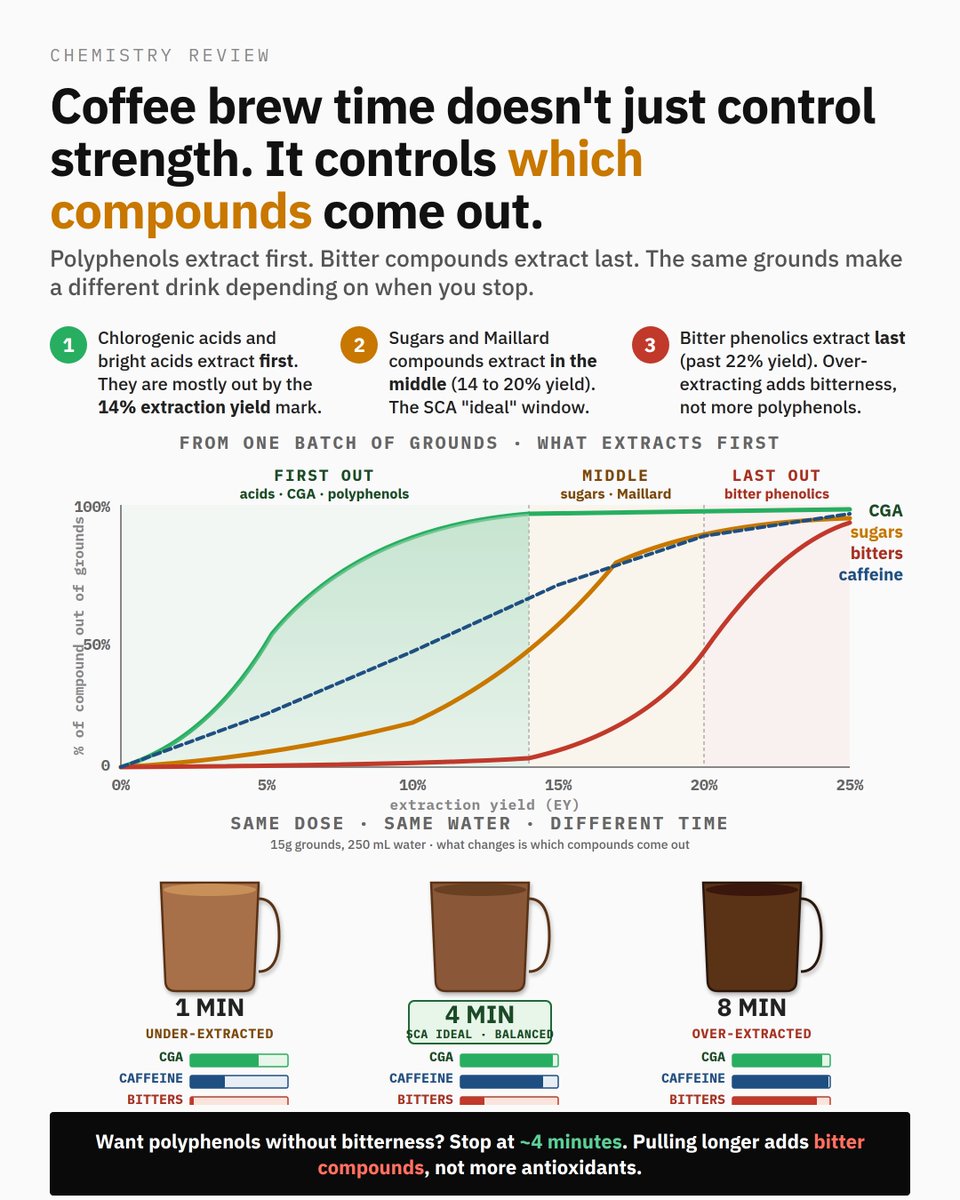
Coffee compounds do not extract together. Acids and polyphenols come out first. Caffeine extracts steadily across the brewing window. Bitter compounds come last and keep coming. The brew time you pick is the dial that decides which mix ends up in the cup.
The extraction order. The Specialty Coffee Association characterizes hot brew extraction in three phases, indexed to extraction yield (EY), the percentage of original coffee mass dissolved into the water. From 0 to roughly 14% EY, you pull mostly acids, including chlorogenic acids (CGA), citric, and malic. These are the bright, sour, polyphenol-rich compounds. From 14 to 20%, sugars and Maillard compounds dominate. Past 22%, bitter phenolics extract heavily. The SCA ideal target is 18 to 22% EY for a balanced cup.
Two compounds matter most for health framing. Chlorogenic acid is the dominant polyphenol in coffee and the main carrier of its antioxidant activity. Caffeine is the dominant stimulant. They do not extract on the same schedule. Fuller and Rao (Sci Rep 2018) showed CGA reaches near-equilibrium quickly in cold extraction. SCA brewing theory and method-comparison studies (Angeloni et al., Food Res Int 2020) show CGA is mostly out early in hot brews, while caffeine continues to extract steadily across the brewing window.
What that means for your cup. Pull a hot pour-over for one minute and you have most of the CGA but less than half the caffeine. Pull for four minutes (the SCA ideal) and you have most of both, with bitterness still low. Pull for eight minutes and you have all of the caffeine, the same CGA you already had at four minutes, and a flood of bitter phenolics. The relationship between time and polyphenols is not linear. CGA plateaus early. Bitterness keeps rising.
A note on the numbers. The percentages on the cup bars are illustrative, not direct measurements from one head-to-head trial of one-, four-, and eight-minute pour-overs. They derive from the extraction curve, which reflects SCA brewing theory and the Fuller and Rao kinetic data. The story they convey, CGA extracts early and plateaus while bitterness extracts late, is well-supported. Exact numbers vary with grind, temperature, ratio, and bean.
A note on degradation. Chlorogenic acid is not perfectly stable at brewing temperature. Prolonged heat can degrade some CGA, so very long hot brews may extract more but also break some down. The eight-minute cup ends up roughly even with the four-minute cup on CGA, not higher.
The takeaway. If your goal is caffeine, a longer brew gets you more. If your goal is polyphenols without bitterness, stop closer to the SCA ideal window. Brewing past it adds bitter compounds, not more antioxidants. Same grounds, same water, same heat will give you very different drinks depending on when you stop.
Angeloni et al., Food Res Int 2020 · Fuller and Rao, Sci Rep 2018 · Specialty Coffee Association extraction theory
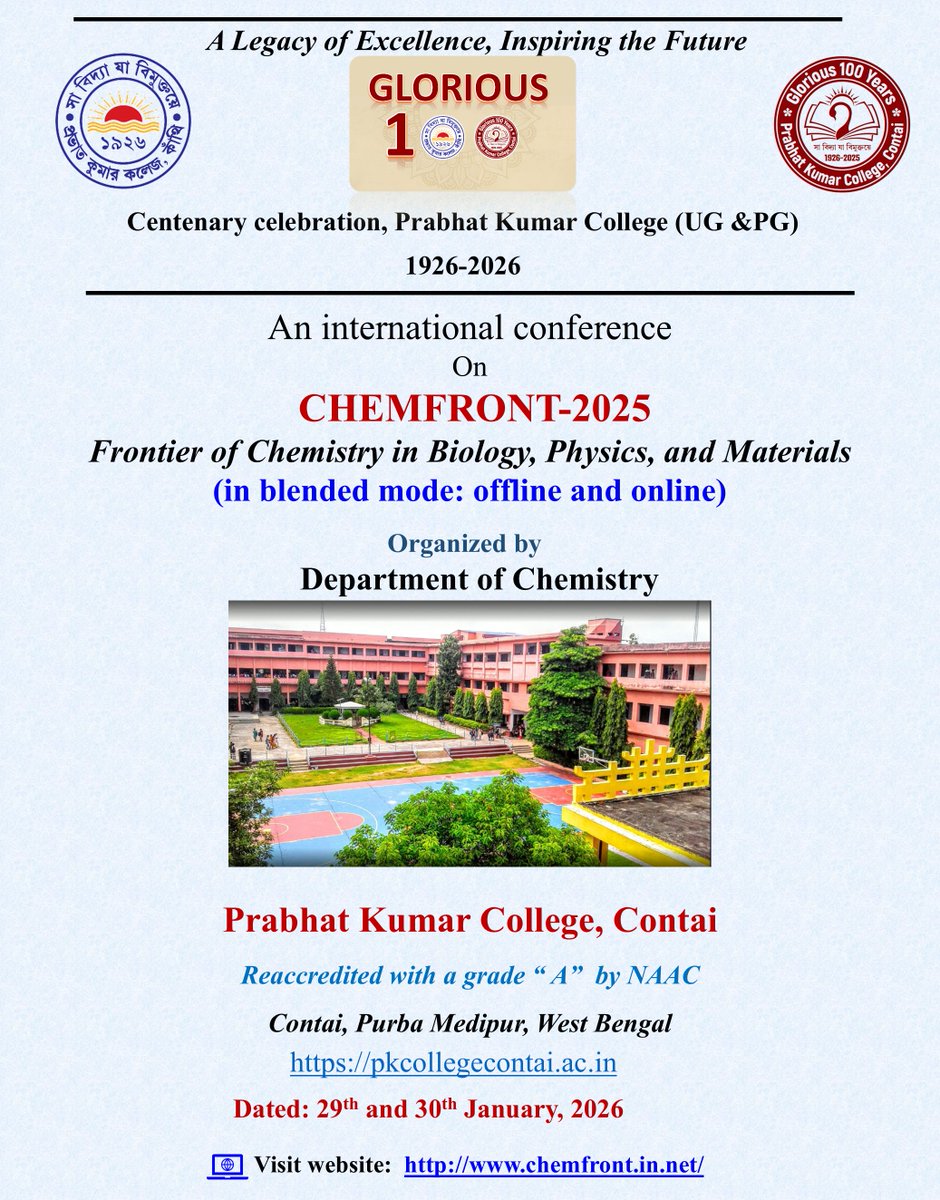
Established in 1926, Prabhat Kumar College proudly celebrates 100 years of academic excellence.
As part of its centenary celebration, the Department of Chemistry is going to organise an International Conference titled "CHEMFRONT-2025"
Visit the website: https://t.co/JmIZ5yjzJ5