Read Keigo Higashino's masterpiece last night, and even though I’d already watched Jaane Jaan, the book’s heartbreaking ending still caught me off guard. had previously also read A Midsummer’s Equation by Higashino. Always brilliant!
Watched The Devil Wears Prada 2 with high expectations but was sadly, disappointed. Story line wasn't compelling enough. Hathaway, one of my favorite actors, was the weakest link for me. Her character didn’t seem to have evolved in 20 years. Just a so-so one-time watch. :(
Just finished @6amiji 's Why Are We This Way? It is simple, well-structured, and a great entry point into Sanatan literature. Reading it felt like revisiting a favourite subject. Perfect for beginners, especially young readers.
@bigfundu So beautifully articulated. We must set an example for the next generation by constantly striving to achieve success in whichever field we pursue. Rather than trying to pull down those who have succeeded, time we emulate their efforts and persistence
@pbhushan1@YouTube Excuse me sir. What credible source did you refer to while spreading such obviously blatant lies? And I'm sorry but a silly youtuber talking shit is not exactly the source you or anyone should be referring to.
@shatakshij7 What went wrong was your
ability to fact check before posting on x. Good job peddling fake narratives. Learn to read some actual news rather than some idiot's delusional tweets
@PratibhaPriyad3 Like clockwork, these detractors come out at Mahashivratri to hurl all their pent up toxicity around. It's a free country, if someone wants to sell something, it's their choice. If someone wants to buy something, it's their choice. Why make it such a big deal?
While all the king's horses and all the king's men
Were choosing to get high on substance
@sza chose to get high on Shiva Shambho!
Hats off to her devotion and spirit. Didn't know her before but certainly a fan now :)
@MaaSutara@SadhguruJV There is a very clear agenda to defame Sadhguru and Sanatan Dharma. These idiots are ready to even spend so much money to achieve their ends.
@ShyamMeeraSingh You have blurred only the faces of the boys entering the suryakund and left the faces of the girls unblurred later during their yoga practices to deliberately mislead people. Shows your ill intent. As many have pointed out, children here, irrespective of gender, grow their hair.
Centuries before passports or digital IDs, language itself was the passport.
If you could think, debate, and learn in Sanskrit, the doors of knowledge opened across cultures.
During the time of Faxian and Xuanzang, Sanskrit was the medium of higher learning in Indian universities like Nalanda University.
Chinese Buddhist students learned Sanskrit to gain admission, much like clearing TOEFL today to study abroad.
It’s humbling to realise how an ancient academic system quietly set the conceptual foundation for today’s global education norms.
vc to the respective owners.
BREASTMILK
She thought she was studying milk.
What she uncovered was a conversation.
In 2008, evolutionary anthropologist Katie Hinde was working in a primate research lab in California, analyzing breast milk from rhesus macaque mothers. She had hundreds of samples and thousands of data points. Everything looked ordinary—until one pattern refused to go away.
Mothers raising sons produced milk richer in fat and protein.
Mothers raising daughters produced a larger volume with different nutrient balances.
It was consistent. Repeatable. And deeply uncomfortable for the scientific consensus.
Colleagues suggested error. Noise. Statistical coincidence.
But Katie trusted the data.
And the data pointed to a radical idea.
Milk is not just nutrition.
It is information.
For decades, biology treated breast milk as simple fuel. Calories in. Growth out. But if milk were only calories, why would it change depending on the sex of the baby?
Katie kept digging.
Across more than 250 mothers and over 700 sampling events, the story grew more complex. Younger, first-time mothers produced milk with fewer calories but significantly higher levels of cortisol—the stress hormone.
The babies who drank it grew faster.
They were also more alert, more cautious, more anxious.
Milk wasn’t just building bodies.
It was shaping behavior.
Then came the discovery that changed everything.
When a baby nurses, microscopic amounts of saliva flow back into the breast. That saliva carries biological signals about the infant’s immune system. If the baby is getting sick, the mother’s body detects it.
Within hours, the milk changes.
White blood cells surge.
Macrophages multiply.
Targeted antibodies appear.
When the baby recovers, the milk returns to baseline.
This was not coincidence.
It was call and response.
A biological dialogue refined over millions of years. Invisible—until someone thought to listen.
As Katie reviewed existing research, she noticed something unsettling. There were twice as many scientific studies on erectile dysfunction as on breast milk composition.
The first food every human consumes.
The substance that shaped our species.
Largely ignored.
So she did something bold.
She launched a blog with a deliberately provocative name: Mammals Suck Milk.
It exploded. Over a million readers in its first year. Parents. Doctors. Scientists. People asking questions research had skipped.
The discoveries kept coming.
Milk changes by time of day.
Foremilk differs from hindmilk.
Human milk contains over 200 oligosaccharides babies can’t digest—because they exist to feed beneficial gut bacteria.
Every mother’s milk is biologically unique.
In 2017, Katie brought this work to a TED stage. In 2020, it reached a global audience through Netflix’s Babies. Today, at Arizona State University’s Comparative Lactation Lab, she continues reshaping how medicine understands infant development, neonatal care, formula design, and public health.
The implications are staggering.
Milk has been evolving for more than 200 million years—longer than dinosaurs walked the Earth. What we once dismissed as simple nourishment is one of the most sophisticated communication systems biology has ever produced.
Katie Hinde didn’t just study milk.
She revealed that nourishment is intelligence.
A living, responsive system shaping who we become before we ever speak.
All because one scientist refused to accept that half the story was “measurement error.”
Sometimes the biggest revolutions begin by listening to what everyone else ignores.
In Cuddalore, rural women running a 30-acre nursery are transforming their lives while powering the Cauvery Calling movement, producing 85 lakh saplings a year to revive the river.
Read here to know more: https://t.co/ryLIYanJzs
#Cuddalore#Cauvery#CauveryCallingMovement #Nursery #ABPLive
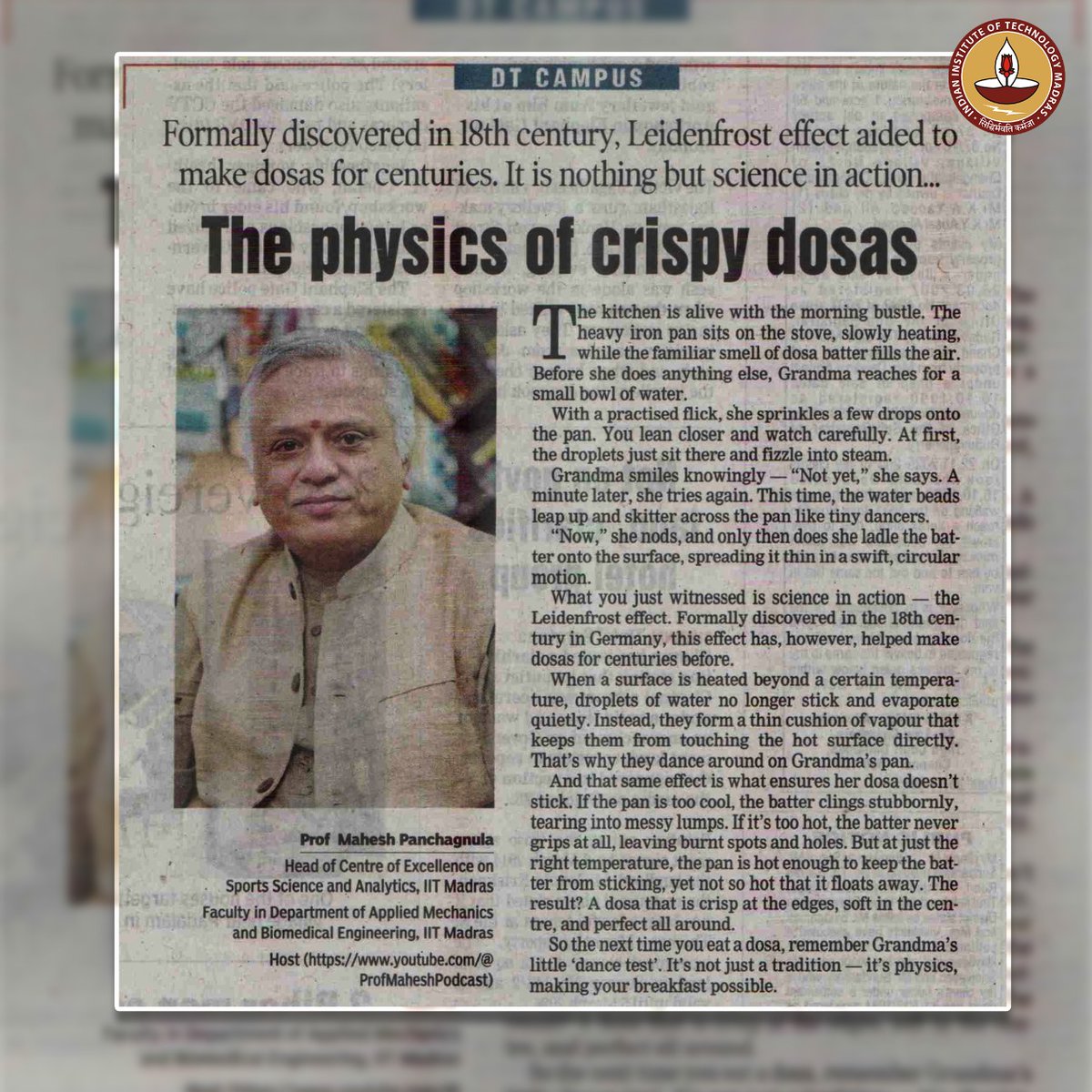
Ever wondered why a dosa turns out perfectly crispy on the outside and soft inside? The secret goes far beyond culinary instinct driven by physics.
In an authored article for @dt_next@iitmadras, Prof. Mahesh Panchagnula unpacks the science behind this everyday magic. The familiar practice of sprinkling water on a hot pan before pouring the batter is actually a test rooted in the Leidenfrost Effect—a phenomenon formally identified in 18th-century Germany but intuitively mastered in Indian kitchens for generations.
When the tawa isn’t hot enough, water just sits and evaporates slowly. But at the ideal temperature, droplets glide and “dance” across the surface, floating on a thin vapour layer. This same effect prevents dosa batter from sticking, allowing it to spread evenly and crisp up beautifully at the edges.
So the next time you hear that sizzle, remember: making the perfect dosa is not just tradition—it’s a brilliant interplay of temperature, vapour, and technique.
#Physics #IITMadras #LeidenfrostEffect