The reason this meme resonates with me is that it captures a common tactic in public democrat debate. Someone points to a broad trend and instead of discussing whether the trend is real, the conversation immediately shifts to an exception.
Mention fatherlessness and someone brings up a successful person raised without a father. Mention failing schools and someone points to a student who excelled. Mention crime and someone finds a neighborhood that remains safe. The exception is treated as though it disproves the pattern.
The problem is that exceptions do not erase trends. Nobody is claiming every circle is red.
They will call me a outlier... An exception.... an anomaly.
The point is that when most of the circles are red, focusing exclusively on the blue one prevents an honest discussion about what the overall picture actually shows. Serious analysis begins with patterns, not exceptions.
That is why so many conversations about public democrat policy go nowhere. Instead of asking why a problem exists, people spend all their energy trying to prove the problem doesn’t exist because they found a single exception.
Reality doesn’t work that way. If most of the circles are red, then the responsible thing to do is explain why.
#AStoneGroove #SilentMajoritySpeaks
You’re 10x more likely to die than to be fired from a UK government department
UK government departments fire people for poor performance at 1/600th the rate of private companies.
For every person they fired for being incompetent, there are 599 incompetent people who didn’t get fired.
That adds up. Imagine if a business behaved this way!
We need government to be meritocratic, competence hierarchies that reward performance and reject inefficiency.
Until this happens it’s hard to trust government with more money.
The framing of the bond markets we get from politicians is totally mad. And shows how little they understand about the mechanics of how the nation finances its deficits.
They seem to think that the bond markets are essentially a small group of evil billionaires sat in a room scheming to influence public policy.
This is bullshit.
In reality, they’re made up of people and institutions the government are asking to lend them money… pension funds, insurers, your gran’s retirement pot, the Bank of England, overseas central banks holding sterling, and so on. A lot of people are involved in these markets.
When politicians say they’re “in hock” to the bond markets. What they’re referring to is the fact that they borrow money from the market and have to pay bond holders back with interest. The participants in the market will buy bonds when the yield on the bonds adequately covers the perceived risk of holding the bonds, and provides a modest expected return to make it worthwhile.
They’re not scheming, they’re just pricing inflation and interest rate risk. Our debt carries a higher risk premium than other core economies like Germany, because of specific structural problems and a credibility deficit on spending.
And a lot of that demand isn’t even a choice. Pension funds and insurers are required to hold gilts to match their liabilities. So your gran’s retirement pot is quietly propping up the very market these politicians claim to be fighting.
The supposed alternative is to balance the budget so you don’t need to borrow. If you don’t want to be “in hock” to the bond markets, don’t borrow money from them. Except even that wouldn’t free us, because we still have to roll over the existing debt as it matures. Escaping the market entirely would mean running surpluses for decades, which would take spending cuts or growth we haven’t got. So the government borrows.
And here’s the tell... a lot of politicians half admit it. They’ll say, as Polanski does here, the markets “just want to know there’s a plan.” Yeah, absolutely. So the problem was never the market. It’s that our politicians haven’t got a credible plan.
So when you hear politicians complaining about the bond markets, what they’re really complaining about is the fact that they can’t borrow endlessly to fund all the mad shit they want to do.
Correct
2004 was the last year with strong income growth, coincidentally it was also the year Britain stopped being a net energy exporter, also EU enlargement (A8 accession) we were one of only three members (with Ireland and Sweden) to grant immediate labour market access, triggering large scale Eastern European migration with significant labour market effects
That water clarity is an engineering decision, and the math behind it is wilder than the video.
Roman aqueducts ran on gravity alone. No pumps, no pressure systems. Engineers carved channels with a gradient so shallow it borders on absurd. The Pont du Gard in southern France drops 2.5 centimeters over 275 meters. That's roughly the thickness of a coin over the length of three football fields. They surveyed that accuracy with plumb lines and wooden leveling instruments.
The clarity you're seeing is a direct product of flow velocity. Too steep and the water erodes the channel walls, picks up sediment, turns brown. Too flat and it stagnates. Roman engineers targeted a slope of about 20 centimeters per kilometer, which kept the water moving fast enough to stay fresh but slow enough to stay clear. Before the water reached the city, it passed through multi-chamber settling tanks where velocity dropped near zero. Suspended particles sank. Clean water flowed out the top into the next chamber. Repeat three or four times.
Pliny specified the minimum slope in writing. Vitruvius published the exact mortar ratio for hydraulic cement: one part lime to two parts volcanic ash for underwater work. The pozzolana from Pozzuoli reacted with water to form a calcium-aluminum-silicate compound that actually gets stronger the longer it sits submerged. Modern concrete degrades in water. Roman concrete bonds with it.
Scale the whole system and it gets harder to process. Eleven aqueducts fed Rome at its peak. Combined output: roughly 1 million cubic meters of water per day. That works out to about 250 gallons per person for a city of one million. Modern New York delivers about 125 gallons per person per day. Ancient Rome had access to double the per capita water supply of the largest city in the United States, running entirely on slope and stone.
The Trevi Fountain in Rome is still fed by one of them. Two thousand years, same source, same gravity, same water.
@Psikobilim_ This seems logical.
I’d be curious what it looks like at the tails of the distribution, as it would seem logical to me that the brightest would also understand that not everyone can be helped. Or being helpful to too many it will start having being unhelpful to others
Exactly. Over the age of 45, if you played your cards right, you were probably fine. If you went into a high earning field, you’ll probably have had it just as a good as the Boomers before you.
33-45, you were screwed. However, if you went into a high earning field, or got sizeable help from the bank of mum and dad, you might have been able to get on and build a life for yourself.
25-32, you were completely screwed and your only chance to get on in life and have a life similar to your parents, is to get a huge amount of help from your parents.
Also, this all a progression. So someone aged 55 has had it much better than someone aged 45, someone aged 45 has had it much better than someone aged 35, someone aged 35 much better than someone aged 25.
Great to see @WilliamClouston, @MellonSdp6741, @ross_baglin and the wider team getting their flowers recently. Long, long overdue, for my money.
It has become increasingly clear that the @sdphq are the only political party with intellectual rigour and Benthamite-adjacent policy formation in the national interest. The old left vs right framing is outmoded and no longer of use as we navigate the new multipolar world order.
Clouston’s call for a Singaporean (LKY) inspired approach to running the state, and a De Gaullist approach to industry, energy, defence and sovereignty, is logically correct. In this new paradigm, it is critically important to heed his impulses.
Moreover, their Energy Abundance paper, launched last year, would solve vast problems Britain faces if implemented. The SDP calculate Britain has lost £3 trillion in cumulative output to post-2004 energy policy, with productivity now 10.8% lower than it would otherwise have been, and that 77.6% of the rise in net energy prices since 2004 has been driven by non-wholesale costs rather than gas.
Their fix is a 60GW build of state-owned gas and coal within five years, a 40GW nuclear fleet over a decade, and a permanent 10p/kWh price fix for consumers and industry. That gets you a disinflationary impulse across virtually all goods and services, the ability to reshore manufacturing and heavy industry, and the baseload we need to participate in the automation revolution. Without it, the Engels pause I’ve written about recently looks baked in and the rebound less likely.
If you think as I do, and want a better long-term solution to moribund Britain’s many problems after the immediately necessary Milei/Thatcherite medicine (reset) that Reform are most likely to be able to deliver, then consider joining:
https://t.co/vcvVy9hTZ7
The thing about bond markets is that if Labour said:
"We're going to borrow this money to do a massive investment in nuclear energy, built to Korean standards, we're going to expand our airports and ports, renew and expand Britain's highway and rail systems, renew Britain's armed services and we're going to dramatically overhaul our planning and approvals system to do it rapidly"
Labour would get a very positive response from the markets and its borrowing rate would fall.
Unfortunately what Labour tells the markets is "we're going to borrow money and throw it at our client groups - welfare recipients, pensioners, the public sector and unions - basically the least productive members of society". Oddly enough this doesn't go down very well.
The absurdity of central banking never ends.
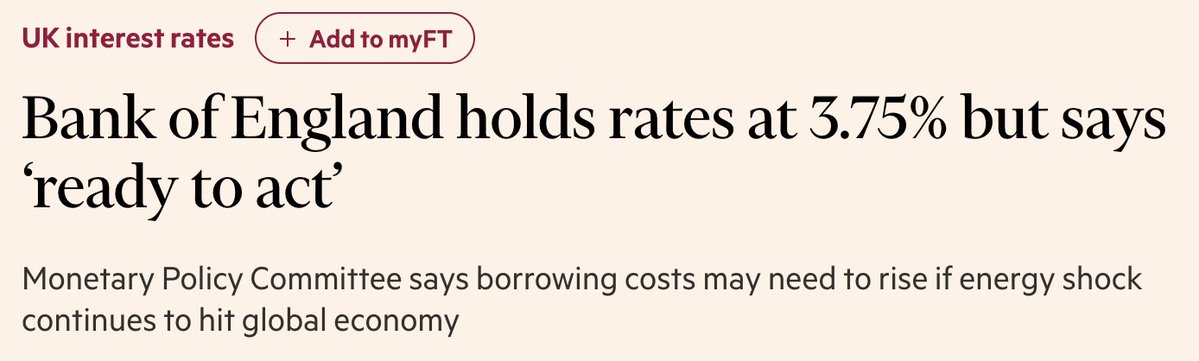
The Bank of England is thinking about raising interest rates because of an energy shock caused by the Strait of Hormuz disruption.
This is the wrong tool for the wrong problem.
Raising rates is a demand side solution. It works by making borrowing more expensive and cooling an overheated economy. That is not what is happening here.
This is supply side inflation. Energy prices are rising because a critical global chokepoint is closed and because the UK has spent a decade destroying domestic energy production in pursuit of net zero vanity projects.
By the way, this is the same institution that recently sold government bonds at a massive loss to the taxpayer. These are the people controlling your currency.
It is time to return to sound money.
I urge everyone to read the post below from Simon Elmer. Simon is a leftist, not a "rabid far-rightist." His research is meticulous and forensic. He is writing about THE most important issue of our times which could see the total collapse of Western civilisation.
We must not read Simon's warning though. It is deemed "hateful" and his book must be burned. This could not happen in a free society. The implications are chilling. Gulags are not very far away now. The Establishment's non-violent war against us us total. It won't remain non-violent. Wake up.
NEW Interesting. Jonathan Powell was only security vetted after he was appointed National Security Adviser, says Morgan McSweeney.
6 Sept 2024: Powell made special envoy on Chagos deal;
8 Nov 2024: Powell made NSA. Obviously no need for deep vetting to negotiate on Chagos?
https://t.co/Il0EZQnFH9
This means that Powell negotiated the entire Chagos surrender deal without having been vetted and while the CEO of a private organisation with ties to
Grandview, a Chinese organisation run by former senior Chinese state officials.
China, of course, has a great deal to gain from the surrender of the Chagos islands, and full vetting in summer 2024 would have surfaced these links in order to establish whether they were compatible with Powell’s role in negotiating the surrender deal.
This is a great interview. It is becoming increasingly clear that much of the post-1997 political settlement, and many of the structural changes that followed it, are fundamentally incompatible with war readiness.
Public spending is too heavily skewed towards welfare and inefficient public services, leaving too little room for serious defence provision. A culture of spin means the country is not told the truth about the actual condition of the armed forces. Legislation such as the Human Rights Act and the Equality Act has constrained military effectiveness and damaged morale. Multiculturalism and uncontrolled mass migration have been a disaster for social cohesion. The Climate Change Act / Net Zero has contributed to the destruction of our industrial base and energy system. Lobbying from special interests means we are not getting the kit we need. The list goes on and on.
As after the Napoleonic Wars, an extended period of peace has encouraged the deeply dangerous fantasy that we have somehow escaped the old rules of power, conflict and national survival. That complacency must end immediately. We cannot go on like this.
My own view is that this is bigger than Starmer and Labour. It reflects a broader collective failure. The opposition and the media need to stop indulging in soap opera and focus, ruthlessly and without distraction, on holding ministers to account.
Posted this (the quote tweet) chart a month ago. The Oxford Economics piece in the Telegraph today is exactly why it matters.
The @Telegraph has run a Bastiat parable and forgotten the punchline. Oxford Economics tell us that reversing population growth costs £700bn of GDP, because the state would spend less on NHS treatments, school places and housing benefit for a smaller population. Correct. That is the broken window.
What they do not mention is the unbroken window, the £700bn of taxes and gilt issuance no longer needed, freed up for productive investment, wages, or simply being left in the pockets of the people who earned it. In Bastiat’s original the villagers cheered the glazier. In the 2026 version they cheer the Home Office.
Let’s use another example to make the same point… India is the world’s fourth largest economy. It also has roughly 1.4 billion people. Hold those two facts next to each other and the GDP headline stops meaning what politicians want it to mean.
India’s problem is not the size of its economy. It is that on a per capita basis it is poor, around $2,200 per head, and no amount of aggregate GDP solves poverty at the household level.
Fiscal capacity, infrastructure, public goods, capital formation, every lever the state can actually pull to lift living standards runs on resources per head, not on the headline total.
Telling an Indian household in Bihar that the country is the fourth largest economy in the world is the same trick British politicians play when they quote sixth largest. The number is real. The relevance to the person paying the bill is not.
And the runway is shorter than it looks. India’s fertility rate is already 1.9, below replacement. The population peaks around 2060 and then declines. The dependency ratio starts deteriorating in the 2040s. The country has to raise productivity per head before the demographic window closes.
Same problem as Britain, different starting point.
Scale is not prosperity.
A big pie divided 1.4 billion ways is still a thin slice.
And a British pie grown by importing more mouths is the same trick with a different accent.
(Hat tip to @GreatBritishTT for picking up on this earlier 👌🏼)
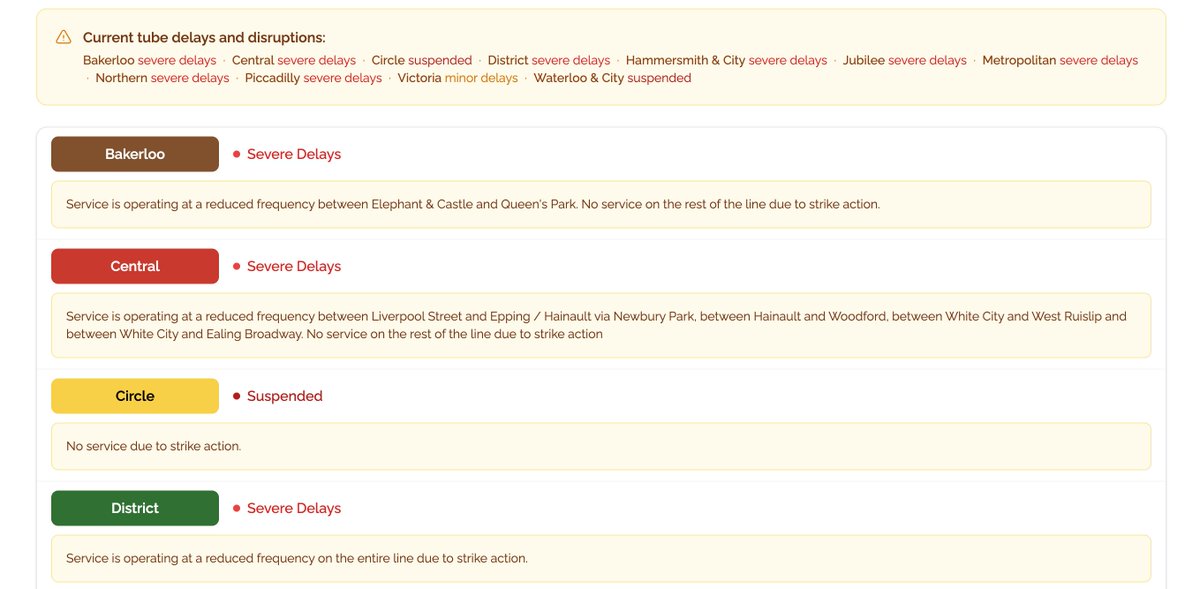
In 2023, TfL was given powers to require 40% service during strikes. Similar systems exist in France, Germany, Italy, Spain, Portugal, Switzerland and elsewhere. (In New York, transit strikes are simply banned.)
The current Government abolished these powers upon coming to office. Londoners should remember that this week's transport chaos flows from a political choice, and could easily have been mitigated by following normal international practice.
The devil will be in the detail. If they claim to be preparing the country for a war-readiness footing, yet persist with unfunded welfarism, continue to live beyond their fiscal means, fail to control migration, restrict North Sea development, keep the fracking ban, prioritise rewilding over production, pressure farmers to sell up, accelerate deindustrialisation, and cling to Net Zero targets, they are doing nothing of the sort. And that’s before we even talk about re-arming, restoring patriotism, and rebuilding social cohesion. It’s going to take more than a few press releases and snazzy TikTok videos with the Prime Minister in military fatigues.
There is no way of knowing how often Parliament votes against what the public actually wants. Until now.
https://t.co/QpJCcn3FBH tracks every bill going through Parliament. You vote. We compare it to how your MP voted. The gap speaks for itself.