Our newest Fertility and Other F Words webcast drops this week. @DrLipshultzTips and I sat down with Drs. Blair Stocks and Taylor Kohn to discuss real innovation in male infertility.
Being told you have no sperm does not always mean no options.
Blaire and Taylor are doing the meticulous work of finding sperm when others stop looking, helping people build families.
Hopeful, science driven, and practical.
Subscribe to DrsAmyandLarry on YouTube to catch the full episode when it drops.
It was an honor to join @DrLipshultzTips and @AmyPearlman1 on their podcast Fertility and Other F Words. Dr. Stocks and I had a lot of fun talking about our research and the future of male infertility interventions!
Newest Fertility and Other F Words with @DrLipshultzTips just dropped 🎙️
One of the hardest visits we have as urologists: telling a man he has no sperm.
Those words land heavy. The next question is always, “What’s next?”
And sometimes… we don’t know if what we try will work.
Urologists are wired to do more.
And even when options are limited, we never want to say, “Good luck, goodbye.”
This episode brings optimism as Dr. Blair Stocks and Dr. Taylor Kohn from @bcmhouston shed light on their innovative strategies to find sperm.
#menshealth #fertility #reproductivehealth #urology
https://t.co/Qq19xvhkDs
Help us welcome Dr. Taylor Kohn to the Scott Department of Urology!
He joins us as an Assistant Professor and will be primarily practicing at our Sugar Land location. We’re thrilled to have him on board—be sure to give him a warm welcome!
#BCMUrology
@PBajicMD @ranjithramamd @JUrology@PranjalA_JHUSOM@JoshHare8 We were able to control for diagnoses of OSA in the propensity matching, but since this is EMR/Claims database analysis compliance or use of CPAP was not accessed, but certainly an interesting question. Overall rates of OSA was about 15-20% in the cohorts
@DrMorgentaler @ranjithramamd @JUrology@PranjalA_JHUSOM@JoshHare8 The other thing to note about our study is that we compare men started on TTh with rising Hct to men started on TTh without a rising Hct so the increased risk of MACE is specifically to men starting TTh whereas TRAVERSE compares men with starting TTh to men not receiving TTh
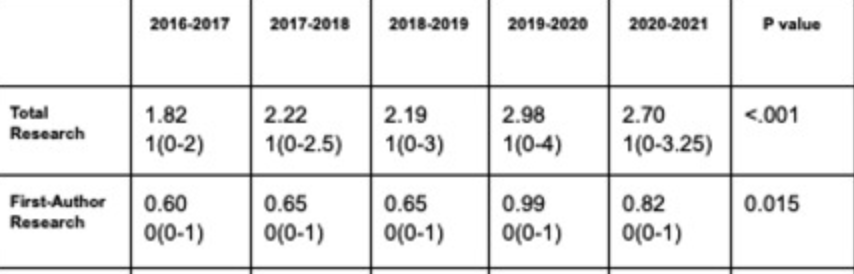
@Uro_Res@UroAcademic@AmerUrological The number of peer-reviewed manuscripts is increasing within urology over time, this study showed publication rates since 2016 to 2021 and numbers have doubled (nearly tripled if looking at numbers from other studies for 2023). https://t.co/zBFW8gWEkY
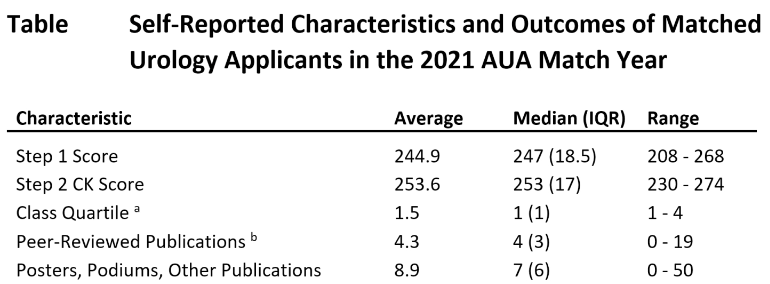
@Uro_Res@UroAcademic@AmerUrological Self-reported data for matched Urology Applicants in 2021 from the infamous google doc sheet, puts average any author peer-reviewed publication at 4.3. Whereas posters/podiums/other publications was 8.9. (https://t.co/yvbPqr9J4c)
@jbcarmody Limiting the number of applicants that can be moved to “do not rank” would prevent programs from punishing people who didn’t do a second look but at least gives the programs an out of if the in person visit goes horribly wrong.
@jbcarmody We proposed a similar “locking” idea within the AUA match:
https://t.co/HO0kbK4ZLK
May need some mechanism by which programs can move 3 or 4 people at most from their rank list to “do not rank” in case any red flags are seen during visits.
@ZSchwen@so_uro@AmerUrological Are they not coming back ever or is it just temporarily shortage? Just read this though, it does seem like it is permanently gone https://t.co/wR7A7gfZZW
@cosgriffc @ReginaRoyan@gbosslet lol. as surgical residents any additional lectures happen before surgery starts and so we just have to come in even earlier to round on patients. Certainly we learn in the OR by doing but surgical residents help keep the machine running and research/education is on our own time.
@Adam_Weiner535 @ranjithramamd Starting out, the first few projects that you will work on will take a lot of time as you are learning. But set aside 1-2 hours per week and you will see over time how much you are able to accomplish in that set aside time
@Adam_Weiner535 @ranjithramamd Basic science can be tough during pre-clinicals or clinicals, they often require months to years and significant amount of time. Start small and figure out if you like research, if you love it you can always do additional gap years doing research years.