‚If Chinese forces attempted to cross the Taiwan Strait tomorrow and the United States came to Taiwan’s aid, the U.S. and Taiwanese militaries would struggle to fight together effectively. Their combined forces would experience gaps in how their systems communicate, how their commanders coordinate, and how their units operate alongside one another. These gaps will cost time and cause disruptions. In combat, this will cost American and Taiwanese lives and ultimately threaten the campaign itself.‘
People often compare JPMorgan to individual European banks.
But that’s the wrong comparison.
The EU banking sector holds around €33 trillion in assets, compared with roughly €21.5 trillion in the United States.
Europe’s problem is not scale.
It’s fragmentation.
Instead of a handful of continental banking giants, Europe has dozens of large banks spread across 27 markets, protected by national interests and regulatory barriers.
Collectively, Europe’s banks are enormous.
Individually, they are too small to compete with the largest global players.
This is why deeper banking integration, a true Banking Union and more cross-border mergers matter.
The proposed UniCredit-Commerzbank deal should be viewed through that lens.
A stronger Europe needs stronger European banks.
The French hate air conditioning.
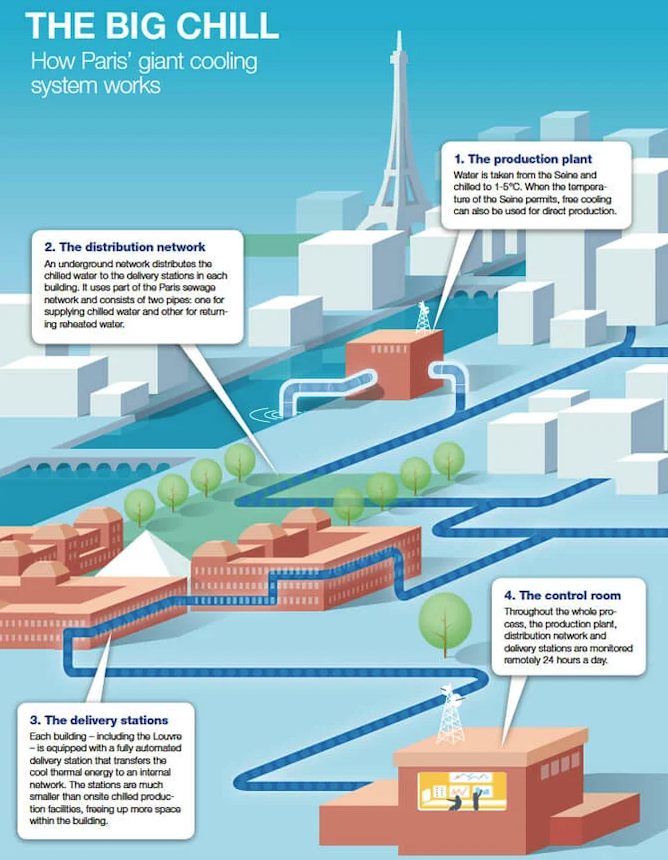
So Paris built a 120-kilometre machine under its streets for producing cold.
It’s called Fraîcheur de Paris, and it does for summer heat what district heating did for winter: centralise the problem.
Instead of every museum, office, hotel, hospital and shop bolting its own cooling plant onto the building, Paris moves cold through pipes.
The network sends water chilled to 2 to 4°C through buried supply lines. The water enters a connected building, absorbs heat through an exchange station, then returns at 12 to 14°C to be cooled again.
It essentially functions with two pipes. One carries the cold out, the other carries heat back.
The production plants cool the circuit from 12°C to 4°C. Some sites use the Seine as a heat sink. In colder periods, the system can use the river’s own temperature for free cooling, which means the machines work less and the electricity demand drops. The Seine water doesn’t become the building water. It stays separate, passing temperature across heat exchangers.
The scale is pretty strange when you see it written down though.
It's got 15 production sites, 4 storage sites, 120 km of underground network with 924 subscribers. This has resulted in 7 million square metres cooled, and 493 GWh of cooling sold.
A cold utility running beneath one of the densest cities in Europe.
The Forum des Halles has been cooled this way since 1979. The Louvre since 1986. Galeries Lafayette, Opéra Garnier, Hôtel de Ville, Station F, La Samaritaine and the National Assembly all sit on the same idea. Tourists stand in the Louvre looking at paintings while a municipal cold loop does part of the dull work below ground.
The boring part is the breakthrough.
Cold can be stored at night in chilled water or ice, then used during daytime peaks. The network is monitored from a control room with more than 125,000 control points. A delivery station inside a building takes 5 to 7 times less space than a standalone cooling installation and avoids the roof and façade clutter that turns cities into compressor farms.
That matters because conventional air conditioning solves heat by moving it somewhere nearby. In a dense city, thousands of private machines mean thousands of outdoor units rejecting heat into streets, courtyards and roofs, plus refrigerants, noise, vibration and maintenance spread across every building.
Paris’s public cooling network has a stated coefficient of performance of 4, against 3 for a wet standalone system and 2 for a dry standalone system. Against an equivalent set of autonomous installations, Fraîcheur de Paris says the network gives 100% higher energy efficiency, 35% less electricity use, 90% fewer refrigerant-fluid emissions and 50% lower CO2 emissions.
The climate backdrop is the real reason this exists.
Paris ran a full crisis exercise called “Paris at 50°C” in 2023. Météo-France’s 2050 reference trajectory for France points to heatwave days becoming five times more frequent, hot nights rising sharply in urban centres, and some local extremes around 48°C becoming possible.
The city signed a 20-year concession in 2022 with Fraîcheur de Paris, owned 85% by ENGIE and 15% by RATP. The contract is worth a projected €2.4 billion. The plan is to extend the network by 158 km by 2042, add 20 production plants and 10 storage sites, and reach more than 3,000 subscribers, including hospitals, nurseries, schools and care homes.
This is basically the infrastructure version of admitting that summer is becoming a public systems problem...
@Kaylavosss Well, biologically this would lead after 2 generations to a nearly male only society and after three generations to a demographic collapse if the entire society.
I am named in this “explanation” for why a German hotel wrote “no Jews allowed” to a Jewish customer.
The writer essentially blames me for spreading misinformation, then offers an explanation that doesn’t make sense.
If a hotel is getting inundated with fake bookings, they should institute a protocol to prevent that, not write “no Jews allowed” to a potential customer.
Stop making excuses for hate.
Stop gaslighting Jews when we call it out.
Stop acting like a retroactive apology earns our silence.
Your benchmark for antisemitism shouldn’t be the Holocaust. It shouldn’t be a physical attack.
Historically, hateful words and social exclusion, exactly like the kind I correctly reported on here, quickly escalate to violence against Jews.
That is why I call it out. Every time.
I am named in this “explanation” for why a German hotel wrote “no Jews allowed” to a Jewish customer.
The writer essentially blames me for spreading misinformation, then offers an explanation that doesn’t make sense.
If a hotel is getting inundated with fake bookings, they should institute a protocol to prevent that, not write “no Jews allowed” to a potential customer.
Stop making excuses for hate.
Stop gaslighting Jews when we call it out.
Stop acting like a retroactive apology earns our silence.
Your benchmark for antisemitism shouldn’t be the Holocaust. It shouldn’t be a physical attack.
Historically, hateful words and social exclusion, exactly like the kind I correctly reported on here, quickly escalate to violence against Jews.
That is why I call it out. Every time.
@hoppenina Sehr gut wenn sie ein bisschen Ahnung davon hätten. War noch nie und wird auch in Zukunft kein Problem sein. Aber wie sagt man in Wien „der Neid is a Hund“….
@hoppenina Befremdlich sind eher moralinsaure Kommentare wie diese. EU Mitgliedsländer stimmen übrigens ihre Positionen im Rahmen der gemeinsamen Außen- und Sicherheitspolitik der EU untereinander ab. Vom „großen Bruder“ als kleinstaatlich abgekanzelt zu werden ist genau großkotzig.