Wow. The Feds lied to minimize the role regular citizens play in stopping mass killers? No way. Who could’ve seen this coming?
Shocking.
This is my shocked face.
On a completely unrelated topic everybody should buy a paperback copy of In Defense of the Second Amendment to give to their friends this Fourth of July.
Okay, time to explain the Imperial system, the metric system, and why attempts to replace either with the other are all retarded.
They have two different purposes.
The metric system is designed around precise measurement of objects. Its goal is to make engineering and scientific calculations simple.
The Imperial system is designed around humans. Its goal is to make calculation unnecessary.
100 degrees is really hot. 0 degrees is really cold. Anything that starts with a 5 is cool, anything that starts with an 8 is warm. No computation.
6 feet is tall, 5 feet is short.
100 pounds is light, 200 pounds is substantial, 300 pounds is heavy.
A 1000 square foot house is small, a 2000 square foot house is medium, a 3000 square foot house is large.
1 mile is a short walk, 2 miles is a medium walk, after that it takes a while.
1 acre of land is a homestead, 10 acres is an estate, 100 acres and up is a ranch or a farm.
Do you see now why it is so strange and awkward to convert from miles to feet?
It's because converting from miles to feet is not something you're supposed to do in the first place. Yes, they are both measures of length, so they are technically convertible, and yes, on rare occasions, you might need to do that.
But feet are for measuring humans, and things built around humans, like doorways, and mattresses. Miles are for measuring travel distance.
You wouldn't measure the distance between Seattle and Portland in feet for the same reason you wouldn't measure the distance between Tokyo and Osaka in mattress-lengths.
It would be silly.
This is why Americans so fiercely resistant to any notion of "conversion" to the metric system. Because it makes no sense. We already use the metric system for what it's good for, which is doing physics and chemistry and whatnot.
But converting everyday measurements to the metric system would be less useful, generally inconvenient, and serve no purpose other than to make petty government bureaucrats happy that everything is now tidy, orderly, and worse, three qualities that bureaucrats love.
I thought about this carefully when I wrote my first science fiction novel. In the world of the 22nd century, extraterrestrial settlers ("Orbitals") use three systems of measurement.
They measure themselves in feet, inches, and pounds.
They measure the spacecraft and habitats they build in meters and centimeters, grams and kilograms.
And they measure space travel distances in light-seconds and light-minutes.
Each system has its own natural scale.
The sole exception to this is when Marcus doses himself with drugs for high-g resistance, Miranda objects that he has taken too much, and Marcus responds by stating his mass... in kilograms.
Why?
Because they're talking about drug doses, a engineering measurement. Drugs are dosed in milligrams per kilogram.
So, yes, the Imperial system makes perfect sense when you understand what it's for, and no, we ain't changing.
And, as a general rule, when an entire civilization of smart people does something for centuries, and it makes no sense to you, they're probably not being silly.
It's more likely there's something you don't know.
On June 13, 1777, a 19-year-old French teenager landed on a beach in South Carolina, uninvited, to fight in someone else's war. He would become one of the most important men in American history.
The Marquis de Lafayette was one of the richest young aristocrats in France. He had a beautiful wife, a fortune, and zero reason to risk any of it. But he believed in the American cause so fiercely that when the French king forbade him from going, Lafayette bought his own ship and sailed anyway. He literally went AWOL from a life of luxury to bleed for a country that didn't exist yet.
Congress was annoyed at first. Another foreign officer looking for a paycheck? Then Lafayette offered to serve for free and pay his own way. That got their attention.
He met Washington and the two formed one of the great father-son bonds in American history. Washington had no biological children. Lafayette named his only son George Washington Lafayette.
He took a bullet in the leg at Brandywine and kept rallying the retreat. He was instrumental at Yorktown, the battle that won the war. He went home a hero on two continents.
A foreign teenager believed in America before America did. 249 years ago today.
Everyone always talking about “talent density” in Silicon Valley when we really should be talking about how 80% of pretzels in America come from a small region of Pennsylvania
The best part of being an adult is realizing nobody can stop you from spending $1,000 on a lazy river for your backyard.
As kids we dreamed about this stuff.
As adults we call it “financial planning.”
Andrew Jackson destroyed the Second Bank of the United States in 1836, delivering the single greatest blow to financial tyranny in American history. You won't hear this story told correctly in any economics textbook, because it reveals how central banking works: as a government-sponsored cartel that redistributes wealth from productive citizens to politically connected bankers.
The Second Bank held a 20-year federal charter starting in 1816. It controlled the money supply, issued currency, and held government deposits. Sound familiar? Nicholas Biddle, the bank's president, wielded more economic power than any elected official. He could trigger financial panics at will by restricting credit. He bought newspapers and bribed congressmen. When Jackson opposed recharter in 1832, Biddle deliberately crashed the economy to punish him.
Jackson called it "a hydra of corruption" and he was right. The bank created artificial booms through credit expansion, then triggered busts when politically convenient. Biddle openly bragged about manipulating markets. Free market economists and Jackson both recognized the core insight: this was legalized counterfeiting with government backing, not free market banking.
The political establishment united against Jackson. Henry Clay, Daniel Webster, and the entire Whig Party defended the bank. Biddle spent millions buying influence. The press attacked Jackson as an economic ignoramus. Every "respectable" voice supported recharter. Jackson stood alone with the American people.
After Jackson killed the bank, the country experienced the strongest economic growth in its history. From 1837 to 1862, America operated without a central bank. Industry flourished. Wages rose. Innovation exploded. This wasn't coincidence. When you stop subsidizing financial speculation and let productive capital find its natural home, prosperity follows.
Central banks don't stabilize economies: they destabilize them for private gain.
NIXON:– and I’ve been thinking about it ever since. The wrestling. The whole thing. Now you took something from me, Bob. You and Henry. You took a thing I cared about and you broke it.
HALDEMAN: That wasn’t my intention, sir.
NIXON: But here’s what I’ve decided. You don’t mourn a thing. You build on it. And I’ve got it. I’ve got the whole thing worked out. The lawn.
KISSINGER: The lawn, Mr President?
NIXON: The South Lawn. We clear it, we, we put up…not a ring, that’s too professional, that’s the fixed stuff. I’m talking the real article. The backyard thing, amateurs, regular fellas. They bring their own folding chairs and they hit each other with them.
[EIGHT SECONDS OF SILENCE]
HALDEMAN: They- they hit each other. On the White House lawn.
NIXON: With the chairs, Bob. And the ladders. You get up on a ladder and you come down on a man. That’s not fixed. Nobody fixes a ladder.
KISSINGER: I am struggling, Mr President, to identify the constituency this is intended to-
NIXON: The, the, uh, face-painters, Henry.
KISSINGER: The-
NIXON: There’s a whole- Bob, what do you call them? The ones with the paint, the clown paint. They drink the, the cheap soda, they listen to the records-
HALDEMAN: I think you mean the…sir, I’m honestly not sure what you mean.
KISSINGER: I believe the President is referring to the Juggalo community.
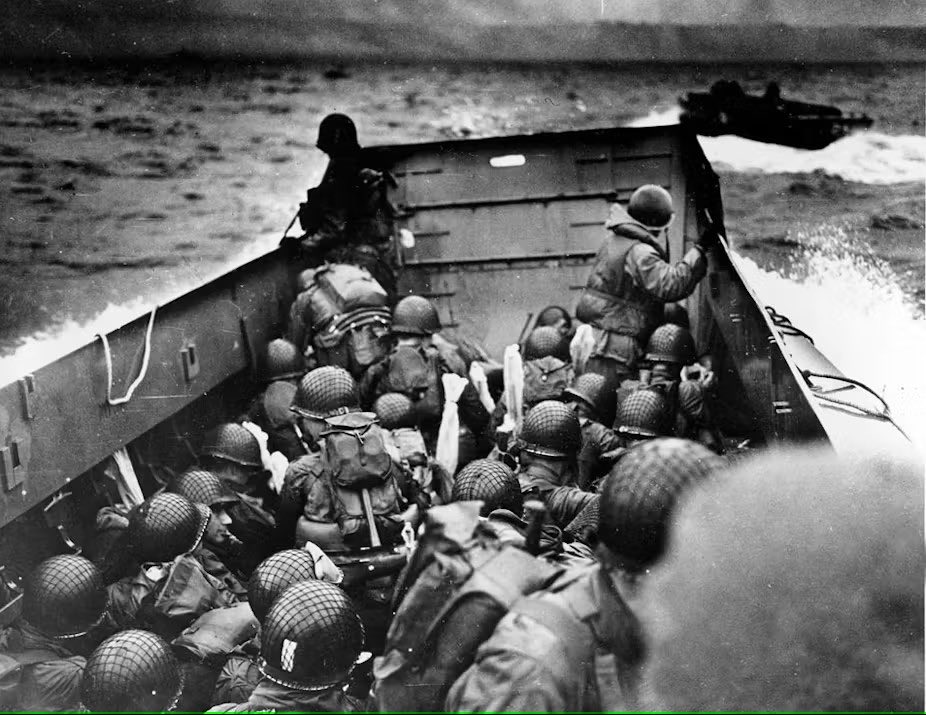
June 6th, 1944.
The English Channel is angry and half the men in the landing craft are seasick. Diesel fumes mix with saltwater and vomit while rifles are checked for the fifth or sixth time by hands that need something to do. Nobody talks much anymore because the jokes have all been told and the bravado has finally burned away somewhere behind the English coast.
You are nineteen years old and carrying more weight than you’ve ever carried in your life. You don’t know it yet, but it’s the most weight you will EVER carry in this life. However long or short it may be.
Your rifle rests across your knees. Your life hangs from a few pounds of steel, wood, and training. Somewhere beyond the gray horizon sits a continent that has spent five years tearing itself apart, and in a few minutes you are going to step into the middle of it.
Across from you sits another kid. He can’t be much older than you. His jaw is clenched. His knuckles are white around his weapon. Neither of you says a word because there is nothing left to say.
Then your eyes drift toward his shoulder.
That red numeral catches your eye: “1”.
You’ve seen it a thousand times before. In barracks hallways, on training fields, in motor pools, and on long marches. It never meant much beyond belonging to the same outfit.
Now it means everything.
Because in a few minutes the world is going to ask something terrible of both of you, and there is comfort in knowing that whatever waits on that beach, neither of you will face it alone.
The historians will eventually reduce this day to arrows on maps and casualty figures. Politicians will give speeches. Journalists will write books. None of that exists inside the landing craft.
What exists is fear, and duty.
What exists is the understanding that courage was never the absence of fear. Courage was always charging into the maelstrom anyway.
The shoreline emerges through the smoke. You can see flashes now. You can hear the distant percussion of artillery. Men stop checking their equipment because there is no point anymore. Whatever mistakes were made are already made. Whatever prayers were going to be said have already been said.
The coxswain throttles down.
The boat grinds forward.
The ramp is about to drop.
Into the abyss.
Overlord.