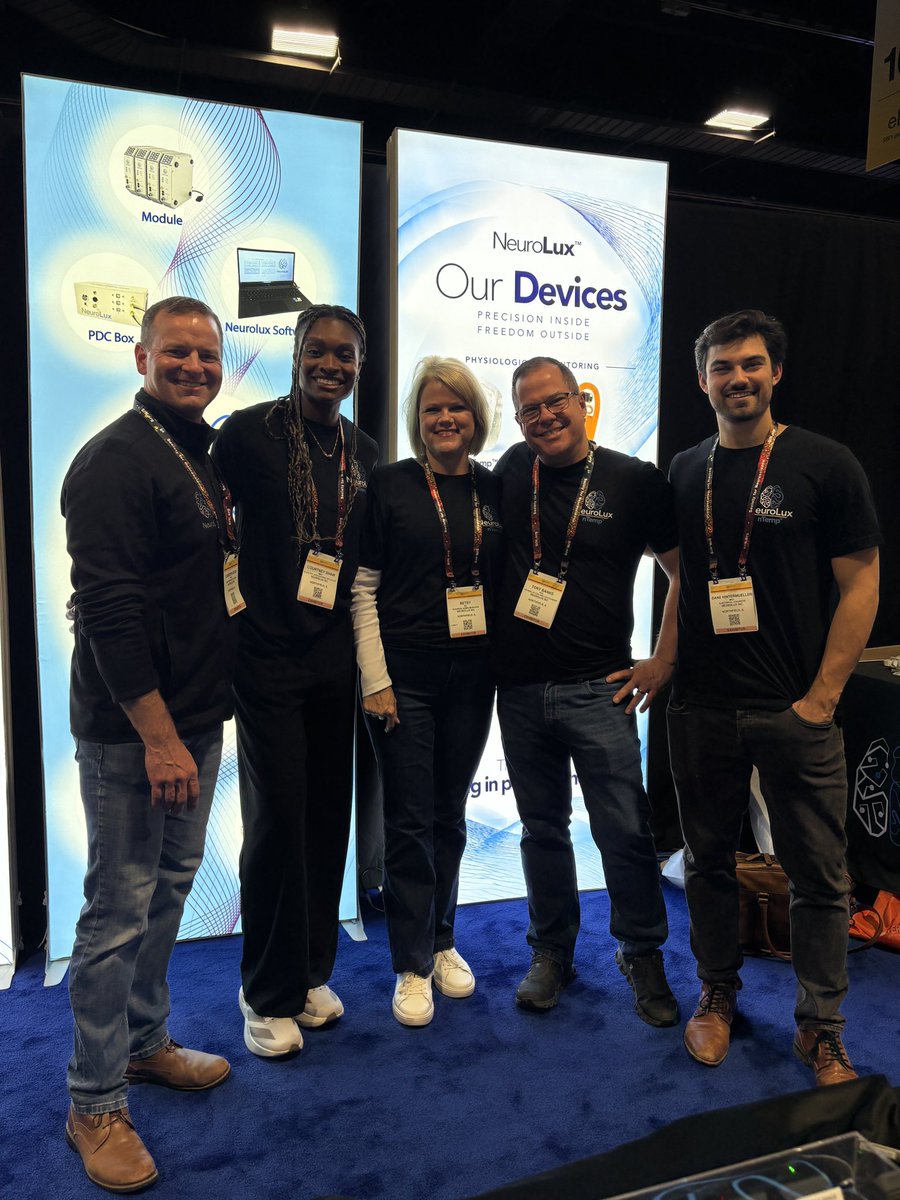
That’s a wrap, #SfN2026! 🧠✨
From unveiling nTemp™ to reconnecting with familiar faces and building new relationships, what an incredible week in D.C.!
Thank you to everyone who made it memorable. We’re just getting started! 💙
#NeuroLux#Neuroscience
We are looking for a Service Engineer (m/f/d) in Berlin to keep our research systems running at labs around the world. From installation and maintenance to on-site training and 24/7 support.
Hands-on technical background, happy to travel, ready for the next step?
Let's talk: https://t.co/ImA2hv2tOU
#TSESystems #FieldService #Servicetechniker #Berlin #Jobs
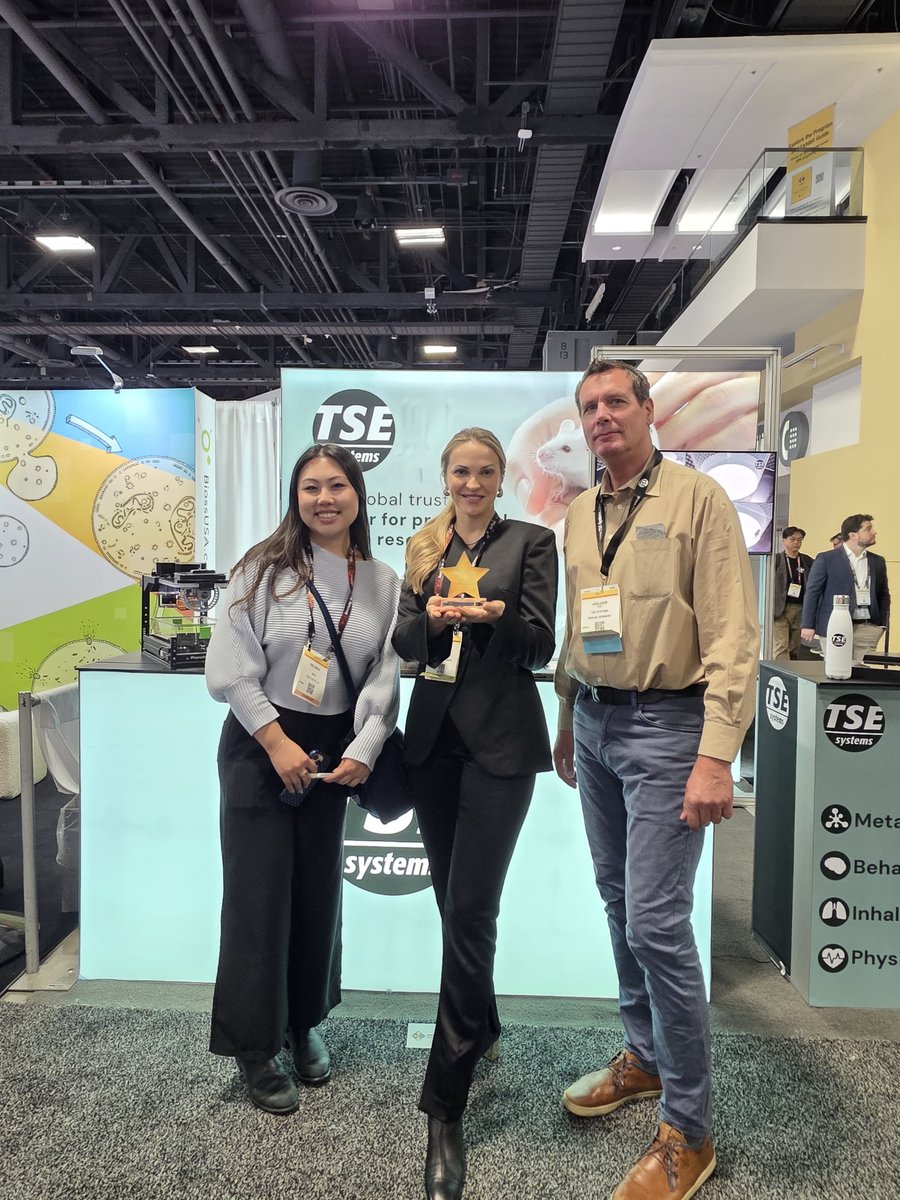
The Bioz team presented us with the 2026 Rapid Star™ Award for Animal Testing in person at #SfN2026. A great moment to share with our team and the scientific community.
As this recognition is built on citations, our biggest thank you goes to the researchers who rely on TSE Systems in their work. ⭐
Could not make it to SfN? We are happy to arrange a virtual demo of our systems.
Book a demo: https://t.co/AFdtfeqFRo
#PreclinicalResearch #Bioz #TSESystems
That is a wrap on @ObesityWeek! 🙌
Thank you to everyone who stopped by our booth to talk metabolic phenotyping, telemetry and behavior. Your questions and study ideas made this week a great one.
A highlight for us: the poster with our partners at Physiogenex, "Individual Metabolic Phenotyping Uncovers the Acute Effects of the GLP-1 Receptor Agonist Semaglutide in Hamsters Fed a Chow Diet or High Fat/Cholesterol/Fructose Diet." The data show acute effects of semaglutide on food and water intake, activity and respiratory exchange ratio, and support hamsters as a valuable translational model for metabolic research.
Thank you @Physiogenex and co-authors for a great collaboration, and to our team Daniela Oettler and Nicholas LeBlanc for representing TSE Systems.
Missed us? Send us a message, we would love to continue the conversation.
#ObesityWeek #Obesity #MetabolicResearch #GLP1 #PreclinicalResearch #TSESystems
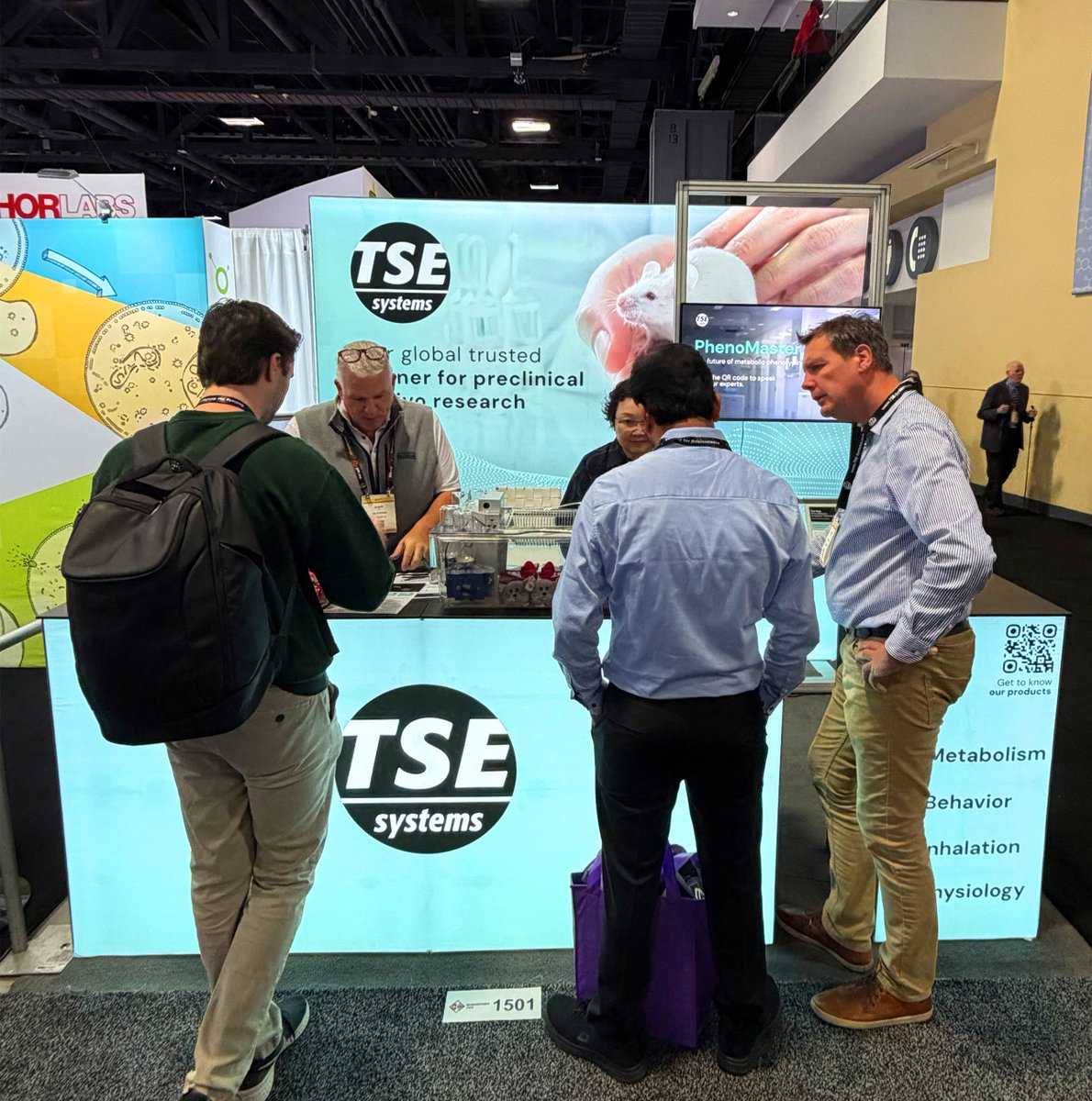
Day 1 at #SfN2026 and Booth #1501 was buzzing! 🎡 We have loved every conversation so far, from study design questions to fresh research ideas.
Still in Washington, D.C.? Stop by before Wednesday to:
🔍 See our products live
🗨️ Talk study design with our team
🎡 Take your own spin at the wheel
See you at Booth #1501! 👋
#Neuroscience #SfN2026 #BehavioralNeuroscience #Telemetry #TSESystems
Heading to #SfN26 in Washington, D.C.?
Take our Research Challenge at our booth #1501: pick your research area, answer five quick questions about your model, build your ideal setup, and get a recommendation from a TSE Systems expert.
Then spin the prize wheel for your chance to win. 🎁 New draw every day, 12:00–2:00 pm.
📅 Reserve your time slot: https://t.co/tSZonbcPuf
#SfN26 #PreclinicalResearch #Prize #Spinthewheel
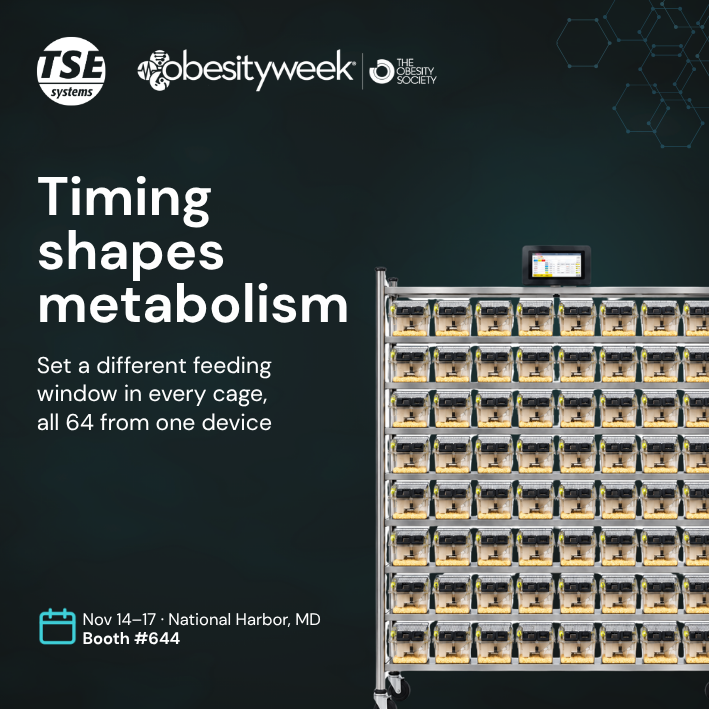
Many feeding and drinking systems ask your lab to adapt to them, with special cages, wired connections, and complex software.
Smart Waiter adapts to your lab instead.
🔹 Every cage gets its own smart unit, with a built-in door and scale to control access by time, amount, or both
🔹 Feeding and drinking modules, so food and water can each run on their own protocol
🔹 Fully wireless and battery-powered: no cables running across the rack, up to 2 weeks of uninterrupted operation
🔹 Fits the standard cages your facility already uses, and is fully autoclavable
🔹 One touchscreen runs up to 64 units, each with its own protocol, planned day by day
🔹 Check status, get alerts, and download data from any browser, even mid-experiment
The result is a cost-effective way to run large feeding and drinking studies, with every cage on its own schedule and one device managing the whole rack.
Come see it in person at Booth #644 at #ObesityWeek, Nov 14–17, National Harbor, MD.
#ObesityWeek2026 #MetabolicResearch #PreclinicalResearch #LabAutomation #SmartWaiter
What could a new generation of telemetry bring to your research? 💡
At SfN's Neuroscience 2026, we are excited to introduce Stellar Ti, the latest evolution of continuous telemetry technology.
Building on the established Stellar platform, Stellar Ti combines a more compact implant design, extended transmission range and greater flexibility for monitoring multiple animals.
And there is more to explore! Join us to discover what has changed, see the new system in action and find out how it could support your neuroscience research.
📍 Visit us at Booth #1501
📅 November 14–18, 2026
📍 Washington, D.C.
📅 Book your demo slot: https://t.co/DKGtTgnAlC
We look forward to seeing you there!
#SfN2026 #Neuroscience #NeuroscienceResearch #Telemetry #PreclinicalResearch #TSESystems
Washington, DC, here we come! TSE Systems is heading to ObesityWeek 2026.
Understanding obesity means looking at behavior, metabolism, and physiology together. Our systems help you capture all three, from metabolic phenotyping to food intake and activity monitoring, so you can connect what you see in the lab to what matters for therapy.
Stop by to meet our colleagues @DanielaOettler and Nicholas LeBlanc on-site and find out what we have been working on. We would love to hear about your research and talk through how we can support it.
📍 Booth #644
🗓️ November 14–17, 2026
📌 Washington, DC, USA
See you there!
#ObesityWeek2026 #ObesityWeek #Obesity #MetabolicResearch #MetabolicPhenotyping #RodentResearch #TSESystems
Most video tracking follows one point on the animal and provides only a handful of parameters, such as distance moved or time spent in a defined area. What about everything else the animal does?
3D-AI BehaviorAtlas uses AI-driven, markerless video tracking to follow the whole body. 4+ synchronized cameras reconstruct 16+ body points in 3D, frame by frame, delivering nearly 40 kinematic parameters.
Unsupervised machine learning then turns that movement into 40+ behavior subtypes, from rearing to grooming to sniffing, without predefined categories. So you can find behaviors you didn’t know to look for.
The AI framework behind it was published in @Nature Communications and has since been used in studies in Neuron and Cell Reports.
See AI behavior tracking live at booth #1501 at #SfN26.
📅 Book your demo slot at the booth: Contact Us: We're Here to Assist You - TSE Systems (https://t.co/OMuw0nEAaY)
#BehaviorAtlas #AI #3D #BehavioralNeuroscience #SfN26
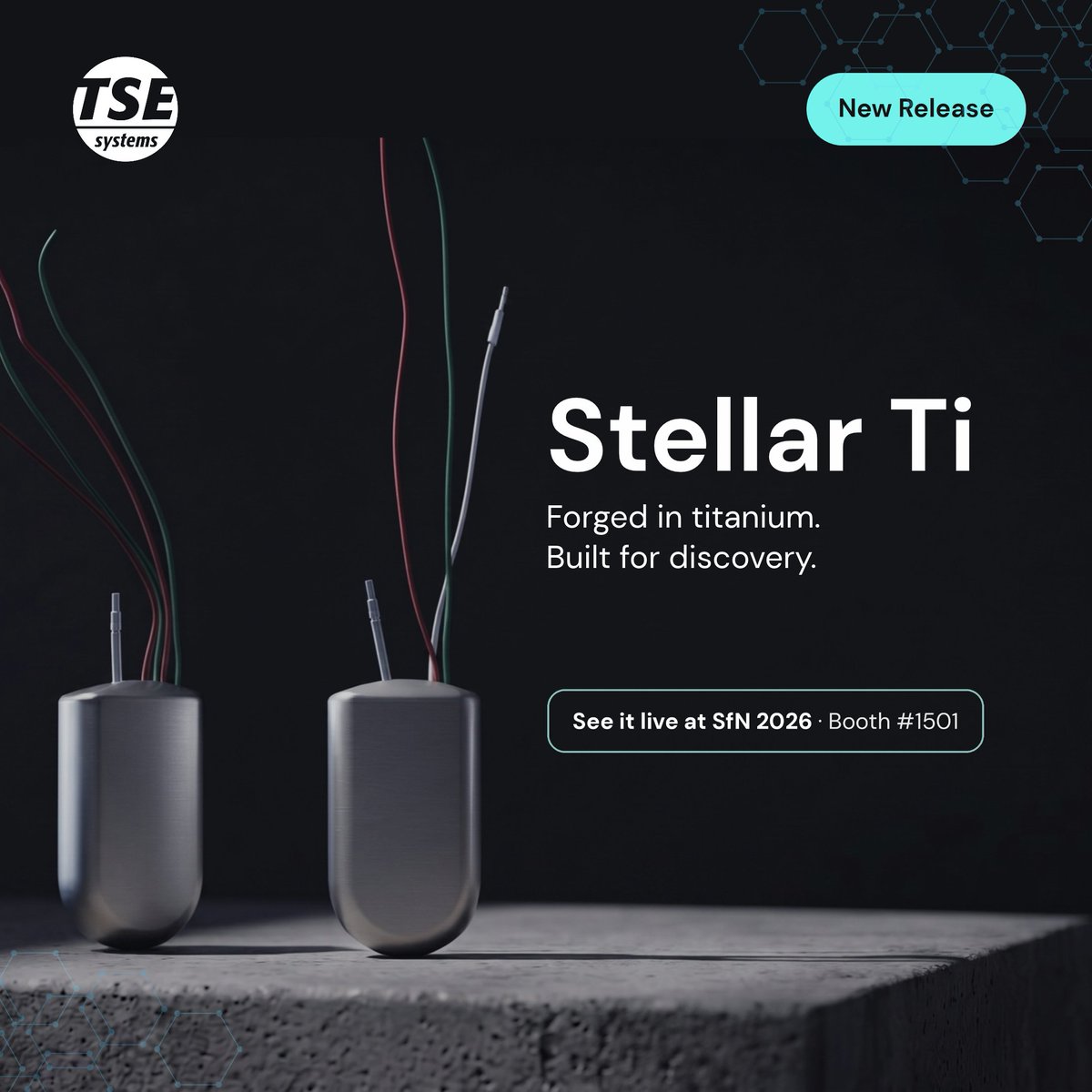
We are excited to introduce Stellar Ti, the next generation of Stellar continuous telemetry.
Built on more than 15 years of Stellar experience, Stellar Ti brings researchers:
🔹 Greater reliability, with titanium-sealed implants made to last
🔹 Longer transmission range
🔹 Longer battery life
🔹 Up to 16 animals on a single receiver
The result is less hardware, more freedom for your animals and more confidence in your data.
Want to see the implants up close? Visit us at #SfN26 in Washington, D.C., November 14–18, booth 1501.
Learn more: https://t.co/l79Yqz9lvW
#StellarTi #Telemetry #Neuroscience #PreclinicalResearch #TSESystems
What happens in your mouse room at 3 a.m.?
For mice, it’s prime time. Yet most behavioral tests run in daylight, one animal at a time, with a human in the loop.
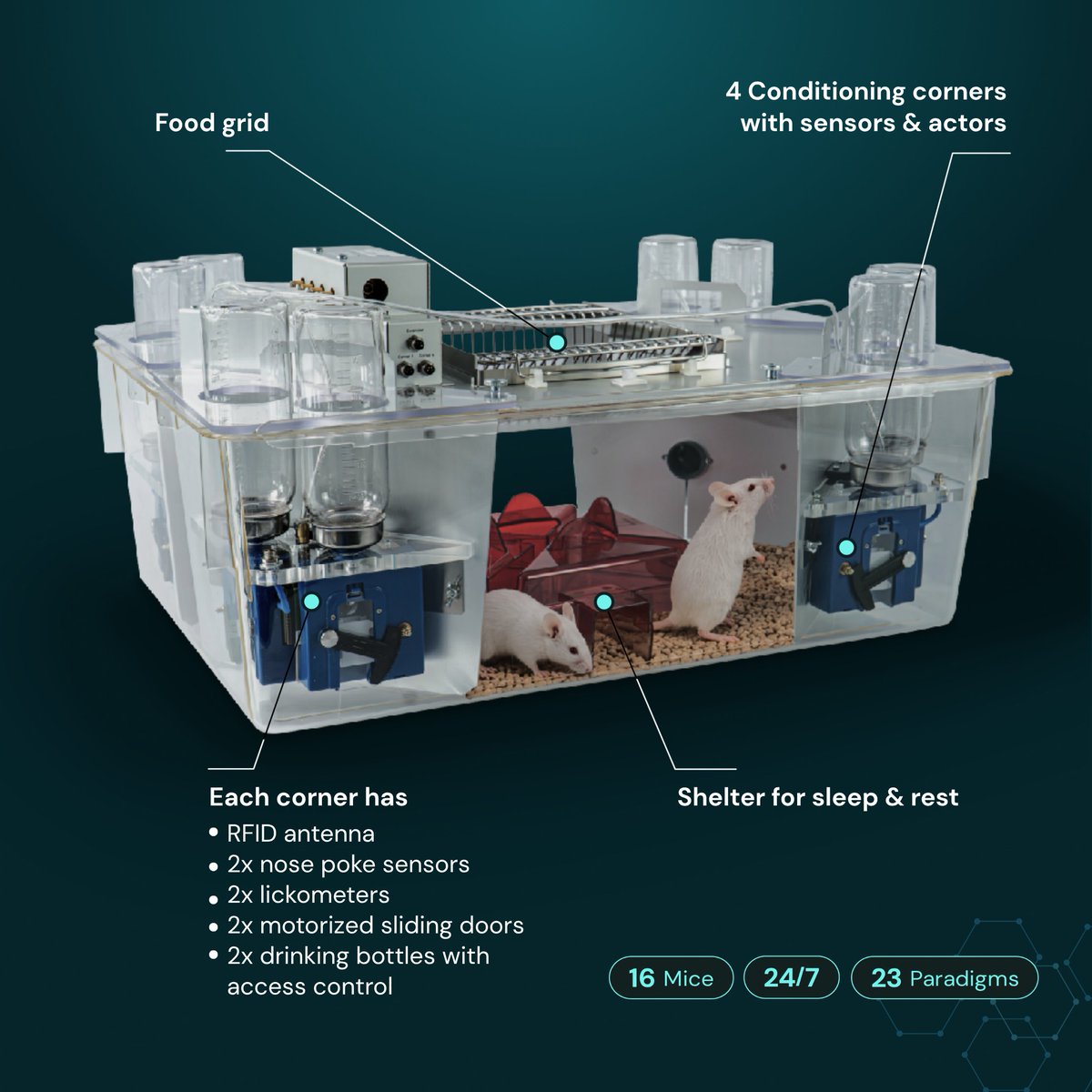
IntelliCage tests 24/7 up to 16 group-housed, not isolated mice in their home cage, day and night, for weeks, with no handling.
See IntelliCage live at our booth #1501 at #SfN26 and discover its full potential.
📅 Book your demo slot: https://t.co/r5RF23BYlO
Does your sucrose test make your mice depressed?
It sounds provocative, but for many labs it is a real question.
The sucrose preference test is one of the most widely used readouts of anhedonia, a core symptom of depression. To measure how much each mouse drinks from the water and sucrose bottles, the classic protocol houses animals alone.
It often adds water or food deprivation first, and tests in short sessions during the light phase. Social isolation is itself a stressor and can induce depressive-like behavior, so the test may change the very phenotype you want to measure.
There is another way.
In the IntelliCage home-cage system, up to 16 mice live together in one cage. Each mouse carries an RFID transponder, and every corner offers a choice between two bottles, for example water and sucrose. The system records which mouse visits, which bottle it chooses, and every single lick, 24/7.
What this means for your experiment:
- Individual sucrose preference, measured in group-housed mice
- No isolation, no deprivation, no handling during the test
- Continuous data through the dark phase, when mice are naturally active
- Time courses over days or weeks, not a single snapshot
Example: @IgorBranchi’s group recently followed anhedonia over three weeks of diazepam treatment in enriched vs. stressful conditions, showing how strongly the environment shapes treatment outcome (Poggini et al., Neuroscience 2026).
Keep your animals socially housed. Reduce experimental stress. Capture every lick.
https://t.co/K7tTF9Xebp