Why did our #PhD students choose TTIC? In our new video, hear our students discuss their #computerscience research, their community, and their experience at the institute: https://t.co/KFFLWgtQLx
Every Ph.D. student at TTIC is fully supported with a competitive stipend, equipment funds, and significant travel funding. Students typically serve as teaching assistants for only one or two quarters. Apply by Dec 9 (no application fee): https://t.co/0LwHTEByu4
This talk is from awhile back but might be newly relevant as more and more AI systems natively “see” the world as text and code.
I think of language as a camera. What kind of camera is it? What color space does it use? What’s its resolution?
(Was fun to visit TTIC!)
1/10 "Can we see language as alike to a camera?" asked Phillip Isola (@phillip_isola of @MIT). He explored this question in his talk at TTIC in Mar 2025. The answer depends on whether their "Platonic Representation Hypothesis" can be proven correct. Talk: https://t.co/N6Uq4EfUeq
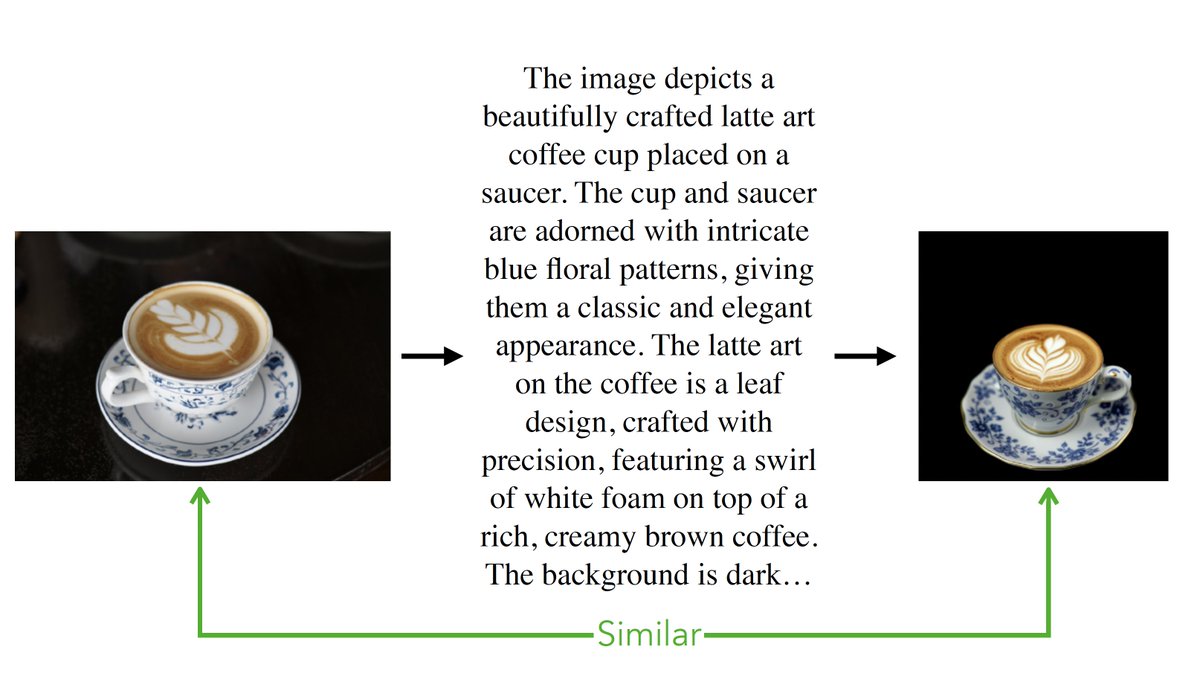
10/10 The score is used to train the image-to-text model to produce better captions. A short caption is analogous to a low-resolution image. A detailed caption contains enough information to reconstruct the original image to a remarkable degree. Paper: https://t.co/dTAAgnHVSx
1/10 "Can we see language as alike to a camera?" asked Phillip Isola (@phillip_isola of @MIT). He explored this question in his talk at TTIC in Mar 2025. The answer depends on whether their "Platonic Representation Hypothesis" can be proven correct. Talk: https://t.co/N6Uq4EfUeq
9/10 Moreover, image-to-text models can be trained to be better cameras. To start with, given an image, such a model generates a caption. A text-to-image model turns the caption back into an image, and a (dis-)similarity score is calculated for the original and reconstruction.
TTIC is on the University of Chicago's campus, and our Ph.D. students enjoy full access to UofC's courses, campus, facilities & resources. Learn more about our Ph.D. program in #computerscience and apply (FREE) by Dec 9: https://t.co/Jr6IPPS3rq
Thank you to Hyde Park Academy students who participated in TTIC student Marcelo Beramendi Caballero's presentation and activities session on AI! Learn more about our community outreach and partnerships: https://t.co/jAIDrgBTLM
Join a fully-funded, highly active research environment with a 4:1 faculty-to-student ratio, strong mentorship, and access to the University of Chicago campus and facilities. Learn more about our Ph.D. program in #computerscience and apply (FREE) by Dec 9: https://t.co/0LwHTEByu4
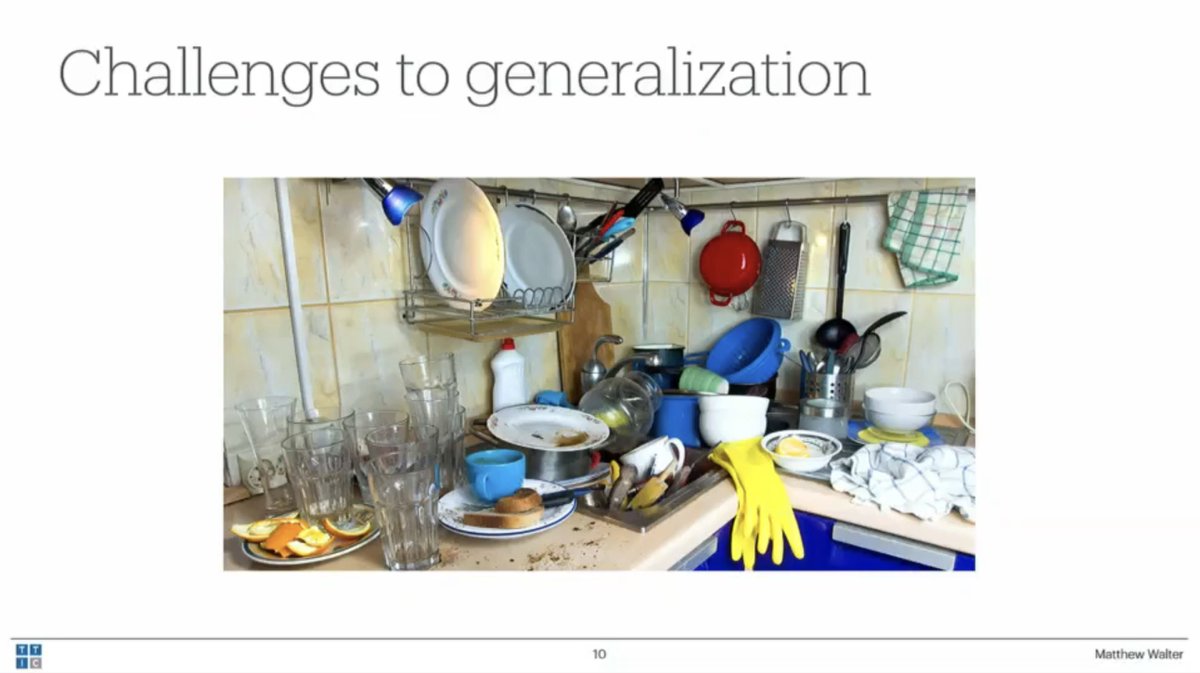
6/6 "The challenge with both of these settings is that our environment doesn't look nearly as clean, and it's structure is not nearly as uniform, as the ones in which [the policies are trained]," said TTIC's Matthew Walter.
1/6 "We want a robot that doesn’t only work in factory settings, [but] ideally would work in our homes," said TTIC's Matthew Walter, in his talk on "Learning from Visual Experience: Toward Generalizable Robot Manipulation." Video: https://t.co/lXaO4Qet5u
5/6 The second dominant approaches uses reinforcement learning (RL). In RL, "we don't need demonstrations, but instead we need some reward specification," said TTIC's Matthew Walter.