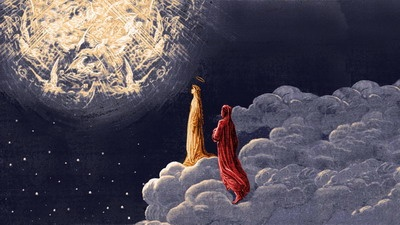
By God, I feel so much love that it seems as though the skies would be rent asunder, the stars fall and the mountains move away if I burdened them with it: such is my experience of love.
—Ibn ʿArabī in his Futūḥāt, trsln. Claude Attas via trsln. Cecilia Twinch
@_M_1711 Ws. Difficult to advise, I've cited lots of books/articles over the years (both which I agree and disagree with). Happy to provide some suggestions on focused topic(s) if wanted?
1 Corr 4:7 (KJV):...what hast thou that thou didst not receive? now if thou didst receive it, why dost thou glory, as if thou hadst not received it?
—O mankind! Ye are the poor in your relation to Allah. And Allah! He is the Absolute, the Owner of Praise.
(Q 35:15; Pickthall)
maker. They have no essence in themselves except that they are related to the First Truth and dependent on It as God the Exalted said: 𝘎𝘰𝘥 𝘪𝘴 𝘳𝘪𝘤𝘩 𝘢𝘯𝘥 𝘺𝘰𝘶 𝘢𝘳𝘦 𝘱𝘰𝘰𝘳.(Q 47:38)
Know my brothers, that the Real—transcendent & most high—is pure being, and that being has no shape or limit. Despite this, it appears and reveals itself through both shape and limit, though its intrinsic shaplessness and limitlessness does not change
al-Burhanpuri (d.1028/1619)
Republic 509A6-10—And so, in the case of things that are known, we should say that not only their being known is present to them owing to the Good, but that their existence and essence is present to them owing to the Good as well, even though the Good is not essence itself,
al-Futuḥāt al-Makkiyya: [t]he intellects indeed have a limit at which they reach a standstill insofar as they are reflective (min ḥaythu huwa mutafakkir), but not insofar as they are receptive (qābil).
Ibn Sīnā: The wisdom of the Peripatetics is a purely discursive (bahthiyya) one, but, in such issues, the truth is established through combining discourse (bahth) and theoretical inquiry (nazar) with unveiling (kashf) and tasting (dhawq). And the wisdom which includes all of
Abū Yazīd al-Bisṭāmī to the exoteric scholars: You have taken your knowledge from one dead person to another, whereas we have taken our knowledge from the 𝘖𝘯𝘦 𝘸𝘩𝘰 𝘪𝘴 𝘌𝘷𝘦𝘳 𝘓𝘪𝘷𝘪𝘯𝘨 𝘢𝘯𝘥 𝘸𝘩𝘰 𝘴𝘩𝘢𝘭𝘭 𝘯𝘦𝘷𝘦𝘳 𝘥𝘪𝘦 (25:58)
Ghazali — Knowledge is above faith, and tasting is above knowledge because tasting is finding, but knowing is a drawing of analogies, and having faith is a mere acceptance through imitation
...the supreme reward of the Divine Law is the law itself, namely, to know God and to love him in true freedom with all our heart and mind. The penalty it imposes is the deprivation of these things and bondage to the flesh, that is, an inconstant and irresolute spirit. ~Spinoza
We clearly understand how far they stray from the true valuation of virtue, who expect to be honoured by God with the greatest rewards for their virtue and best actions...as if virtue itself, and the service of God, were not happiness itself, and the greatest freedom.
(Spinoza)
Why I say truly, as long as you do works for the sake of heaven or God or eternal bliss, from with-out, you are at fault. It may pass muster, but it is not the best.
(Eckhart)
All things are returned to it as their own goal. All things desire it: Everything with mind and reason seeks to know it, everything sentient yearns to perceive it, everything lacking perception has a living and instinctive longing for it, and everything lifeless
Oh dervish! You must not put your trust in this world or this world's comfort, and you should not put your trust in the life or veracity of fortune or fame. Everything under the sphere of the moon and the stars, does not keep its original state. It will certainly change, in other
"This is the whole of our metaphysics: it is about emanation, exemplarity, and consummation; that is, to be illumined by spiritual rays and to be led back to the Supreme ."
- St. Bonaventure (In Hex. I.17)
DBH: Reason abhors a dualism. Any ultimate ground of explanation must be one that unites all dimensions of being in a simpler, more conceptually parsimonious principle.
https://t.co/nNO5RrA4kj
Guenon: The principal unity demands in effect that there can be no irreducible oppositions; therefore while it is true that opposition between two terms can exist in appearance and posses a relative reality at a certain level of existence, this opposition must disappear as