Getting into IT shouldn’t feel confusing.
Yet many people who want to learn an IT skill feel overwhelmed — by too much information, too many tools, and unrealistic promises.
Here’s the simple truth 👇
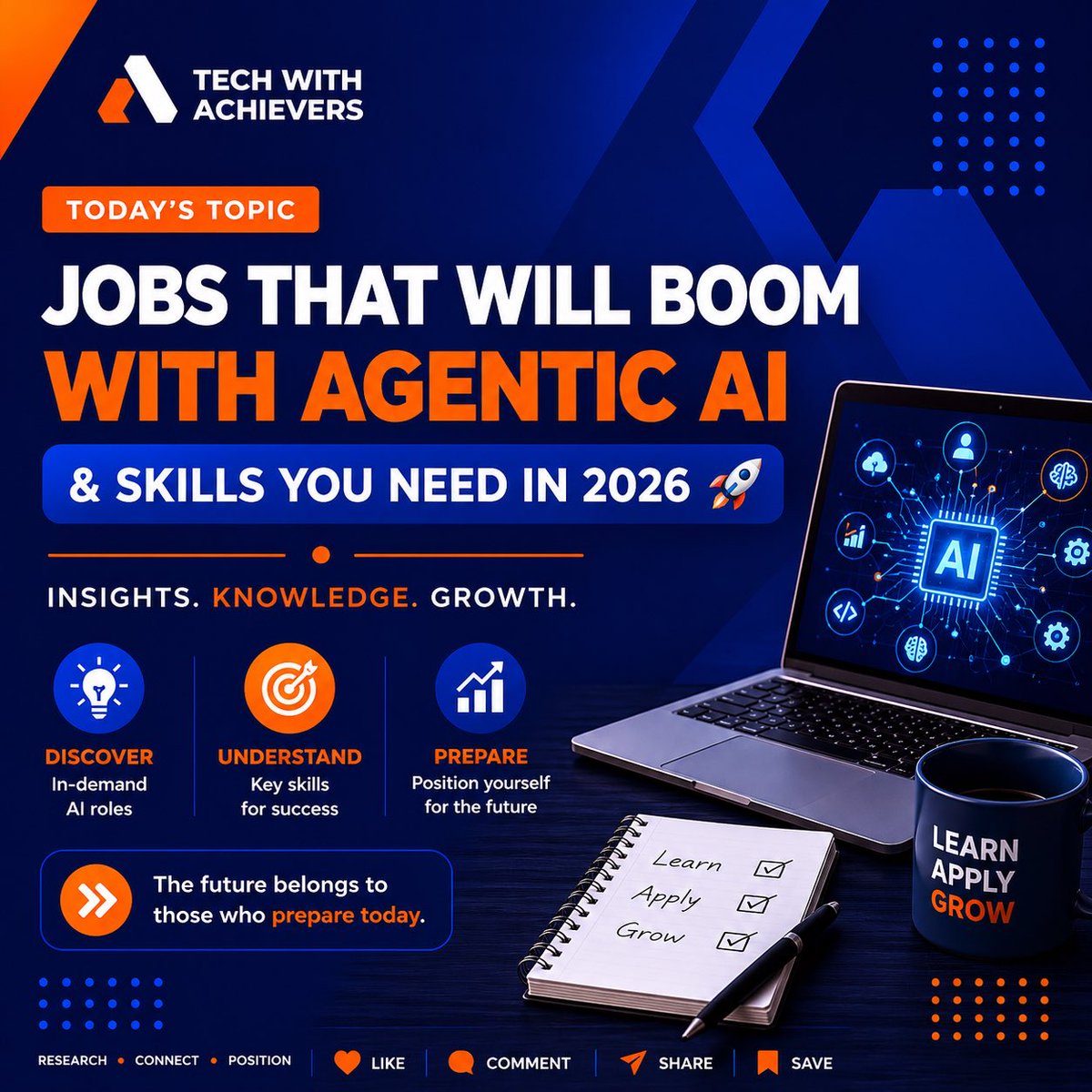
🚀 Jobs That Will Boom with Agentic AI in 2026
The next generation of tech professionals won’t compete with AI systems.
They’ll learn how to work with them.
Businesses are rapidly adopting AI agents to automate workflows, decision-making, operations, and customer experiences.
The biggest opportunity in AI may not be building models, but learning how to orchestrate, manage, and work alongside intelligent systems effectively.
This isn't something to watch.
It's something to prepare for.
Here are 8 roles expected to see massive demand:
🔹 AI Agent Developer: Builds and integrates AI agents capable of performing tasks, automating workflows, and interacting with tools and systems.
Skills: Python, APIs, LLM integration, orchestration frameworks
🔹 AI Agent Architect: Designs the structure, behavior, security, and governance systems behind scalable AI agent ecosystems.
Skills: System design, AI safety, tool governance, workflow architecture
🔹 AI Orchestrator / Workflow Designer: Creates intelligent workflows that coordinate AI systems, automations, tools, and human interactions efficiently.
Skills: Prompt engineering, systems thinking, automation logic
🔹 AI Implementation Specialist: Helps businesses deploy and integrate AI solutions into real operational environments and business processes.
Skills: RAG pipelines, vector databases, deployment workflows
🔹 Agentic AI Engineer (Infra + Ops): Manages the infrastructure, monitoring, reliability, and operational performance of AI systems at scale.
Skills: DevOps, observability, cloud infrastructure, agent monitoring
🔹 Human-in-the-Loop Analyst: Ensures AI systems remain accurate, ethical, reliable, and aligned with human judgment and business expectations.
Skills: Verification, evaluation, critical thinking, quality assurance
🔹 AI Trainer / Data Specialist: Improves AI performance through data preparation, feedback systems, testing, and evaluation processes.
Skills: Evaluation frameworks, feedback loops, data quality management
🔹 AI Product Manager: Bridges AI technology with business goals by leading AI-driven products, adoption strategies, and execution.
Skills: AI literacy, business strategy, risk management, stakeholder communication
If you’re just getting started, focus on understanding how AI systems and workflows actually work.
If you already work in tech, the next level is learning how to manage, coordinate, and work alongside intelligent systems effectively.
2025 was the year of AI tools.
2026 will be the year of AI agents and the people who know how to work with them.
Which of these AI roles interests you the most and why 🤔?
Let us know in the comments 👇
Over the next few days and weeks, we’ll be doing deep dives into these roles, the skills required, and how you can position yourself for opportunities in these fast-growing areas of tech.
🔐 STILL THINKING ABOUT IT? HERE'S YOUR REMINDER.
Our 6-month Cybersecurity Bootcamp (June 2026) is filling up fast.
Beginner → Job-ready. No experience required.
Enugu is gradually becoming home to more young professionals building careers in tech.
If you’ve been looking for a structured way to enter cybersecurity, this could be your opportunity.
Applications are open for our 6-Month Physical Cybersecurity Bootcamp.
Everything connects:
Day 1 list → Day 2 research → Day 3 connections → Day 4 projects
This is how positioning becomes results.
Next up: How to showcase your work so it gets seen.
How to build projects that get noticed 🧵
We've been building something this week: strategic positioning instead of random applications.
Day 1: Target list
Day 2: Research
Day 3: Connections
Now it all connects 👇
Your action plan today:
Pick 1 company from your list.
1. Review your Day 2 research
2. Find 1 problem they mentioned
3. Sketch a solution
4. Build it this weekend
5. Share next week and tag your Day 3 connections
Start small. Build strategically.
Your action today:
Pick 5 people from your target companies.
1. Follow them on LinkedIn/X
2. Read their 3 recent posts
3. Leave 2 thoughtful comments
4. Do this for 1-2 weeks
Then send personalized connection requests.
Day 4 tomorrow: How to build projects that get noticed.
How to connect without being annoying 🧵
"Hi, any job openings?"
This message gets ignored 100% of the time.
Here's why your connection requests fail (and what to do instead) 👇
Bad connection message:
"Hi, can you refer me to your company?"
See the difference?
When you add value first, you're not a stranger asking for favors.
You're someone they recognize. Someone who's been contributing.