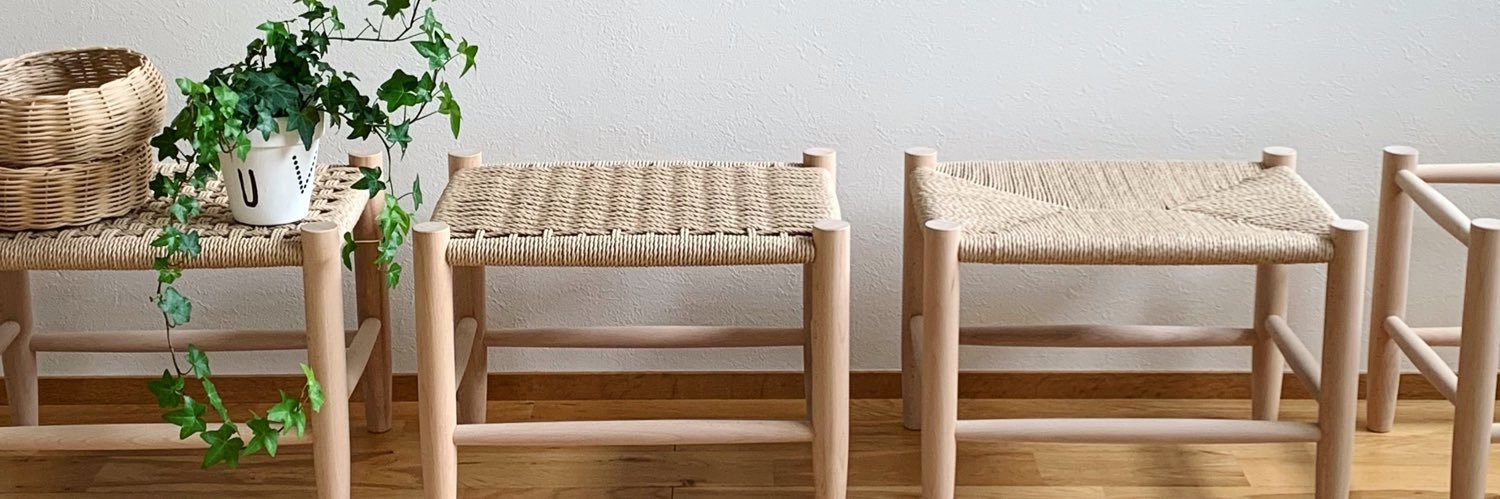
came up with this method to accurately cut a mortise and tenon into round dowels and join them together.
Unlike a dowel joint, all of the machining references are perpendicular surfaces, making alignment easier and reducing the chance of error. It also creates a stronger joint than a typical dowel connection.
Material: Beech
By using magnets as the hinge pins, I created a removable wooden hinge.
As with my previous designs, the back remains perfectly flush, giving it a clean and refined appearance.
The magnets turned out to be surprisingly strong, providing more holding power than I expected and functioning very well in practice.
Wood: Pine and walnut.
I wondered if wedges could be applied to a cross joint, so I came up with this design.
As the wedges are driven in, the internal tenons expand and lock the joint in place.
Material: Pine & Walnut
The thread angle was approximately 2°.
Surprisingly, no guide pin was needed.
Chamfering it as shown in the video gives it a more authentic bolt-and-nut appearance.
Wooden Bolt & Nut (M33)
Wood: African Mahogany
Even without making a jig, you can create a temporary template using CA glue and masking tape, allowing this type of machining to be done with high accuracy 👍
In fact, when routing end grain, the cutting resistance is very low, making the operation remarkably smooth.
Wood: Pine
Dowels: Walnut
I tried to build a wood lathe with the simplest design possible using a drill.
The only special parts are a bearing and a bolt, and it can probably be built in about 30 minutes 👍
The final project was a peg, but I'll share that video another time.
Bolt: M8
Just a wooden block… until you press it.
This hidden coat hook was carved from a single block of wood, so the grain continues through the entire mechanism.
Material: African Mahogany
A relatively simple way to join 3 pieces of wood.
In this video, I mainly used a miter saw for the cuts and finished it with some trimming using a router.
It reminded me how accurate machine work can be 👍
Wood: Zelkova