@edster994@AFCWimbledon Hi mate. Are you just looking for a single one? I bought two but couldn't get seats together, so likely going to have one going spare!
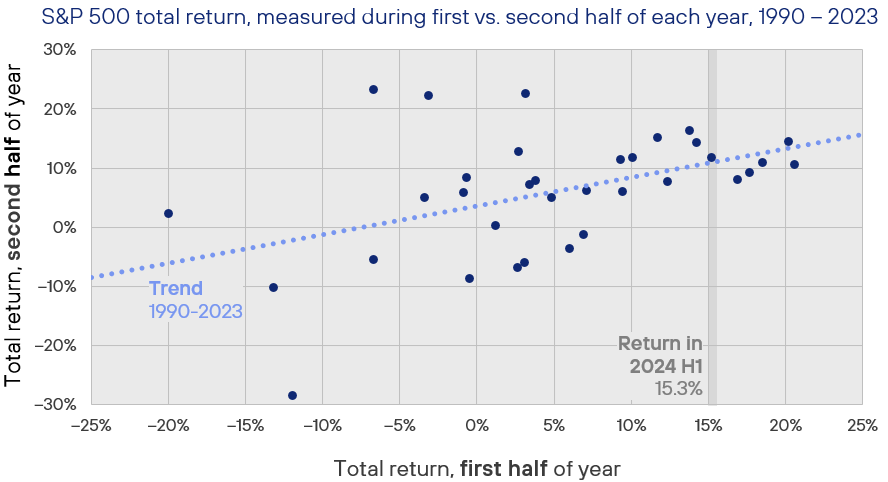
...in years with positive performance in the first two quarters. Investors will be hoping this year plays out like 2021, whose H1 return was nearly identical to this year’s, and whose second half brought another 11%.7% of upside.
Does that tell us anything about likely performance over the next six months? Going back to 1990—a small sample, to be sure—there’s at least a hint that US equities could be in for good times in the second half, with the S&P 500 tending to do better from July through December...
It was a stellar first half of 2024 for US stocks, with shares in the S&P 500 climbing just over 15% year-to-date, through the end of June, making thirty-one new record closing highs along the way: half a dozen more than the average number posted over the last fifteen full years.
Indeed, through the end of June, Mag 7 stocks have meaningfully outpaced the remaining 493 names in the S&P 500, adding 32.8% in the first half, versus a still-very-respectable 8.3% for those hundreds of ‘also-ran’ listings.
Driven by a resurgence of enthusiasm for the AI mega trend captivating investors since ChatGPT arrived in late 2022—not to mention a continuation of Nvidia’s stellar financial outperformance—shares in big tech have registered disproportionate gains year-to-date.
While a broad set of US stocks participated in the market’s first-quarter rally, we witnessed that breadth give way in Q2 to gains much more concentrated in a handful of stocks: the usual suspects in the ‘Magnificent 7’, for example, five of which scored double-digit gains in H1.
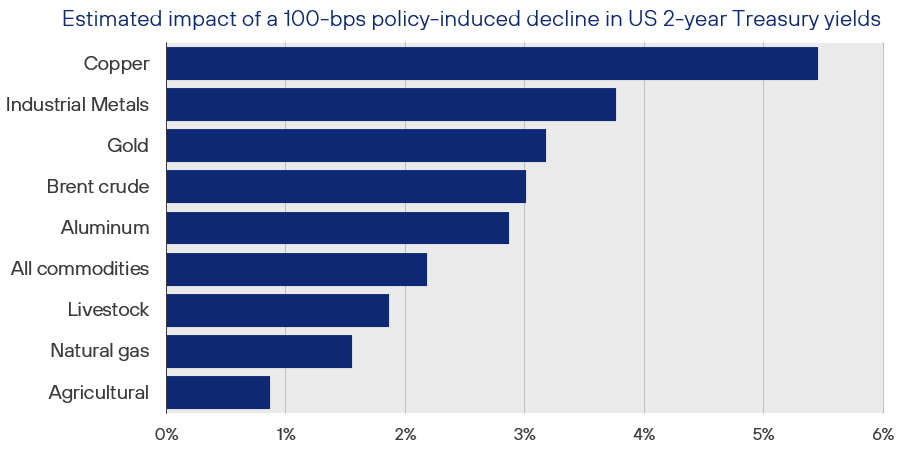
Although investors’ hopes of plentiful rate cuts and a swift start to easing soured over the course of the year, we suspect that the recent easing will provide a nice boost to global manufacturing and the commodities that power industrial production around the world.
A nice bit of analysis by Goldman Sachs earlier this year estimated the price impact of a 100-bps drop in yield on US Treasuries, assuming no recession, based on data from past Fed policy cycles.
Consistent with our thinking on the benefits of cuts, they found that though a diversified commodity basket would likely perform well, the biggest gains would be in industrial metals: the sector which happened to contribute most to commodities’ positive Q2 return.
Indeed, a FTSE NAREIT index tracking US real estate investment trusts has traced an approximate mirror image of moves in 10-year US Treasury yields for much of the last decade.
The period from the beginning of the pandemic to the onset of Fed tightening was an exception, as REITs clawed their way back from a COVID drawdown at the same time bonds priced in concern about the end of easy Fed policy and, eventually, the impact of growing price pressures.
This plot says little about improving REIT fundamentals over the last few years, but it does explain why we expect eventual cuts to lift their valuations.
In his latest piece for @Citywire, our CIO, Ben Ashby, reflects on what 2024 may have in store for Investment Managers and the adaption of AI into their investment processes.
https://t.co/7i5woCpF13
Rachel Reeves arrived in London 3 months ago. Like some sort of financial Mary Poppins, she just had to click her fingers and she could fix public services and boost the economy all without raising taxes.
https://t.co/AaLBlbEUe6
A pleasure to have representatives from @TheSCT join our recent Investor Lunch and to hear how they have supported over 80,000 families over the last 42 years. https://t.co/VS5EBFIvqG
https://t.co/7kFKfMtQVM
"The beauty of diversification is it's about as close as you can get to a free lunch in investing" Barry Ritholtz Our Director, Dr Jason Hsu, has written an excellent article on the investment case for Japan, one of the world's most undervalued markets
https://t.co/XG8ZsjsI9x
Rachel Reeves arrived in London 3 months ago. Like some sort of financial Mary Poppins, she just had to click her fingers and she could fix public services and boost the economy all without raising taxes.
https://t.co/AaLBlbEmoy