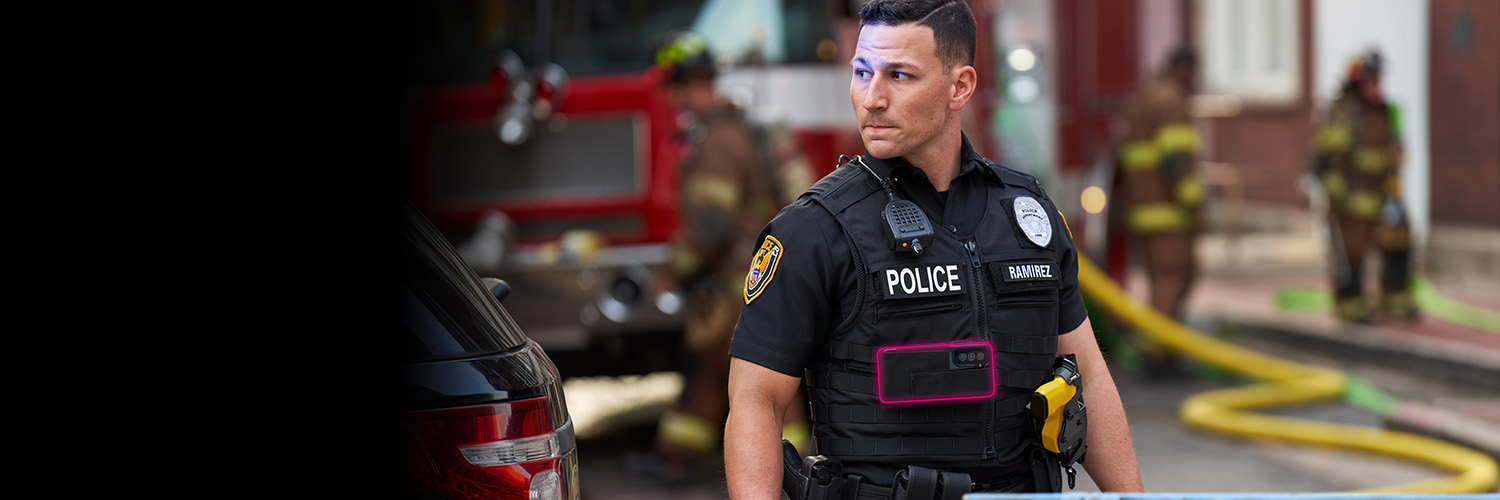
Connection loss breaks coordination.
T-Priority is designed to prevent that.
With satellite-enabled connectivity and Motorola Solutions’ APX NEXT in the field, communication holds through changing conditions.
Operational continuity depends on it. https://t.co/wK9B3DN4BI
Public safety operations don’t stop after major incidents.
Neither should the support behind them.
National Safety Month is a reminder of why T-Priority was built with priority network access and year-round support for public safety. https://t.co/qvTqjgb1ZZ
Surge events put pressure on more than voice traffic.
T-Priority prioritizes both voice and responder data to help keep dispatch and coordination systems moving.
Because response doesn’t slow down when demand spikes.
https://t.co/W6ZOOhbbW2
If security starts after connection, you’re already exposed.
When a device connects, untrusted data can reach your systems before control is established.
T-Priority starts authentication at the SIM — before access.
https://t.co/VnHl7op0bI
EMS is measured in minutes.
The job doesn’t pause between calls.
The next call arrives before the last one is complete. Information changes in motion.
This #EMSWeek—we recognize the work that never makes it into the report.
At the end of Police Week, the names are still here.
Former officer Pamela Barnum reflects on what it means to witness this community — and the responsibility that doesn't leave when the week ends.
Behind every name on the wall is a life still carried by someone. During Police Week, survivors and families return to remember and reconnect. Alongside @nationalcops, former Ofc. Pamela Barnum listened to the stories they continue carrying forward. Some stories stay with you.
Each rider arrives carrying a name, a memory, and a reason for coming back.
The Unity Tour brings riders to D.C. during Police Week to honor those they've lost and to find the community that keeps showing up for them.
Former officer Pamela Barnum is on the ground listening.
Most people see the Memorial. The CEO of @NLEOMF sees what others miss.
Bill Alexander joins Pamela Barnum to share what this space really holds — and why people keep coming back.
Every May, Washington, D.C. becomes the center of the public safety world.
This week, we're walking alongside former officer and federal prosecutor Pamela Barnum — listening to the voices behind the names.
We are not here to cover Police Week. We are here to honor it.
Under surge, the first point of failure is intake.
That’s where delays begin—and response is most exposed.
T-Priority helps keep public safety traffic moving under load.
Engineer your network to hold under peak demand.
https://t.co/o3svKTuDAU
Most people see the call.
You live everything around it.
Before. During. After.
Then you do it again.
International Firefighters’ Day reminds us:
This isn’t just what you do. It’s how you live.
Critical communications shouldn’t have to compete.
But on shared networks, they do—and performance breaks down.
T-Priority enforces how traffic moves so responder communications go first—even at capacity.
https://t.co/D290z5TsY0
First in line doesn’t mean you get through.
When networks are full, priority isn’t enough.
Preemption creates the space critical comms need to move under pressure.
That’s what T-Priority is built for. https://t.co/D290z5TsY0
VPNs weren’t built for movement. Response depends on it.
When units move, tunnel-based connections introduce delay—slowing coordination.
T-Priority with T-SIMsecure keeps access live without tunnel dependency.
Built for the field. https://t.co/VnHl7op0bI
Real-time data matters only if it shows up on time.
Spokane County Sheriff’s Office built around that reality—making connectivity part of the response.
Not just infrastructure.
The result: faster decisions, fewer delays, and operations that keep moving.
See how: https://t.co/hlsE8WdlgC
Ransomware breaks systems when it spreads.
That’s when CAD fails. Mapping drops. Field comms go down.
T-Priority isolates compromised devices at the network level—containing the threat before it disrupts critical systems.
See how containment keeps operations running.
https://t.co/DLD6qRANIr
Organ recovery doesn’t wait for the network.
When congestion hits, standard traffic competes—and delays follow.
Mid-America Transplant relies on T-Priority for priority access, so communication holds under load.
Read more: https://t.co/iobNHkyvMo
The first decision in every emergency belongs to a 911 telecommunicator.
Recognizing the voices behind the call during National Public Safety Telecommunications Week — the response starts with you. #NPSTW