A ROBOT BRAIN FOR $3 AN HOUR?
Dream Labs just unveiled Dream-1 — an AI model designed to control robots it has never seen before.
The company also announced a $90M seed round.
The $3/hour figure is for access to the AI model, not the full cost of operating a robot.
But here's the bigger question:
What happens when robot intelligence becomes a service anyone can rent?
Physical AI could be the next massive platform shift.
Why are you still paying more for inference?
DeepSeek just open-sourced DeepInfer, the production stack behind V4.1-Flash. Not a demo, the real thing.
Expect a wave of cheap hosting built on it. 🐋
🚀 Introducing DeepInfer, our in-house inference framework, now fully open source!
Powering DeepSeek-V4.1-Flash at scale with high throughput and low latency. We’re sharing our production stack to help the community lower compute costs, reduce energy use, and make AI more affordable.
🔗 https://t.co/JGAik1kgk0
1/4
Multi-agent systems have one real UX problem: you can't see who started whom, who failed, and what it cost.
Sketch of how I'd show it:
→ one orchestrator on top
→ every sub-agent as a node under the one that spawned it
→ status, cost, and time on each card
→ failed agent turns red, retry spawns a new branch
Live total in the corner. No more guessing where the $4 went.
Would you add anything to the card?
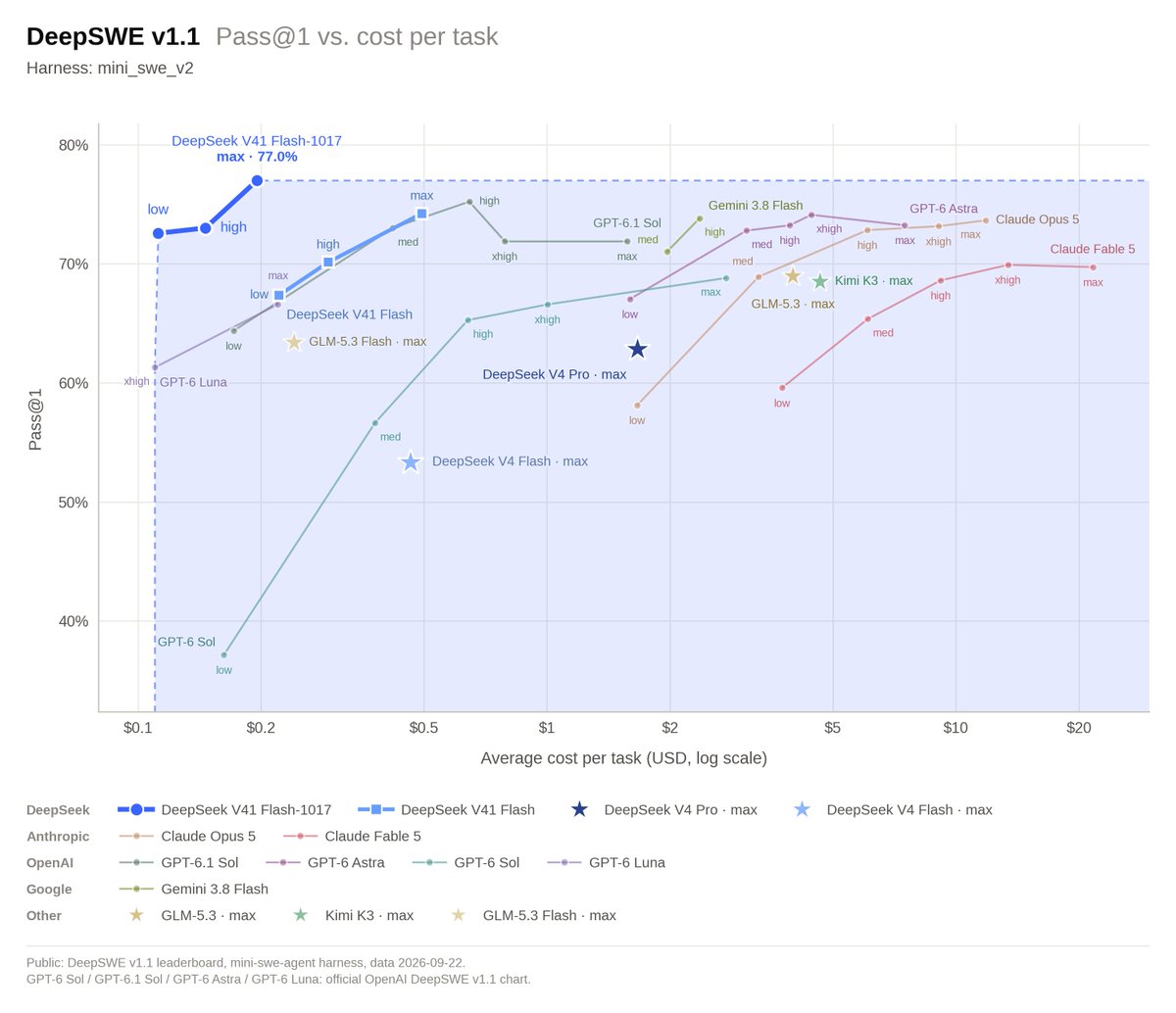
DeepSeek just made Claude and GPT look expensive.
V4.1-Flash-1017 is out — and this isn’t just another update. The model is stronger on benchmarks, completes tasks faster, and produces shorter outputs. The price stayed the same.
It’s a direct improvement in the performance-to-cost ratio. Agents and coding now cost less while delivering better results. It’s already available via API, in the app, and on the website, with open weights.
While closed models keep raising prices and limiting access, DeepSeek once again shows that open-source can be both more powerful and more cost-effective at the same time.
Closed models are left behind again.
🚀 DeepSeek-V4.1-Flash-1017 is here!
Stronger benchmark performance, faster task completion, and shorter outputs than the previous version—a Pareto improvement in performance and cost. Now live on our website, app, and API.
🛠️ Optimized for @DeepSeekHarness, Tencent CodeBuddy, WorkBuddy, and more. Upgrade to DeepSeek Harness v0.2.1-rc.1 or later for the best experience with the new model.
1/4
AI has already fired more than a 100 thousand people. And this is only the beginning.
Not long ago it was just helping. Now it’s taking over entire chunks of work that used to require a person — and doing them faster, with fewer mistakes, and cheaper.
Companies see this and don’t really hesitate. Where the system can handle the task, people get cut. Not out of malice, but because it’s more profitable.
This is no longer “somewhere in tech, someday.” It’s happening in different places right now, and the pace is only increasing.
There will be more layoffs ahead. Not because someone wants to scare people, but because businesses choose what works better.
There’s still time to prepare. Later there will be less of it.
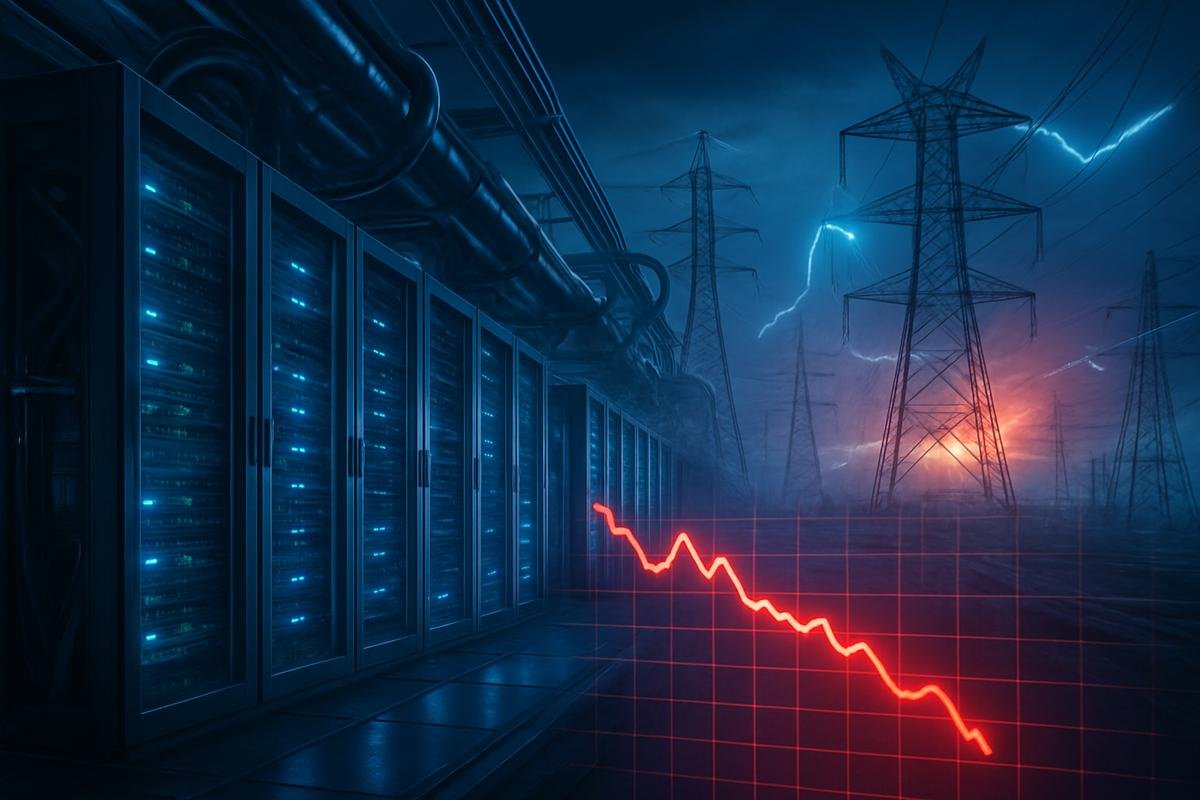
THE $10 TRILLION AI BOOM IS STARTING TO CRACK.
47 major U.S. data center projects delayed, canceled or blocked in 2026.
Only 35% of the planned pipeline is considered credible, according to analysts cited by the FT.
Wall Street is pricing an AI revolution.
But the infrastructure behind it is hitting reality.
The next AI winners may not be the companies promising the most compute.
They may be the ones that can actually deliver it.
@Frelzu Interesting shift. In F1 it looks like the AI is already recommending concrete actions mid-race. Do you think football and tennis are moving in the same direction, or is it still more of a supporting tool there?
“AI saved us 10 hours.”
Does that include the time spent checking it?
Say a tool cuts 10 hours of manual work, but reviewing and fixing its output takes 8. You’ve saved 2 hours. That might still be worth paying for—just a very different calculation.
This is what I want to see in automation demos: the work that comes after the impressive part.
Who checks the numbers? Who handles exceptions? How often does someone have to step in?
Before adding another AI subscription, I’d measure one ordinary week, including the cleanup.
The subscription price is only part of the bill.
Open 10 tabs. Check the prices. Update the spreadsheet. Do it again tomorrow.
That’s a workflow worth automating.
Here’s how you could put it together without writing a custom scraper:
Website → collection tool → Claude → spreadsheet.
The collector fetches the page text. Claude extracts the product names, prices, and discounts. Your automation sends the results to the right columns.
Give Claude a narrow job:
“Extract product name, price, currency, and discount. Include the source URL. Return structured JSON. Use null for missing fields. Don’t guess.”
Start with one page. Compare the output with the original. Once the fields map correctly to your spreadsheet, add a schedule.
One detail worth keeping: flag missing data instead of quietly filling the gaps. A blank cell is easier to catch than a convincing wrong price.
You’ll still need to handle blocked pages and layout changes. But a reliable workflow like this could save you a lot of repetitive copying.
Your personal data doesn't disappear after a breach.
It can circulate for years — emails, passwords, usernames, and more.
One leaked password can put multiple accounts at risk.
Check your exposure. Use unique passwords. Enable 2FA.
Your digital footprint is worth protecting. 🔐
Would you trust a car that can leave the ground?
Hovering, smoke, thrusters at night. Amazing to watch, but the real questions are regulation, cost, and who gets to use it first.
#Tech#FlyingCar
Google just dropped a free AI notetaker for Mac. "Google AI Edge Foresight" takes live notes, detects questions mid-meeting and answers them in a side panel. No subscription. Runs fully local, powered by EmbeddingGemma 2. #AI#Productivity
Six tiny employees. A live ticker. Charts moving on every monitor. Papers flying across the floor.
No artist. No developer. No Unity. Just one screen recording and one sentence.
Here's exactly how it happened.
1. I started with a reference, not a prompt
I saw a pixel-art animation in my feed and thought: I want that.
So I screen-recorded it and sent it to an AI with six words: "I need an animation like this."
No long brief. No design vocabulary. The AI broke the video into frames and worked out the parts: desks, monitors, characters, a ticker, a clock, a board.
2. I didn't copy it. I rebuilt it
Different company. Different names. Different tickers. Different colors.
Same energy, original world. That's the line between inspiration and theft, and it keeps your post from getting reported.
3. I got a live page, not a video
The result is a web page where:
- every character picks where to walk on their own
- they pop up with speech bubbles ("BUY", "HEDGE", "SIZE UP")
- the bars on the monitors never repeat
- the log at the bottom writes itself
Open the link on your phone and it just runs. Want a video? Screen-record 15 seconds.
4. Editing took one line each
"Add night mode." "Add two more characters." "Put my name on the wall."
Each change took about a minute. That's the real shift: you don't need to know how, you need to know what you want.
Steal this prompt
Make a pixel-art animation of [office / café / harbor / lab]. Employees walk between desks, live charts on the monitors, a board at the top, a ticker at the bottom. Everything fictional. Single web page, mobile-friendly.
Swap the setting for a pharmacy, a newsroom, a space station. It works the same.
One honest warning
The numbers on my board are random. They predict nothing.
If someone tells you AI will "make money for you" in the market, ask who gets paid when you sign up through their link.
AI is great at making things. It is not a money printer.
The takeaway
A year ago this was a job for three people. Today it's a reference, an idea, and a few edits.
The bottleneck isn't skill anymore. It's taste.
What world would you build?
I made this in 10 minutes. I can't code.
Six tiny employees, a live ticker, charts moving on every monitor.
My process:
1. Screen-recorded an animation I liked
2. Sent it to AI: "I need an animation like this"
3. Got a working page, then edited it with one-line requests
All fictional. The numbers are random.
What world should I build next? 👇