@bangerz Hit it right on the nose …
But the first step to finding ANNNNYYY solution, is understanding the problem 🤷♂️
This top people in this industry preyed on hope like vultures
Anyone coming in understands the potential, they just don’t understand the traps or pitfalls
@chrisdotsol@toly@ramzyyalii Decentralization lolz
No one is in charge😅🫠
Just a bunch of human beings, being human 🤷♂️ fuckin shit up
Then trying again
Accountability doesn’t exist in web3 yet … that’s a tradfi thing 😂🤣😭
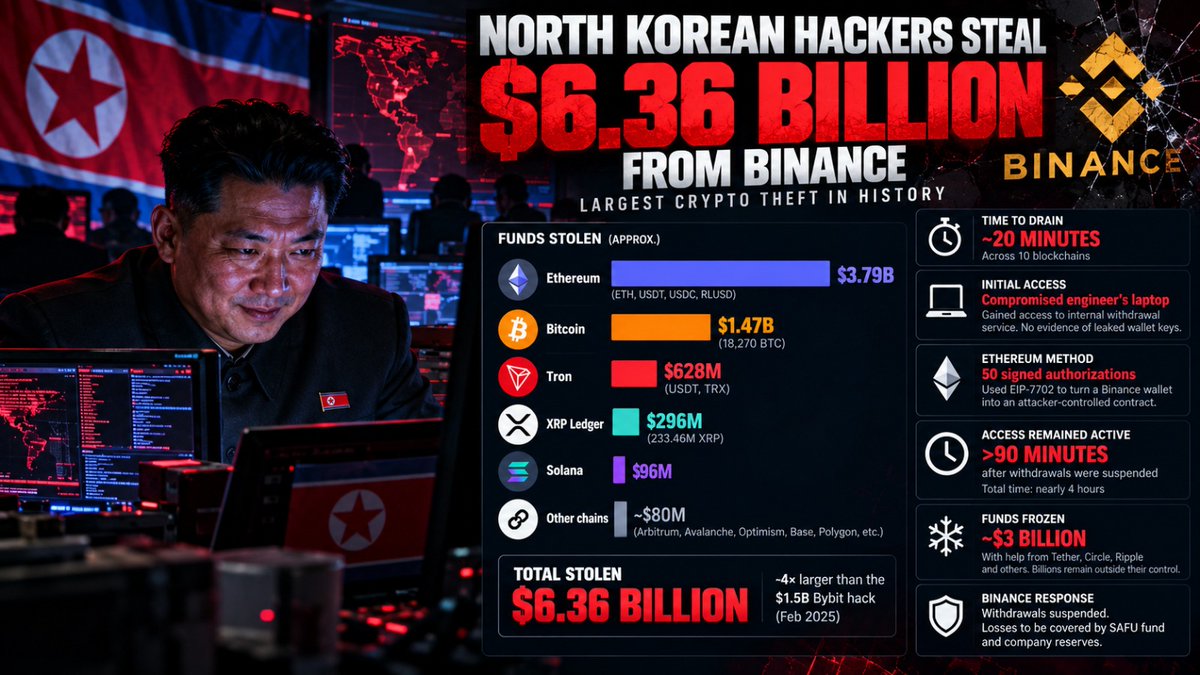
🇰🇵 North Korean hackers just pulled off the largest cryptocurrency theft in history, stealing roughly $6.36 billion from Binance in just 20 minutes.
Blockchain intelligence firm TRM Labs has linked the attack with high confidence to TraderTraitor, a North Korean state-sponsored hacking group associated with the notorious Lazarus Group.
The attackers reportedly drained Binance wallets across 10 blockchains, stealing approximately $3.79 billion from Ethereum, $1.47 billion in Bitcoin, $628 million from Tron and $296 million from the XRP Ledger.
The scale of the operation is staggering, with the amount stolen roughly four times greater than the $1.5 billion Bybit hack in February 2025, which was also attributed to North Korean hackers.
Binance's preliminary investigation suggests the attackers compromised an engineer's laptop, gaining access to systems used to authorize withdrawals rather than directly stealing wallet private keys.
On Ethereum, investigators found that attackers used 50 signed authorizations to gain control of a Binance wallet, allowing them to drain funds and intercept subsequent deposits.
More remarkably, that access reportedly remained active for nearly four hours, including more than 90 minutes after Binance suspended withdrawals.
The exchange has pledged to cover losses using its emergency SAFU fund and company reserves.
Meanwhile, cryptocurrency companies have reportedly helped freeze approximately $3 billion of the stolen assets, although billions remain outside their control.
Source: TRM Labs, @binance / Writer: Mhedi
The next major exploit might not involve breaking cryptography or stealing a private key….
It could just be manipulating legitimate features in ways their developers never anticipated.
What concerns me most is the bigger picture….
Are we underestimating the attack surface created by wallet delegation, transaction signing, multisig systems and cross-protocol integrations?