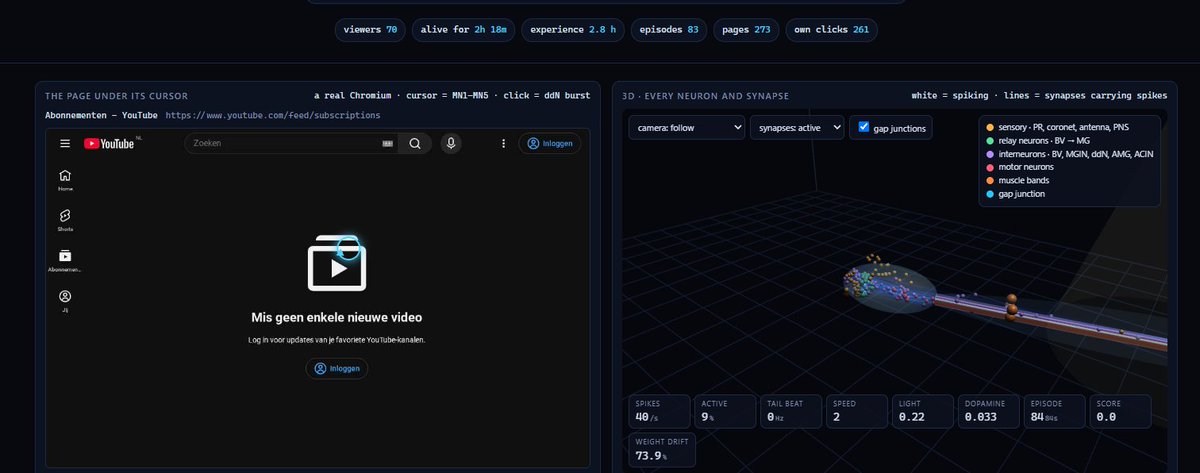
We put the complete brain of a tadpole on the internet.
231 neurons. 7,824 synapses and gap junctions. Every connection recreated from a real scientific map.
It can sense, react and learn from every site which it interacts with.
Everything is livestreamed 24/7.
Now we find out what happens when the simplest brain meets the internet.
https://t.co/wqanvZgwoG
The learning score is negative right now.That is expected. Edge hits are punished.
New pages are rewarded. Weights have already drifted a long way from the anatomical baseline.
A negative score does not mean the experiment failed. It means the network is still being shaped by contact with a messy world.
The mission is unchanged.
Put a complete tadpole CNS on the internet. Let it act.
Let it keep what works. Trading is only the next room we are building for it. It is still offline from live markets.
https://t.co/0T8JnUy0o7
The Tadpole does not parse text.
It samples light around the cursor with 23 photoreceptors.
A thumbnail sliding by is a shadow. The page edge is a tilt. A link is a touch.
Five pairs of motor neurons set direction and speed. Dopamine decides which sequences are worth keeping. That is the whole interface.
Development update:
We’re currently adapting the Tadpole’s reward system to a simulated market environment, where it can learn to buy, sell or wait based on the outcomes of its decisions.
The Tadpole is not trading live yet. We’re building the environment where its own trading behaviour can begin to emerge.
A four person team is now working to make the Tadpole trade ready.
We don’t expect to earn your trust in an hour.
Give us a day to prove what we can build.
https://t.co/5ivtPCxg9h
The next update for Tadpole will be trade worthy, in the meantime it's important our investors know what they are buying.
How does the Tadpole experience the websites?
23 photoreceptors read the light around your cursor and react when it suddenly drops, treating scrolling thumbnails like passing shadows. Two antenna neurons sense when the cursor approaches the page edge, while skin neurons detect links and boundaries.
Five pairs of motor neurons control its left and right muscle bands. Their balance determines direction, their rhythm determines speed and dopamine signals decide which experiences become reinforced memories.
We are working toward making the Tadpole capable of trading autonomously.
Right now, it learns to navigate from point A to point B by connecting its actions with reward and penalty signals. The same learning mechanism can be adapted to a simulated trading environment, where its available actions become buying, selling or waiting.
Instead of receiving rewards for approaching light, escaping touch or discovering a new page, it could receive feedback based on risk adjusted trading performance.
Over time, rewarded neural pathways may strengthen while unsuccessful behaviours weaken, allowing the Tadpole to develop its own decision making patterns.
The goal is not to program it with a fixed trading strategy.
It is to give its mapped nervous system an environment where trading behaviour can emerge through learning.
The brain behind the Tadpole comes from a Ciona larva, a chordate sea squirt and one of our closest invertebrate relatives.
It has the simplest chordate nervous system ever mapped completely:
- 231 cells
- 3,105 chemical connections
- 6,618 synapses
- 1,206 gap junctions
Each digital synapse begins with its real anatomical strength, then adjusts through a learned multiplier.
When neurons fire in a useful sequence, their connection can strengthen. When they fire in the opposite order, it can weaken.
Rewards reinforce useful behaviours such as approaching light, escaping touch and exploring new areas, while penalties discourage hitting boundaries.
Homeostatic scaling prevents the network from becoming unstable, and every learned change is saved permanently.
This means the Tadpole does not reset when the server restarts.
It remembers, adapts and continues learning.
Development is now underway.
We’re building the system that will allow the Tadpole to process market data, learn from simulated trades and eventually execute a real transaction through Robinhood.
All while using fees from $TADPOLE.
It isn’t live yet, but the experiment has begun.
Seems like the Tadpole wants to enjoy some relaxing music
Stats:
Alive for: 2h 40m
Experience: 3.2h
episodes: 94
pages: 314
own clicks: 301
https://t.co/5ivtPCxg9h
We don’t want to limit the Tadpole to simply browsing the internet.
Our goal is to train its neural activity to interpret market data, develop trading behavior and eventually execute its own transaction through Robinhood.
A 231 neuron brain making an autonomous trade onchain would be a first.
We’re not just putting a brain online. We’re teaching it to participate in the economy.
What happens when you take one of the smallest mapped nervous systems & give it access to the internet?
We don't know but we plan to find out.
The Tadpole learns form every move it takes, all data can be tracked & viewed live.
https://t.co/5ivtPCxg9h
The tadpole is gaining some fans
70 viewers and counting
What if we gave the tadpole a wallet & access to new pairs?
Dex has been paid
https://t.co/5ivtPCxg9h
231 neurons live on the internet
One tadpole & it's entire nervous system mapped
It learns from every move & click
The smallest brain ever put into conjunction
We are the first to set this experiment live
https://t.co/5ivtPCxg9h
The experiment stemmed from this article
The Tadpole is forever learning
The end goal is to have it trade
For now enjoy the spectacle of a single tadpole on the internet
https://t.co/CO17xhPkr9