Thanks Hayden for the deep summary.
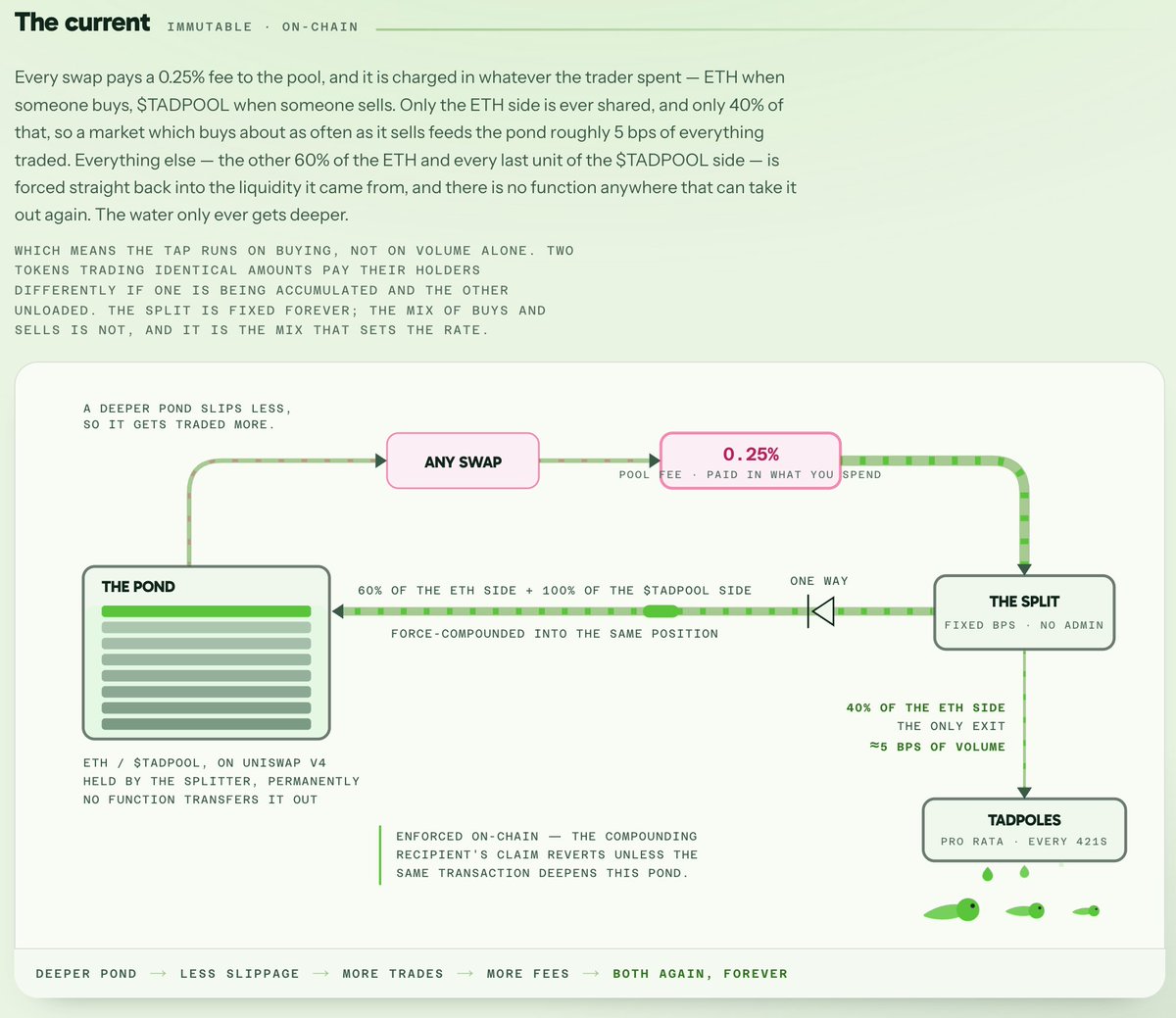
Maybe we ELI5'd it better in our previous tweet and on our site, but I will share an illustartion again of how $TADPOOL on https://t.co/DQWNC3aYAh works.
Taken from https://t.co/vxF48Vmf76
Incredibly excited for the launch of @TradePools!!
This rollout has been absolutely insane. Degens discovered earlier versions of the smart contracts and traded over $150m in trading volume before the UI even went live
This created a unique challenge where we had to update our site and indexing to support both the earlier test versions and the final versions of the contracts at the same time, which added some additional time to the launch
People have used uniswap as both a launchpad and launchpad infra for over 8 years. We're excited to be building alongside all the other launchpads to move the space forward
What most sets https://t.co/wEWmXIGbvx apart?
- no added launchpad fee, just the normal protocol fee that comes with all v4 pools. This makes the launch pool way better for traders, with total spreads far lower than most launchpads
- autocompounding liquidity (excited to bring this feature to normal Uniswap LPing as well)
- permanently locked liquidity for all launches
- two launch methods: instant launch works similar to other launchpads, and crowd launch simplifies what we built with CCA to create a fairer, more bundle resistant launch method
- deep integrations and distribution: Pools has day one support across uniswap web app, wallet, trading api, all third party trading api integrations, bitget, fomo, gmgn, okx wallet, etc, with more coming online rapidly
Have seen various takes claiming incorrect fee splits - to be clear the 0.25% LP fees autocompounds to the locked liquidity pool, it does not go to the uniswap team. This becomes 20% to the creator and 80% to the liquidity compounding mechanism
Uniswap Labs team has been cooking hard on this one but its still in beta. We intend to ship a constant stream of upgrades and improvements from here. So please share any feedback!!
The keeper and distribution, will not be switched off.
Even our last two epochs paid out, albeit small amounts.
The narrative doesn’t change - This is the first and possibly the only token to distribute the fees to all its holders on https://t.co/DQWNC3aYAh.
The coins of the last cycle traded on much lower fees than the ones of recent and we have never been close to the likes of $SHIB, $PEPE, $FLOKI (at its peak) since.
Now we are trading on those same fees and what’s better is, in $TADPOOL‘s case:
100% of creator fees fund holders
With that said, I can’t think of any other reason for the price action, there’s also some big wallets still holding 4% of the supply at this price which understandably left people with unease.
The token is heavily dependent on volume.
Without it, there’s no payout during an epoch.
With that said, the trade fee of 5bps is a positive for traders wanting to trade at volume, but also a negative for holders where much less fees are yielded compared to something like $INDEX
The token is heavily dependent on volume.
Without it, there’s no payout during an epoch.
With that said, the trade fee of 5bps is a positive for traders wanting to trade at volume, but also a negative for holders where much less fees are yielded compared to something like $INDEX
The coins of the last cycle traded on much lower fees than the ones of recent and we have never been close to the likes of $SHIB, $PEPE, $FLOKI (at its peak) since.
Now we are trading on those same fees and what’s better is, in $TADPOOL‘s case:
100% of creator fees fund holders
@ChippahJones Yes 0.05% of every trade as documented and reported by Uniswap.
It may be small now, but don’t mid-curve the fact that lower fees enables higher volume and more frequent trading.
@TheRedWizardsol@ponsdotfamily Less fees enables more trade volume and less vamps, it goes in roundabouts.
$TADPOOL gives 100% of the fees to holders by the way
Tadpools might have to be the involuntary educational project, representative of https://t.co/DQWNC3aYAh
No @FarmerBrownDeFi Thats misunderstood:
- 80% of the fees goes to auto-compounding liquidity
- 20% of the fees goes to the creator fee receipient (in our case all holders)