ISM Manufacturing (Mar) ⚠️
Headline 50.3 (Exp. 48.5, Prev. 47.8)
This is the first expansionary reading (albeit marginal) since 2022, breaking a run of 16 consecutive contractionary readings and eclipsing expectations.
Readings below 50 = contraction
-----------------------------------------
A few key metrics:
• Prices (inflation measure)
55.8 (Prev. 52.5)
• Employment
47.4 (Prev. 45.9)
'Head-count reductions continued in March, with sizable layoff activity reported.'
• Imports
53 (Prev. 53)
• New orders (demand)
51.4 (Prev. 49.2)
• Exports
51.6 (Prev. 51.6)
• Production
54.6 (Prev. 48.4)
-----------------------------------------
Overall
Mixed but generally positive print considering 16 months of previous contraction. Demand increased as did production within the manufacturing sector.
However, price increases accelerating at a faster pace than the prior month suggests increasing inflationary pressures within the manufacturing sector.
Companies also continue laying off staff members as evidenced by the employment index remaining in contraction. However, this was at a slowing rate.
Markets are still pricing in the first rate cut from the Fed to be in June; the probability of this, as per CMEFedWatch, declined from it's closing last week.
-----------------------------------------
Simply explained
Purchasing manager indexes (PMIs) are indexes which are based on survey responses from business executives. The surveys enquire about whether businesses are seeing an increase, no change or a decline across multiple topics.
Topics include:
• Production
• Prices
• Delivery times
• New Orders
• Employment
• Inventories
• Exports and imports
For all other than supplier deliveries a reading above 50 = expansion/growth. Hence, a >50 print for deliveries suggests slower deliveries and is the only metric in the ISM inversed. This is because slower delivery times generally implies higher demand.
US CPI BREAKDOWN⚠️
Jerome Powell emphasized at the FOMC press conference that the Fed want to see a continuation of what they had been seeing in the 6 months leading up to their last meeting.
That wasn’t what they got, as month over month core CPI rose to 0.4%; in annualized terms this amounts to a rate of 4.9%. The Fed obviously look past single fluctuations in prices but on a 3 month and 6 month annualized basis core CPI rose 4% and 3.7% respectively, well above the Federal Reserve 2% inflation target.
Month over month
CPI 0.3% (Exp. 0.2%, Prev. 0.2)
Core 0.4% (Exp. 0.3%, Prev. 0.3)
Year over year
3.1% (Exp. 2.9%, Prev. 3.4%)
3.9% (Exp. 3.7%, Prev. 3.9%)
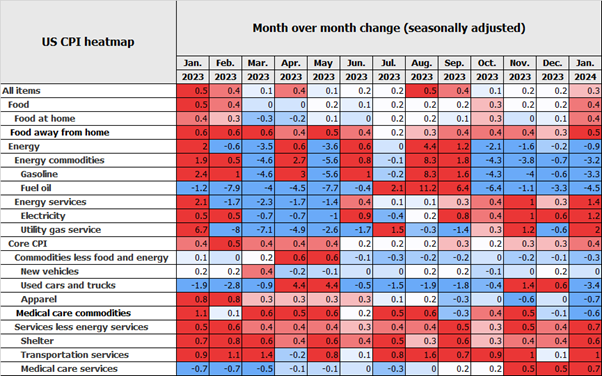
Services, insurance, food, transport, medical services and shelter all pushed the print higher on a monthly basis, as can be seen in the heatmap below.
US CPI Heatmap
The rate of price increases in shelter, the highest weighted services category, advanced at a rapid pace of 0.6% MoM, contributing two thirds of the monthly inflation print and up 6% this year.
This might lead you to think that the problem is focussed in housing.
However, a closely watched metric of Powell’s known as supercore (core services excluding shelter) advanced by 0.85% MoM, a pace not seen since April 2022. Supercore is now running at a 3 month annualized pace of 6.6%, which will absolutely catch the eye of the Federal Reserve as it delivers the message that services inflation is a wider issue than housing alone.
It wasn’t all hot, as used car prices plummeted 3.4%, apparel -0.7% (led by women’s clothing while men’s clothing ran hot) while core goods and energy continued to deflate in price.
It should be noted that in the data used for cars and trucks prices has just had a change of methodology applied for the first time this month relating to mileage estimations used vehicles. Thus, I would take it with a pinch of salt.
The Federal Reserve's chances of cutting rates in March has gone from being the market's baseline expectation at the start of January to a 91.5% chance of a continued pause.
Markets are now pricing in the first cut to come in May 2024, a significant push back on rate cut bets.
Fed meeting probabilities as per CMEFedWatch
US Treasury yields rose on the news and the S&P fell 1.37% on the day.
Simply explained CPI
Release by the Bureau of Labor Statistics monthly
The Consumer Price Index measures the change in prices for goods and services for consumers and thus is a measure of inflation. A basket of goods and services is sampled monthly. The good and services in question are supposed to reflect the spending patterns of consumers in the United States. The data is meant to be representative of prices for over 90% of the US population.
Different items in the CPI are given different weighting relative to their deemed importance.
Core CPI is the most closely watched metric within CPI as it excludes food and energy, which tend to be more volatile, and as a result allows for a closer look at underlying inflationary pressures within the economy.
While CPI is not the Fed’s preferred measure of inflation, well known to be core PCE, it still is of significant importance bearing on the direction of monetary policy as the Federal Reserve try to achieve their dual mandate of maximum employment and stable prices (2% inflation target).
@SocratesDergi@canereler@mgmotorturkiye Zamanda yolculuğun mümkün olduğu ortamda geçmişe 1 bileti var. Hayatının hangi bölümünü tekrar yaşamak ister? Neden?
POWELL SPEECH SUMMARY⚠️
1. Rates remain unchanged at 5.25% to 5.5%. The vote was unanimous. Rate of QT left unchanged.
2. Inflation has eased and the economy has made good progress. The Fed initially thought that a loosening of the labor market and below trend GDP growth would be necessary for inflation to return to target but they have been surprised and no longer think this as inflation has fallen without this occurring. They still expect growth to moderate but have expected this for a while now. Powell described that overall they are seeing a pretty good picture.
3. Policy rates are well into restrictive territory and are likely at their peak (changed from at or near their peak). The Fed are currently balancing the risk of cutting too soon vs too late, described by Powell as being in ‘risk management mode’. The Fed will remain data dependent, keeping rates where they are for longer or cutting more quickly if warranted.
4. The Fed feel it will be appropriate to begin dialling back policy at some point this year but do not want to cut rates until they have greater confidence that inflation is on a sustainable path down to 2%. They ARE confident of this but want to see more evidence. Last 6 months of good inflation data not enough for Fed to make this decision to cut but want to see a continuation of what we have been seeing of late. Powell wouldn’t give a specific number of months the Fed needed of good data.
5. Almost every participant on the committee believes it will be appropriate to reduce interest rates. Powell stated that there is a healthy variety of viewpoints in the committee about when rate cuts will occur.
6. Powell stated that he didn’t expect for the first cut to be at March meeting but didn’t entirely rule it out.
7. Rather than a rebound in inflation the Fed see the bigger risk as inflation stabilising above 2%. The Fed aren’t looking for a single 2% print, they are looking for inflation to be anchored there and in the process, there may be some prints below and above target.
8. The risks of monetary policy have come into better balance as inflation has eased. Raising the Fed Funds Rate by 5.25% and reducing the balance sheet (QT) by $1.3 trillion is putting downward pressure on economy.
9. A slide in employment would bring Fed to cut rates faster but this is not something they are looking to achieve. Similarly, if inflation was stickier then this would result in them holding off for longer.
10. Balance sheet run off has gone well so far. The Fed are going to discuss future possible changes to the pace of QT at meeting in March in depth. Fed don’t see the need to see the RRP (Reverse Repo) to go to zero prior to tapering the rate of QT
11. Powell states they have a ways to go prior to achieving a soft landing. They are encouraged by progress but not declaring victory at all at this point.
12. The labor market is at or nearing normal. Job openings and wage increases not yet back to normal. The economy is broadly normalising, and this process will take time (couple of years) to get all the way back. The labor market is rebalancing, there was a severe imbalance due to the pandemic.
13. The Fed is committed to dual mandate of stable prices (2% inflation) and maximum employment