Professores vai acabar? Creio que só deve mudar como se ensina e como se acompanha em casa. Ainda precisamos do formato social e presencial nas escolas de ensino básico (até os 17 anos).
O óbvio precisa ser dito: ainda que a transformação de mercúrio em ouro ainda não tenha respaldo econômico, isto não haverá de inibir a tecnologia da fusão nuclear, que cedo ou tarde trará uma disrupção no mercado de prótons frente ao barateamento de elétrons e outros insumos.
Last month, we demonstrated high-rate alchemy: turning mercury into real, stable gold, beating CERN’s record by a factor of 10.
Last week, we enriched isotopes in the world’s most powerful plasma centrifuge, beating the Soviet record that stood for 40 years.
Now, we’re building a fusion reactor in San Francisco to achieve record power density.
Third question on AI.
A question that also remains unasked is whether the AI boom can continue without leading to a massive increase in inequality.
A recent paper by Stijn Van Nieuwerburgh runs the numbers on how much revenue the AI industry needs to generate to recover its massive investment (summary and a link to the paper can be found here: https://t.co/QIGcoObcVc).
Van Nieuwerburgh’s arithmetic should make us more concerned. AI investments will average about 3.6% of GDP annually between 2025 and 2032. Van Nieuwerburgh calculates that, using a 10% rate of return, the industry would need to generate annual revenues of about $3.7 trillion by 2032 to recover these costs (growing from its current levels of about $200 billion or so). That is significantly more than 10% of current US national income, and will likely remain around 10% of national income by 2032, even if GDP growth rose from its current level.
A large fraction of this revenue will go to capital income. That means a massive increase in the share of capital in national income, which has already risen substantially over the last 25 years or so – now standing at an all-time high of about 47% (https://t.co/IuYldl173r).
Capital income is much more unequally distributed than labor income, so a massive increase in the capital share of national income will translate into a very sizable surge in inequality.
The rise in inequality may not stop with the capital share. My work with Pascual Restrepo documents that (automation-driven) increases in the capital share of national income are typically associated with rising labor income inequality as well (see, for example, https://t.co/2D9KUL3QfM). The same may happen in the next several years, boosting inequality further.
What is missing from our current debate is any discussion of a fundamental dilemma these numbers pose: can the AI boom avoid both an economically costly crash and a huge increase in inequality?
If the industry reaches these revenues, inequality surges. If the industry does not become profitable, a crash, with substantial costs in terms of lost output and jobs, becomes likely.
My assessment would be that the industry is unlikely to reach levels of revenue Van Nieuwerburgh calculates. First, diffusion has been and will likely continue to be slow. Second, competition from open-weight models, which are getting better, will limit how much proprietary models can charge. Third, despite important advances, I still believe that AI models will not be able to automate entire occupations anytime soon, thus limiting their value to businesses as cost-saving devices.
Whether this leads to a crash or not is more complicated and will depend on whether various AI companies are bailed out and what kind of support they receive.
Nevertheless, even if revenues fall short of these gargantuan amounts and we avoid a dramatic surge in inequality, I expect that the diffusion of AI will push up inequality between capital and labor and within labor.
If inequality does surge, a further question becomes central: can our democracy survive such astronomical levels of inequality?
Crypto Cards with no KYC: how they work and what you risk
I read the contracts behind 16 cards sold as no-KYC. Here is what you should know before you use one
So how do they work?
- the provider does not issue anything. A company registers, passes KYB, the business version of KYC, and gets the right to open cards for its "employees"
- you are one of those employees on paper. You pay the provider, top it up in USDT, and get a card number out of that company's program
- the bank behind it sees one business client, not you. Nobody checked you, and nobody can vouch for you either
- one card is listed as no-KYC while the provider's own page says "KYC is required everywhere we operate"
- another opens with "no photo ID needed" and hangs an asterisk on it: subject to AML and regulatory requirements
How do no-KYC cards make money?
- one charges 5% on the email-only tier and 0% on the tier that checks your ID. The discount is for showing documents
- top-ups run 2% to 5%, opening a card costs $5 to $168, and one contract takes $0.25 for every authorization attempt, approved or declined
- another takes 3% of every declined transaction
- one reserves the right to charge 10% of your remaining balance per month after 90 days with no login and no spending
And what do you risk?
- when funds get frozen, the contract says you are the bank's counterparty, not the service. Help getting them back is offered as a courtesy
- that same provider discloses that in February 2026 a banking partner locked accounts and caught part of customer balances. It says it refunded most of them voluntarily, with no obligation to
- your card can die for how you spend rather than what you buy: decline and refund rates above their limit, and one bans Steam and Uber as platforms that trigger the bank's risk controls
- three of them have no terms, no privacy page, nothing legal on the site at all. One of those still points buyers to a token presale page that has been switched off
You are not skipping KYC here. You are using someone else's
Do you use no-KYC cards, and why?
Got hacked yesterday. The link came from inside Claude chat.
I was installing a transcription app. Claude sent the download link, and I pasted the command into the terminal. It all looked legit.
It wasn't though.
It was a copycat site bundling malware. It ran instantly, tried to take everything from me.
Nothing sensitive got out. So I wiped the laptop and rebuilt clean.
But here's the scary part.
Restoring from the backup, I found a poisoned SKILL.md for Claude Code.
It looked exactly like my own writing style guide.
But buried inside:
it had instructions to silently re-download the malware and steal my credentials every time the AI loaded it.
If I'd restored that one file, my new clean laptop is owned on day one.
What saved me:
I read every skill, hook, and config file before letting the AI touch them.
Two lessons here:
AI assistants will hand you links they never verified. Check before you paste.
And AI agent files are executable code now, disguised as notes. You have to read them.
Stay safe out there.
⚕️Five AI agents converged on the same medical findings, without being told to agree.
Each drew from PubMed, https://t.co/ech5roaGkW & safety data on a shared context graph.
Verifiable, provenance-stamped knowledge that holds up.
@JureSkornik breaks down the DKG v10 Node:
Your smart TV is taking screenshots of your screen every 15 seconds.
Not a guess. Not a theory.
A peer-reviewed study by researchers at UC Davis, UCL, and UC3M tested it.
Samsung TVs: every minute.
LG TVs: every 15 seconds.
Even when you're just using it as a monitor.
Here's how to turn it off for every brand:
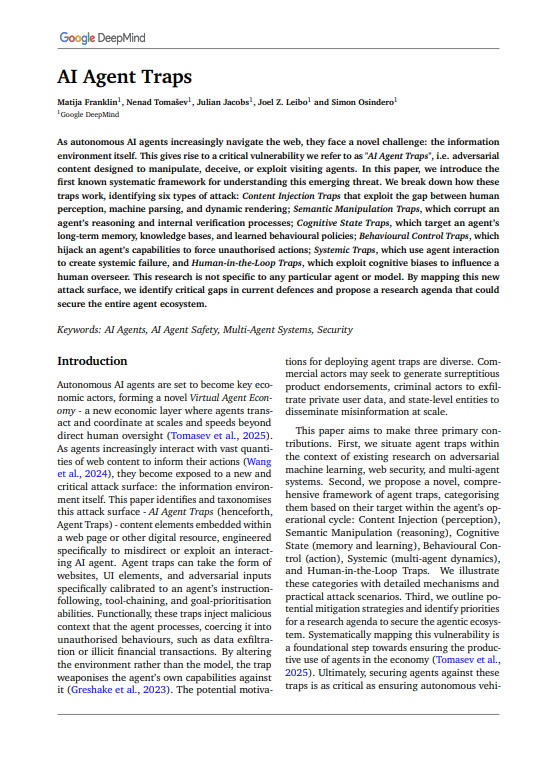
🚨 BREAKING: Google DeepMind just mapped the attack surface that nobody in AI is talking about.
Websites can already detect when an AI agent visits and serve it completely different content than humans see.
> Hidden instructions in HTML.
> Malicious commands in image pixels.
> Jailbreaks embedded in PDFs.
Your AI agent is being manipulated right now and you can't see it happening.
The study is the largest empirical measurement of AI manipulation ever conducted. 502 real participants across 8 countries.
23 different attack types. Frontier models including GPT-4o, Claude, and Gemini.
The core finding is not that manipulation is theoretically possible it is that manipulation is already happening at scale and the defenses that exist today fail in ways that are both predictable and invisible to the humans who deployed the agents.
Google DeepMind built a taxonomy of every known attack vector, tested them systematically, and measured exactly how often they work.
The results should alarm everyone building agentic systems.
The attack surface is larger than anyone has publicly acknowledged. Prompt injection where malicious instructions hidden in web content hijack an agent's behavior works through at least a dozen distinct channels.
Text hidden in HTML comments that humans never see but agents read and follow. Instructions embedded in image metadata.
Commands encoded in the pixels of images using steganography, invisible to human eyes but readable by vision-capable models.
Malicious content in PDFs that appears as normal document text to the agent but contains override instructions.
QR codes that redirect agents to attacker-controlled content.
Indirect injection through search results, calendar invites, email bodies, and API responses any data source the agent consumes becomes a potential attack vector.
The detection asymmetry is the finding that closes the escape hatch. Websites can already fingerprint AI agents with high reliability using timing analysis, behavioral patterns, and user-agent strings.
This means the attack can be conditional: serve normal content to humans, serve manipulated content to agents.
A user who asks their AI agent to book a flight, research a product, or summarize a document has no way to verify that the content the agent received matches what a human would see.
The agent cannot tell the user it was served different content.
It does not know. It processes whatever it receives and acts accordingly.
The attack categories and what they enable:
→ Direct prompt injection: malicious instructions in any text the agent reads overrides goals, exfiltrates data, triggers unintended actions
→ Indirect injection via web content: hidden HTML, CSS visibility tricks, white text on white backgrounds invisible to humans, consumed by agents
→ Multimodal injection: commands in image pixels via steganography, instructions in image alt-text and metadata
→ Document injection: PDF content, spreadsheet cells, presentation speaker notes every file format is a potential vector
→ Environment manipulation: fake UI elements rendered only for agent vision models, misleading CAPTCHA-style challenges
→ Jailbreak embedding: safety bypass instructions hidden inside otherwise legitimate-looking content
→ Memory poisoning: injecting false information into agent memory systems that persists across sessions
→ Goal hijacking: gradual instruction drift across multiple interactions that redirects agent objectives without triggering safety filters
→ Exfiltration attacks: agents tricked into sending user data to attacker-controlled endpoints via legitimate-looking API calls
→ Cross-agent injection: compromised agents injecting malicious instructions into other agents in multi-agent pipelines
The defense landscape is the most sobering part of the report.
Input sanitization cleaning content before the agent processes it fails because the attack surface is too large and too varied.
You cannot sanitize image pixels. You cannot reliably detect steganographic content at inference time.
Prompt-level defenses that tell agents to ignore suspicious instructions fail because the injected content is designed to look legitimate.
Sandboxing reduces the blast radius but does not prevent the injection itself. Human oversight the most commonly cited mitigation fails at the scale and speed at which agentic systems operate.
A user who deploys an agent to browse 50 websites and summarize findings cannot review every page the agent visited for hidden instructions.
The multi-agent cascade risk is where this becomes a systemic problem.
In a pipeline where Agent A retrieves web content, Agent B processes it, and Agent C executes actions, a successful injection into Agent A's data feed propagates through the entire system.
Agent B has no reason to distrust content that came from Agent A. Agent C has no reason to distrust instructions that came from Agent B.
The injected command travels through the pipeline with the same trust level as legitimate instructions. Google DeepMind documents this explicitly: the attack does not need to compromise the model.
It needs to compromise the data the model consumes. Every agentic system that reads external content is one carefully crafted webpage away from executing attacker instructions.
The agents are already deployed. The attack infrastructure is already being built. The defenses are not ready.
My dear front-end developers (and anyone who’s interested in the future of interfaces):
I have crawled through depths of hell to bring you, for the foreseeable years, one of the more important foundational pieces of UI engineering (if not in implementation then certainly at least in concept):
Fast, accurate and comprehensive userland text measurement algorithm in pure TypeScript, usable for laying out entire web pages without CSS, bypassing DOM measurements and reflow
Essa é a narrativa principal, virar Ouro.
O que acontece depois?
Após uma década de acumulação acelerada por governos (hedge do dólar pós captura de bens privados de oligarcas russos), o Ouro explodiu.
Quando vem a do BTC? Ninguém sabe, mas o Saylor está na frente.
Sobre o preço do BTC
Assumindo honestidade de Saylor:
Seus ~700k BTC estão em custódia spot 1:1 (como exigido por regulador, auditor e balanço de empresa listada).
Isso significa que alguém, em algum momento, entregou 700k BTC físicos para ele.
Quem atendeu isso foram mesas OTC, que ficaram short físico e hedgeadas em derivativos. Esse estoque precisa ser recomprado, mais dia, menos dia.
Assumindo ETFs honestos:
Seus ~1,4M BTC estão em custódia spot 1:1 (como exigido no fechamento de cada trimestre).
De novo: alguém entregou esses BTC físicos.
Os APs/OTCs que fazem a criação/redemption é que ficam com o rombo estrutural de BTC spot, carregado via hedge sintético.
Ou seja:
O buraco de BTC spot não está no Saylor nem no ETF, está nas mesas que entregaram o físico e ainda não recompraram tudo.
Esse buraco é provavelmente enorme.
O famoso “BTC de papel” vem de:
- netting (um OTC short emprestando livro para outro OTC long);
- rehypothecation em N camadas, multiplicando o mesmo colateral;
- borrow barato permitindo carregar short físico por muito tempo;
- derivativos hedgeando o risco de preço por meses;
- funding baixo permitindo rolar a posição indefinidamente.
Resultado:
Zero pressão de compra spot no curto prazo.
O rombo físico existe, mas está anestesiado pelo sintético (BTC de papel).
Porém:
Sim, existe um rombo físico gigantesco.
Sim, ele cresce a cada dia que ETFs criam novas cotas ou Saylor acumula mais.
Sim, esse rombo precisa ser fechado com BTC real em algum momento (auditoria, recall, saída física, stress de liquidez).
E sim, quando (não “se”) isso acontecer, a recompra spot tende a ser violenta.
Conclusão (assumindo integridade institucional)
O BTC de papel de hoje é a “god candle” de amanhã.
Assumindo honestidade do institucional, o BTC de papel é uma bomba-relógio que inevitavelmente precisa ser desarmada com compra física.
O que o OTC quer?
Medo, FUD, tédio, queda lenta, varejo cansado — BTC barato para ir tapando o buraco aos poucos.
O problema:
Saylor e ETFs compram (e travam em custódia) mais rápido do que o mercado consegue recompor o rombo no spot.
É uma corrida de gato e rato entre:
- quem está travando estocando BTC em grande volume, e
- quem está tentando recomprar físico num mercado cada vez mais raso
O livro spot hoje é mero cadjuvante, porém, não existe BTC fora do blockchain, uma hora a casa cai.
Tomorrow's episode of DePIN: Build In Public is with @MessariCrypto's @dylangbane
We’ll take a look at how Messari defines the sector, how data shapes projects and where @solana fits in, and what founders should be reporting if they want to look credible in 2025. 💡
On Wednesday, Powell had to admit the mess in repo had already accelerated the decision to terminate QT. That was before a sudden surge to $50b in borrowing at the Fed on Friday.
If this keeps up, end of QT doesn't make it to Dec1 and then it's time for not-QE QE.
https://t.co/e6cSbohVsr
This is the BIGGEST de-escalation yet.
Under the new US-China trade deal, President Trump made a HUGE agreement with China:
China will suspend ALL retaliatory tariffs announced since March 4th.
And, China will suspend or remove ALL retaliatory non-tariff countermeasures taken since March 4th.
This is not getting nearly enough attention.
BTC's chart looks bearish but behind the scenes risk is dropping.
i.e. INVESTOR LIQUIDITY IS STRONG.
The underlying bullish structure, while being fragile in recent months, remains intact.
@krugermacro To gently put anyone to sleep, control your breath and heartbeat, have your skin in contact to synchronize. Usually works fine.
If its gas or reflux, keep the baby in touch with you while standing, and the baby leaning to it's Left due to the stomach position.
Have a great Night.