@MallyBhullar Literally this low and the hype was like every testnet user get a life changing airdrop 😂
It was so funny to see pennies in testnet users
do Kiedex have any team? why aren't they coming out? and in the starting they didn't tell us that there will be kyc and in last after we all spent our money they told that KYC is mandatory and till now they didn't even disclosed who will be verifying our credentials and where it would be kept or when it be removed from their server. Till now they haven't conducted any of the, face to face events so how can we even trust on this shit ?
@Kinetiq_xyz is sitting on $1.14B+ in TVL, but its token is pulling back… but
I kept seeing it everywhere in the HYPE ecosystem, so I decided to actually dig into the protocol.
What is Kinetiq?
Kinetiq is a liquid staking protocol built on @HyperliquidX .
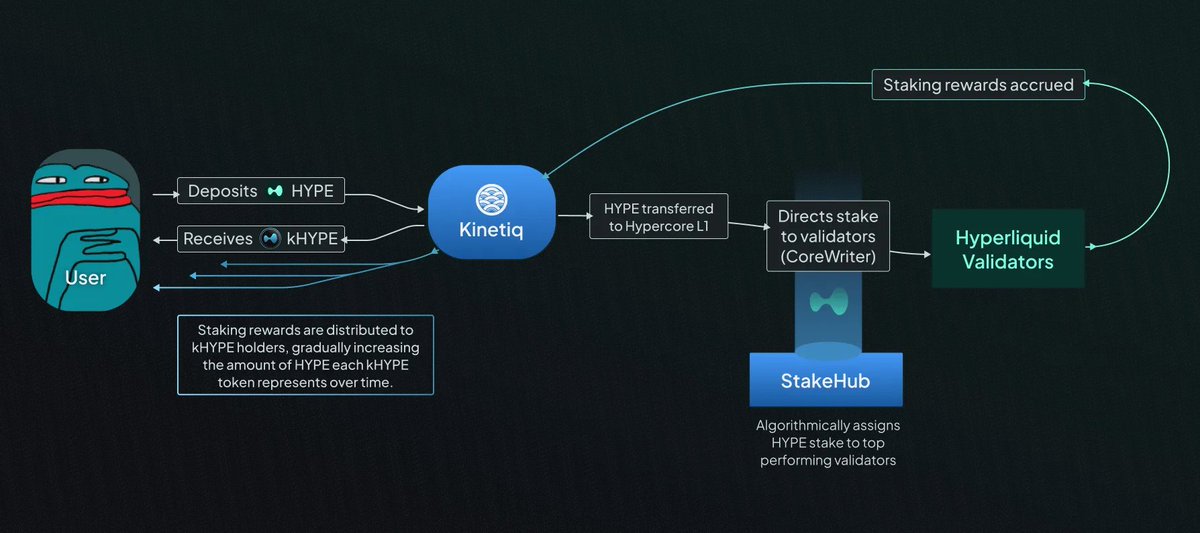
Basically, you stake your hyperliquid:native through Kinetiq and in return you receive $kHYPE.
The HYPE you stake is then delegated across top-performing Hyperliquid validators to help secure and decentralize the network. Validator selection is handled through StakeHub. (Kinetiq's own algorithm)
And the important part:
kHYPE is the liquid asset you can use across the HYPE ecosystem while still keeping your Hype staked in their protocol.
What problem does Kinetiq solve?
Strengthening network security
This is basically the normal benefit of staking.
Making liquid staking simpler
Normally, staking can involve keeping track of validators, checking their performance, managing rewards and rebalancing.
And sometimes the staking token you receive in return doesn't have much use outside the staking platform.
Kinetiq automates a lot of this.
Its system evaluates validators and allocates stake based on their performance, while rewards are automatically compounded.
And instead of getting an asset that just sits there, you receive kHYPE, which can be used across DeFi in khype ecosystem
You can use it for things like:
→ Lending & borrowing
→ Trading positions
→ Liquidity / DeFi strategies
→ Other applications in the ecosystem
All without unstaking your HYPE.
How does Kinetiq actually work?
You stake HYPE.
The system selects validators based on their performance.
Validator rewards increase the value of your kHYPE over time, meaning the kHYPE/HYPE exchange rate increases.
Rewards compound automatically, so you don't have to manually claim them.
You can use your kHYPE across other DeFi applications.
When you want to withdraw, you submit a withdrawal request and wait through the security delay period, which is around 8–9 days.
How are validators selected?
Kinetiq evaluates validators across 5 main categories:
• Reliability - uptime, responsiveness and block production
• Security -slashing history and infrastructure quality
• Economics - fees and reward consistency
• Governance -participation in network governance
• Longevity -operating history and software maintenance
These factors are combined into a score, and the stake is allocated accordingly.
The validator scores are publicly visible onchain.
Risks to keep in mind
Smart contract risk - audits can reduce code risk, but never eliminate it.
Validator risk -validators can underperform or potentially get slashed, although Kinetiq spreads stake across multiple validators.
Liquidity risk - kHYPE liquidity can vary, so its market price can deviate from its underlying value.
Protocol risk - governance changes and other protocol-level decisions can affect how the system works.
One thing I found interesting:
On Kinetiq's website, there are assets other than just HYPE, including assets from ecosystems like Avalanche, Base Ethereum etc.
The interesting part is that I couldn't find clear documentation explaining exactly where those assets are deployed.
My interpretation: they may be bridged into the Hyperliquid ecosystem and then used through the underlying staking infrastructure, potentially involving Enso.
But this is my interpretation, not something I'm claiming as confirmed by Kinetiq.
There is honestly a LOT more to cover here.
kHYPE itself, how the funding works, how Kinetiq generates revenue, the actual economics, ecosystem integrations, and most importantly, why Kinetiq is falling are all still left to cover.
This post is already getting way too long 😂
So I'll cover those in another part.
Until then, if you have questions or think I missed something, drop it in the comments.
And yeah, follow me if you like these kinds of deep dives.
I've got a lot more ecosystems to cover.
I think if your niche as a creator is something logical, like understanding how systems work, then you have to actually help your followers make money. That’s what will benefit you in the long run too.(that's the only way they will follow you)
But if you’re just shitposting, it’s way easier because the crowd naturally prefers simple and entertaining content over intellectual topics.
Is @ConcreteXYZ Team really scammers?
I’ve seen a few people sharing screenshots saying they were removed by the mods from the Concrete Discord.
So I looked into it.
After seeing multiple posts about this, I checked what actually happened. From what I found, the people who were removed had been inactive for around a month.
The mods also mentioned in their conversations with some of the removed users that anyone who wants to rejoin is welcome they just need to stay active in the community.
So getting removed for inactivity ≠ getting scammed.
But there’s another thing I want to talk about: airdrops and the mindset around them.
Since the Telegram bot meta started, this sector got flooded with projects. A lot of them were scams, and many people got used to the idea of doing a few clicks and getting free money.
The projects that gave some of the biggest rewards were often the ones launched by major names in the Telegram ecosystem. That created a mindset where people started expecting every project to hand out huge airdrops for minimal effort.
Now the sector is slowly getting more mature.
But you still see people doing some social tasks, clicking around Discord, and then expecting a 3–4 figure airdrop.
And if they don’t get it?
“Scam.”
I honestly find that funny.
If you only completed a few social tasks, what actual value did you contribute to the protocol?
You can’t expect every project to give you thousands of dollars just because you followed them, joined Discord and completed some tasks.
Take Concrete as the latest example.
Instead of only looking at how much your airdrop was, look at the actual numbers TVL, FDV, revenue, protocol activity, and how many users were eligible for the airdrop.
Then look at how the distribution was actually done.
From what I’ve seen, Concrete didn’t simply exclude everyone who didn’t invest large amounts. They distributed the airdrop across users who had actually engaged with the protocol, with their social or their platform who have invested their money
If the protocol had intentionally separated genuine users from people who only completed free social tasks and then gave nothing to the latter, that would be a different discussion.
But calling the entire project a scam simply because your airdrop wasn’t worth 3-4 figures doesn’t make much sense to me.
And just to be clear:
I’m not a Concrete supporter, I’m not an ambassador, and I didn’t receive their airdrop.(I am discussing about it because that's the only post on my X account for now shortly i will be coming with more detailed analysis with other projects)
I’m just sharing my POV after looking into the situation.
Maybe Concrete has other things worth criticizing and if there are legitimate issues, they should absolutely be discussed.
But “I did some tasks and didn’t get enough money” ≠ “the project is a scam.”
The airdrop meta needs to mature, and honestly, so does the mindset of the people participating in it.
(I have attached the detailed analysis of what concrete actually do below)
Thanks for reading.
I kept seeing @ConcreteXYZ everywhere, but I didn't really understand what it did.
So I dug into it.
What Concrete really is?
Concrete is basically a system of smart contracts that works as a vault system.
Users or institutions deposit assets into these vaults and, in return, receive shares representing their portion of the vault.
The system then deploys that capital into different strategies.
If the strategy makes a profit, the value of your shares increases, and you can redeem those shares for the underlying asset according to the vault's rules.
For example, if you deposit ETH into a vault, you receive a vault share representing your portion of that vault. If the vault makes a profit, the value of that share goes up.
One important point: these strategies don't guarantee profit. Past performance doesn't guarantee future results. DYOR before investing.
How does the system work?
A Concrete vault is essentially a smart contract with a defined set of rules.
When you deposit, you receive shares of that vault.
For example, ctDefiUSDT represents your portion of the vault.
Your profit or loss depends on how the particular vault's strategy performs.
And this is important:
You can't simply say, “Concrete uses this one strategy.”
Different vaults can use different strategies.
So for each vault, you need to check:
→ Where is the capital being deployed?
→ Which protocols are being used?
→ How is the vault actually generating yield?
I'm not going into every vault strategy here because the point of this post is to understand what Concrete actually does, not every individual strategy.
There are 3 ways deposits/withdrawals can work
1. Atomic Vault
You can deposit and withdraw directly when the required liquidity is available.
2. Queued Withdrawal
Your withdrawal may take time.
If there isn't enough immediate liquidity, the withdrawal request enters a queue and gets processed as liquidity becomes available.
3. Pre-Deposit
Used for cross-chain vaults.
Why can withdrawals take time?
Pretty simple.
If a vault doesn't have enough available liquidity at that moment, it can't give everyone their money instantly.
If your redemption can't be fulfilled immediately, your request can enter a queue.
As liquidity becomes available, the request gets processed.
So if you're putting a large amount of money into a vault, withdrawal terms and available liquidity are worth checking.
Now let's understand the maths
Suppose you deposit 1 ETH.
You receive ctETH representing your share in the vault.
Let's say the vault makes 4% from its strategy.
Your amount of ctETH doesn't necessarily increase.
Instead, the value of each ctETH increases.
For example:
1 ctETH = 1 ETH
After a 4% increase:
1 ctETH ≈ 1.04 ETH
So you still hold the same amount of ctETH, but each share is now worth more.
The opposite can also happen.
If the vault loses money, the value of your ctETH can decrease.
The key point:
The number of shares doesn't necessarily increase. The value of those shares changes.
What happens with liquidity?
When you deposit, the capital is deployed according to the vault's strategy.
At the same time, the system needs to manage liquidity for withdrawals.
Smaller withdrawals may be processed directly if enough liquidity is available.
But if there's a large withdrawal request and liquidity isn't available, it can enter the queue.
So you shouldn't assume every withdrawal will be instant.
What about vault transparency?
Concrete provides information about where the vault's capital is being deployed.
You can see:
→ Assets -portfolio share by token
→ Protocols - share deployed in each protocol
→ Networks - share held on each network
This lets you see where the capital is going.
But you still need to research the individual vault because different vaults can have different strategies and risks.
Talking about fees
Concrete doesn't charge deposit or normal withdrawal fees.
However, individual vaults can have management and performance fees depending on how they're configured.
Management fee: the fee for managing the vault.
Performance fee: charged when the strategy generates positive returns.
There can also be a hurdle rate.
For example, if the hurdle rate is 5% and the vault makes 3%, the performance fee may not apply.
If the vault makes more than 5%, the performance fee can apply according to that vault's configuration.
Some vaults can also charge a fee for bypassing a withdrawal cooldown.
So again, check the fee structure of the specific vault.
What problem does Concrete really solve?
This was one area where I couldn't find a very direct answer from their website or docs.
Concrete describes its product around institutional-grade infrastructure for deploying assets into on-chain yield.
My interpretation:
DeFi can get complicated when you're dealing with multiple protocols, chains, strategies, liquidity and capital management.
Concrete is trying to provide the infrastructure and vault system through which this capital can be deployed and managed.
In simple terms:
DeFi yield is complicated to manage Concrete is trying to make that process easier through its vault infrastructure.
That's my interpretation from looking at what they're building, not a claim that Concrete described the problem in exactly those words.
What is the current status of the ecosystem?
Now let's look at some actual numbers.
As of 1 October 2026:
Deposits - $1.332B
Volume - $24.21B
Depositors - 53.89K
These numbers include both institutional and normal users.
At that time, there were 9 live vaults on their website.
The numbers alone don't tell us whether the protocol is “good” or “bad.”
But $1.3B+ in deposits shows that capital is actually flowing through the system.
TVL and fees
According to DeFiLlama:
1 February 2025
TVL - $551M
Fees ~$700K
May 2025
Highest monthly fees- $8.64M
Valuation - around $495M
Then there was a significant drop.
July 2025
TVL - $7.4M
Revenue - ~$237K
After that, the numbers recovered with some fluctuations.
August 2026
TVL - $1.54B
Fees -$1.95M
And the earnings figure I found was around $444.54K.
One thing worth pointing out:
Fees, revenue, gross profit and earnings are not the same thing.
So I don't want to look at one number and simply say:
“Concrete earned X.”
You have to understand exactly what that metric represents.
Funding + institutional investors
2024 - $7.5M
Hashed, Tribe Capital, Portal Ventures, SALT, Hypersphere, Lightshift, Avalanche Foundation and others.
2025 - $9.5M
Led by Polychain Capital, with YZi Labs, VanEck, BitGo, Gate Ventures, Portal Ventures, Auros and others.
2026 -Strategic round
Amount undisclosed.
Led by Polychain Capital, with Bullish, Keyrock, FalconX, Flowdesk, BitGo and others.
Total disclosed funding: $17M+
Some notable partnerships
BitGo - institutional custody + yield
BinanceWallet -direct access to Concrete yield
Figment_io -institutional staking + DeFi yield
RenzoAI + EigenLayer - restaking vaults
Euler + Morpho - lending / curation
Symbiotic - restaking infrastructure
TRES Finance -institutional reporting / accounting
Hypernative + zeroShadow for security
What about competitors?
This is one area I haven't gone very deep into yet.
Some projects in the space include:
@veda_labs@grovedotfinance@mellowprotocol@upshift_finance@aera
@Lagoon
@EmberProtocol@Lombard_Finance
I haven't researched each product deeply enough to make a proper comparison.
I used ChatGPT to get a basic overview of what each project does, but I don't want to make a detailed comparison without researching them myself.
So I'll keep the competitor analysis for another post.
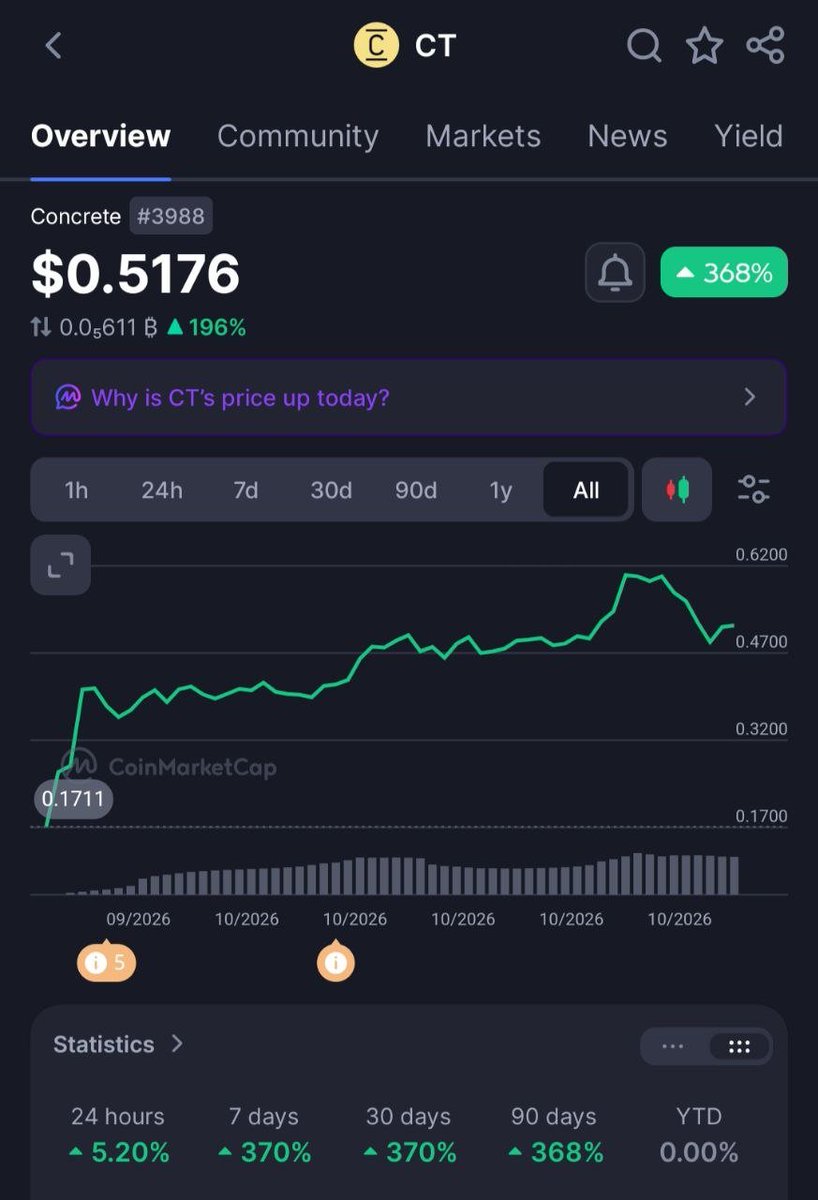
How is CT connected to Concrete?
CT isn't an ownership or revenue-share token.
Its documented utility mainly comes from:
Governance - CT holders can participate in decisions around protocol parameters such as strategies, collateral and fees.
Staking - CT can be locked to access certain protocol benefits, including fee adjustments on supported modules.
The important point:
Concrete's revenue does not automatically go to CT holders.
The token's value ultimately depends on the demand created by these utilities and the available token supply.
So this is basically what I understood about Concrete.
It's a vault and infrastructure system where users and institutions deposit assets, receive vault shares, and have that capital deployed through different strategies.
I mainly wanted to understand:
→ What Concrete actually does
→ How the vaults work
→ How vault shares make/lose value
→ How Concrete earns through fees
→ What the current ecosystem looks like
→ How CT fits into the system
Not a recommendation to invest.
DYOR.
Thanks for reading.
Wanted to know your POV on this.
@9Xvenom@kiedexapp@MarqelCapital@uormapp Yepp bro i noticed it too and I have also questioned in @kiedexapp discord but they didn't gave any answer related to their founder or their team, and about kyc they just say it will be safe. And we are not forcing.
If you think Concrete didn’t give a good airdrop, I honestly don’t get it.
Bruhhh, people completed a few social tasks and expected a 3–4 figure airdrop? 😭
I actually dug into Concrete’s revenue model and how much they distributed. I wrote about it in detail on my account you can check that post and you’ll understand( it is a overall post of the project with a part about its revenue model)
Also, one thing worth noting: they distributed the airdrop to users without making the whole thing about Sybil filtering.
Not defending them blindly, just saying people should look at the numbers and token distribution before calling it a bad airdrop.
I kept seeing @ConcreteXYZ everywhere, but I didn't really understand what it did.
So I dug into it.
What Concrete really is?
Concrete is basically a system of smart contracts that works as a vault system.
Users or institutions deposit assets into these vaults and, in return, receive shares representing their portion of the vault.
The system then deploys that capital into different strategies.
If the strategy makes a profit, the value of your shares increases, and you can redeem those shares for the underlying asset according to the vault's rules.
For example, if you deposit ETH into a vault, you receive a vault share representing your portion of that vault. If the vault makes a profit, the value of that share goes up.
One important point: these strategies don't guarantee profit. Past performance doesn't guarantee future results. DYOR before investing.
How does the system work?
A Concrete vault is essentially a smart contract with a defined set of rules.
When you deposit, you receive shares of that vault.
For example, ctDefiUSDT represents your portion of the vault.
Your profit or loss depends on how the particular vault's strategy performs.
And this is important:
You can't simply say, “Concrete uses this one strategy.”
Different vaults can use different strategies.
So for each vault, you need to check:
→ Where is the capital being deployed?
→ Which protocols are being used?
→ How is the vault actually generating yield?
I'm not going into every vault strategy here because the point of this post is to understand what Concrete actually does, not every individual strategy.
There are 3 ways deposits/withdrawals can work
1. Atomic Vault
You can deposit and withdraw directly when the required liquidity is available.
2. Queued Withdrawal
Your withdrawal may take time.
If there isn't enough immediate liquidity, the withdrawal request enters a queue and gets processed as liquidity becomes available.
3. Pre-Deposit
Used for cross-chain vaults.
Why can withdrawals take time?
Pretty simple.
If a vault doesn't have enough available liquidity at that moment, it can't give everyone their money instantly.
If your redemption can't be fulfilled immediately, your request can enter a queue.
As liquidity becomes available, the request gets processed.
So if you're putting a large amount of money into a vault, withdrawal terms and available liquidity are worth checking.
Now let's understand the maths
Suppose you deposit 1 ETH.
You receive ctETH representing your share in the vault.
Let's say the vault makes 4% from its strategy.
Your amount of ctETH doesn't necessarily increase.
Instead, the value of each ctETH increases.
For example:
1 ctETH = 1 ETH
After a 4% increase:
1 ctETH ≈ 1.04 ETH
So you still hold the same amount of ctETH, but each share is now worth more.
The opposite can also happen.
If the vault loses money, the value of your ctETH can decrease.
The key point:
The number of shares doesn't necessarily increase. The value of those shares changes.
What happens with liquidity?
When you deposit, the capital is deployed according to the vault's strategy.
At the same time, the system needs to manage liquidity for withdrawals.
Smaller withdrawals may be processed directly if enough liquidity is available.
But if there's a large withdrawal request and liquidity isn't available, it can enter the queue.
So you shouldn't assume every withdrawal will be instant.
What about vault transparency?
Concrete provides information about where the vault's capital is being deployed.
You can see:
→ Assets -portfolio share by token
→ Protocols - share deployed in each protocol
→ Networks - share held on each network
This lets you see where the capital is going.
But you still need to research the individual vault because different vaults can have different strategies and risks.
Talking about fees
Concrete doesn't charge deposit or normal withdrawal fees.
However, individual vaults can have management and performance fees depending on how they're configured.
Management fee: the fee for managing the vault.
Performance fee: charged when the strategy generates positive returns.
There can also be a hurdle rate.
For example, if the hurdle rate is 5% and the vault makes 3%, the performance fee may not apply.
If the vault makes more than 5%, the performance fee can apply according to that vault's configuration.
Some vaults can also charge a fee for bypassing a withdrawal cooldown.
So again, check the fee structure of the specific vault.
What problem does Concrete really solve?
This was one area where I couldn't find a very direct answer from their website or docs.
Concrete describes its product around institutional-grade infrastructure for deploying assets into on-chain yield.
My interpretation:
DeFi can get complicated when you're dealing with multiple protocols, chains, strategies, liquidity and capital management.
Concrete is trying to provide the infrastructure and vault system through which this capital can be deployed and managed.
In simple terms:
DeFi yield is complicated to manage Concrete is trying to make that process easier through its vault infrastructure.
That's my interpretation from looking at what they're building, not a claim that Concrete described the problem in exactly those words.
What is the current status of the ecosystem?
Now let's look at some actual numbers.
As of 1 October 2026:
Deposits - $1.332B
Volume - $24.21B
Depositors - 53.89K
These numbers include both institutional and normal users.
At that time, there were 9 live vaults on their website.
The numbers alone don't tell us whether the protocol is “good” or “bad.”
But $1.3B+ in deposits shows that capital is actually flowing through the system.
TVL and fees
According to DeFiLlama:
1 February 2025
TVL - $551M
Fees ~$700K
May 2025
Highest monthly fees- $8.64M
Valuation - around $495M
Then there was a significant drop.
July 2025
TVL - $7.4M
Revenue - ~$237K
After that, the numbers recovered with some fluctuations.
August 2026
TVL - $1.54B
Fees -$1.95M
And the earnings figure I found was around $444.54K.
One thing worth pointing out:
Fees, revenue, gross profit and earnings are not the same thing.
So I don't want to look at one number and simply say:
“Concrete earned X.”
You have to understand exactly what that metric represents.
Funding + institutional investors
2024 - $7.5M
Hashed, Tribe Capital, Portal Ventures, SALT, Hypersphere, Lightshift, Avalanche Foundation and others.
2025 - $9.5M
Led by Polychain Capital, with YZi Labs, VanEck, BitGo, Gate Ventures, Portal Ventures, Auros and others.
2026 -Strategic round
Amount undisclosed.
Led by Polychain Capital, with Bullish, Keyrock, FalconX, Flowdesk, BitGo and others.
Total disclosed funding: $17M+
Some notable partnerships
BitGo - institutional custody + yield
BinanceWallet -direct access to Concrete yield
Figment_io -institutional staking + DeFi yield
RenzoAI + EigenLayer - restaking vaults
Euler + Morpho - lending / curation
Symbiotic - restaking infrastructure
TRES Finance -institutional reporting / accounting
Hypernative + zeroShadow for security
What about competitors?
This is one area I haven't gone very deep into yet.
Some projects in the space include:
@veda_labs@grovedotfinance@mellowprotocol@upshift_finance@aera
@Lagoon
@EmberProtocol@Lombard_Finance
I haven't researched each product deeply enough to make a proper comparison.
I used ChatGPT to get a basic overview of what each project does, but I don't want to make a detailed comparison without researching them myself.
So I'll keep the competitor analysis for another post.
How is CT connected to Concrete?
CT isn't an ownership or revenue-share token.
Its documented utility mainly comes from:
Governance - CT holders can participate in decisions around protocol parameters such as strategies, collateral and fees.
Staking - CT can be locked to access certain protocol benefits, including fee adjustments on supported modules.
The important point:
Concrete's revenue does not automatically go to CT holders.
The token's value ultimately depends on the demand created by these utilities and the available token supply.
So this is basically what I understood about Concrete.
It's a vault and infrastructure system where users and institutions deposit assets, receive vault shares, and have that capital deployed through different strategies.
I mainly wanted to understand:
→ What Concrete actually does
→ How the vaults work
→ How vault shares make/lose value
→ How Concrete earns through fees
→ What the current ecosystem looks like
→ How CT fits into the system
Not a recommendation to invest.
DYOR.
Thanks for reading.
Wanted to know your POV on this.