$HYPE has been officially added to $DEFI.ssi — following a review by the SSI Index Committee.
The committee recognized $HYPE’s measurable progress in decentralization and infrastructure - including the launch of HyperEVM L1, validator expansion, and permissionless perps via HIP-3 - meeting the criteria for DeFi sector classification.
This inclusion strengthens $DEFI.ssi’s representation of the evolving DeFi landscape and enhances portfolio balance across market cycles.
@HyperliquidX
🛰️ CTC-0 Mission: Complete
Cadets, there’s no better way to hear this very special mission update than straight from Captain Oh.
We’ve officially routed the world’s first end-to-end blockchain transaction through space, proving that our vision of a decentralized, satellite-based internet is technically viable!
The signal was sent from Chile → CTC-0 → Portugal, spanning over 7,000 km, and showcases intercontinental transmission capability.
To celebrate our milestone, we’re planning a special event to get Cadets involved in our digital testing lab, where you can actively observe live blockchain message transmissions from the CTC-0 satellite! More details to come soon.
For now, to thank you for your continued support as we build our network, we are giving you 150 points toward our airdrop S2.
Head to Penguinbase and use code: CTC0Success.
Onward to the next mission!
INJECTIVE ANNOUNCES INTEGRATION OF PAXOS AND PAYPAL’S JOINT STABLECOIN $PYUSD: DETAILS…
- @Injective, a leading L1 blockchain, announced supporting Paxos and PayPal’s joint stablecoin, $PYUSD, becoming one of the first L1 platforms to do so.
- $PYUSD is fully backed by USD deposits, allowing users to purchase 1 $PYUSD with 1 USD.
- PayPal, a global online payments system, allows users to send and receive money worldwide. Paxos, a digital asset solution provider, serves leading financial services entities globally.
- Users can now use Wormhole to onboard onto Injective with PayPal USD.
- Decentralized applications on Injective can leverage $PYUSD for various purposes, including DeFi, trading, and rapid payments.
Image: Injective
#Injective #Paypal #PYUSD #Paxos
.@injective ranks 2nd among Top Blockchains with the most Revenue, updated on 6th June 2024🔥
This is happening due to the constant development, update of #Injective Ecosystem through years!
If you haven’t been in the Injective Ecosystem yet, join us & experience the fastest Blockchain ever!❤️🔥
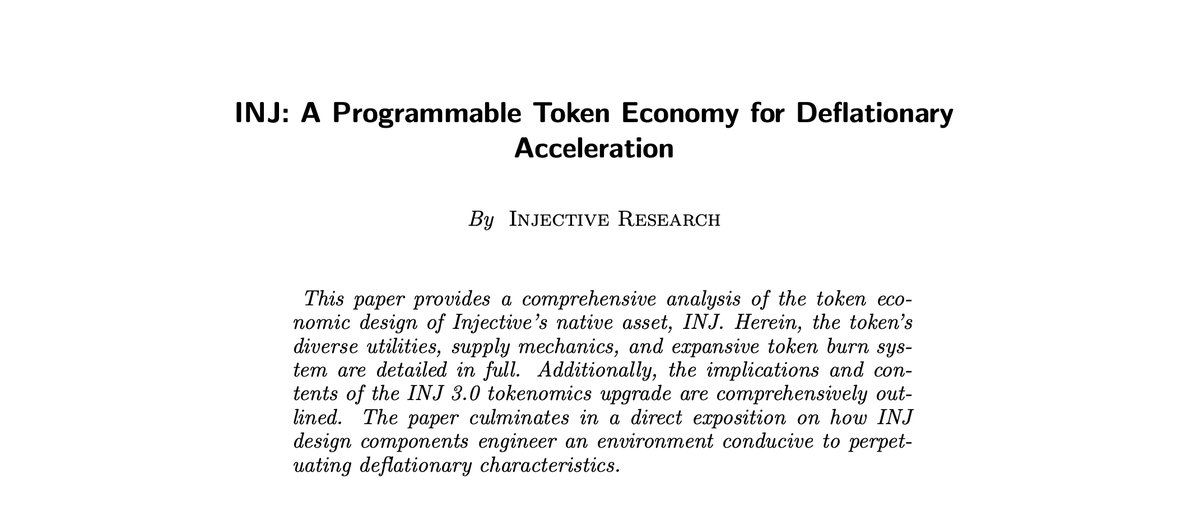
🧵Deep Dive into @injective Tokenomics Document
@injective released its tokenomics paper yesterday, and as a researcher, I found it incredibly fascinating. Therefore, I summarized its key points.
Ultimately, the most important keyword when describing the INJ token is its deflationary asset characteristic. Injective also highlighted in this paper that the primary distinguishing feature of $INJ, compared to other PoS chain governance tokens, is its deflationary nature. Injective's tokenomics is quite interesting, incorporating concepts I encountered while studying monetary economics, which I’d like to share.
Injective’s K Percentage Rule
The renowned American economist Milton Friedman criticized the United States' lax monetary policy, emphasizing that the money supply should adhere strictly to predetermined rules and not exceed them. Injective's token supply policy reminds me of Friedman's rule-based approach(but INJ is more conservative).
Injective's token supply is regulated by a single criterion, the Gold Bonded Percentage. This means that if the actual supply of INJ falls short of this threshold, Injective increases the supply; conversely, if it exceeds the threshold, the supply is reduced. This protocol-driven approach aims to avoid lax monetary policies, benefiting the asset holders.
As INJ 3.0 arrives, this rule becomes more stringent (the lower bound decreases from 5% to 4%, and the upper bound from 10% to 7%), meaning the overall supply will be further reduced.
Injective’s Deflation
How does Injective manage the overall supply of tokens according to this rule? By consistently burning tokens to preserve value. Injective's deflationary mechanism has evolved through three phases, leveraging the entire ecosystem. In INJ 1.0, a portion of fees from the exchange module was sold at auction, and the proceeds used to burn INJ tokens. In INJ 2.0, this scope was expanded to include not just apps utilizing the exchange module but all apps, and the entire fee could be allocated to auctions. Starting with INJ 3.0, regular users can contribute to auctions, allowing more tokens to be burned. The amount of INJ burned is continuously increasing. As of May 2024, approximately 5,920,000 INJ have been burned, amounting to a value of about 200 million USD.
No Unlocked Supply
As of January 2024, all initially locked tokens have been fully distributed. This contrasts with many Layer 1 projects that have tokens scheduled to unlock over several years.
Personal Thoughts
Injective stands out as a unique project in several ways. Since its mainnet launch, it has adjusted its tokenomics with a focus on enhancing and preserving the value of the project and its ecosystem. The burn mechanism is strategically designed to align the interests of the Injective team and the community effectively.
As user engagement with the protocol increases and generates more fees, a larger amount of assets goes to auction, requiring more INJ to be spent. This reduces the supply of INJ, thus preserving the value of the entire ecosystem. To support this mechanism, the Injective team continuously brings in high-quality applications, such as Ondo and Ethena, which users actively utilize and promote.
While there was a previous project with a similar structure (starting with Te... and ending with ...rra), Injective’s approach, though potentially less dramatic, appears to offer a robust and safe cyclical structure. Unlike Terra, which aggressively burns Luna to mint Terra and must re-supply burnt Luna when Terra's demand decreases, Injective does not re-supply burnt $INJ to the ecosystem, even if network usage demand declines. This makes Injective a very promising project. It is exciting to witness the growing anticipation for a project that emerged in 2020.
You can read the full paper on Injective's Tokenomics here: https://t.co/YfwvEmaEwQ
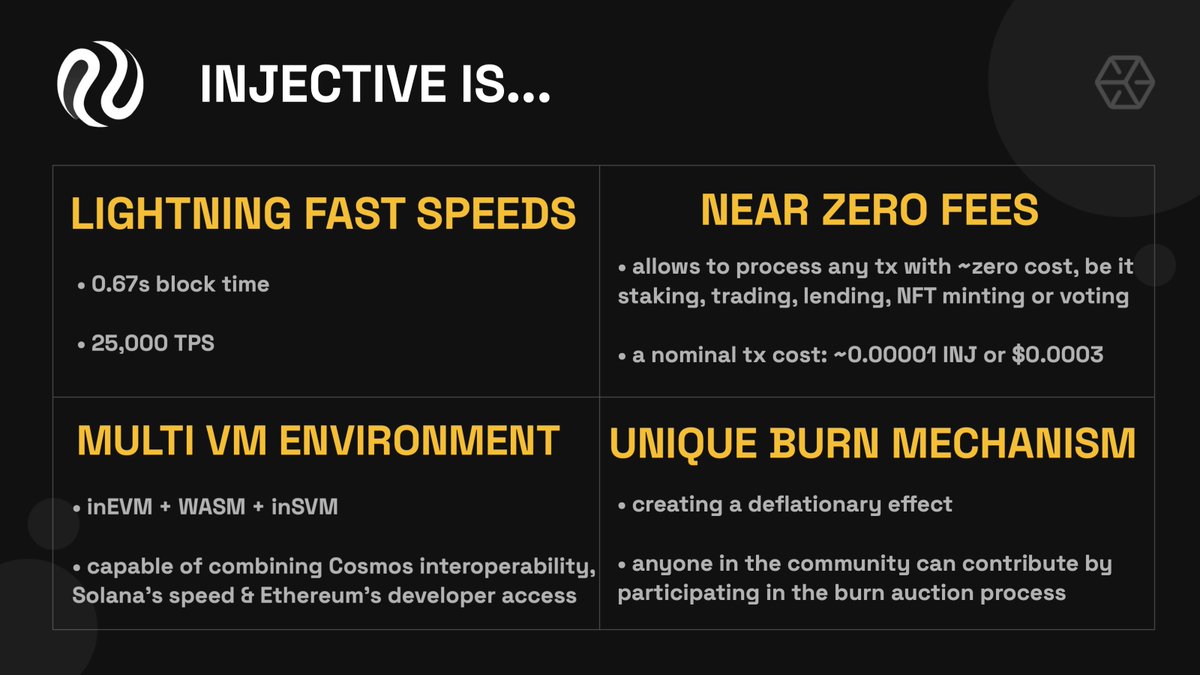
🥷 @injective is:
• lightning fast: 0.67s block time, 25,000 TPS
• multi VM environment: inEVM + WASM + inSVM
• unique burn mechanism creating a deflationary effect
• the only L1 capable of combining Cosmos interoperability, Solana's speed, and Ethereum's developer access
• near-zero fees, allowing to process any transaction with almost zero cost, be it staking, trading, lending, minting an NFT, or voting on a gov proposal (tx on Injective incurs a nominal cost of ~0.00001 INJ or $0.0003)
Study Injective here: https://t.co/JaJSBEQzrY
🔥 Been a hot minute since our last $BWB announcement
👀 Join the #BWB AMA with our COO @alvinkan as he discussed about the future of $BWB and our newest layer
🏆 We’ll be giving away 300 BWB if you:
1️⃣ RT this post
2️⃣ Comment “I love $BWB” with your Bitget Wallet EVM address
🌟 An extra 200 BWB will be up for grabs for engagement during the AMA! #giveaway #airdrop
⏰ May 17, 22:00 (UTC+8)
📆 Mark your calendars: https://t.co/3wPr4L1FXM