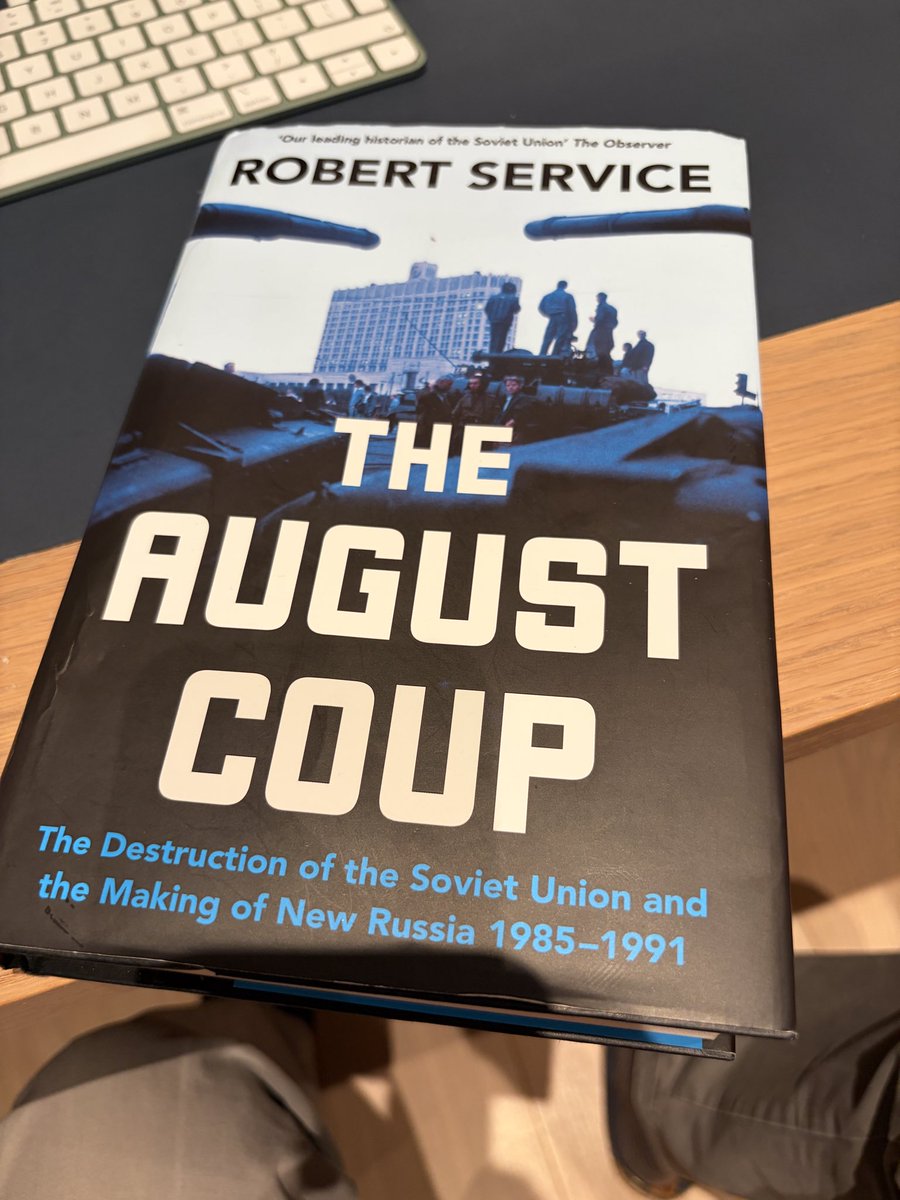
The best book I have read on the collapse of the Soviet Union. Highly recommended for anyone not only interested in that specific episode, but also in the broader topic of how governance structures may collapse. Bravo @robertservice00
@Seatradelawyer Restore Britain’s members, reach more than 150,000 in just one year.
I don't know but I really want to hear it from you.
Is that a remedy, a treatment, a settlement, or a solution which I doubt?
“History makes clear that trade imbalances are always resolved eventually,” writes @michaelxpettis. “What remains uncertain is how damaging the resolution will be—and for whom.”
https://t.co/74FWSqkhw2
You feel lost tense and overwhelmed because of what's happening now. Read @ButlerCreon and his vision on how we can rescue the global economy and build a fresh model for future generations neither US nor China to form a new Economic Bloc, and you'll find hope for what lies ahead.
The Economist magazine has achieved something rare with this article:
It has gotten most of the economics community to a similar conclusion—namely, that this is a harsh assessment.
https://t.co/JX1fcA6ETr
#economy#economics
The University of Cambridge has announced the launch of a second independent inquiry in the space of a week, as the institution faces mounting pressure over its recruitment and institutional practices #highered#Cambridge#inquiry
https://t.co/VCo1dt5gCp
"An Award Without an Oral Hearing" that was the question that caught Dr. Vivekananda's attention at @KingsCollegeLon The marvellous question we asked opened up a new dimension in arbitration, with an international expert Nigel Blackaby from @Freshfields
Thank you Prof Manuel 🍀
Why the Trump regime might implode, hopefully before it does more damage to democracy. My latest. The Coming Showdown in Trumpworld by Dani Rodrik - Project Syndicate https://t.co/NROsL478QX
Paul Samuelson was the first American to win the Nobel Prize in Economics. He spent his career proving that ordinary people should not try to beat the market. He also quietly beat the market himself for 60 years. His last full-length interview explains how. Almost nobody has watched it.
Samuelson taught at MIT for 65 years, from 1940 until he died in 2009. His textbook "Economics" sold roughly four million copies. He rewrote the field. Every finance professional working today learned economics from a book he wrote or a book written by his students.
He also ran his own money quietly. His returns reportedly outpaced most active managers of his era, and he was an early investor in Warren Buffett's Berkshire Hathaway. He never advertised the numbers. He said the opposite in public. His most famous line about investing:
"Investing should be more like watching paint dry or watching grass grow. If you want excitement, take $800 and go to Las Vegas."
He was one of the earliest advocates for index funds. He believed almost nobody could beat the market and almost nobody should try. His nephew Larry Summers became Treasury Secretary. His students founded half the modern economics profession. He was invited into every important economic policy debate of his lifetime.
His view on personal finance was unusually blunt for a Nobel laureate. In one of his final interviews, near the end of his life, he explained his framework in three sentences. Personal finance is not a science. It is a set of common-sense decisions repeated for decades. Save more than you spend. Diversify. Do not chase excitement. Do not trust anyone who promises certainty. He said these things thousands of times over 70 years and the industry ignored him every year.
The full interview covers his childhood, his years at Chicago and Harvard, his rise at MIT, his Nobel, and his philosophy on money. He was 94 years old at the time. His voice is thin and his answers are direct. He does not soften anything. He treats the interviewer like a graduate student who happens to be holding a camera.
The more sophisticated a market becomes, the more valuable the boring advice becomes. Every investor who ignored Samuelson's rules is a receipt for how right he was. Every quant who read his mathematics and skipped his common sense missed the point.
Samuelson died December 2009. He was 94. His textbook is still in print. The interview is free.
Super interesting!
"A Fabulous Debt: The Epic Story of How Bonds Built the Modern World" by Robin Wigglesworth.
"With clarity and wit, Wigglesworth takes readers from medieval Venice to modern Wall Street, tracing how bonds evolved from obscure financial instruments into the invisible architecture of the modern world. Along the way, we meet warlords and water boards, merchant princes and mathematicians, financiers and fraudsters—all of whom helped build the most powerful machine in global finance. This isn’t just a book about the past. It's a guide to the present and future of the financial system—and a love letter to the engine that keeps it running."
https://t.co/lccvOMTfun
"If you're not at the table, you end up on the menu."
Germany's wealthiest person, Dieter Schwarz, made his fortunes from supermarkets. Now, he wants to take on the likes of Google, Microsoft, and Amazon and make Germany a hub for innovation.
https://t.co/o5WRzxSCut