All based on numbers that don’t reflect reality. Most founders don’t realize this until cash gets tight.
If you want a deeper breakdown of why e-commerce accounting needs to be specialized and when to switch, read the full article here: https://t.co/k8xUc7hOkb
Revenue going up does not mean your e-commerce business is profitable.
It’s a nice dashboard flex, but it’s not profitable.
Here’s where most brands get it wrong: In e-commerce, product cost is not your real cost.
If you’re only tracking unit cost, your margin is inflated.
It wasn’t built for multi-channel payouts, inventory in transit, and volatile cash timing.
Specialized ecommerce accounting was, and this is where things get expensive.
When your margin is wrong, you scale ads too aggressively, over-order inventory, and hire too early.
Hiring an SDR in the US is expensive.
We’re talking $50k–$100k/year for a role that has a turnover rate of 14 months. 💸
Global talent can cut that cost by 80%. But one bad hire can burn your entire lead list.
Here is how to vet them properly 🧵
You should screen for Business Fluency. Can they handle an awkward silence? Can they mirror the prospect's tone?
We’ve used this exact framework to place hundreds of SDRs for US startups.
Grateful for our clients, our team, and the talent that drives everything we do.
Thank you for being part of this journey 🚀
Happy New Year from the Talent Hackers team 🎉
Wrapping up the year with a moment to connect as a team ✨
Grateful for the collaboration, trust, and shared wins this year.
Merry Christmas and warm wishes from all of us at Talent Hackers 🎄🤍
Hiring offshore is easy. Building a team that shows up isn’t.
You need a partner who protects your time, not one who creates more work.
That’s what we do. Jacob explains it better 👇🏼
We broke the full framework down, including scorecards, red flags, and a 14-day plan to hire offshore SDRs properly.
If you care about protecting your pipeline, it’s worth the read: https://t.co/kwijQlkfwZ
Most SDR hiring mistakes don’t look like mistakes at first.
They look like a good interview, clear English, and “sales experience” on a CV.
Then six months later, the pipeline is dry, and nobody can explain why.
What works is a simple, job-relevant process: async screens to filter fast, short live calls to test clarity, work samples, metric-driven interviews, and a paid trial with clear ramp goals.
Our co-founder @Razak_Malas documented the full journey in a free guide: the decisions, the risks, and the choices that shaped the business early
on.
If you’re building from zero and want a realistic look at what it actually takes, read it here: https://t.co/zne2CR4nJI
Hiring is where many early-stage businesses get it wrong.
They hire locally too early, burn through cash, and stall before revenue has time to catch up.
Talent Hackers grew from $0 to $1M in 9 months. Bootstrapped, no outside funding, plenty of uncomfortable trade-offs.
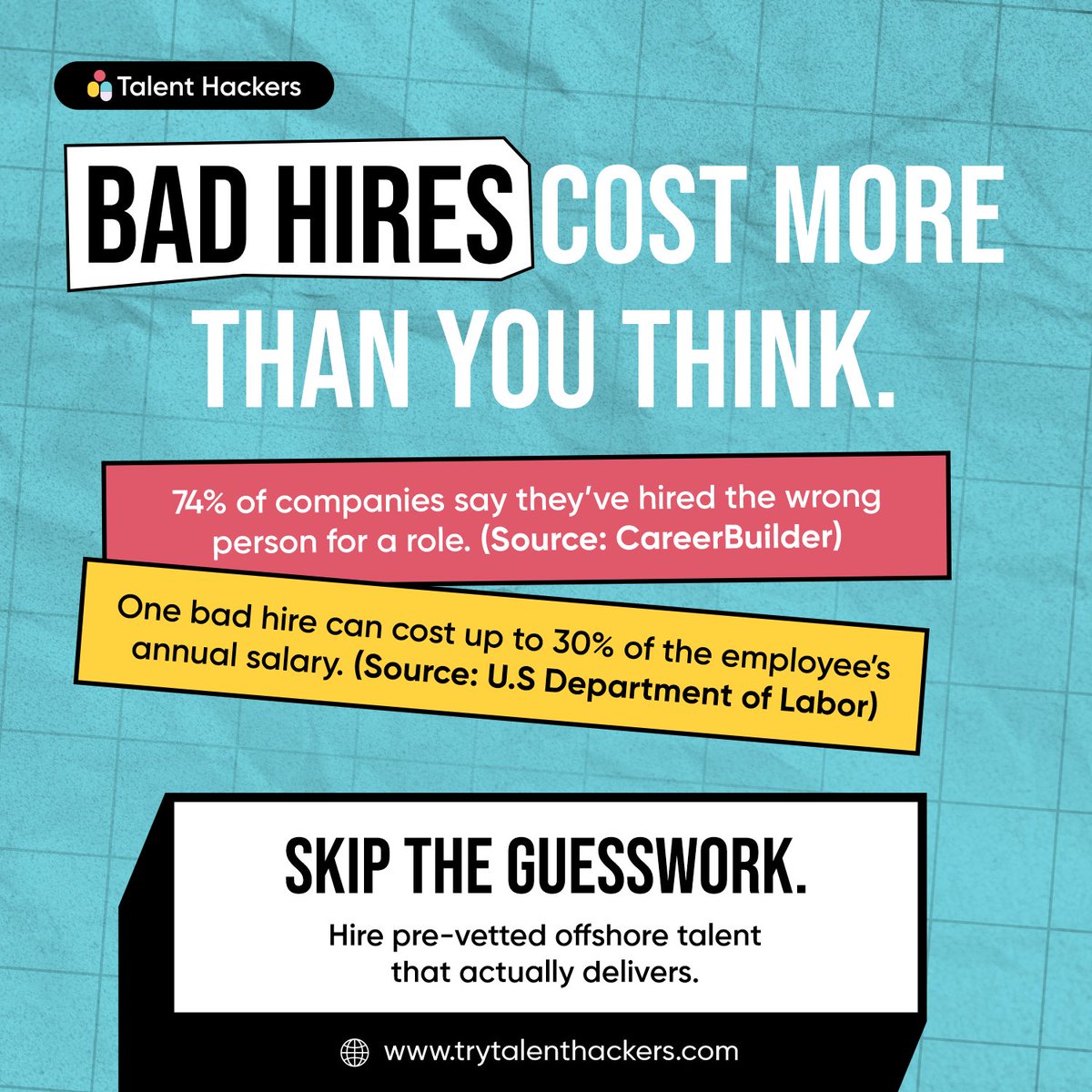
You don’t just lose money with a bad hire. You lose time and trust, and by the time you realize it, the damage is already done.
At Talent Hackers, we don’t gamble on talent; we vet for performance, culture fit, and actual delivery.