The Nayaks of Kandy were a #Telugu dynasty that ruled the majority of Sri Lanka until 1815. They were the final independent ruling dynasty of Sri Lanka before the island fell completely under #British colonial rule.
#srilanka#kandy#telugukings#andhra#telangana#india
Well played🫡
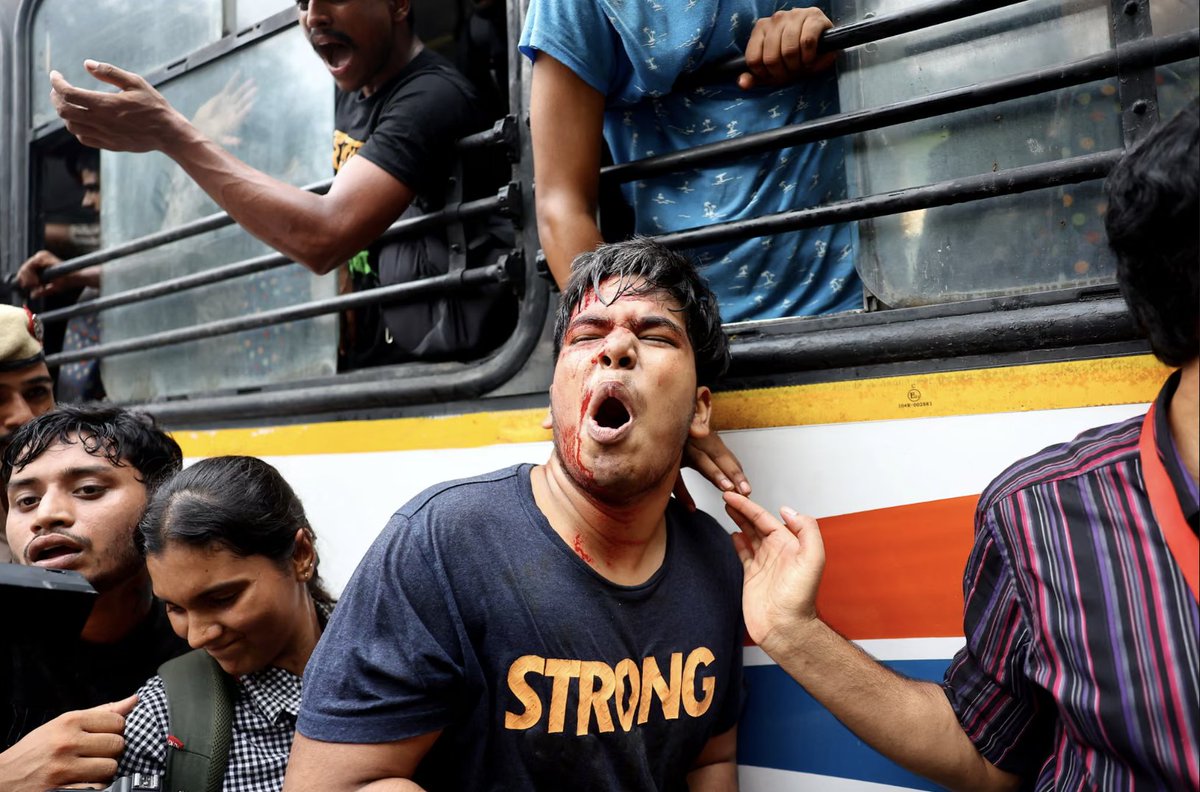
Some of the world's most prestigious photo agencies clicked Delhi Police in action today🔥
@Reuters@GettyImages@AP@EPA_Images📸 Now millions more will see😵💫
We used to think such brutality comes from Islamabad or Dhaka - but now we are atmanirbhar! 💪🏽
Similar titles!
GanapatiDeva Chakravarthi of Kakatiyas had 2great titles-
GanapatiDeva title for arts,"Samasta vidyā vilāsinīlāsaka rasika"!
KDR had "Sakala kalā vallabha"!
GanapatiDeva title for literature-"Kavikula kamalākara Divākara"!
KDR had "Sāhitī samarāgana sārvabhouma"
Nico Williams gives his world cup gold medal to his mom, who crossed the Sahara desert in search for a better life while pregnant with his older brother...
540 Janapadas! 🔥
This is the total number of Janapadas - kingdoms- in Bharata Varsha, as per Mahabharata.🔥
This will blow your mind as this is several times more than the number of Sixteen Janapadas that the mainstream history taught you!
Itihāsa Mahābhārata is inseparable from Bhāratavarṣa. No other ancient text contains this much information about the Geography of Bhāratavarṣa.
Mahābhārata mentions around 540 Janapadas, more than 100 cities, towns, & villages, 230 rivers & lakes, 100 mountain ranges & peaks, 20 forests, 59 regions, and 280 holy spots (Tirtha Stanas).
But what did we learn in schools?
Just 16 Janapadas!
మా దళిత గొర్రెలకు అస్సలు అర్థం కాదు.
అన్ని వాడే కనిపెట్టాడు , కనేసే పెట్టాడు అనే మాటలు మాట్లాడుచుంటారు.
వాడు కని పెట్టేక ముందే ఇక్కడ వాళ్ళకు మా భారతీయులు కనీ పెట్టీ ఉంచారు వాళ్ళు copy and paste చేసుకున్నారు.
ఇప్పటికైనా తెలుసుకుంటారా లేక మా తులసక్క వలె రావణ్ వలే వాదిస్తారా.?
The Asuras are not demons in the Ṛgveda,
They are the Anu. The Anavas.
And once you see this, the entire Indo-European story realigns.
In the Ṛgveda, the great civilizational divide is not “good vs evil”.
It is Anu vs Puru.
The Devas are the ancestral gods of the Puru / Pauravas.
They are the Ādityas, sons of Aditi, the mother of the gods, working under Tvāṣṭar, the divine architect.
Tvāṣṭar is not a marginal figure.
In the Ṛgveda he appears repeatedly as father-in-law to major god's wives, linking lineages.
He is the god of craft, metallurgy, design, and construction, the civilizational signature of the Harappan–Sarasvatī–Sindhu world of North-West India.
On the other side stand the Anu / Anava.
The Ṛgveda describes them with remarkable precision:
Anindra – those who reject Indra
Avrata – those who do not follow Vedic ritual norms
Vadhri-vācāḥ – those who speak different dialects
Not barbarians.
Linguistic cousins.
Proto-Avestan and other early Indo-European speech forms.
This is why the Anavas are consistently hostile to Indra because Indra is the tribal god of the Purus.
Now pause here.
The Anu are not a minor Vedic clan.
👉 Anu is the supreme god of the Sumerians.
That is not coincidence.
From the Anavas emerge two great branches remembered in Itihāsa-Purāṇas:
Daityas
Dānavas
The Daityas correspond to proto-Iranians.
Their sacred river is named Daityā in the Avestan text Vendidad —identified with the Jhelum.
The Dānavas correspond to proto-Greeks, Albanians, and wider Europeans.
Their sacred river is Danu, preserved as Danube, Don, Dnieper, and more.
Even Greek memory is explicit.
The heroes of the Iliad and Odyssey trace themselves to the Danaans.
And Ireland?
The Irish gods trace their divine ancestry to Danu, their great grandmother goddess.
Now return to the Ṛgveda.
Here, Dānu does not mean a demon queen.
It means dew, ice, flowing waters, rivers born from Himalayan glaciers.
Sapta Dānu = Seven Rivers = Sapta Sindhu.
Only later, in the Itihāsa-Purāṇas, do we see a theological reshuffle:
Aditi, Diti, and Danu are turned into wives of Kaśyapa Prajāpati.
But Kaśyapa is a Late Ṛgvedic figure, prominent mainly in the Late Ṛgveda, associated with Kashmir-region Ṛṣis.
The very concept of Prajāpati itself emerges only in the 10th Maṇḍala.
In effect: 👉 The cosmic role of Ṛgvedic Tvāṣṭar is retro-assigned to Kaśyapa.
👉 Older civilizational memory is reorganised into later genealogy.
So what we are seeing is not mythology, but layered historical memory:
Puru vs Anu
Indra-worshippers vs Indra-rejecters
Indo-Gangetic ritual core vs outward-moving Indo-European branches
Read literally, you get demons and gods.
Read historically, you get the Indo-European split preserved inside the Ṛgveda.
If this perspective is new to you, say YES in the comments.
If you want a deep dive into Anu > Danu > Daityas & Dānavas, react 🔥
If this reframes Indo-European history for you, share & retweet.
More threads coming, if people want them.