Have questions for leading MH researchers? Ask them here. Be sure to enable Tweets & Replies to follow the dialogue! Check back for more slo-mo Twitter chats.
Hiring a PhD level Mental Health Research Scientist (24007948) to work on multiple NIMH grants focused on early psychosis and public sector mental health services. Lived experience applicants strongly encouraged! https://t.co/BbJJJtz5Sx
Don’t worry if you missed our month-long Chat on disability employment research! We’ll soon post a Wakelet summary, including the outstanding resources that were shared. Stay tuned!
Thank you for joining our slow-motion Chat on disability employment research throughout September! Follow along here for additional reflections & mental health services research information & strategies.
Let’s keep the conversation going!
@IPSinAction (Part 2 of 2) This article from the Boston College Ctr on Retirement Research is a bit technical, but looks at the future of jobs and their suitability for older workers—it is reassuring about the availability of jobs for older adults in the future. https://t.co/urHK2gU605
What is the future of employment research for ppl with psych disabilities? We need to innovative around new services, directly informed by the needs of people with psych disabilities, involve peers at all levels, and conduct randomized trials to demonstrate effectiveness.
@IPSinAction (Part 1 of 2) Projections from the Bureau of Labor Stats (US DOL) suggest that older workers will grow as a part of the labor force more than any other age group! Good material on workforce trends, jobs for older ppl seeking work & other useful info. https://t.co/MH0Tsc6ZCw
@PolicyDad Nine service categories are required under the CCBHC initiative (https://t.co/u2SiIVcuE8), including psychiatric rehabilitation. Employment & reclaiming valued roles are essential to psych rehab & recovery, & so seems to be a central service in the CCBHC.
@TUCollab (Part 2 of 2) We don’t have good outcome data on these DEI initiatives, but this would be a good line of research. Second, employers should learn about/offer Reasonable Accommodations to make ppl w/ disabilities feel welcomed/productive-See this resource (https://t.co/azEPor2Trq)
@TUCollab (Part 1 of 2) At least two ways come to mind to make the workplace more welcoming for ppl with disabilities. First, employers can embrace Diversity, Equity, Inclusion and Justice (DEI & J) initiatives for ppl with disabilities not just for underrepresented or marginalized groups.
@TUCollab (Part 2 of 2) In addition, for providers, the American Psychiatric Association has a way of evaluating the security, usability, value of MH apps—the site is called App Advisor: https://t.co/uEzgJ4Z9Od
@TUCollab (Part 1 of 2) Apps have burgeoned recently! More research is needed on the accessibility, use & effectiveness of phone applications for MH & work. A Ctr at Dartmouth devoted to the development, evaluation & implementation of technology-based tools in MH https://t.co/nN0K1aDcEA
@Fran595284811 Thank you for that question! There are several studies worthy of more research. Using peer specialists to support employment; health interventions; the use of a coaching model to support peer specialists, delivering career guidance to ppl with MH conditions. And more!
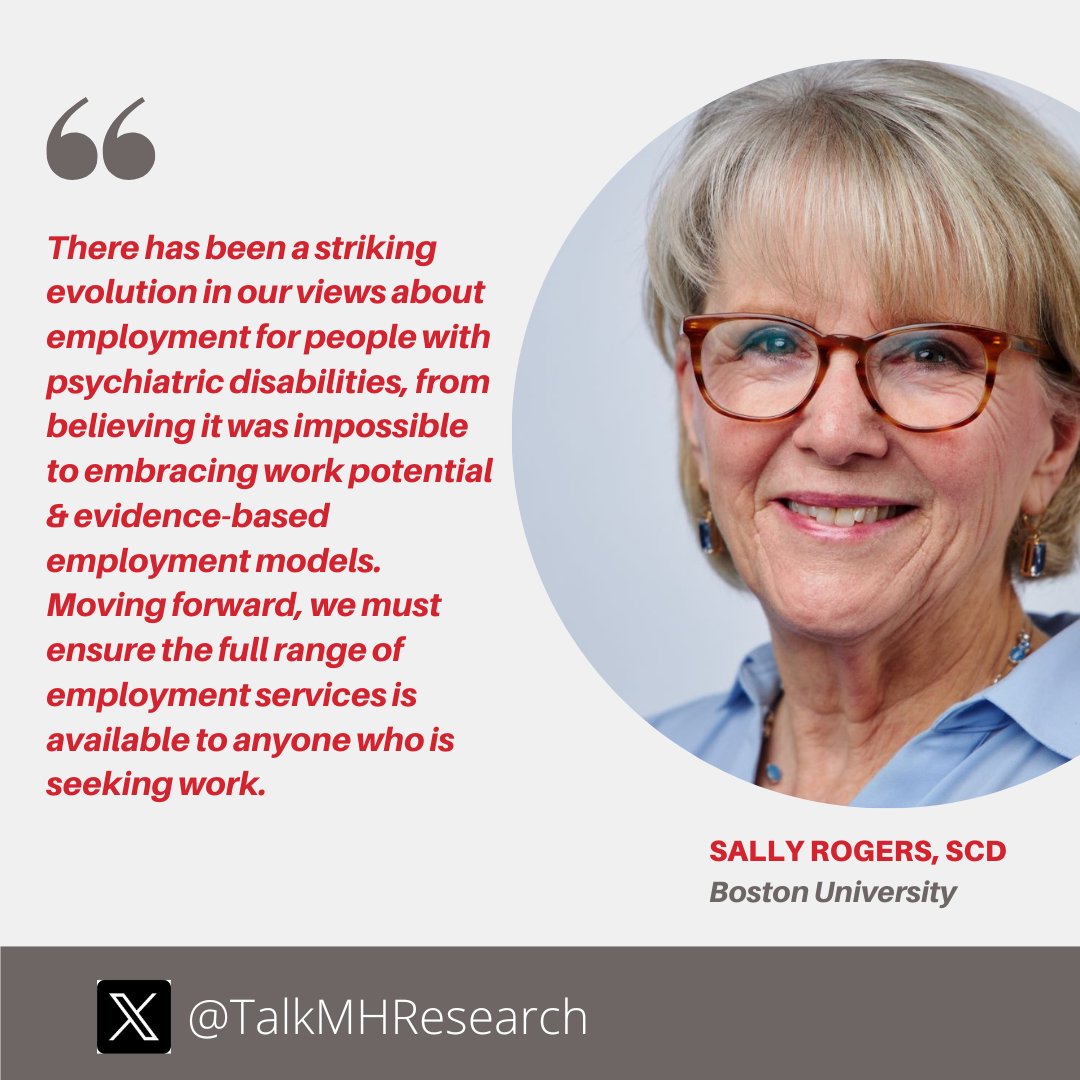
Welcome to all of our followers! We have great dialogue going. Don't forget that you can ask expert Sally Rogers anything this month about disability employment research. She’s sharing many important & inspiring resources here, & would love to answer more questions!
@pjsteig I think that this is an excellent idea for research. We will be examining SDoH for a newly funded project in aging and MH--perhaps we can take a closer look in those planned analyses for SDoE!
@IPSinAction@UICHealthRRTC Very true! Anecdotally, we have heard from young adults that have attempted post secondary ed, that their student debt may be worse because they have to take school multiple times to deal with their MH condition, accruing more debt but with no credentials.
The Center for Psychiatric Rehabilitation developed an innovative College Mental Health Education Program, designed to support young adults in college with psych disabilities https://t.co/oZLCFCGRhb
The National Institute of Mental Health recognized the educational & vocational needs of young people with psych disabilities with the RAISE study: https://t.co/7j06UVmaWU
@IPSinAction@UICHealthRRTC (Part 2 of 2) This is a compelling study of the cost of mental illness over the life time and the mitigating effects of employment on those costs: https://t.co/hPkuEtPc0i
@TUCollab The majority of jobs require social interaction & community engagement. Having co-workers, getting to & from work, engaging with customers-these are all aspects of community engagement that are born from and can flourish because of work.Ppl also report that work combats isolation