In life you may not control every circumstance, but you can control how you face it.
A strong mindset can turn obstacles into opportunities and setbacks into strength.
𝐓𝐡𝐞 𝐨𝐧𝐥𝐲 𝐝𝐢𝐬𝐚𝐛𝐢𝐥𝐢𝐭𝐲 𝐢𝐧 𝐥𝐢𝐟𝐞 𝐢𝐬 𝐚 𝐛𝐚𝐝 𝐚𝐭𝐭𝐢𝐭𝐮𝐝𝐞.
𝐈𝐍 𝐈𝐍𝐃𝐈𝐀, 𝐀𝐒𝐊𝐈𝐍𝐆 𝐅𝐎𝐑 𝐀𝐍𝐒𝐖𝐄𝐑𝐒 𝐂𝐀𝐍 𝐂𝐎𝐌𝐄 𝐀𝐓 𝐓𝐇𝐄 𝐂𝐎𝐒𝐓 𝐎𝐅 𝐘𝐎𝐔𝐑 𝐋𝐈𝐅𝐄.
The Right to Information Act was supposed to empower ordinary citizens to question the government, expose corruption and demand accountability.
But what happens when the people asking those questions become targets themselves?
The numbers are deeply disturbing.
According to the Commonwealth Human Rights Initiative (CHRI), as reported by The Week in October 2025:
• At least 107 RTI activists have been killed in cases linked to their use of the RTI Act.
• At least 7 activists have reportedly been driven to suicide.
• CHRI’s earlier 2022 figures had already documented 180 physical assaults and 187 incidents of threats and harassment.
These are documented cases, not a claim that every death has been legally established as a murder motivated by RTI activism.
And here is another disturbing part.
In a written reply in the Rajya Sabha on 20 July 2022, the Ministry of Home Affairs stated that the NCRB does not maintain separate data on attacks against RTI activists.
Think about that.
People risk their lives trying to expose corruption, but the country does not even maintain a dedicated national crime database to track attacks against them.
Now consider whistleblower protection.
India passed the Whistle Blowers Protection Act in 2014. It was meant to protect people exposing corruption and misuse of public office.
Yet, in a parliamentary reply dated 11 December 2025, the government confirmed that the Act had STILL NOT BEEN BROUGHT INTO FORCE.
The government cited the need for amendments concerning disclosures affecting national sovereignty and security.
Meanwhile, the Central Vigilance Commission continues to receive corruption disclosures under the separate PIDPI framework.
So we have a law passed in 2014 that remains unimplemented, no separate NCRB tracking of attacks on RTI activists, and citizens who continue to face threats for demanding answers.
This is not just an RTI issue.
It is a democracy issue.
A citizen should not have to choose between staying silent and risking their life.
The government must answer some basic questions:
Why is there still no centralised database of killings, assaults and threats against RTI activists and whistleblowers?
Why has the Whistle Blowers Protection Act, 2014, still not been brought into force?
How many of these cases have resulted in convictions, and how many remain unresolved?
What protection is actually available to someone who exposes corruption involving powerful officials, contractors or political interests?
𝐖𝐇𝐎 𝐖𝐈𝐋𝐋 𝐏𝐑𝐎𝐓𝐄𝐂𝐓 𝐓𝐇𝐄 𝐏𝐄𝐎𝐏𝐋𝐄 𝐖𝐇𝐎 𝐓𝐑𝐘 𝐓𝐎 𝐏𝐑𝐎𝐓𝐄𝐂𝐓 𝐏𝐔𝐁𝐋𝐈𝐂 𝐌𝐎𝐍𝐄𝐘?
A democracy cannot call itself transparent if the people demanding transparency have to live in fear.
#RTI #Whistleblowers #India #Transparency #Accountability #Corruption
Sources:
1. CHRI data: 107 RTI activists killed and 7 reportedly driven to suicide — The Week, October 2025
2. Government admission that NCRB does not maintain separate data on attacks against RTI activists — Ministry of Home Affairs, Rajya Sabha reply
3. Whistle Blowers Protection Act, 2014 still not implemented — PIB, 11 December 2025
4. Earlier CHRI figures: 99 killings, 180 physical assaults and 187 threats/harassment incidents — Front Line Defenders, August 2022
5. Detailed documentation of attacks and deaths — CHRI report: Life and Death in the Time of RTI
The irony is unbelievable.
Villages affected by mining received no DMF-funded projects, while money meant for their welfare was spent on projects questioned by the CAG.
Who is accountable?
𝐎𝐃𝐈𝐒𝐇𝐀’𝐒 ₹𝟐𝟔,𝟔𝟎𝟐 𝐂𝐑𝐎𝐑𝐄 𝐌𝐈𝐍𝐈𝐍𝐆 𝐅𝐔𝐍𝐃: 𝐖𝐇𝐎 𝐀𝐂𝐓𝐔𝐀𝐋𝐋𝐘 𝐁𝐄𝐍𝐄𝐅𝐈𝐓𝐓𝐄𝐃?
The people living with the consequences of mining were supposed to benefit from the wealth extracted from their land.
But a CAG performance audit of Odisha’s District Mineral Foundation (DMF) has raised some serious questions about where that money actually went.
Between 2015–16 and 2023–24, Odisha’s 30 districts received ₹26,602 crore in DMF contributions from mining leaseholders. Nearly ₹25,970 crore was sanctioned for projects.
Now look at what the audit found:
1. Money spent in villages untouched by mining
₹983.32 crore was spent in 976 villages that were not identified as directly or indirectly affected by mining.
At the same time, 584 mining-affected villages received not a single DMF-funded project — including 488 directly affected villages and 96 indirectly affected villages in Keonjhar and Sundargarh.
2. Mining welfare money used for a hockey stadium
Sundargarh DMF spent ₹136.77 crore on the International Hockey Stadium in Rourkela.
The CAG questioned this expenditure, observing that the stadium did not fall under the activities permitted by the PMKKKY guidelines.
3. Money spent on purposes that raise serious questions
The audit flagged spending that included:
Vehicles for police patrolling.
Renovation of a municipality office.
Renovation of a reading room at the District Collector’s residence.
Inauguration expenses and school functions.
In Sundargarh alone, ₹25.01 crore was spent on such activities, classified as irregular by the audit.
4. ₹171.79 crore diverted to MGNREGS wages
Three DMF trusts released ₹171.79 crore for additional MGNREGS wage payments — a use the CAG found to be in violation of the applicable guidelines.
5. Poor financial control
Implementing agencies had not returned ₹470.25 crore in unspent project funds to the respective DMFs after project completion. Another ₹26.51 crore in interest earned on those funds was also not returned.
6. Projects approved outside the prescribed framework
The CAG identified ₹679.14 crore sanctioned for projects beyond the permissible activities under PMKKKY guidelines.
These are not allegations from social media. These are findings and observations recorded in a CAG performance audit.
And remember what DMF money is meant for: drinking water, healthcare, education, environmental protection, sanitation, skill development and livelihoods for communities affected by mining.
The people of Keonjhar and Sundargarh live with the dust, pollution, environmental damage and disruption caused by mining.
When thousands of crores are collected in their name, they deserve more than announcements and construction projects that may not address their needs.
The real question is not how much money Odisha collected from mining. It is how much of that money actually improved the lives of the people who paid the price for it.
The Odisha government must publicly explain:
Who approved these projects?
Who is accountable for expenditure flagged by the CAG?
Will the irregular expenditure be investigated and recovered wherever required?
When will the mining-affected villages that received no projects finally get the development they were promised?
𝐍𝐀𝐓𝐔𝐑𝐀𝐋 𝐑𝐄𝐒𝐎𝐔𝐑𝐂𝐄𝐒 𝐒𝐇𝐎𝐔𝐋𝐃 𝐂𝐑𝐄𝐀𝐓𝐄 𝐖𝐄𝐀𝐋𝐓𝐇 𝐅𝐎𝐑 𝐓𝐇𝐄 𝐏𝐄𝐎𝐏𝐋𝐄 — 𝐍𝐎𝐓 𝐉𝐔𝐒𝐓 𝐑𝐄𝐕𝐄𝐍𝐔𝐄 𝐅𝐎𝐑 𝐓𝐇𝐄 𝐆𝐎𝐕𝐄𝐑𝐍𝐌𝐄𝐍𝐓.
#Odisha #DMF #CAG #Mining #Accountability #Governance
Sources:
Official CAG Odisha Performance Audit, Report No. 7 of 2026: CAG report
Business Standard — CAG flags ₹1,662 crore DMF spending outside norms
The Indian Express — Where did funds for mining areas go in Odisha?
𝐖𝐇𝐀𝐓 𝐈𝐅 𝐓𝐇𝐄 𝐆𝐎𝐕𝐄𝐑𝐍𝐌𝐄𝐍𝐓 𝐂𝐋𝐀𝐈𝐌𝐒 𝐀 𝐏𝐎𝐎𝐑 𝐅𝐀𝐌𝐈𝐋𝐘 𝐇𝐀𝐒 𝐑𝐄𝐂𝐄𝐈𝐕𝐄𝐃 𝐀 𝐇𝐎𝐔𝐒𝐄, 𝐁𝐔𝐓 𝐓𝐇𝐀𝐓 𝐅𝐀𝐌𝐈𝐋𝐘 𝐒𝐓𝐈𝐋𝐋 𝐃𝐎𝐄𝐒𝐍’𝐓 𝐇𝐀𝐕𝐄 𝐎𝐍𝐄?
A CAG performance audit of Pradhan Mantri Awaas Yojana-Gramin in Bihar exposed serious implementation failures between 2017–18 and 2023–24.
𝐋𝐎𝐎𝐊 𝐀𝐓 𝐓𝐇𝐄 𝐅𝐈𝐍𝐃𝐈𝐍𝐆𝐒:
1️⃣ 𝐇𝐎𝐔𝐒𝐄𝐒 𝐂𝐎𝐌𝐏𝐋𝐄𝐓𝐄𝐃 𝐎𝐍 𝐏𝐀𝐏𝐄𝐑, 𝐈𝐍𝐂𝐎𝐌𝐏𝐋𝐄𝐓𝐄 𝐎𝐍 𝐓𝐇𝐄 𝐆𝐑𝐎𝐔𝐍𝐃
• 306 out of 1,324 houses marked completed had not even reached the roof-casting stage. • Only 961 of those 1,324 houses were actually found completed during physical verification.
2️⃣ 𝐒𝐄𝐑𝐈𝐎𝐔𝐒 𝐕𝐄𝐑𝐈𝐅𝐈𝐂𝐀𝐓𝐈𝐎𝐍 𝐅𝐀𝐈𝐋𝐔𝐑𝐄𝐒
• In 155 cases, photographs uploaded to the government portal showed different houses from those physically verified. • In 55 cases, houses were geo-tagged at incorrect locations, including outside their district and even outside Bihar.
3️⃣ 𝐅𝐀𝐌𝐈𝐋𝐈𝐄𝐒 𝐖𝐀𝐈𝐓𝐈𝐍𝐆 𝐅𝐎𝐑 𝐌𝐎𝐍𝐄𝐘
• In 1,248 out of 1,454 sampled cases, the first instalment was delayed. • 390 beneficiaries who received their first instalment had still not started construction even after 34 to 93 months.
4️⃣ 𝐄𝐕𝐄𝐍 𝐂𝐎𝐌𝐏𝐋𝐄𝐓𝐄𝐃 𝐇𝐎𝐔𝐒𝐄𝐒 𝐋𝐀𝐂𝐊𝐄𝐃 𝐁𝐀𝐒𝐈𝐂 𝐅𝐀𝐂𝐈𝐋𝐈𝐓𝐈𝐄𝐒
• 541 out of 961 physically verified completed houses had no toilets. • 157 houses lacked basic amenities such as drinking water, electricity, LPG connections, bathing areas or waste-management facilities.
5️⃣ 𝐏𝐔𝐁𝐋𝐈𝐂 𝐌𝐎𝐍𝐄𝐘 𝐀𝐍𝐃 𝐌𝐎𝐍𝐈𝐓𝐎𝐑𝐈𝐍𝐆 𝐅𝐀𝐈𝐋𝐔𝐑𝐄𝐒
• ₹53 lakh was transferred to incorrect bank accounts in 83 cases. • Delays in transferring central funds to the State Nodal Account created an interest liability of ₹71.08 crore. • Only 3,648 of the 13,328 required social audits were conducted — just 27%.
Think about this.
A poor family waits years for a permanent home. Government records show progress. Funds are allocated. Completion figures are celebrated.
But the CAG’s physical verification reveals a very different picture in the sampled cases.
This is not just about construction. It is about public money, accountability and the dignity of families who depend on government support.
𝐀 𝐇𝐎𝐔𝐒𝐄 𝐂𝐎𝐌𝐏𝐋𝐄𝐓𝐄𝐃 𝐎𝐍 𝐀 𝐆𝐎𝐕𝐄𝐑𝐍𝐌𝐄𝐍𝐓 𝐃𝐀𝐒𝐇𝐁𝐎𝐀𝐑𝐃 𝐈𝐒 𝐍𝐎𝐓 𝐓𝐇𝐄 𝐒𝐀𝐌𝐄 𝐀𝐒 𝐀 𝐅𝐀𝐌𝐈𝐋𝐘 𝐑𝐄𝐂𝐄𝐈𝐕𝐈𝐍𝐆 𝐀 𝐂𝐎𝐌𝐏𝐋𝐄𝐓𝐄, 𝐋𝐈𝐕𝐄𝐀𝐁𝐋𝐄 𝐇𝐎𝐌𝐄.
Who is accountable when the records and ground reality don’t match?
And how many such failures go unnoticed when proper audits are not conducted?
#PMAY #Bihar #CAG #GovernmentAccountability #PublicFunds #RuralDevelopment #India
Source: CAG Audit Report No. 4 of 2025 — Bihar.
🚨INDIA IS POLLUTING THE VERY RIVERS THAT KEEP THE COUNTRY ALIVE.
The numbers should concern every Indian.
According to United Nations SDG data:
• The proportion of India’s river water bodies with good ambient water quality fell from 36.7% in 2017 to just 10% in 2023.
• Only 29% of domestic wastewater was safely treated in 2024.
• India withdrew approximately 66% of its available renewable freshwater resources in 2023.
And CPCB monitoring data for 2024 revealed:
• 146 out of 768 water-quality monitoring stations across 70 rivers recorded Biochemical Oxygen Demand (BOD) levels above prescribed limits.
• Faecal coliform levels exceeded limits at 227 monitoring stations across 101 rivers during the pre-monsoon period.
Think about what these numbers mean.
Untreated sewage, industrial discharge and inadequate wastewater management are putting our rivers under enormous pressure.
We worship rivers. We celebrate them as sacred. Millions depend on them for drinking water, agriculture, livelihoods and survival.
Yet we continue to put this precious resource at risk.
We talk about becoming a developed nation by 2047.
But what kind of development are we building if we cannot protect the water our people depend on?
Where is the accountability? Who is responsible for ensuring that sewage is treated and industrial waste does not enter our rivers?
A nation cannot secure its future while poisoning its own water.
#India #RiverPollution #WaterCrisis #Environment #CleanRivers #WaterSecurity #ClimateAction
Sending a child to school and educating a child are two very different things.
According to ASER 2024, only 23.4% of Class 3 children in government schools could read a Class 2-level text.
Only 27.6% could solve a basic subtraction problem.
Think about that.
Children are progressing through grades, but many are still struggling with foundational skills.
We measure education through enrolment, buildings and examination results.
But shouldn’t we measure it by what children can actually read, understand and calculate?
What is the point of schooling if a child leaves the classroom without learning the basics?
Education is not about how many children enter a classroom.
It’s about how much they learn inside it.
#Education #IndianEducation #ASER2024 #EducationReform #India #LearningCrisis
🔴4 years of Russia–Ukraine war. Missiles and drones striking regularly. No outrage.
🔴3 years of Israel–Hamas war. Rockets, airstrikes and destruction. No comparable environmental panic.
🔴7 months of US–Iran war. Military strikes and escalation. No festival-style lectures.
🔴1 month of Saudi–Houthi conflict. More attacks and destruction.
But Sunday is Diwali.
Suddenly, fireworks will destroy the environment, global warming will peak, glaciers will melt and dogs will suffer severe mental trauma.
Let’s be clear: pollution matters, and firecracker emissions deserve attention.
But why is environmental concern so selective?
If you care about the environment, care about it consistently — not just when it’s Diwali.
Anyway, wishing everyone a very Happy Diwali! May this festival bring happiness, peace and prosperity to every home. 🪔❤️
#HappyDiwali #Diwali #Environment #AirPollution #ClimateChange #DoubleStandards
Today, I watched Ramayana, and honestly, my chest swelled with pride.
There are films you watch for entertainment.
And then there are stories that touch something deep inside your soul.
Ramayana is not just a story for us.
It is our civilisation, our heritage, our values and our history — a legacy passed down through generations.
For centuries, this epic has lived in our homes, our hearts and our culture. Seeing it brought to life on such a magnificent cinematic scale was an emotional experience.
A special salute to @niteshtiwari22 for his vision and for bringing this epic to the screen with such grandeur.
And a huge appreciation to @malhotra_namit for daring to dream on this scale and having the courage, ambition and determination to turn that dream into reality.
This is what Indian cinema should aspire to — telling our stories with the scale, quality and ambition they deserve.
We have stories the world needs to see.
We have a civilisation with thousands of years of heritage.
And we should never hesitate to showcase it to the world.
Today, I didn’t just watch a film.
I felt proud of our heritage.
Jai Shri Ram. 🙏🇮🇳
#Ramayana #JaiShriRam #IndianCinema #NiteshTiwari #NamitMalhotra #IndianCulture #ProudIndian
Indian society expects women to work two shifts — one for the economy and another for the family.
But only one gets recognised as work.
India’s Time Use Survey 2024 exposes the imbalance:
🔴92.9% of women aged 15–59 participated in unpaid domestic work, compared with just 30.4% of men.
🔴Women spent an average of 305 minutes a day on domestic work. Men spent 86 minutes.
🔴41% of women participated in unpaid caregiving, compared with 21.4% of men.
🔴Women spent 140 minutes a day on caregiving, while men spent 74 minutes.
🔴Only 24.9% of women participated in paid activities, compared with 74.5% of men in the same age group.
Read those numbers again.
A woman cooks, cleans, raises children, cares for elderly parents and keeps the household running.
And society often calls it her responsibility, not her work.
We celebrate women on Women’s Day, talk about empowerment and quote equality.
But inside many homes, how much of that equality actually exists?
If a man works eight hours outside and a woman works eight hours outside too, who is expected to do the cooking, cleaning and caregiving when they both return home?
Why is unpaid domestic work still treated as a woman’s natural duty rather than a shared responsibility?
The real question is not whether women are capable of doing more.
It’s why society still expects them to do so much more.
#GenderEquality #UnpaidCareWork #WomensRights #TimeUseSurvey2024 #India #EqualResponsibility
🚨 A country begins to decline when people start treating its problems as normal.
First, people stop questioning.
Then, institutions stop answering.
Eventually, incompetence becomes normal, corruption becomes routine, and accountability becomes a joke.
The most dangerous stage isn’t when a country is poorly governed.
It’s when people become so used to poor governance that they stop demanding better.
That’s when decline starts looking like normal life.
Stop normalising failure.
Question those in power.
Demand accountability.
Refuse to settle for less than your country deserves.
Silence protects those in power.
Your voice can demand change.
🧠A mathematical challenge for every AI on Earth.
Start with any positive integer n₀.
Generate the next number using these rules:
• If nₖ is even: nₖ₊₁ = nₖ / 2
• If nₖ is odd: nₖ₊₁ = 3nₖ + 1
Repeat this process indefinitely.
THE CHALLENGE:
Prove or disprove that, for every positive integer n₀, the sequence eventually reaches 1 after a finite number of steps.
A valid proof must cover ALL positive integers, not just numbers tested by computers.
No assumptions.
No brute-force evidence presented as proof.
Only rigorous mathematics.
Can AI solve a problem that remains unsolved?
Name: The Collatz Conjecture.
BETI BACHAO, BETI PADHAO:
11 YEARS OF SLOGANS.
WHERE IS THE FULL ACCOUNTABILITY?
In January 2015, the government launched Beti Bachao, Beti Padhao with a powerful promise: protect the girl child, fight gender discrimination and ensure girls get the education and opportunities they deserve.
It was a promise every Indian should support.
But after more than a decade, we must ask a difficult question: How much measurable change has this scheme actually delivered, and how much of its success can be directly attributed to it?
Let’s examine the government’s own data. 🧵
1️⃣ ₹740.18 CRORE SPENT. ₹401.04 CRORE ON MEDIA CAMPAIGNS.
According to the Ministry of Women and Child Development, between 2014–15 and 2021–22, the scheme recorded expenditure of ₹740.18 crore at the Ministry level.
Of this, ₹401.04 crore — approximately 54% — went towards media advocacy and campaigns.
That is more than half the expenditure during those years.
The government defended the spending, saying the campaign helped establish the scheme’s brand and create awareness about the value of the girl child.
But here is the uncomfortable question:
How do we measure success — by how recognisable a government slogan becomes, or by independently verified improvements in girls’ lives?
2️⃣ WHAT ABOUT THE LATEST NUMBERS?
The government’s February 2026 parliamentary reply reported:
• Sex ratio at birth increased from 918 girls per 1,000 boys in 2014–15 to 929 in 2024–25.
• Girls’ gross enrolment ratio at the secondary-school level rose from 75.51% to 80.2% over the same period.
These improvements matter. They should not be dismissed.
But there is an important distinction: these are national-level indicators. They do not, by themselves, prove how much improvement was caused by Beti Bachao, Beti Padhao rather than other government programmes or wider social changes.
The government must demonstrate the scheme’s specific contribution, not simply point to national progress.
3️⃣ THE PROBLEM IS BIGGER THAN A SLOGAN.
Saving a girl child is only the beginning.
Can she complete school? Can she pursue higher education? Can she work without discrimination? Can she travel safely? Can she make decisions about her own life?
A scheme that claims to empower girls must be judged across these outcomes — not merely by awareness campaigns or a single national statistic.
And rising school enrolment alone does not tell us how many girls complete their education, learn effectively or gain access to meaningful employment.
These are the questions that deserve serious measurement.
4️⃣ WHERE IS THE TRANSPARENT, DISTRICT-BY-DISTRICT SCORECARD?
Citizens deserve publicly accessible data showing:
• How much money was allocated, released and actually spent in each state and district?
• How much reached grassroots interventions rather than publicity?
• Which districts improved, which stagnated and which regressed?
• How many girls were helped to remain in school and complete secondary education?
• What independent evaluation establishes the scheme’s impact compared with what would likely have happened without it?
These are reasonable questions for any publicly funded programme.
They are not an attack on the cause. They are demands for accountability to the very girls the scheme was created to serve.
5️⃣ THE GOVERNMENT MUST BE HELD TO ITS OWN PROMISE.
Beti Bachao, Beti Padhao was never supposed to be merely a slogan. It was supposed to change the lives of millions of girls.
If it has succeeded, publish the evidence and show the country exactly where, how and by how much.
If gaps remain, acknowledge them and fix them.
And if certain interventions have delivered poor results, taxpayers deserve to know why.
A girl’s future is not a publicity campaign.
Beti bachao. Beti padhao. And above all, prove that the promises are being delivered.
#BetiBachaoBetiPadhao #GirlsEducation #WomenEmpowerment #Accountability #Indian
You earn money → pay income tax.
You spend what remains → pay GST.
You buy a car → pay road tax.
You buy fuel → pay fuel taxes.
You buy property → pay stamp duty.
You save and invest → face more taxes.
Earn. Pay. Spend. Pay again. Save.
Get taxed. Die. Leave your wealth behind—and your family may face taxes along the way.
🚨WHAT IF GOLD COULD BE MANUFACTURED IN A NUCLEAR REACTOR?
A San Francisco startup claims it has turned mercury into real, stable gold using nuclear fusion technology — and says its result is 10 times CERN’s previous record.
If independently verified and eventually made commercially viable, this could have implications far beyond a scientific breakthrough.
It could create a new revenue stream for fusion energy and
raise a bigger question: what happens when a material we consider scarce can be manufactured?
For centuries, turning ordinary metals into gold was the dream of alchemists. Today, nuclear physics may be bringing that dream into the realm of science.
🧵 But how does mercury actually become gold, what has the company proved so far, and could this technology ever disrupt the global gold market? Let’s break it down.
AN IAS OFFICER IS NOT A KING.
HIS SUBORDINATES ARE NOT HIS PERSONAL SUBJECTS.
Meet Kumar Rajeev Ranjan, a 2010-batch IAS officer serving in Jammu & Kashmir.
During an official meeting, a video allegedly captured him calling a junior woman officer “bloody shit”, declaring “I am your boss, stupid”, and directing that a suspension order be prepared after she challenged his language.
Now, look at the wider record:
🔴 2020: Suspended following his arrest by the CBI in an arms-licence case involving alleged forged documents.
🔴 2021: Reinstated by the government.
🔴 2025: Reportedly investigated by the CBI in a disproportionate-assets case, with searches at seven locations.
🔴 2026: An inquiry has been ordered into the alleged misconduct towards a junior woman officer.
To be clear: allegations are not convictions, and the current inquiry must follow due process.
But here is the question:
Who holds powerful bureaucrats accountable when they allegedly misuse their authority?
An IAS badge should represent public service—not personal superiority.
Power is not permission to humiliate people. And “I am your boss” is not an answer to accountability.
My demand:
Kumar Rajeev Ranjan must be suspended pending a fair and impartial inquiry.
The woman officer must be protected from retaliation, and the findings must be made public.
Sources:
https://t.co/Sjdxh3d4aF
#IAS #Bureaucracy #Accountability #WomenAtWork #JammuAndKashmir
Did a little digging.
Here are the full details of this man and his disgusting comments about women.
The name associated with the X account @jyotipandabbsr is Jyotirmaya Panda.
He is from BHUBANESWAR .
His bio reportedly describes him as an electrical engineer.
He was reportedly a Plant Head at Kurlon in Bhubaneswar and is currently said to be a General Manager at Sheela Foam in Bhubaneswar.
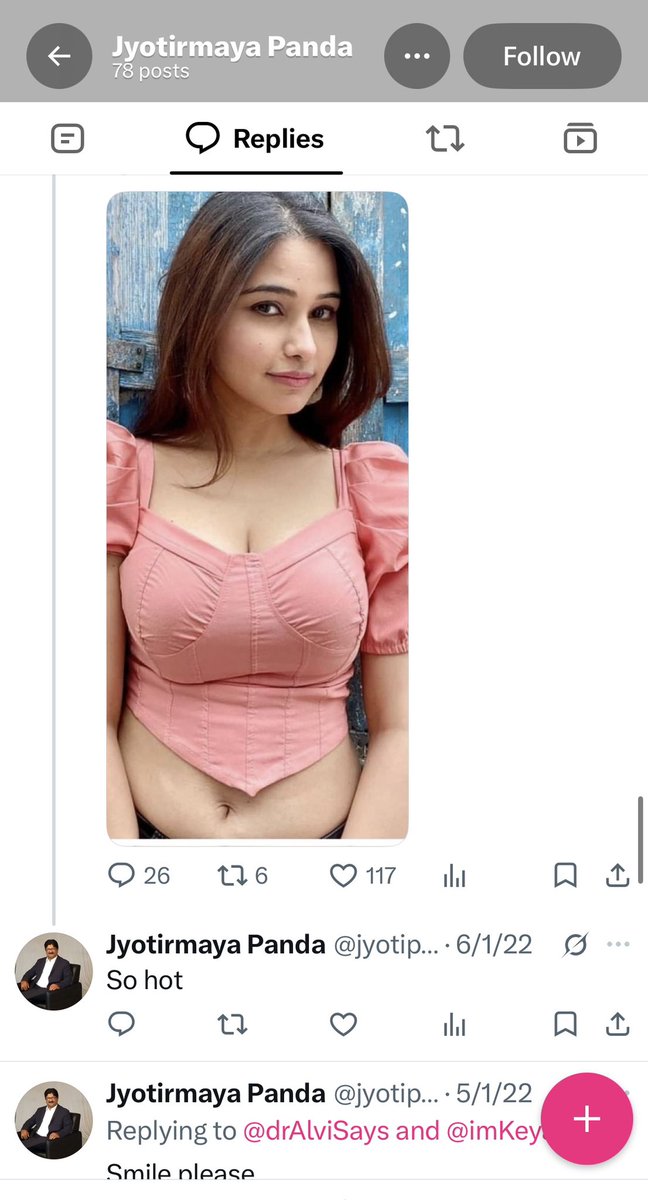
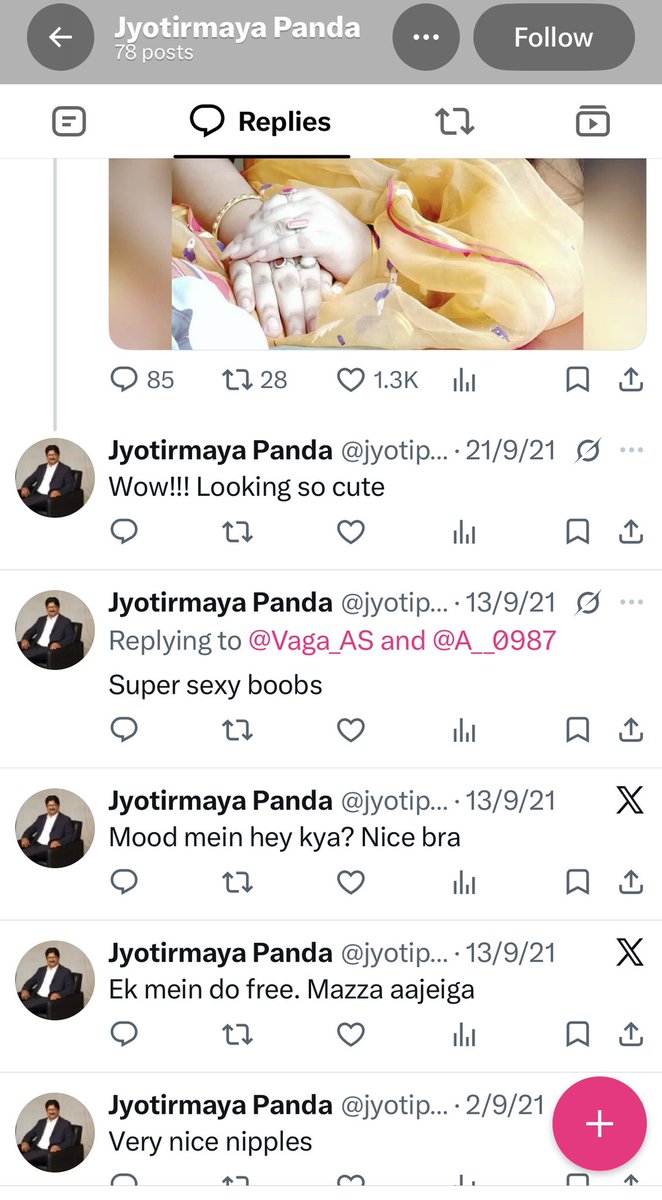
Screenshots show sexually suggestive comments about women attributed to this account.
If the account is genuine and belongs to this individual, this behaviour raises serious concerns about respect for women and professional conduct.
@b2bsheelafoam@mysleepwell — will you verify the account ownership and clarify whether this individual is associated with your organisation?
A professional title deserves respect only when accompanied by professional responsibility. Accountability matters.
🔗 https://t.co/dFVyEofLJs
#SheelaFoam #Sleepwell #Kurlon #RespectWomen #ProfessionalEthics #AccountabilityMatters
Does anyone from Odisha know this man personally? Who is he, and what exactly is his role at sheelafoam?
If this account is genuine, it’s absolutely disgusting—especially from someone in a senior position.
Can anyone verify his identity and professional background?
Sheelafoam @b2bsheelafoam
— IS THIS THE PUBLIC CONDUCT YOU EXPECT FROM YOUR SENIOR LEADERS?
I’m bringing a serious question to your attention.
An X account identified as @jyotipandabbsr has screenshots showing sexually suggestive comments about women, including remarks about their bodies.
These are not allegations of a crime. They are public comments that deserve scrutiny and a fair response.
Public professional profiles and company-related records also list a Jyotirmaya Panda in connection with Kurlon and Sheela Foam. The company should clarify whether the account belongs to its employee.
My questions to @b2bsheelafoam :
• Does this account belong to your General Manager?
• Are these comments consistent with your standards of respect for women?
• Will the company verify the screenshots and respond transparently?
A senior position comes with responsibility.
Professional status should never put anyone beyond reasonable scrutiny.
I’m asking for verification and accountability—not a verdict based on screenshots alone.
@b2bsheelafoam, will you address this publicly?
X account: https://t.co/dFVyEofLJs
#SheelaFoam #Kurlon #RespectWomen #ProfessionalEthics #Accountability