We’ve explained crypto like it’s only for devs.
Used language that makes people feel like outsiders.
Told folks to “DYOR” while giving them whitepapers full of high-industry language. 😵💫
I don’t think people are TOO SLOW FOR CRYPTO.
They’re just not spoken to in the right language.
That’s why I make content that:
– Explains Web3 like you’re my cousin
– Brings culture & emotion into the space
– Doesn’t assume everyone’s a tech bro
If we want mass adoption,
We have to start with mass connection.
That’s what I care about ❣️
That’s what I’m building.
Hi, I’m Mide. I believe in better crypto culture, real connection, and onboarding the next billion humans into the space.
Not just “users.” People.
If this resonates, follow me.
And if you know someone who’s been curious about Web3 but feels lost or left out
Share this with them.
You might be the reason they finally feel like they belong.
Let’s build something more human. Together. 🕸️❤️
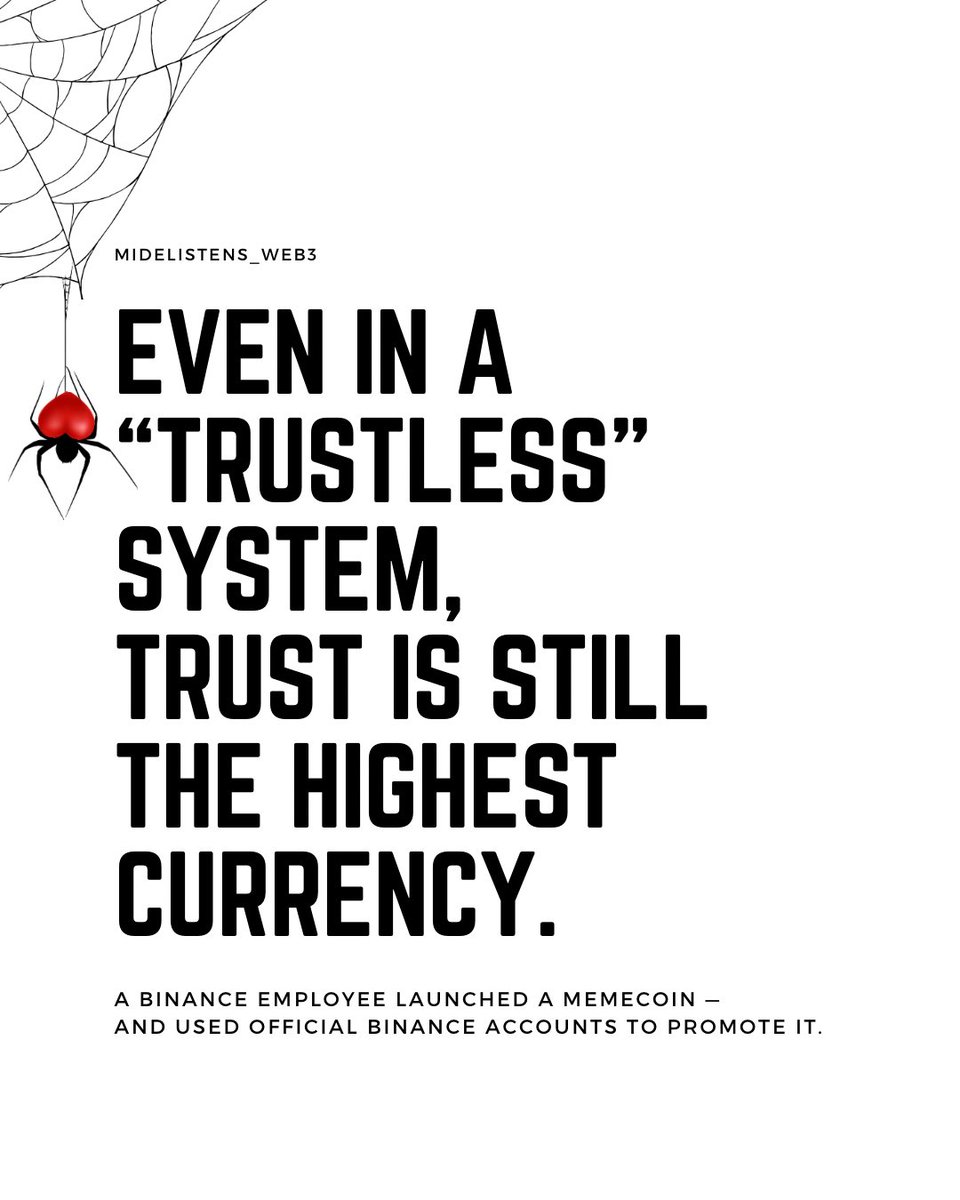
So yes — even in a trustless system, trust is still a high-value currency.
Verification can be automated.
Trust can’t.
Web3 needs more heart and culture.✨❤️
From the outside, these moments rarely come with context.
They leave people wondering:
“Who’s being truly honest here?”
“Is this fair?”
“Is this insider-driven?”
Those questions matter for mass adoption.
Here’s the irony:
Web3 reduces the need to trust systems.
But it still relies on people to act responsibly within them.
When credibility is misused, confidence in the ecosystem takes a hit.
Binance later suspended the employee, calling it an abuse of position for personal gain.
The technology didn’t fail.
The systems worked.
What failed was something more abstract:
human judgment, ethics, and restraint.
Those don’t get replaced by code.
What happened (facts only):
A Binance employee launched a memecoin and used official Binance Twitter accounts to promote it.
Because those accounts carry institutional credibility, people acted — and the token pumped.
https://t.co/MnI053iNoL
Web3 is often described as “trustless”,
you don’t have to trust intermediaries or institutions to verify transactions.
That doesn’t mean trust isn’t needed.
It simply operates at a different layer.
I agree. Building for the real world requires sitting with the real world longer. Not just user metrics, but real emotions, confusion, and trust gaps.❤️🧠
Vulnerable post
Lately, I’ve been very nervous about the new year.
Not in a dramatic way.
More like a quiet pressure in my chest that makes me overthink every step I want to take.
I’ve realized a lot of my decisions come from one place:
seeking safety.
Emotional safety.
Creative safety.
Being able to truly live and make an impact — not just survive.
Because I know, deeply, what it feels like to not feel safe, and that’s an unhealthy environment for any human to grow.
I’ve also noticed how childlike I can be, How trusting.
And I don’t want to lose that by becoming paranoid.
So instead, I analyze for safety.
Not to harden myself, but to find places where I can be soft safely.
That kind of space is rare.
And it’s why I deeply appreciate the few people who genuinely try to create safety for others, especially in places where it isn’t common.
Even when I don’t directly benefit from it.
The feeling it gives isn’t happiness.
It’s relief.
And I’m learning that safety is what allows so many good things to exist in the first place.
Safety is truly a priceless gift. ❤️
I hope one day I’ll look back at this from a calmer, more optimistic place.
So yes — even in a trustless system, trust is still a high-value currency.
Verification can be automated.
Trust can’t.
Web3 needs more heart and culture.✨❤️
From the outside, these moments rarely come with context.
They leave people wondering:
“Who’s being truly honest here?”
“Is this fair?”
“Is this insider-driven?”
Those questions matter for mass adoption.