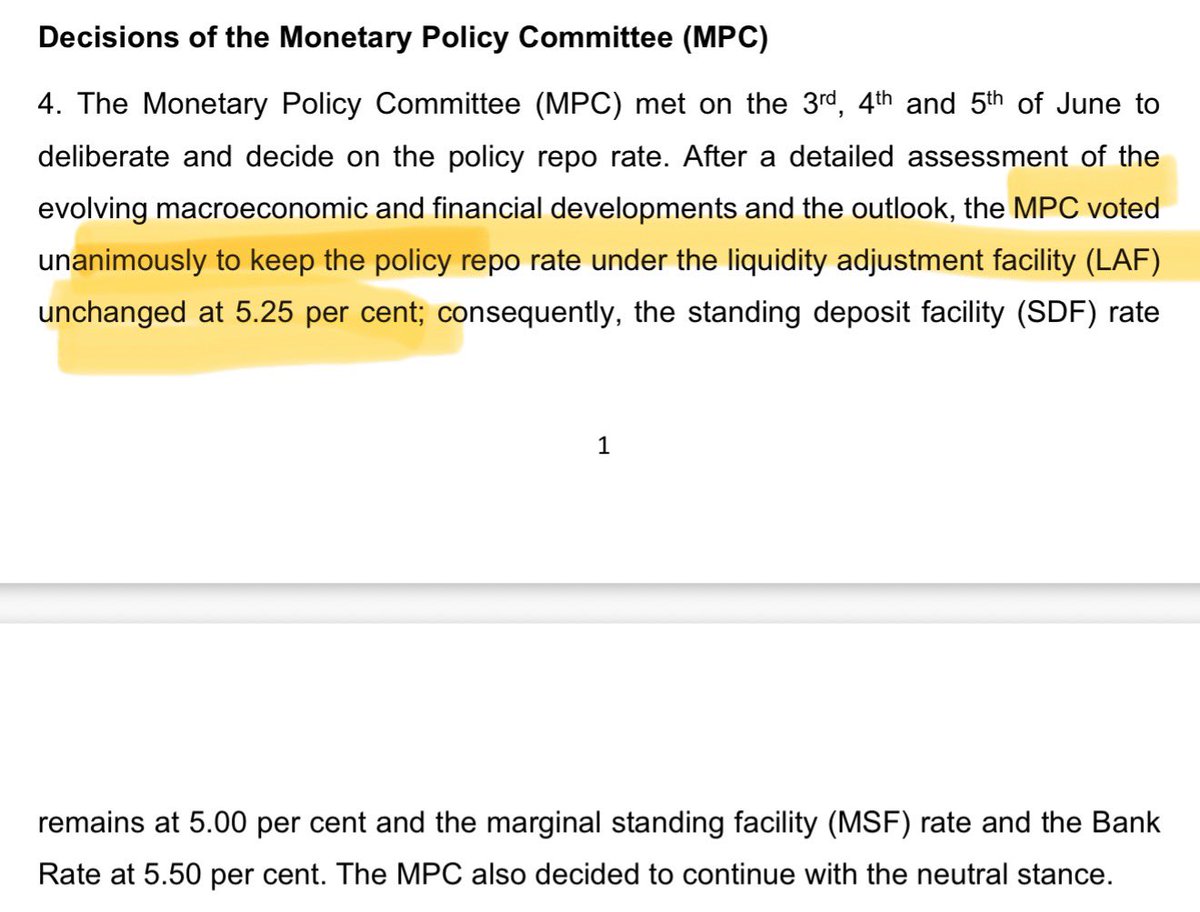
RBI kept the interest rate unchanged for now.
Real GDP growth estimate for 2026-27 is 6.6%. Revised CPI inflation at 4.7%.
Governor’s speech included many indicators which leaves it open ended to possibilities on tightening, majorly driven by supply side shocks and sustained demand.
- “Major advanced economy central banks are likely to pivot towards monetary policy tightening”
- Retail inflation is going to rise as a result of passing on the high input cost
- Discretionary spending is still high
- El Nino can be another supply side shock too but rural demand can soften as well
- Energy price increase, supply chain disruptions likely to weigh on economic activity
#rbi
Is #india facing another 1991-style economic #collapse ?
In 1991, Iraq's invasion of Kuwait triggered a perfect storm:
- #crudeoil prices surged
- rupee collapsed, and
- India's #forex reserves crashed to just $1.2 billion—barely enough to cover 2-3 weeks of imports
Government was forced to pledge 67 tonnes of #gold to the #IMF just to avoid default.
Thirty-five years later, a new #geopolitical #shock (Iran-Israel escalation, Strait
of Hormuz closure) is repeating the external pressure.
- Oil has climbed from ~$70 to $120+/barrel.
- rupee has weakened
- US tariffs of 50% on Indian goods are hammering exports.
So... are we repeating 1991?
https://t.co/iENME1a6iZ
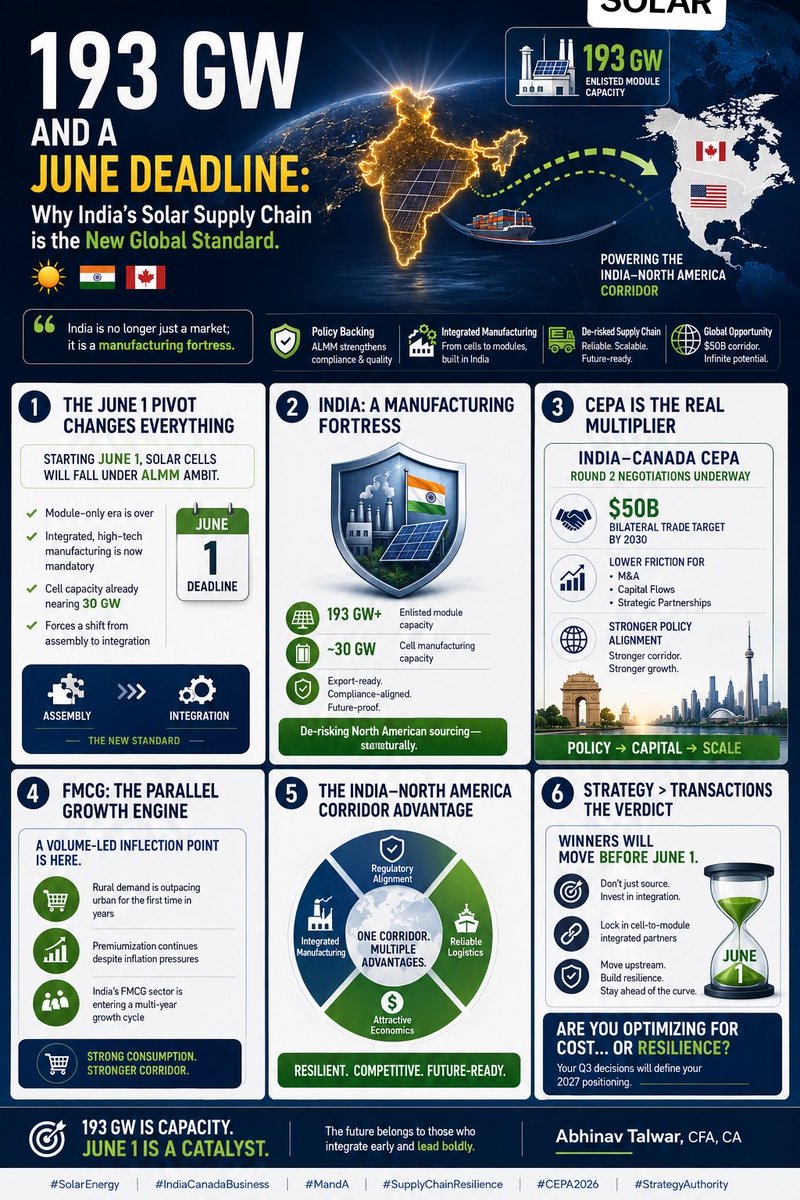
193 GW and a June Deadline: Why India’s Solar Supply Chain is the New Global Standard.
I’ve spent a few hours diving into the May 2026 ALMM (Approved List of Models and Manufacturers) updates by #MNRE and the signal is clear:
India is no longer just a market; it is a manufacturing fortress.
As of this week, India’s enlisted solar module capacity has officially surpassed 193 GW.
But the real "Strategy" play isn't in the module numbers—it’s in the June 1st cell mandate.
Here is what you need to know about the India-North America corridor today:
📆"June 1st" Pivot:
Starting next month, solar cells will officially fall under the ALMM ambit. This forces a shift from simple "module assembly" to integrated, high-tech manufacturing.
Cell capacity is already nearing 30 GW, de-risking the supply chain for North American buyers.
All modules for government and open-access projects must source cells from the ALMM List-II (domestic manufacturers). This forces a structural shift from simple "module assembly" to integrated, high-tech manufacturing.
With cell capacity already hitting 27-30 GW, the supply chain for North American buyers is becoming significantly de-risked.
🔋HJT Frontier:
The mandate is a massive catalyst for next-gen technologies. While TOPCon now accounts for over 39% of manufacturing capacity, the focus is rapidly shifting toward HJT (Heterojunction Technology).
Big firms are leading the charge into ultra-high efficiency, ensuring that Indian exports are not just cost-competitive, but technically superior.
Canadian Pipeline:
On the other side of the corridor, Canada’s demand is accelerating. With over 24 GW of opportunities announced for the next decade and roughly 8 GW of utility-scale solar and storage expected to connect by 2029, Canadian developers are actively seeking the high-efficiency, ALMM-compliant modules that India is now producing at scale.
📜The CEPA Momentum:
As of yesterday, India and Canada have entered the second round of CEPA negotiations in New Delhi.
💰With a target of $50B in bilateral trade by 2030, the friction for cross-border M&A in the energy and FMCG sectors is about to drop significantly.
💡Don't just source; invest in the integration. The winners in this corridor are those moving early to lock in cell-to-module integrated partners before the June 1st regulatory crunch.
Are you prioritizing supply chain "resilience" or "cost" in your Q3 cross-border planning?
Let’s discuss in the comments.
Follow Abhinav Talwar, CFA, CA
#SolarEnergy #IndiaCanadaBusiness #SupplyChainResilience #CEPA2026 #Canadarenewables #Renewable
The "Sweet Spot" of FMCG: Why the India-North America Bakery & Confectionery Corridor is Exploding in 2026. 🍪🍫🍰
If you think the Indian cookie and chocolate market is just about mass-market biscuits, you’re looking at an outdated map.
As we hit the mid-way point of 2026, the "Premiumization Pivot" has turned this into one of the most lucrative M&A and sourcing corridors in the world.
The 2026 Data Breakdown:
1.The Chocolate Surge:
The Indian chocolate market is projected to hit $2.72B this year, growing at a 7.63% CAGR. While North America remains the value leader, India is the growth engine.
The real story? Dark chocolate is outperforming the market with an 8% growth rate, driven by a new "Bean-to-Bar" movement.
2.The "Cookie King" Status:
India’s bakery market has surged past the $12B mark. While the US market is focused on "Functional & Keto" cookies, India is dominating the "Premium-Indulgence" space—fusing traditional ingredients like saffron and cardamom with high-end European patisserie techniques.
3.The Cake Revolution:
The Indian cake and pastry market is seeing a 6% YoY increase, with a massive shift toward Vegan and Sugar-Free alternatives.
In fact, specialty bakeries in Tier 1 Indian cities are now seeing 25% higher engagement when they offer hyper-customized, social-media-ready designs.
The Corridor Comparison:
• North America:
The focus is on "Clean Label" and "Functional Benefits" (Protein-fortified cookies, gluten-free pastries).
• India:
The focus is on "Premium Gifting" and "Flavor Fusion" (Traditional tastes meets modern French/Swiss textures).
Noticing a massive increase in North American specialty retailers looking for "Private Label" partners in India who can meet FSSAI and FDA/CFIA standards simultaneously. The "Made in India" tag for premium sweets is becoming a mark of artisanal quality, not just cost-efficiency.
Are you seeing more interest in Indian "Flavor Fusion" products in the North American retail space, or is "Clean Label" still the primary driver for your sourcing?
#FMCG #M&A #FoodIndustry #IndiaBusiness #SupplyChain #Premiumization #ConfectioneryTrends
One challenge with Indian authorities is not knowing the unknown with these new age assets and the fear of over or under regulation makes them followers vs. drivers of change.
In general also, Indian markets are still getting matured with many other decades old financial products like REITs/InvIts, F&O and regulating something as radical as bitcoin or stablecoins might be a stretch for the authorities.
Legalise Virtual Digital Assets (like Crypto, Stablecoin) in India. Don’t drive them offshore.
India taxes VDAs (virtual digital asset) like they are legal. But regulate it like they are illegal.
India taxes cryptocurrency at 30% Capital Gain Tax + 1% TDS; yet offers no legal recognition, no investor protection, no dedicated AML (anti-money laundering) framework.
The result is:
• 12 crore Indians invest via overseas platforms
• ₹4.8 lakh crore in VDA trading moved offshore
• 73% of India's trading volume shifted to foreign exchanges
• 180 Indian crypto startups relocated abroad
The answer is : compliance in India. Give VDAs clear asset class status in India.
A clear domestic regulatory sandbox, with strong AML guardrails can bring activity back onshore, protect investors, improve compliance and add ₹15,000–20,000 crore in annual tax revenue.
Let us not fear innovation, let us regulate it.
Prohibition is not protection, Regulation is protection.
Government has to be most reliable stakeholder and if they change course midway, that is breach of trust. Especially knowing that the move is driven by asset class up swing.
Taxing SGB Sovereign Gold Bonds retrospectively is unfair.
Investors were assured of tax-free maturity, but #Budget2026 made it taxable for secondary market buyers.
The proposal should be reviewed and dropped. What are your thoughts?
Baffled
Checked Armani Acqua Di GIO Elixir 50ML at Pearson Airport Toronto while leaving for Delhi and the tag price was $230 which I skipped buying eventually but after landing at IGI Delhi I thought to cross Armani aisle to compare prices and to my surprise it was listed at only ₹9000.
What in the world is driving the cost difference as big as 40%?
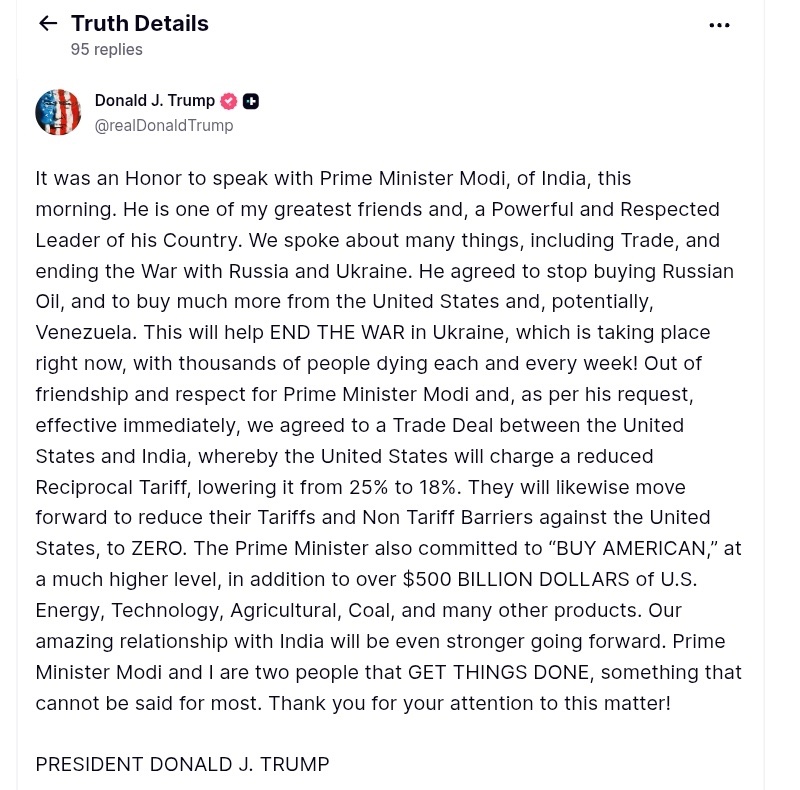
Haven’t read the fine print yet but assuming there is nothing net new for India, this deal gives them pass to keep exporting the current portfolio. Sure it is going to cost more in US but with everyone else is going to pay some kind of tariff, our sectors may not be too far out on rhe extreme end of the range. Now within US manufacturing, can our companies compete - that is to be seem in time.
I am fairly bad at mathematics. Can someone explain to me like I am 5, what benefit India got from the US India deal? Because I am scratching my head for an hour and I have nothing! ZERO Clue! Exactly like the ZERO tariff which apparently India has agreed to put on the US??? Are you f’ing kidding me?
Creeping up STT on Derivatives and positioning it be a deterrent is analogous to tobacco and liquor duties. People end up paying more for the habit vs. eliminating it.
90% F&O traders wouldn’t have lost money if financial cost was ever a deterrent.
It’s dopamine issue.
#Budget2026
Until 3 years ago, posting in-flight and in the air was not even possible for ordinary travellers but now it is made super convenient by @AirCanada and @Bell
Catching up with Budget speech en-route to Delhi. No problems at all.
p.s.: couldn’t watch live due to time zone and sleep cycle. 🙃
👇 सब बता दो एंड दिखा दो टाइम पे NRIs/PIOs
#Budget2026
Catching up with Budget speech en-route to Delhi. No problems at all.
p.s.: couldn’t watch live due to time zone and sleep cycle. 🙃
👇 सब बता दो एंड दिखा दो टाइम पे NRIs/PIOs
#Budget2026
What a day to fly out to India and miss Sunday trade day. Going to try to catchup with Budget highlights on-flight. Thanks to @AirCanada WiFi services.
#Budget2026#BudgetSession2026
Reduction in TCS from 5% to 2% for medical and education related remittances under LRS is a good move to reduce burden on Indian parents with children studying abroad.
This has been an undue hardship since launching TCS on remittances few years ago.
#Budget2026
What a day to fly out to India and miss Sunday trade day. Going to try to catchup with Budget highlights on-flight. Thanks to @AirCanada WiFi services.
#Budget2026#BudgetSession2026
Silver’s worst single day drop in 47 years comes today.
Silver’s use case in future is clear and demand supply will be tight with future technologies needing more Silver for EVs, Solar Panels, Electronics but the run up has been unprecedented and correction was around the corner.
#Silver #Gold