I've written a @claudeai skill that is useful when you’re starting a new project and want to absorb fifty papers before writing a word yourself.
/tyler converts a folder of academic PDFs into a token-efficient markdown wiki for literature review. Point it at a directory of papers and it produces one lightweight .md file per paper, plus an index, so Claude Code can load an entire literature into context without burning tokens on raw PDF parsing.
Named in honour of @tylercowen, the economist behind @MargRev and a famously voracious reader.
Available from --> https://t.co/B6mVrbmB4U
📢Call for papers
The 12th Annual Meeting of the Danish Society for Economic and Social History will commence under the theme of “Demography, Education, and Social Change in Economic History”
📅September 24th, 2026
📍University of Southern Denmark, Odense
Read more below!
A great chance to join us for a workshop in economic history in Odense - featuring a keynote talk by David de la Croix - applications from all areas are most welcome
Are you a PhD student interested in economic history?
Our summer school at the University of Southern Denmark in the beautiful town of Odense will be on theme of “Populism, uncertainty, and the globalized economy”
We will also have a focus on big data and ML tools
17-21 of Aug
A really dangerous situation. Too many submissions. Too many generated papers. Little responsibility.
1. In 2026, more than 24,000 submissions were made to the International Conference on Machine Learning (ICML). It’s TWO times more than in 2025. To fight it, the organizers now require researchers to pay $100 for every subsequent paper.
2. LLM adoption has increased researcher productivity by 90% (there’s a recent paper in Science).
3. The number of papers is becoming far too high. Submissions to arXiv have risen by 50% since 2022.
4. There are simply not enough reviewers. Plus, many scientists no longer want to invest precious time in it for free.
5. We can’t easily identify AI-made papers from the genuine ones.
__
Important words from Paul Ginsparg, a co-founder of arXiv:
“AI slop frequently can’t be discriminated just by looking at abstract, or even by just skimming full text. This makes it an “existential threat” to the system.”
Basically, we’re getting closer to the tipping point.
📍 Many professors blame the AI.
But the problem is likely elsewhere:
1. Without a sufficient number of papers, many PIs can’t get funded. They have to prove their credibility to reviewers. Their proposals have to rely on prior publications. In many countries, there are some informal (or even formal) expectations for how many papers a group with a certain size has to publish to survive (funding-wise).
2. Our students / postdocs need papers if they want to be hired in faculty roles. Yes, some departments hire people with few publications. But the majority still want to ensure their faculty can get funded. If funding is partly a function of papers, this is used in decision-making.
3. The number of papers is important if you want to get high-level awards. Many of them are not given because you published one paper (even if it’s great). They are given because you made a meaningful CONTRIBUTION to the field. How do you make it? Publish more papers.
4. Tenure promotions in many places take the number of your papers into account (often indirectly). Your tenure may get delayed if you don’t publish enough. Not everywhere, but for many mid- to low-ranked universities this story is more or less the same.
+ There are many more to mention.
📍My opinion:
Much of this is rooted in how funding is distributed.
There is a strong correlation between the requirements at a university and the funding acquisition criteria.
If funding were based ONLY on the quality of published papers, universities would hire people for the quality of their science. If funding agencies strongly discouraged publishing too many papers, universities wouldn’t expect numbers from faculty during promotions. And some supervisors wouldn’t pressure students and postdocs to publish unfinished studies and low-quality data.
Yes, we need good detectors of fake papers.
But we also need the right policies and better funding allocation criteria.
🚨 Out Now: The Elgar Companion to the Economies of Latin America and the Caribbean, edited by Francisco Rodríguez (@frrodriguezc)
🟠 Learn more: https://t.co/k2MYCbvrWd
🆓 Open Access Chapters: https://t.co/VtyIYxyHGh
Contributors: @ecuarauz (cont. in tags & thread)
🚨¡Nuevo episodio de TODO COMENZÓ AYER! en el nº89, @RaulMolinaRecio y @MarGomezMartin comparten una gran episodio sobre la Economía China con @CarlesBraso, @yuanjiazh, @KleeRoser
"El dragón no nació ayer… una mirada histórica a la economía de China"
https://t.co/piYa47W5XP
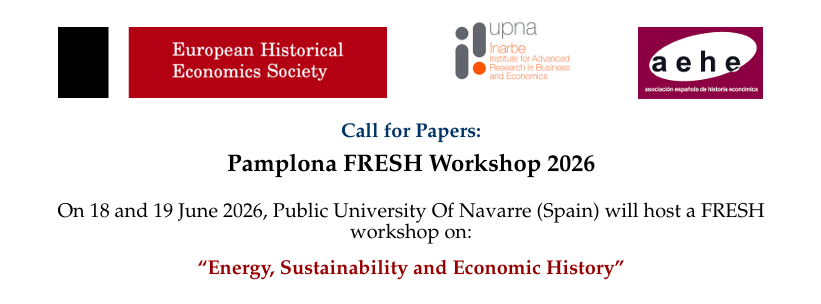
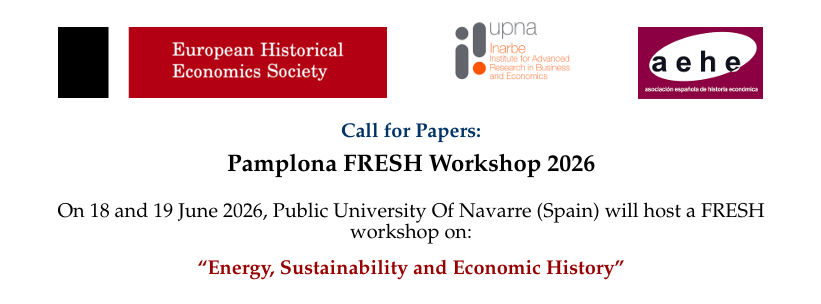
On the 18th and 19th of June 2026, the Public University of Navarre (Spain) will host a #FRESH meeting on "Energy, Sustainability, and Economic History"
Keynote lecture by Henry Willebald (@HWillebald )
Local organizer: Cristián Ducoing
More details below:
The program for the "New perspectives on Middle Eastern Economic History workshop" on 9th of January is already available! https://t.co/wrT5hJtz1P.
Registration for the online event is open on the link!
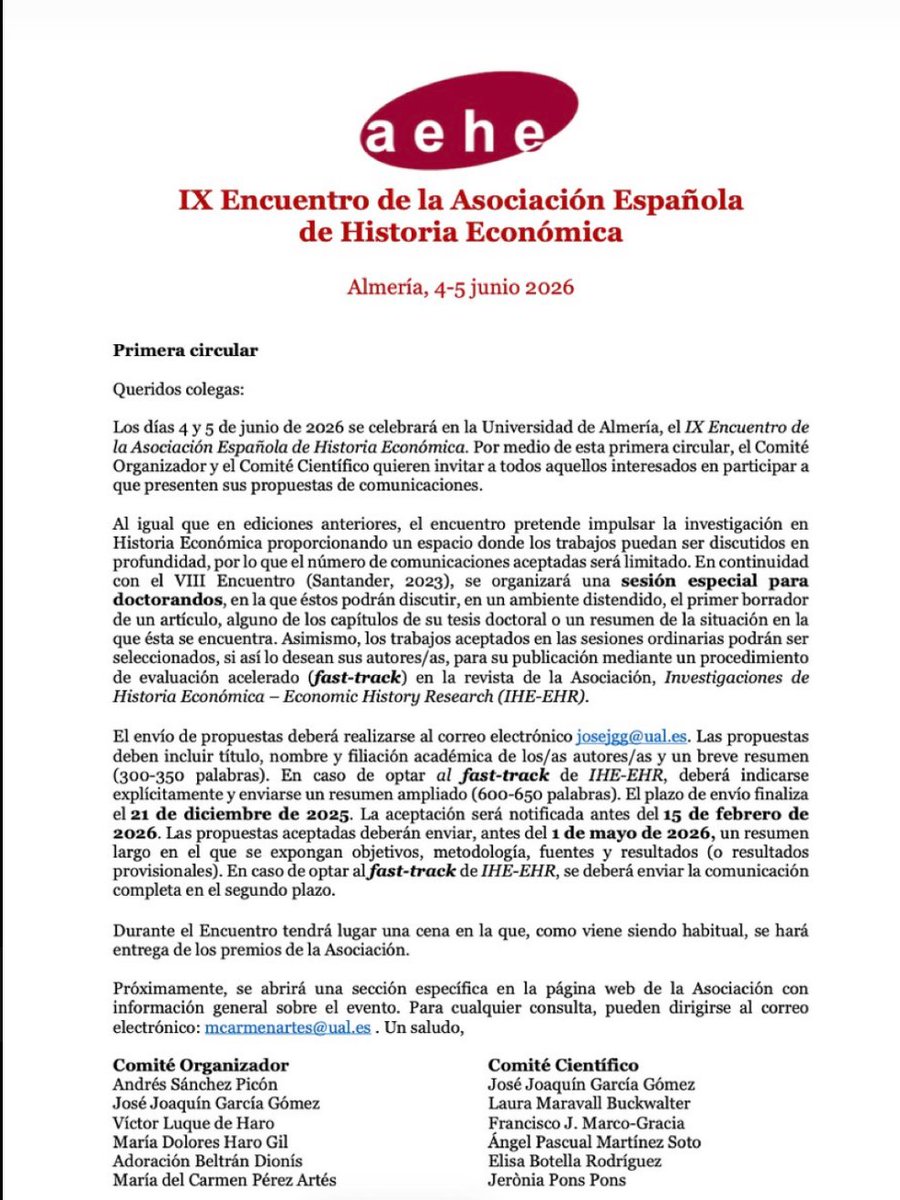
¡RECORDATORIO! Los días 4 y 5 de junio de 2026 se celebrará en la @ualmeria el IX Encuentro de la
@_AEHE, organizado por @hedes_ual. 📷 El plazo de envío de propuestas finaliza el 21 de diciembre.
Hoy protagoniza nuestro podcast en la sesión dedicada a tesis doctorales Guillermo Antuña quien en este episodio explica el sector metalmecanico de Asturias tras la Guerra Civil y analiza sus posibilidades presentes y futuras.