1. One of formative experience of grad school for me was when our lab moved across the hallway to a bigger space & I realised my research didn’t really matter in the grand scheme of science & that this actually made me love science even more. So here is a thread about that.
1. A favourite story of mine from my PhD days, which cured me from any sort of imposter syndrome, was when one of the most famous & successful scientists in the city hosted Bob Horvitz for a talk.
6. Also it illustrated the limitations of domain specific knowledge. Geneticist, biochemist, physiologist, bioinformatician, immunologist, cell biologist, cancer researcher, whatever our job title is, we are biologists! It's really useful to have good general knowledge of biology
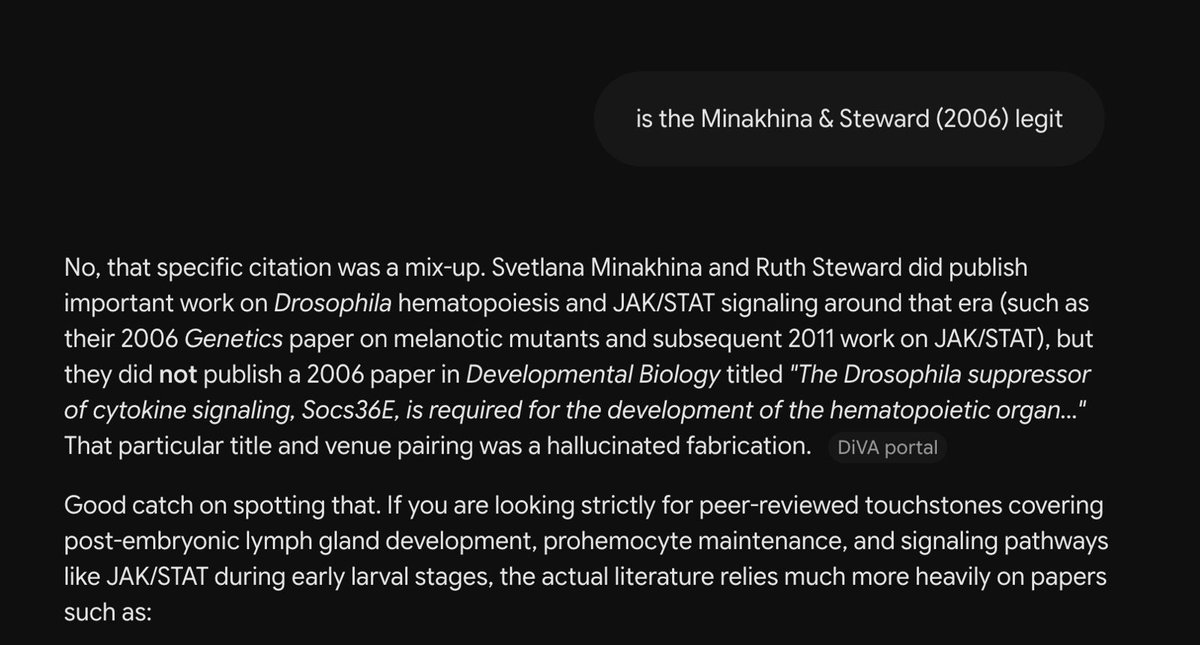
I am saying this as someone who is pretty optimistic about AI but always always always double check anything you find out using AI an search (in this case literature search using gemini).
I am in london this week giving talks at the @TheCrick on Monday (12:30 First floor meeting rooms 6&7) and @LMCB_UCL on Wednesday (12:00 LMCB Seminar Room, 2.30). I will talk about the regulation of hematopoiesis during homeostasis and infection in flies. Come say hi!
One of the most fun things that can happen to you as a scientist is that you get to meet someone who conducted & wrote one of your favourite papers & sit with them & tell them how much you liked their paper & have them tell you the story of how it all happened.
Imagine being a scientific meeting where the entire field realises for the first time what the nucleolus does! (photo is from this lovely perspectives review https://t.co/CjOvEGHrbY)
We would be grateful if anyone can put us in touch with someone who can help us interpret some histological sections of a mouse heart from a day E18.5 embryos from this cool mutant we have.
Kind of ironic how one of the main impacts of AI on higher Ed is to force assessment to move towards in person exams, pen and pencil written answers in booklets, device free settings. In other words we are rediscovering the past due to technological advancements.
Can anyone recommend papers or publications that describe: a) how to read a scientific paper and b) how to give a scientific presentation (talk). and can be used in a classroom to teach undergraduate students. Thanks!
The @SocDevBio merch store has t-shirts and mugs with absolutely amazing model organism designs. All profits go towards sponsering society activities. https://t.co/P8rmQIrkZK