How to Structure Your ETF Portfolio on @EasyEquities An Educational Guide
ETFs allow you to invest in a basket of assets in a single transaction, giving you instant diversification without needing a large amount of capital. One of the most important decisions when investing is how you structure your portfolio based on your goals, timeframe, and risk appetite. Here are 10 illustrative examples to help you understand how different portfolios can be built using ETFs available on Easy Equities and how to avoid too much overlap.
1. Beginner Core Portfolio: Satrix Top 40 ETF (40%) | Satrix MSCI World Feeder ETF (40%) | 10X Yield Bond ETF (20%)
The Satrix Top 40 ETF gives you broad exposure to South Africa's top 40 companies in a single investment. The Satrix MSCI World Feeder ETF provides global developed market exposure, acting as a rand hedge by investing in international markets. The 10X Yield Bond ETF adds stability and income to reduce overall portfolio volatility. Together these three form a simple, low-cost foundation that balances local and global exposure with a measure of income protection.
2. Balanced Growth Portfolio: Satrix Top 40 ETF (30%) | Satrix MSCI World Feeder ETF (25%) | Satrix RESI 10 ETF (20%) | Satrix MSCI India ETF (15%) | Satrix Divi Plus ETF (10%)
The Satrix Top 40 ETF and Satrix MSCI World Feeder ETF provide the stable core, with the MSCI World already carrying your exposure to the largest US technology companies. The Satrix RESI 10 ETF adds exposure to South Africa's resources sector, specifically capitalising on the Gold and Platinum cycle which currently makes up over 70% of this fund's performance. The Satrix MSCI India ETF gives you a second high-growth engine in a completely different part of the world, avoiding the double-up on US technology while capturing India's rapidly expanding economy. The Satrix Divi Plus ETF provides a dividend income buffer to smooth returns during volatile periods.
3. Aggressive Growth Portfolios: Satrix RESI 10 ETF (30%) | EasyETFs AI World ETF (25%) | Satrix MSCI Emerging Markets Asia ETF (20%) | Satrix STOXX Europe 600 ETF (15%) | Satrix Japan ETF (10%)
This portfolio is built for investors seeking maximum growth across different parts of the world without concentrating in any single region. The Satrix RESI 10 ETF specifically capitalises on the Gold and Platinum cycle. The EasyETFs AI World ETF serves as your only US-heavy exposure, giving you the aggressive technology and artificial intelligence growth you want. The Satrix MSCI Emerging Markets Asia ETF captures the high-growth economies of China and Taiwan. The Satrix STOXX Europe 600 ETF and Satrix Japan ETF add aggressive growth from Europe and Asia respectively. Together these four non-overlapping global positions ensure you are invested across every major growth continent without buying the same companies twice.
4. Conservative Income Portfolio: 10X Yield Bond ETF (25%) | 10X Government Bond ETF (10%) | Satrix Property ETF (25%) | Satrix Divi Plus ETF (20%) | Satrix MSCI World Feeder ETF (15%) | Satrix Inflation Linked Bond ETF (5%)
The 10X Yield Bond ETF and 10X Government Bond ETF provide high and relatively predictable yields, making them the anchor of an income-focused portfolio. The Satrix Property ETF invests in listed property, which distributes rental income regularly. The Satrix Divi Plus ETF focuses on dividend-paying South African equities for additional income. The Satrix MSCI World Feeder ETF adds a small global growth element to protect purchasing power over time. This portfolio prioritises capital preservation and regular income over aggressive growth.
5. Resource and Commodity Hedge Portfolio Satrix RESI 10 ETF (40%) | Satrix Top 40 ETF (20%) | NewGold ETF (15%) | EasyETFs Global Equity ETF (15%) | Satrix Property ETF (10%)
The Satrix RESI 10 ETF is the dominant holding here, specifically capitalising on the Gold and Platinum cycle which currently makes up over 70% of this fund's performance. The NewGold ETF provides direct exposure to the gold price, which historically performs well during periods of rand weakness and global uncertainty, making it a powerful hedge. The Satrix Top 40 ETF keeps you anchored to the broader South African market. The EasyETFs Global Equity ETF and Satrix Property ETF add balance through global equities and real assets. This portfolio suits investors who want inflation and rand protection alongside equity growth.
6. Pure Global Diversification Portfolio: Satrix MSCI World Feeder ETF (40%) | Satrix MSCI Emerging Markets Asia ETF (20%) | Satrix STOXX Europe 600 ETF (20%) | Satrix Japan ETF (20%)
This portfolio is designed to give you mathematically clean exposure to the entire planet without doubling up on any single country or region. The Satrix MSCI World Feeder ETF provides your core developed market base covering the US and UK. The Satrix MSCI Emerging Markets Asia ETF captures the high-growth economies of China and Taiwan. The Satrix STOXX Europe 600 ETF and Satrix Japan ETF provide a hedge against US-specific volatility. This structure ensures that your wealth is not tied to the mood of a single country's stock market, making it a truly diversified global portfolio.
7. Thematic Innovation Portfolio: EasyETFs AI World ETF (30%) | Satrix MSCI Emerging Markets Asia ETF (25%) | Satrix RESI 10 ETF (20%) | Satrix STOXX Europe 600 ETF (15%) | Satrix Divi Plus ETF (10%)
This portfolio is built around the belief that artificial intelligence, emerging market technology, and commodity innovation will be the defining investment themes of the coming decade. The EasyETFs AI World ETF leads as your primary exposure to the best of the United States and global technology. The Satrix MSCI Emerging Markets Asia ETF captures the best of the East through China and Taiwan. The Satrix STOXX Europe 600 ETF covers the best of the West through Europe's most innovative companies. The Satrix RESI 10 ETF adds commodity exposure specifically through the Gold and Platinum cycle. The Satrix Divi Plus ETF introduces a small income element to reduce overall volatility. This portfolio now covers the world's most innovative regions without buying the same US companies twice.
8. Retirement Multi-Asset Portfolios Satrix MSCI World Feeder ETF (30%) | Satrix Top 40 ETF (25%) | Satrix Balanced Equity ETF (20%) | 10X Yield Bond ETF (15%) | Satrix Property ETF (10%)
Retirement portfolios need to balance growth during the accumulation phase with stability as you approach retirement. The Satrix MSCI World Feeder ETF and Satrix Top 40 ETF provide long-term equity growth. The Satrix Balanced Equity ETF introduces multi-asset management to navigate different market conditions. The 10X Yield Bond ETF provides income and capital protection. The Satrix Property ETF adds property for diversification and regular distributions. This portfolio is designed to compound steadily over time while managing drawdown risk.
9. High-Yield Income Portfolio: 10X Yield Bond ETF (20%) | 10X Government Bond ETF (15%) | Satrix Property ETF (25%) | Satrix Divi Plus ETF (20%) | Satrix Income ETF (10%) | EasyETFs Global Equity ETF (10%)
The combination of the 10X Yield Bond ETF, 10X Government Bond ETF, Satrix Property ETF, and Satrix Divi Plus ETF creates a portfolio focused on maximising regular income distributions. The Satrix Income ETF further enhances the income focus with a dedicated income fund. The EasyETFs Global Equity ETF adds a small global growth element to prevent the portfolio from falling behind inflation over time. This portfolio is ideal for investors who need their portfolio to generate consistent cash flow, such as those in or approaching retirement.
10. ESG Sustainable PortfolioSatrix ESG Equity ETF (30%) | Satrix Capped All Share ETF (25%) | Satrix RESI 10 ETF (20%) | Satrix MSCI World Islamic ETF (15%) | 10X Yield Bond ETF (10%)
This portfolio is for investors who want their money to reflect their values. The Satrix ESG Equity ETF provides exposure to companies screened for environmental, social, and governance criteria. The Satrix Capped All Share ETF provides a cleaner and more diversified South African base than the Top 40 alone by including a broader range of local companies with individual stock caps to prevent over-concentration. The Satrix RESI 10 ETF represents the minerals, specifically Gold and Platinum, that are essential to the global green energy transition. The Satrix MSCI World Islamic ETF ensures the international portion of the portfolio stays within ethical and sustainable investment boundaries. The 10X Yield Bond ETF adds stability and income.
NB: These are illustrative examples only and do not constitute personalized financial advice.
Key Dividend-Driven ETFs and Income Funds on @EasyEquities 2026
If you are looking to build a portfolio that pays you regularly through dividends or income distributions, EasyEquities offers a strong selection of ETFs and income funds to choose from.
The @SATRIX_SA Divi Plus ETF tracks the FTSE/JSE Dividend Plus Index, targeting companies with the highest anticipated dividend payouts on the @JSE_Group. The @10Xinvestments Yield Selected Bond ETF focuses on generating yield through bond investments, making it a solid fixed income option. For property exposure, the @1nvest_SA Global REIT Index Feeder ETF invests in high-income property investments globally, while the 10X SA Property Income ETF gives you exposure to the South African property sector with consistent income distributions.
For actively managed income, the 10X Income AMETF is designed to provide steady returns through professional management. The Satrix Global Balanced Fund of Funds ETF offers income through a diversified mix of global assets, and the Sygnia Itrix Global Property ETF targets global real estate for those wanting offshore property exposure.
A few things to keep in mind, most of these ETFs pay dividends either quarterly or semi-annually, depending on the fund. EasyEquities makes it easy to either automatically reinvest your dividends back into more shares (which compounds your returns) or receive them as cash if you prefer to use the income. The options cover both local South African equity and property ETFs as well as international property and bond ETFs, giving you the flexibility to diversify across geographies and asset classes.
An underrated cheat code in life: being incredibly reliable. Show up on time. Do what you say you will. Own your mistakes. It goes so much further than you think.
Things you need to know about Namibia’s new financial regulations
Namibia’s new financial regulations officially came into operation on 1 May 2026, and this is something or
Things you need to know about Namibia’s new financial regulations
The Government Gazette brings three major notices into effect. Government Notice 147 brings the Financial Institutions and Markets Act, 2021 into operation from 1 May 2026. Government Notice 148 brings the Namibia Financial Institutions Supervisory Authority Act, 2021 into operation from the same date. Government Notice 149 then gives the detailed regulations covering insurance, financial markets, retirement funds, friendly societies, medical aid funds and related topics.
The first thing people must understand is that the laws are not coming into force in full. The Gazette specifically excludes some provisions from commencement. Under Government Notice 147, the excluded parts of FIMA include the definition of “Adjudicator”, part of the definition of “financial services law”, section 112(2)(v), part of the definition of “defined contribution fund” in section 249, and section 427(1)(b). Under Government Notice 148, the excluded parts of the NAMFISA Act include the definitions of “Adjudicator,” “Financial Services Adjudicator Act,” and “Office of the Adjudicator,” as well as references to the Office of the Adjudicator and the Financial Services Adjudicator Act in sections 4, 31 and 55.
That is not a small issue. A financial system does not only need regulators watching institutions from above. Ordinary people also need a clear, accessible place to take complaints when pension funds, insurers, advisors or other financial institutions treat them unfairly. If the adjudicator-related provisions are not yet operational, then consumer protection is still incomplete.
The Gazette does include important retirement fund rules. It deals with actuarial surplus distribution, retirement benefit transfers, interest on delayed transfers, unpaid contributions, and housing-related loans or guarantees by retirement funds. For example, if a retirement benefit transfer is delayed beyond the allowed period, the fund must credit the transfer value with interest at the Bank of Namibia repo rate plus 4%. It also provides that unpaid required contributions bear interest, and responsible parties may remain liable.
That is important for workers because pension contributions are not just deductions on a payslip. They are part of a person’s future financial security. If an employer fails to pay contributions or a fund delays a transfer, workers should know that the law provides consequences.
But the controversial pension preservation issue remains sensitive. FIMA has commenced, but that does not mean compulsory pension preservation has automatically been implemented in full. The Gazette includes retirement fund regulations, but some of the most contested preservation-related provisions appear to have been excluded, delayed, or left for further alignment and consultation. That distinction must be made clearly so workers are not misled or unnecessarily alarmed.
The Gazette also deals with micro-insurance. Many micro-insurance categories, including funeral, disability, health, life, vehicle, fire and gap insurance, are capped at N$25,000. Personal insurance is capped at N$2,000, while miscellaneous micro-insurance may go up to N$2.5 million.
This is both useful and concerning. It creates structure for lower-cost insurance products, but ordinary people must not assume that a micro-insurance policy gives full protection. A N$25,000 payout may help with a basic emergency, but it may be far too low for serious illness, disability, funeral costs, vehicle loss or property damage.
The Gazette also tries to separate health insurance from medical aid. Health policies must not be marketed as if they are medical aid, and disclosures must make it clear that the product is an insurance policy, not a medical aid fund.
That is important, but it is also a red flag. Many people may still buy health-related policies without fully understanding the difference. A health insurance policy may give a limited benefit, while medical aid works differently. Consumers must ask directly, Is this medical aid, or is it only a limited insurance benefit?
The regulations also define money market instruments as short-term financial instruments with a maturity or redemption date of 12 months or less, designed to preserve capital, provide daily liquidity and offer returns in line with money market rates.
That is useful for people using money market funds for short-term savings, but it does not mean no risk. It means lower risk, short-term liquidity and credit quality requirements. People must still understand where their money is placed.
Another major issue is how friendly societies and medical aid funds may invest money. These institutions must keep at least 45% of their assets in domestic assets. They may also invest up to 95% in government bonds, 75% in shares, 50% in corporate bonds, 50% in foreign bonds and 10% in property, subject to additional limits.
On paper, this supports local investment. But it also creates concentration risk. Namibia’s capital market is small. If institutions are required to keep a large portion of assets locally, ordinary members may be exposed to a limited pool of local banks, bonds, companies and government-linked instruments. Local investment is important, but concentration risk should not be ignored.
The Gazette also introduces enforcement measures. A self-regulatory organisation can face a penalty of up to N$5 million for non-compliance, and late renewal of registration can attract interest of 20% per year.
That sounds strong, but enforcement is the real test. Rules are only useful if @namfisa has the capacity, independence and consistency to enforce them. Ordinary people do not benefit from strong laws that sit on paper while institutions continue business as usual.
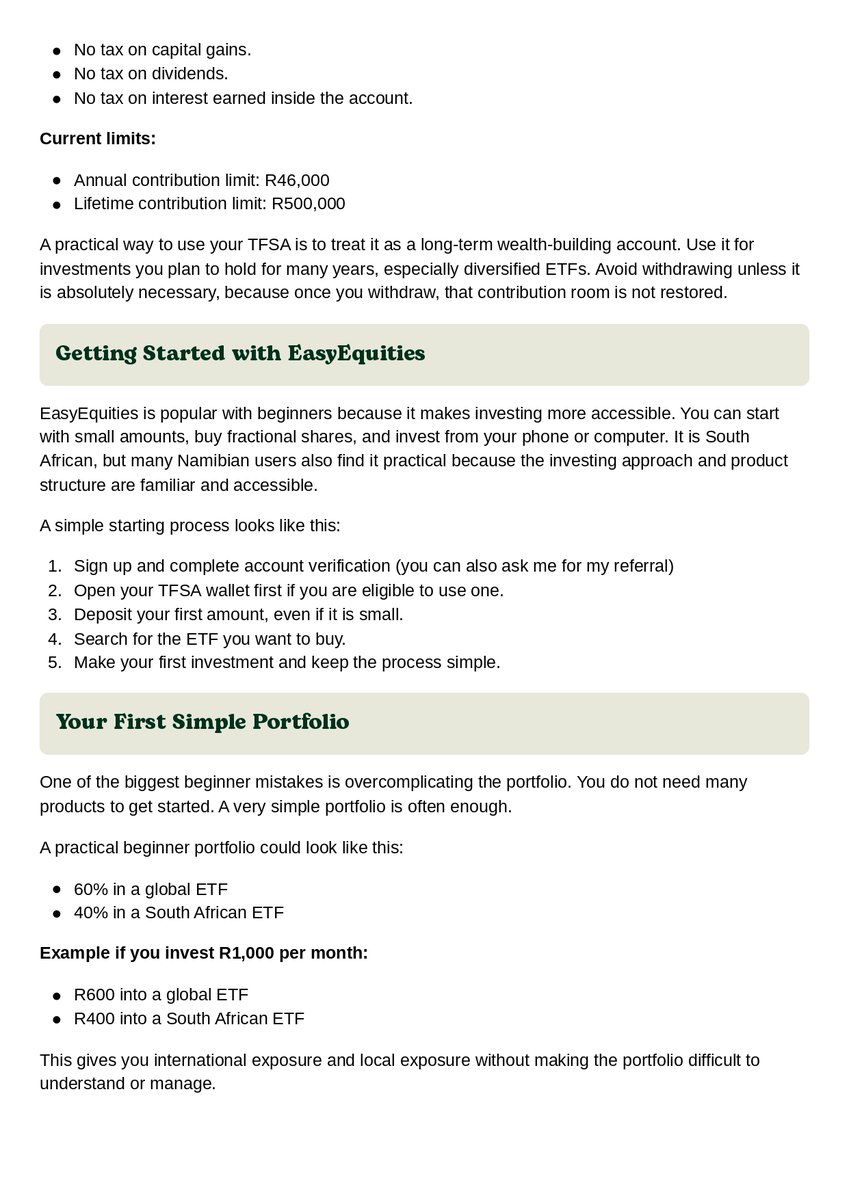
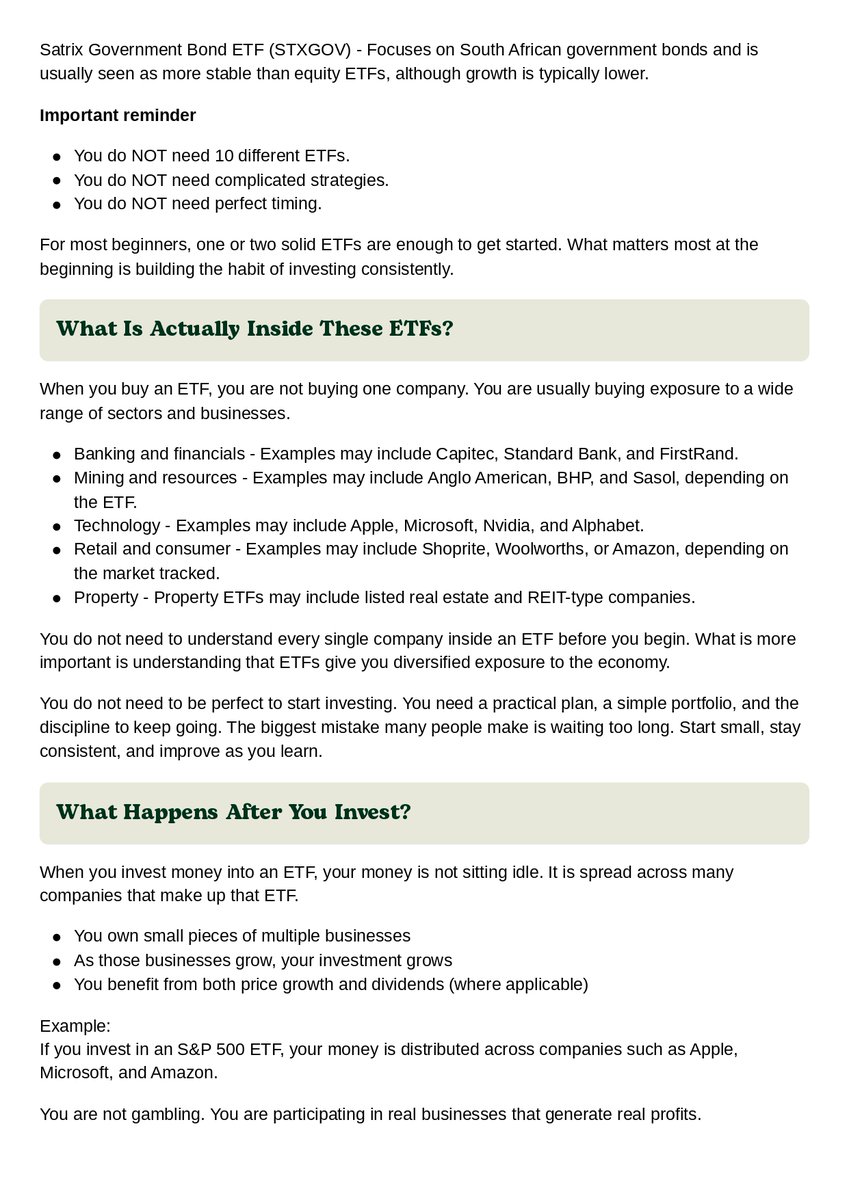
To my beginners.. I put together a simple, practical guide for anyone who wants to start investing but doesn’t know where to begin.
This is for educational purposes only and not financial advice.
Part 1
We are a nation that is incredibly well prepared to be buried but not well prepared to stay alive. Not well prepared for a hospital bill. Not well prepared for a month without income. Not well prepared for retirement.
And the over insurance problem makes it worse. Many Namibians are holding multiple life and funeral policies believing that more policies means more protection and more payout when something goes wrong. But most policies contain non duplication provisions which means insurers can limit payouts when multiple policies cover the same risk. You could be paying for four or five policies and only truly benefiting from one.
We are planning for death better than we are planning for life. Very sad.
Funeral policy. Life policy. Another life policy. Cover for this. Cover for that. But no investment account. Nothing building for the future.
And here is what most people do not know. There is a maximum amount you can be covered for across all your life policies. You cannot keep adding policies and expect them all to pay out in full. Some of you are literally over insured and do not even know it.
This is not financial advice, purely for educational purposes.
Namibians are sitting on one of the most attractive investment tax environments in Africa.
There is currently no Capital Gains Tax in Namibia. That means if you buy shares and they grow in value over time, the profit you make when you sell belongs to you. No tax on your gains. That alone is something most countries do not offer their everyday investors.
Interest earned from Namibian Government Bonds and Treasury Bills is also completely tax free. And dividends from Namibian companies have traditionally been exempt for residents, though a 10% dividend withholding tax is proposed to come into effect in 2026.
What gets me most though is this. There are no estate duties, no gift taxes and no inheritance taxes in Namibia. What you build during your lifetime you can pass on to your children without losing a portion of it. That is generational wealth in its truest form.
I am not sharing this to convince anyone of anything. I just think this is information that every Namibian deserves to have. The tax environment here genuinely rewards people who invest and yet so many people are not taking advantage of it simply because they were never told it exists.
The tools are there. The environment is favourable. The rest is just a decision.
This is not financial advice, purely for educational purposes.
A unit trust pools money from multiple investors together and uses that combined capital to buy a diversified portfolio of assets, which could be shares, bonds, property, or a mix of all three depending on the fund. When you invest, you are buying units in that pool, and the value of your units moves up or down based on how the underlying assets perform.
The portfolio is managed by a professional fund manager who makes the day to day investment decisions on your behalf. You do not need to pick individual stocks or monitor the market constantly. You simply choose a fund that matches your risk appetite and investment goal, contribute regularly, and let the manager and compounding do the work over time.
The more units you accumulate and the better the fund performs, the more your investment grows. It is one of the most accessible and diversified ways to invest, you can start with as little as R500 per month depending on the platform and the fund.
For those who want to explore unit trusts further on @EasyEquities , you can browse all available options at https://t.co/CDSFvNpnLe there are about 88 unit trusts to choose from, covering everything from equity and property to balanced and income funds. One of the biggest advantages of using this platform is the low fees, which means more of your money stays invested and working for you. If you are ready to get started, you can sign up here: https://t.co/KyLYXyWpQp
When you are looking into unit trusts, there are a few important things you need to pay attention to, and one of the biggest ones is fees. A lot of people focus on returns, which is understandable, but very few take the time to understand what it actually costs to be invested. Over time, those costs can reduce your returns without you even realizing it.
If you look at some of the Old Mutual Namibia funds, you start to see how this works. The initial charge, for example, can go up to 5%. This means that before your money even starts working for you, a portion of it may already be deducted. In some cases, this fee can be waived or negotiated, but it is something you should always ask about before investing.
Then there are the ongoing costs, which are even more important. The Namibia Growth Fund has a total expense ratio of around 1.22% per year, while the Namibia Managed Fund is slightly higher at about 1.37%. The Namibia Real Income Fund sits around 1.32%, and the Namibia Property Fund is a bit lower at approximately 1.07%. The Namibia Money Market Fund, which many people treat like a savings option, has a lower cost of around 0.69% per year.
At first, these percentages might not seem like much, but over time they make a real difference. If your investment is growing at around 10% a year and you are paying over 1% in fees annually, that is a noticeable portion of your return going toward costs. Over the long term, this can significantly affect how much you actually walk away with.
The key thing to understand is that fees are not the same across the board. They differ from provider to provider and from fund to fund, and there are options out there with lower costs. That is why it is important to compare and understand what you are paying for.
Before you invest, don’t just focus on what you might earn. Take the time to understand what it will cost you to stay invested.