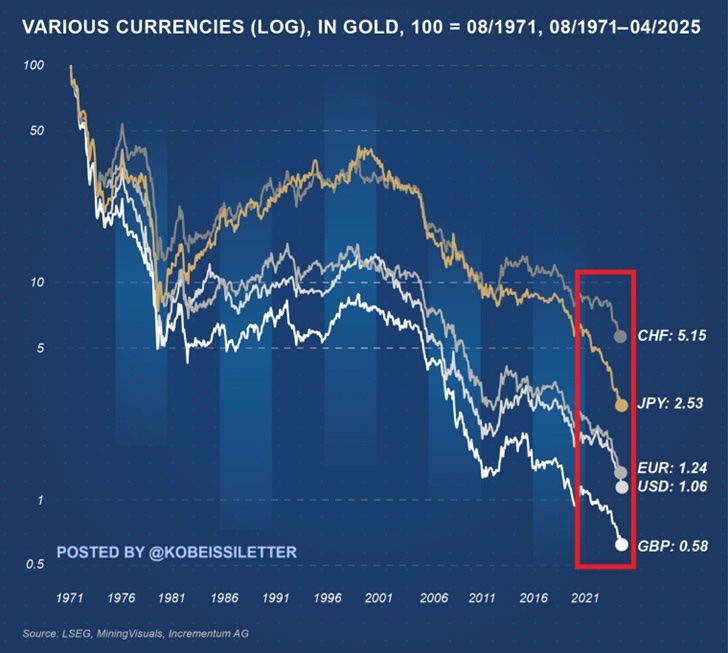
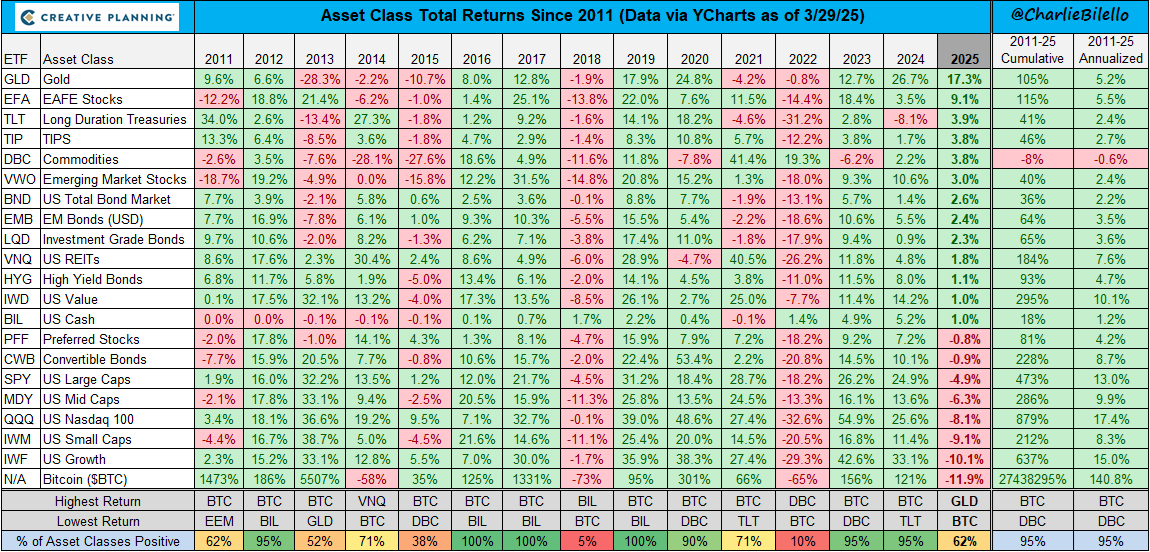
The decline in value of fiat currencies against gold has been truly remarkable:
Since 1971, the US Dollar has lost 98.94% of its value against gold, the second-largest fall among major currencies.
During the same period, the British Pound has declined 99.42%.
The Euro would have lost 98.76% if it existed since 1971.
Furthermore, the Japanese Yen and Swiss Franc have dropped 97.47% and 94.85%, respectively.
Meanwhile, gold prices in US Dollar terms are up ~1,000% during this period.
Gold remains a hedge against currency debasement.
Commodities like oil, silver, and copper are down sharply today as investors are pricing in a global recession. But the recession will mainly be limited to the U.S. The rest of the world is about to boom, as they will be liberated from having to subsidize the U.S. economy.
The U.S. has a difficult road ahead. We need to start producing all the stuff we've been importing. That requires significant investment and painful short-term sacrifice. On the other hand, all the rest of the world has to do is consume more of what they already produce. Not only is that easy to do, but it's also fun.
Every week I break down the most important charts and themes in markets and investing. Subscribe to our YouTube channel for the latest video content...
https://t.co/rQuXrxVpWs
Procter & Gamble posted a surprise drop in fourth-quarter sales as demand for its Charmin toilet paper and Pampers slowed globally. The brand has also been hit by weak spending in China and boycotts of Western brands in the Middle East. More here: https://t.co/vfdSPGTuJ0
@KobeissiLetter I have some bad news for those expecting lower inflation ahead.
Usually $HG (Copper) leads inflation by 5/6 months. The correlation is very strong and I doubt this time will be different.
Here's an embedded version of the Broken Money video.
-An analysis of the past, present, and future of money, and how technology impacts it over time.
-How the current disequilibrium (transactions way faster than settlements) creates centralized and corrupted money clusters:
The Japanese people are known for being strong savers!
But what does a culture of savings mean when your trillions of dollars equivalent in fiat Yen is burning away in value?
IT IS NOT THAT YOU SAVE, IT IS ABOUT HOW YOU SAVE!!!
Çin, "Dağlar & Nehirler" adlı Shan-Shui Girişimi ile devasa bir ekolojik iyileştirme çalışmasıyla yaklaşık 6,7 milyon hektar araziyi tarıma kazandırdı. Türkiye'deki sulanabilir arazinin 8.5 milyon hektar olduğu göz önüne alınırsa çalışmanın ne kadar önemli olduğu ortaya çıkıyor.
https://t.co/AY6adjWwA9 via @wired Floating photovoltaic systems provide electricity and reduce evaporation. Plus, you don’t need to clear land for a solar farm.