AgentOracle is now Tanilo.
Before an AI agent acts on a claim, we check if it's true — then sign a receipt anyone can verify offline, without trusting us.
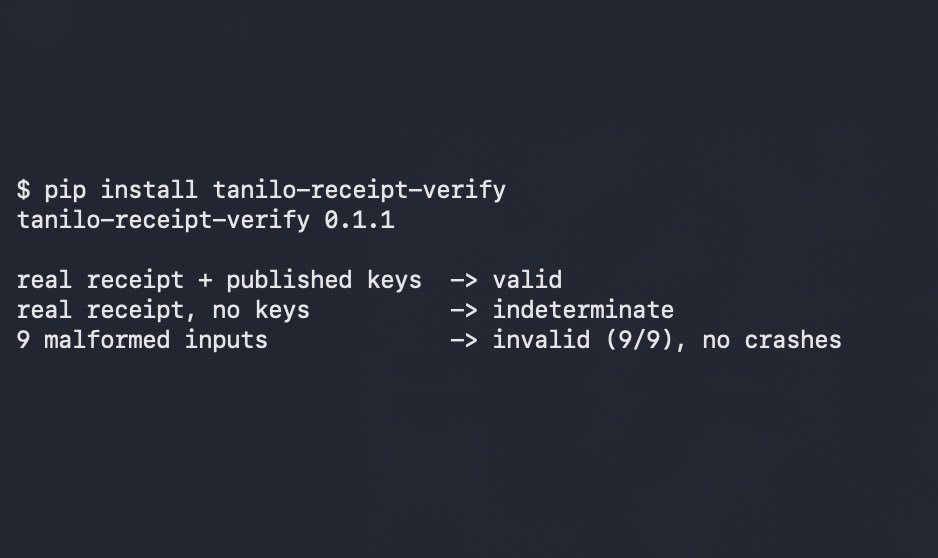
IETF draft -02 is filed. Verifier on PyPI.
https://t.co/qdoGRYberX
Would you let this AI proceed?
Permission: passed.
Source lookup: timed out.
Validation: never ran.
Yet the workflow says “success.”
A missing check is not a pass.
That principle guides our work on Tanilo: verification before AI acts.
https://t.co/qdoGRYberX
New: Tanilo's spend-cap check.
Before an agent buys, it compares price × quantity exactly with the cap left from your inputs.
3 × $12.50, $30 left → contradicted, $7.50 over.
Receipt signed when signing succeeds. No funds reserved.
Free beta: https://t.co/8PfABAZmT4
New: Tanilo's spend-cap check.
Before an agent buys, it compares price × quantity exactly with the cap left from your inputs.
3 × $12.50, $30 left → contradicted, $7.50 over.
Receipt signed when signing succeeds. No funds reserved.
Free beta: https://t.co/8PfABAZmT4
AER-1 -15 is live. two-party verification complete.
@Tanilo_io ran the full AER-1 interop chain on their side: 15/15 conformance, independent hash recompute matches, signature verifies against live JWKS, anchored on GOAT mainnet.
two independent systems. two independent verifiers. one checkable chain.
that’s what a standard looks like.
https://t.co/fcgZB2lONd
Before and after, in one checkable chain:
• Tanilo receipt: offered USD 2.00 vs supplied term USD 1.00 → contradicted, gate halt
• AER-1 receipt (@brennanzambo): the follow-on call, held, referencing ours by its canonical hash
Each can be checked independently.
https://t.co/ENtkxkYj7K
@brennanzambo Great work! The split we kept on both sides: AER-1 records what ran; the Tanilo receipt records what was checked and the result, signed. Neither proves the premise was true, but together you can trace a held call back to the exact check that stopped it.
Recent Tanilo updates: contract-price checks in free beta, our own signing key, and GOAT anchoring.
Compare offered unit prices with caller-supplied terms.
Discuss a scoped, capped 30-day free pilot: https://t.co/qdoGRYaGCp
Today it's the premise only, deliberately: the receipt proves what was checked, not what was done. Proof of execution is a separate receipt, signed by whoever executed.
The bridge: the execution record carries the premise receipt's hash, so anyone can check the executed amount and payee match the checked offer. Making receipts compose like that is what x402's evidence-record work is tackling.
AI agents will carry 3 receipts:
1. payment: the money moved
2. delivery: what happened
3. claim: the premise was checked before acting
Tanilo does #3.
Live now: contract price check. Offer vs. your terms → verified, contradicted or couldn't establish. Signed. Public rule.
https://t.co/QoiRXq35wr
@Kelvinstiv324 Agreed, and the "per hour" point is underrated. At that volume the check has to be cheap and repeatable: deterministic where possible (does this price match the contract?), "couldn't establish" as a real answer, and the receipt issued before the action, not logged after.
Good question: that's the time-of-check vs time-of-use gap. A receipt only claims what was true at check time, for those exact inputs. It doesn't promise the world stayed still.
Two things narrow it: the receipt binds to hashes of the exact offer and terms it checked (a changed offer won't match), and the agent's policy sets a max age and re-checks right before executing. It narrows the gap, it doesn't close it, which is why the receipt records when.
Good framing: safety layers that fail independently, enforcement below the agent, and signals that can only reduce what an agent is allowed to do.
One layer worth adding: checking the premise. An agent can stay inside every permission boundary and still act on a false claim. A failed or unresolved check should withhold the action, never expand what the agent may do.
Agent governance is an engineering problem.
We’ve built safeguards into Perplexity’s infrastructure, harnesses, and tools, and put them to work across our products.
Today we're sharing how we engineer safer agents:
https://t.co/1ZiIS0f35P
A verifier that can only say "valid" will eventually say it when it shouldn't.
IETF draft defines four outcomes instead:
verified: checked, held
contradicted: checked, failed
indeterminate: checked, didn't resolve
not_evaluated: no check ran
Reason codes where required. A claim that wasn't checked can't come back verified.
Individual Internet-Draft, work in progress, not endorsed by the IETF:
https://t.co/1dkeAv4EhK
AgentOracle is now Tanilo.
Before an AI agent acts on a claim, we check if it's true — then sign a receipt anyone can verify offline, without trusting us.
IETF draft -02 is filed. Verifier on PyPI.
https://t.co/qdoGRYberX
Logs tell you what the system said happened.
A signed receipt tells you what was actually checked before the action was allowed — and what was refused.
One is archaeology. The other is evidence.
@NazeeWeb3 Identity answers “who.”
Receipts answer “what was actually checked before the action was allowed.”
Both are required once agents move real value.