Paris, juillet 1944.
La baignoire est remplie d'eau glacée.
La femme détenue en dessous n'a pas parlé depuis trois jours. Les agents de la Gestapo lui enfoncent à nouveau la tête sous la surface. Lorsqu'ils la relèvent, haletant et tremblant, ils posent les mêmes questions qu'ils se posent depuis le moment où ils l'ont arrêtée.
Noms. Des refuges. Contacts de résistance. Emplacements.
Elle ne dit rien.
Elle s'appelait Catherine Dior – et presque personne ne se souvient d'elle.
Ayant grandi riche dans la France des années 1920, Catherine semblait destinée à une vie tranquille et privilégiée. Puis la guerre est arrivée. Puis les nazis envahirent Paris. Et Catherine a fait un choix qui allait presque tout lui coûter.
Elle rejoint la Résistance française.
En tant que coursière du réseau de renseignement F2, elle s'est déplacée à travers la France occupée avec quelque chose de plus dangereux que n'importe quelle arme : des informations. Positions des troupes. Itinéraires de ravitaillement. Plans de bataille. Emplacements des refuges. Elle a tout mémorisé et l'a gardé enfermé dans son esprit, parce que son esprit était le seul endroit où la Gestapo ne pouvait pas fouiller.
Jusqu'à ce qu'ils l'arrêtent.
La torture n'était pas une punition. Il s’agissait d’une tentative d’extraire tout ce qui était stocké dans sa tête – des noms et des lieux valant des dizaines de vies. Bains de glace. Des coups. Privation de sommeil. Des techniques conçues par des personnes qui avaient passé des années à perfectionner la science de la destruction des êtres humains.
Catherine Dior n'a jamais fait faillite.
Pas un nom. Pas un seul endroit. Pas une seule planque. Son silence est devenu un bouclier pour tous les résistants qui ne savaient jamais à quel point ils étaient sur le point d'être attrapés.
La Gestapo a finalement renoncé à tenter de la briser. À la place, ils l'ont envoyée dans un endroit pire.
Ravensbrück. L'un des camps de concentration les plus brutaux de l'Allemagne nazie. Elle est arrivée sous le numéro de prisonnière 57813. Autour d'elle, des femmes mouraient quotidiennement de faim, de maladie, de travail forcé et d'exécution. Catherine a survécu à tout cela – de justesse. Lorsque les forces alliées libérèrent le camp en mai 1945, elle en sortit avec un poids inférieur à 80 livres.
Elle est revenue dans une France célébrant la libération.
Elle aurait pu devenir une héroïne célèbre. Elle aurait pu écrire des mémoires. Elle aurait pu faire des discours sur tout ce qu'elle a enduré.
Au lieu de cela, Catherine Dior s'est rendue au marché aux fleurs.
Aux Halles de Paris, elle a travaillé tranquillement avec le jasmin et les roses – ses mains dans la terre au lieu de secrets, entourées de parfums au lieu de peur. Elle n'a pas cherché à être reconnue. Elle a choisi la beauté. Délibérément, tranquillement, complètement.
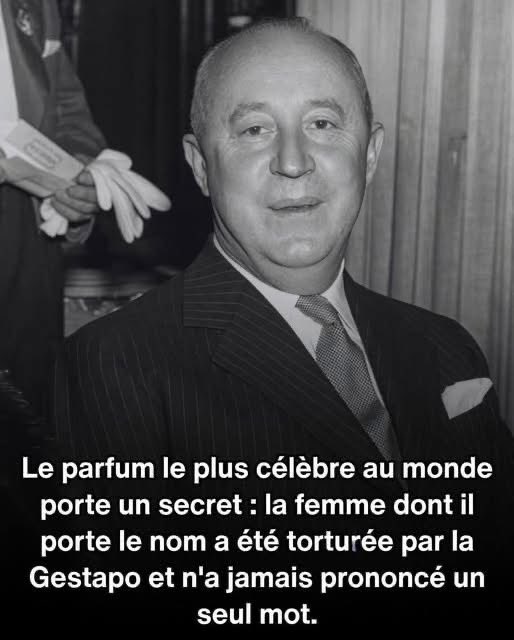
Deux ans plus tard, son jeune frère Christian s'apprêtait à lancer son premier parfum. Il n'arrivait pas à lui trouver le bon nom. Le parfum était extraordinaire – élégant, lumineux, ne ressemblant à rien d’autre.
Puis Catherine entra dans la pièce et quelqu'un dit : « Ah, voilà Miss Dior.
Christian l'a su instantanément. C'était le nom.
Les notes de cœur du parfum ? Jasmin et rose. Les fleurs exactes que sa sœur entretenait chaque jour au marché.
Miss Dior est l'un des parfums les plus emblématiques au monde depuis plus de 75 ans. Des millions de personnes l'ont porté. Des millions d’autres reconnaissent la bouteille à vue.
Presque aucun d’entre eux ne sait ce que porte ce nom.
Ils ne connaissent pas les bains de glace. Ils ne connaissent pas Ravensbrück. Ils ne connaissent pas la femme qui a protégé des dizaines de vies en refusant de parler – même si parler aurait mis fin à son agonie.
Ils vaporisent du jasmin et de la rose sans savoir que ces fleurs représentent une femme qui a choisi de devenir belle après avoir survécu au pire de ce que les êtres humains peuvent se faire les uns aux autres.
Do you know who he is?
He’s truly incredible. His jumps, his spins, and the way he can spin so long with such beauty are absolutely mesmerizing. His technique is simply outstanding.
In 458 BC, Rome was on the brink of collapse.
An invading army had trapped the Roman consul and his legion in a mountain pass. Panic spread through the city. The Senate did the only thing they could think of:
They sent messengers to find a 60-year-old farmer plowing his field.
His name was Lucius Quinctius Cincinnatus. He had once been a senator, then lost his fortune paying his son's bail. Now he worked his own four-acre plot just to feed his family.
When the Senate's envoys arrived, they found him sweating behind a plow. They asked him to put on his toga so they could deliver an official message.
The message: Rome was making him dictator. Absolute power. Total command of the army. No checks. No oversight. No term limit.
He accepted.
Within 16 days, Cincinnatus had raised an army, marched out, surrounded the enemy, and forced their surrender. The republic was saved.
He had legal authority to rule for six months. He could have stayed. He could have expanded his power. He could have done what every other ruler in human history did when handed unlimited control.
Instead, he resigned on day 16.
He took off the toga, walked back to his farm, and finished plowing the field he'd left half-done.
Twenty years later, when Rome faced another crisis, they called him back. He was 80 years old. He took command, crushed the conspiracy, and resigned again, this time after just 21 days.
He died poor. On his farm.
2,200 years later, when George Washington was offered a kingship after winning the American Revolution, he refused and went home to Mount Vernon. The reason he was hailed as "the American Cincinnatus" is because Europeans literally could not believe a man who had won would willingly give up power.
King George III, on hearing Washington would resign rather than rule, said: "If he does that, he will be the greatest man in the world."
The lesson isn't that Cincinnatus was humble.
The lesson is that for most of human history, the people most qualified to lead were the ones who didn't want to. And the moment a society starts rewarding those who chase power instead of those who flee from it is the moment the republic begins to die.
Cincinnati, Ohio is named after him.
Most people who live there have no idea why.
Er is natuurlijk in de regio Rotterdam geen enkel installatiebedrijf dat een zeer gemotiveerde, ervaren, vrolijke, slimme, nergens zijn hand voor omdraaiende 18-jarige installateur zoekt, die net zo makkelijk CV's en meterkasten aanpakt als.. zink- en loodwerk!?
#rotterdam
Rt=❤️
Tchaikovsky wrote this piece as a final farewell to his sister, Alexandra Tchaikovskaya — a last dance to the world after learning of her passing. It feels like music born from profound loss, the sound of loving someone with your whole heart and having to let them go.
I’ve never quite broken down listening to it, but it moves me deeply every time.
Some say “Moscow Nights” is the Russian song that brings tears — but for me, they’re wrong. It’s Pyotr Ilyich Tchaikovsky’s Pas de deux that truly breaks the heart. 🎻💔✨
𝐓𝐜𝐡𝐚𝐢𝐤𝐨𝐯𝐬𝐤𝐲 - 𝐩𝐚𝐬 𝐝𝐞 𝐝𝐞𝐮𝐱
In Praise of Being Told What We Can’t Eat
I used to find European regulations mildly embarrassing. The endless directives, the committees, the solemn deliberations about cucumber curvature. It seemed like a continent-wide exercise in missing the point.
Then I looked at what was actually in my food.
More than 10,000 chemicals are permitted in the American food supply.
Nearly 99 percent introduced since 2000 were approved not by the FDA, but by the food industry itself. 
Companies writing their own permission slips, essentially. The GRAS loophole, created in 1958, allows manufacturers to self-certify that their ingredients are safe. The EU has no equivalent.

The results are specific. BHT, used to extend shelf life in cereals and crackers, is banned in Europe over endocrine disruption concerns – which is why you will never find Wheat Thins here. 
Bovine growth hormone, linked to elevated cancer markers, is injected into American dairy cows and banned across the EU. Standard American milk contains it unless the label says otherwise.
Potassium bromate, a probable human carcinogen, is still used in American bread. 
This is not accident. Three of America’s biggest lobbying firms work for the food industry. Pepsi alone spends nine million dollars a year on lobbying. Incentives, working exactly as designed.
Europe chose the precautionary principle. Prove it is safe before it goes in. America chose the reverse. Things are safe until enough people are harmed to prove otherwise.
Throw in the right to repair, universal charging cables, and food labels a human being can actually parse – and what emerges is not bureaucratic overreach. It is a regulatory culture that decided to represent the person eating the food rather than the company selling it.
Critics can call that excessive. I call it civilization.
Stay connected,
Follow Gandalv @Microinteracti1