We created OpenShell to make AI agents safe for enterprises.
Built in open source so any company can adopt and trust it, this secure sandbox controls what agents can access, share, and send.
Our CEO, Jensen, explains 👇
Internally at NVIDIA, we use cuOpt based agentic workflows with agent skills to optimize our supply chains. Since it’s open source, you can too.
With optimizations ready in minutes instead of weeks, the workflow uses multi-agent LangChain Deep agent orchestration and GPU-accelerated solvers to turn natural language into optimized decisions.
Spin it up instantly with a Brev Launchable (preconfigured GPU environment) and grab free developer credits while they last.
TokenSpeed is a brand new inference engine purpose built for speed-of-light agentic workloads.
Read their blog to learn more about its advanced KV cache management, safe and efficient scheduler, and pluggable layered kernel system designed for multi-silicon support. Plus, it also has the fastest MLA attention kernel on NVIDIA Blackwell.
Congrats to @lightseekorg on the launch!
Meet Nemotron 3 Nano Omni 👋
Our latest addition to the Nemotron family is the highest efficiency, open multimodal model with leading accuracy.
30B parameters. 256K context length. 🧵👇
We’re looking for a talented Salesforce Developer (LWC) to join our growing team! This is a great opportunity to work on modern Salesforce architecture, build impactful solutions, and collaborate in an agile, fast-paced environment. If you have hands-on experience withLWC
🚀 We’re Hiring: Senior Cloud Engineer (Cloud Operations Lead)
Drive enterprise cloud transformation across Azure & GCP in a high-impact role.
📍 Remote (US – CT Preferred)
📅 1-Year Contract | W2$65/hr
☁️ What You’ll Do
• Lead cloud operations across Azure & GCP
The CIA is hiring Support Integration Officers to deploy and provide operational support across finance & budget, logistics, HR, security, facilities, and project management.
Learn more at https://t.co/havFrmiaj9.
Infosys has agreed to work with Anthropic to develop and deliver artificial-intelligence services to businesses in complex, regulated industries. https://t.co/uQXLcx7ECb
RAG is not just one technique, it is an entire ecosystem of intelligence.
From context-aware assistants to domain-specific systems, here are 16 types of RAG models shaping the next wave of AI innovation -
1. Standard RAG
The foundation of all RAG systems - combines retrieval and generation for question answering and knowledge synthesis.
2. Agentic RAG
Empowers AI agents to retrieve and act autonomously, perfect for assistants that need dynamic, tool-based reasoning.
3. Graph RAG
Uses knowledge graphs for relational reasoning - ideal for expert systems in law, medicine, and semantic search.
4. Modular RAG
Breaks retrieval, reasoning, and generation into independent components - enabling collaborative, scalable AI workflows.
5. Memory-Augmented RAG
Adds persistent external memory for context retention, powering long-term chatbots and personalized experiences.
6. Multi-Modal RAG
Processes text, images, and audio together - perfect for video summarization, captioning, and multi-modal AI tools.
7. Federated RAG
Enables privacy-preserving retrieval from decentralized sources, used in healthcare and secure enterprise systems.
8. Streaming RAG
Performs real-time retrieval and generation, ideal for financial dashboards, live feeds, and social media monitoring.
9. ODQA RAG (Open-Domain QA)
Handles large, diverse datasets - ideal for search engines and intelligent virtual assistants.
10. Contextual Retrieval RAG
Maintains session-level awareness, great for conversational AI and customer support chatbots.
11. Knowledge-Enhanced RAG
Integrates structured domain data, useful for legal, educational, and professional knowledge applications.
12. Domain-Specific RAG
Custom-tailored for specific industries - like finance, healthcare, or legal analytics.
13. Hybrid RAG
Combines multiple retrieval approaches, bridging structured and unstructured data for high precision.
14. Self-RAG
Introduces self-reflection to refine its own answers, enabling AI models to fact-check and improve reasoning autonomously.
15. HyDE RAG (Hypothetical Document Embeddings)
Generates hypothetical documents to guide retrieval, excellent for complex or niche query contexts.
16. Recursive / Multi-Step RAG
Performs multiple retrieval-generation loops, enabling advanced problem-solving and reasoning chains.
From simple retrievals to self-improving AI reasoning loops, RAG is evolving fast.
Which type do you think will dominate enterprise AI systems in 2026?
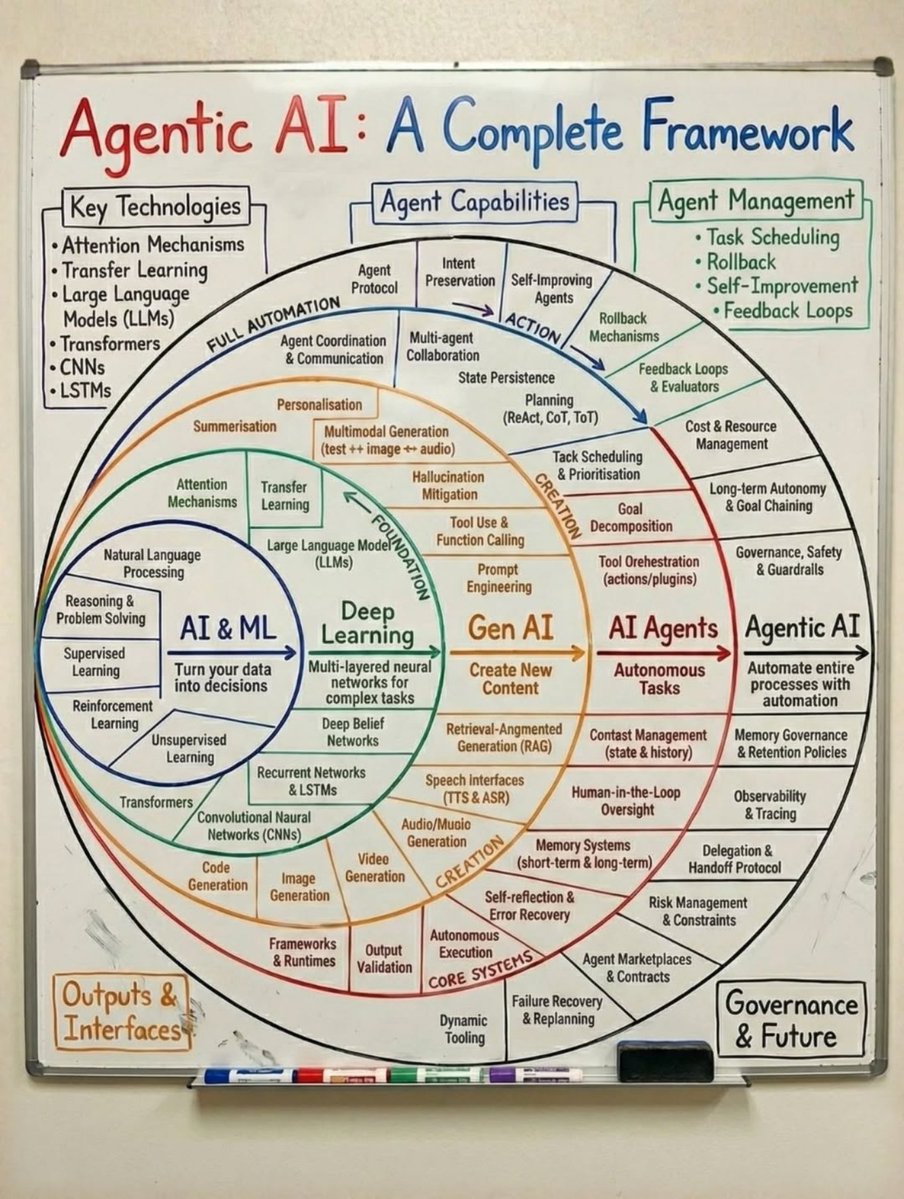
Agentic AI isn’t just a buzzword. It’s a full stack.
Here’s the complete framework:
𝗟𝗮𝘆𝗲𝗿 𝟭: 𝗔𝗜 & 𝗠𝗟
Turn data into decisions. Supervised, unsupervised, reinforcement learning.
𝗟𝗮𝘆𝗲𝗿 𝟮: 𝗗𝗲𝗲𝗽 𝗟𝗲𝗮𝗿𝗻𝗶𝗻𝗴
Multi-layered neural networks. CNNs, LSTMs, transformers.
𝗟𝗮𝘆𝗲𝗿 𝟯: 𝗚𝗲𝗻 𝗔𝗜
Create new content. Text, image, audio, video generation.
𝗟𝗮𝘆𝗲𝗿 𝟰: 𝗔𝗜 𝗔𝗴𝗲𝗻𝘁𝘀
Autonomous task execution. RAG, tool use, memory systems.
𝗟𝗮𝘆𝗲𝗿 𝟱: 𝗔𝗴𝗲𝗻𝘁𝗶𝗰 𝗔𝗜
Full automation with self-improvement, feedback loops, and governance.
Each layer builds on the last. Skip one, and the system breaks.
Over to you: Which layer are you currently building on?
Image from Lab49 team!
Some 𝗔𝗜 𝗔𝗴𝗲𝗻𝘁𝘀 might seem simple from the outside. They are not 👇
Here are some of the layers that are hidden from you as a user of agentic
We usually start building and experimenting with Raw Model APIs. These rely on complex underlying infrastructure.
𝟭. 𝘎𝘗𝘜/𝘊𝘗𝘜 Resources.
𝟮. 𝘉𝘢𝘴𝘦 𝘐𝘯𝘧𝘳𝘢𝘴𝘵𝘳𝘶𝘤𝘵𝘶𝘳𝘦 that orchestrates Model deployment. Think Kubernetes, Slurm, vLLM.
𝟯. 𝘍𝘰𝘶𝘯𝘥𝘢𝘵𝘪𝘰𝘯 𝘔𝘰𝘥𝘦𝘭𝘴 themselves that required tens of millions of dollars to be trained.
To produce a reliable MVP you will need some internal data and visibility to your system. This will require you to make choices in how you:
𝟰. 𝘚𝘵𝘰𝘳𝘦 the data: Vector DBs, Graph DBs etc.
𝟱. 𝘖𝘣𝘴𝘦𝘳𝘷𝘦 𝘓𝘓𝘔 interactions to see into the actions your system is performing. You will need this for debugging and evolving your Agents.
Scaling up requires more stability and insights into what is happening inside of the system.
𝟲. 𝘌𝘷𝘢𝘭𝘶𝘢𝘵𝘪𝘰𝘯 helps you to go beyond passively observing the system to proactively monitoring it by bringing automation via evaluation rules that are applied against steps performed by your Agents.
𝟳. 𝘖𝘳𝘤𝘩𝘦𝘴𝘵𝘳𝘢𝘵𝘪𝘰𝘯 of the system: LLM Orchestration frameworks help with solving issues like retries, chaining your prompts, tool calling etc.
To expose your application to the general public you would need additional automations and guardrails to prevent disasters that could shut your business in seconds.
𝟴. 𝘔𝘰𝘥𝘦𝘭 𝘙𝘰𝘶𝘵𝘪𝘯𝘨 helps in choosing best LLMs for your prompts, prompt management, fallback mechanisms in case of unresponsive LLM APIs or hitting API limits. Etc.
𝟵. 𝘚𝘦𝘤𝘶𝘳𝘪𝘵𝘺 is critical to avoid disasters related to data leakage. Think Guardrails, Red Teaming etc.
❗️And these are just basic requirements, there is more 🙂
Come in the emerging requirements:
𝟭𝟬. Memory.
𝟭𝟭. Agent Communication Protocols.
...
Anything I am missing? Let me know in the comments 👇
Learn these infrastructure layers hands-on in my End-to-end AI Engineering Bootcamp, next cohort kicking off on January 12th: https://t.co/gWBu8OLTzn
🎁 Use code NYRESOLUTION at checkout for 10% off.
#LLM #AI #MachineLearning
If judged based on consumer adoption, AI chatbots are the most popular technology ever. If judged based on poll numbers, they are the least popular. How to explain this?
A big part of it is the Doomer Industrial Complex — hundreds of astroturfed organizations that have spread doomer narratives about AI.
Writer Nirit Weiss-Blatt (@DrTechlash) has analyzed this ecosystem and traced its funding to just a few Effective Altruism billionaires. Namely Dustin Moskovitz, Jaan Tallinn, Vitalik Buterin, and Sam Bankman-Fried (yes, the convicted felon).
Collectively they have donated over a billion dollars to the cause of catastrophizing AI. Those repeating the memes should understand the source.
Full article: https://t.co/2XevU0jvnP
The U.S. finally feels like it's back on offense. Innovation is happening and is encouraged.
It's hard not to be an optimist right now. We're in a golden age for freedom.