Yes the models will sometimes write slop. But you’ll catch it. You’ll fix it. Just like you always have when it was your interns and new hires and careless coworker writing code.
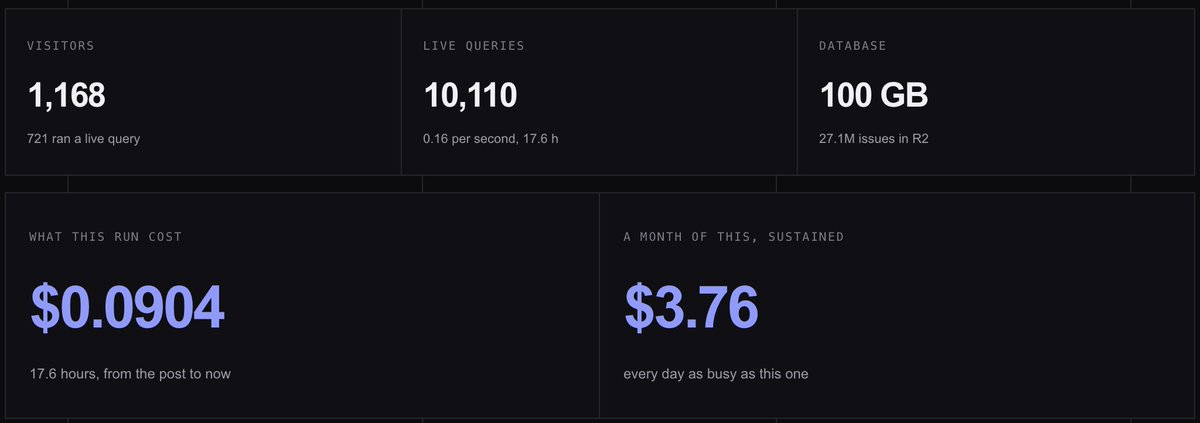
What did this cost to run since the post? $0.09 or $3.76 a month if this load is sustained all month.
$1.50 (40%) of that is the 100GiB R2 storage cost.
How fast and slim can we make Zero's IVM? To find out, we looked for the tiniest and most constrained runtime to put it in. Here it is. Zero's next-gen IVM engine in a single DO. Querying a 100GiB DB stored in R2 and maintaining live queries.
https://t.co/2FrZDKHv3Z
@milonspace Zero's original IVM algorithm was already unique in that the state it uses is proportional to output size rather than input size, so 3 years working on that is what prepared for this 😅. Sharing a single query pipeline across all variable bindings for it was the next unlock.
How fast and slim can we make Zero's IVM? To find out, we looked for the tiniest and most constrained runtime to put it in. Here it is. Zero's next-gen IVM engine in a single DO. Querying a 100GiB DB stored in R2 and maintaining live queries.
https://t.co/2FrZDKHv3Z
@milonspace Query planning, surprisingly! Keeping the stats up to date so it wouldn't fall through to picking `owner_id` when `project_id` would be better.
@Southclaws@CloudflareDev IVM is a PITA. The algorithms in the literature use massive amounts of state and fall down on `order by x limit y`. A cool thing that falls out of IVM, for the R2 case, is that you have a lot more information on what to cache. Eg., cache all the leaves used in subscriptions.
Anecdotally, LLMs are collapsing all the layers and hacks for my own work. Ripping out SQLite to build a custom tree that actually fits the problem is one example.