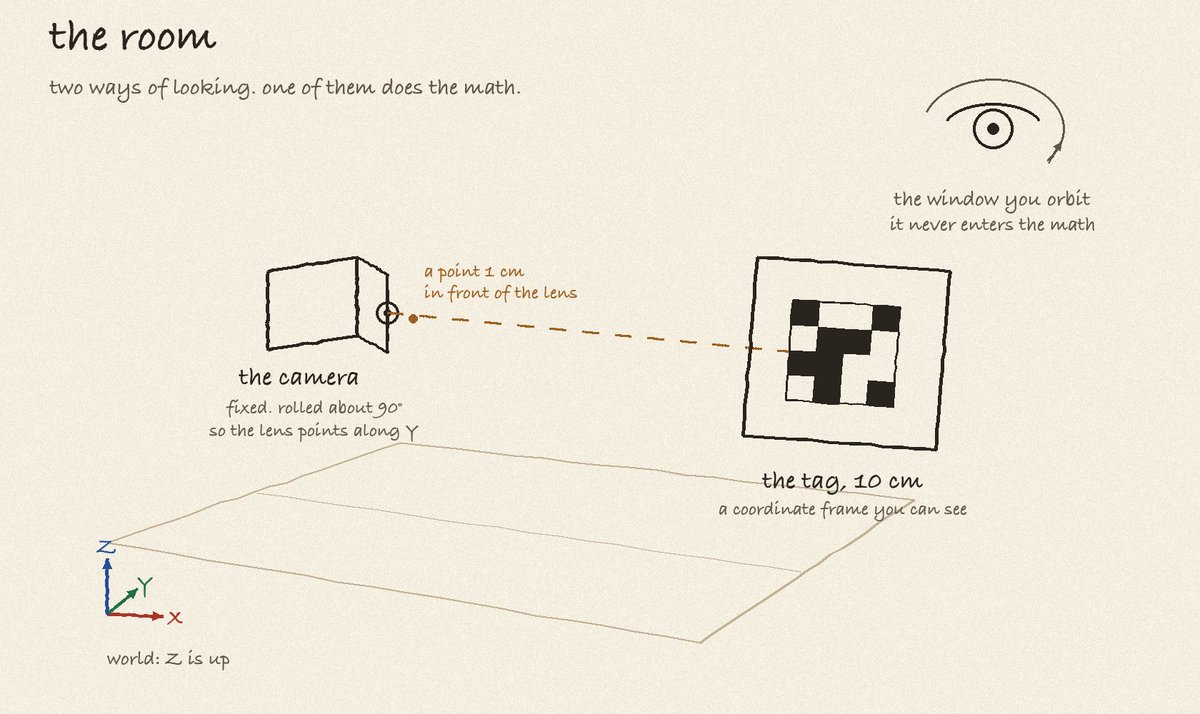
4/4 - I started this just wanting to make a camera detect an ArUco marker
Ended up spending hours looking into coordinate frames, camera geometry, transformations, and pose estimation.
Surprisingly, you build something small, and suddenly there's a whole new layer underneath it
1/4 - I wanted to see if I could get a camera to detect an Aruco marker in 3D. For that, I created a small PyBullet setup with a camera and a marker.
Camera → detects the marker → solvePnP() → gives me its position and orientation.
Sounds simple, right?
Until it wasn't. 😅
3/4 - Then came the part that ArUco markers are sensitive to lighting.
Even a small shadow falling across the marker can change the contrast enough to affect corner detection or lead to a wrong detection.
Small details are important. 🤔
3.) What I really like about this, though, is what could come next.
Right now I'm just looking at dots on my hand. But those dots are coordinates, and coordinates can become inputs to something else.
Curious, right? 😀
Been playing around with OpenCV and MediaPipe, and this was probably the first project where computer vision started to feel a little more real to me.
I built a small hand-tracking system that detects 21 landmarks on each hand in real time.
Here's a glimpse:
2.) I also ran into one of those small things that makes you realize how many layers are involved.
- OpenCV reads the image as BGR.
- MediaPipe expects RGB.
So before sending each frame to MediaPipe, I had to convert it:
BGR → RGB → MediaPipe
Two intuitive reasons I've come up with:
1. Squaring gives more weight to values far from the mean.
2. It's partly a design choice because squared deviations give us some very convenient properties.
Wondering if there is a deeper, more intuitive reason to use L2 over L1? 🤔
Lately I was looking into probability and stumbled upon a question I found surprisingly interesting about variance.
If the goal is simply to measure how far values are from the mean, why do we use L2 norm over L1 norm?
No solid H/M on Morpho or DreUSDC (both still in escalation), nothing big, or I'd rather say still judging on Battlechain YET. Metric has gone into judging. Fingers crossed for Metric 🤞
We used to burn energy convincing devs a bug was real.
BUT NOW the bug has to survive AI triage, dev pushback, and judging, just to be reviewed again like a tax return. 😅
You’re not wrong. You're just outnumbered. 😑
Placed 7th out of 889 researchers in the @reserveprotocol audit competition on @cantinaxyz 🎉
Grateful to the @cantinaxyz team, the @reserveprotocol team, and fellow researchers who make these competitions both challenging and rewarding.
On to the next one. 🚀
Built a 𝗦𝗼𝗹 𝗔𝘂𝗱𝗶𝘁 𝗔𝗻𝗮𝗹𝘆𝘇𝗲𝗿, a tool that automates much of the post-audit review process. 🚀
𝗪𝗵𝗮𝘁 𝗶𝘁 𝗱𝗼𝗲𝘀
- Highlights misclassified TP/FP findings
- Parses findings across audit folders
- Detects duplicate findings & much more
https://t.co/RDLF6hynG4
Published a 3-part research series on recurring ERC-4626 exploit patterns in DeFi:
• $11M lost in ERC-4626 vaults
• Resupply exploit
• Building “VaultGuard”: a static analyzer for ERC-4626 exploit detection
Next: research into an AI-driven smart contract security system.