Highly relevant!
"International Risk-Sharing in a Fragmented World" by Javier Bianchi, Sebastian Horn, Giovanni Rosso, and César Sosa-Padilla.
"This paper studies how geopolitical risk shapes financial fragmentation and international risk-sharing, using bilateral official lending data from 1910 to 2024. We document that when geopolitical risk is high, bilateral lending increasingly follows geopolitical alignment. Because geopolitically aligned countries experience more synchronized shocks, this fragmentation limits the effectiveness of international risk-sharing. To rationalize these patterns, we introduce geopolitical considerations into a limited-commitment model of sovereign borrowing. The model shows that, even with non-discriminatory default, higher geopolitical tensions redirect international lending toward allied countries and weaken risk-sharing."
https://t.co/DxR7C3XXv9
In the May issue, “Exporting, Global Sourcing, and Multinational Activity: Theory and Evidence from the United States” by Pol Antràs, Evgenii Fadeev, Teresa C. Fort, and Felix Tintelnot. https://t.co/W2tbBPuHsr
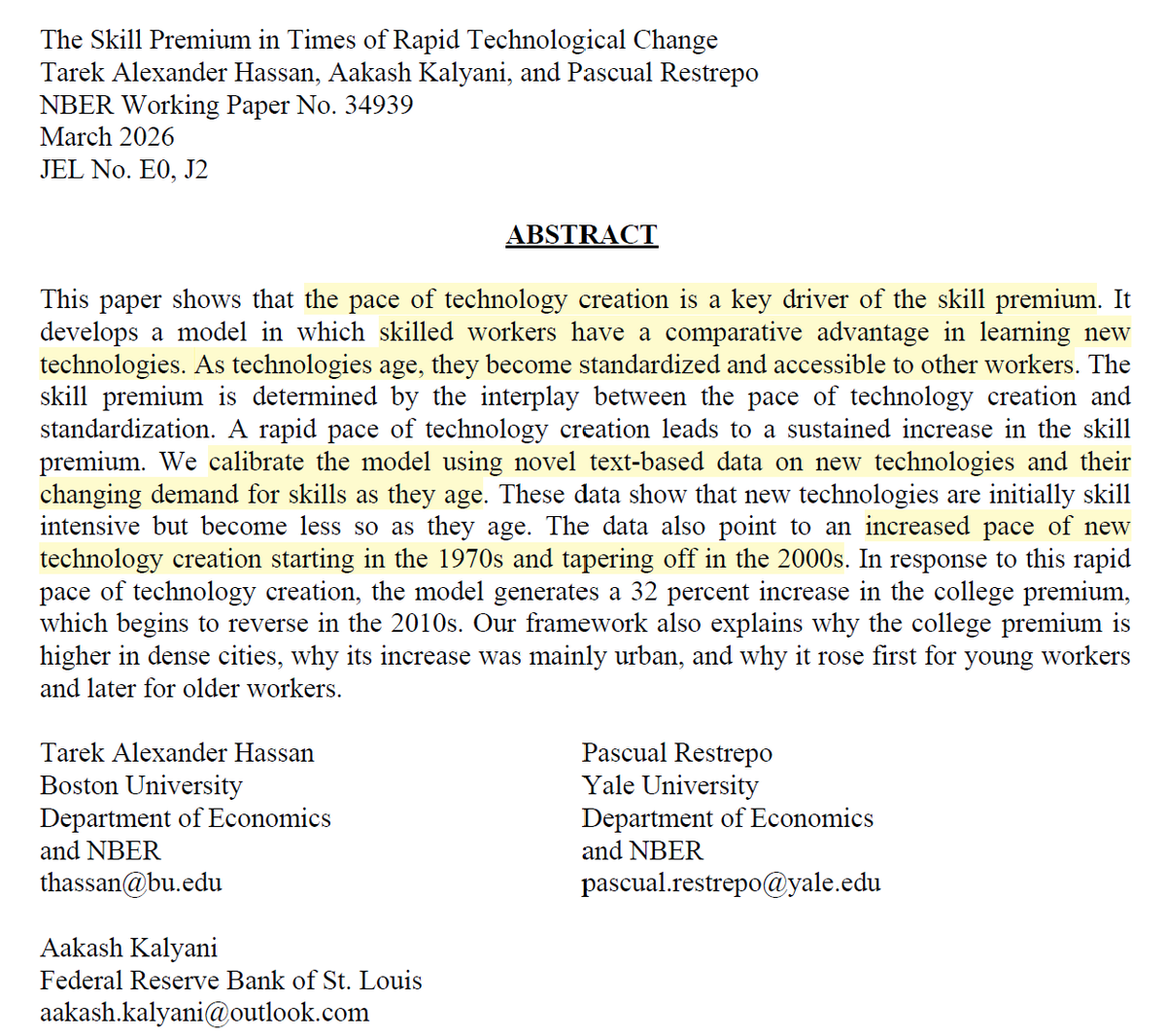
The Skill Premium in Times of Rapid Technological Change
Fantastic new @nberpubs WP by @t_a_hassan - @AakashKalyani - Restrepo (@YaleEconomics).
💡In a model where skilled workers have a comparative advantage in learning new technologies, a rapid pace of technology creation leads to a sustained increase in the skill premium.
I think of this as a modern application of the "Nelson-Phelps (1966) view of human capital", used to understand the college-wage premium.
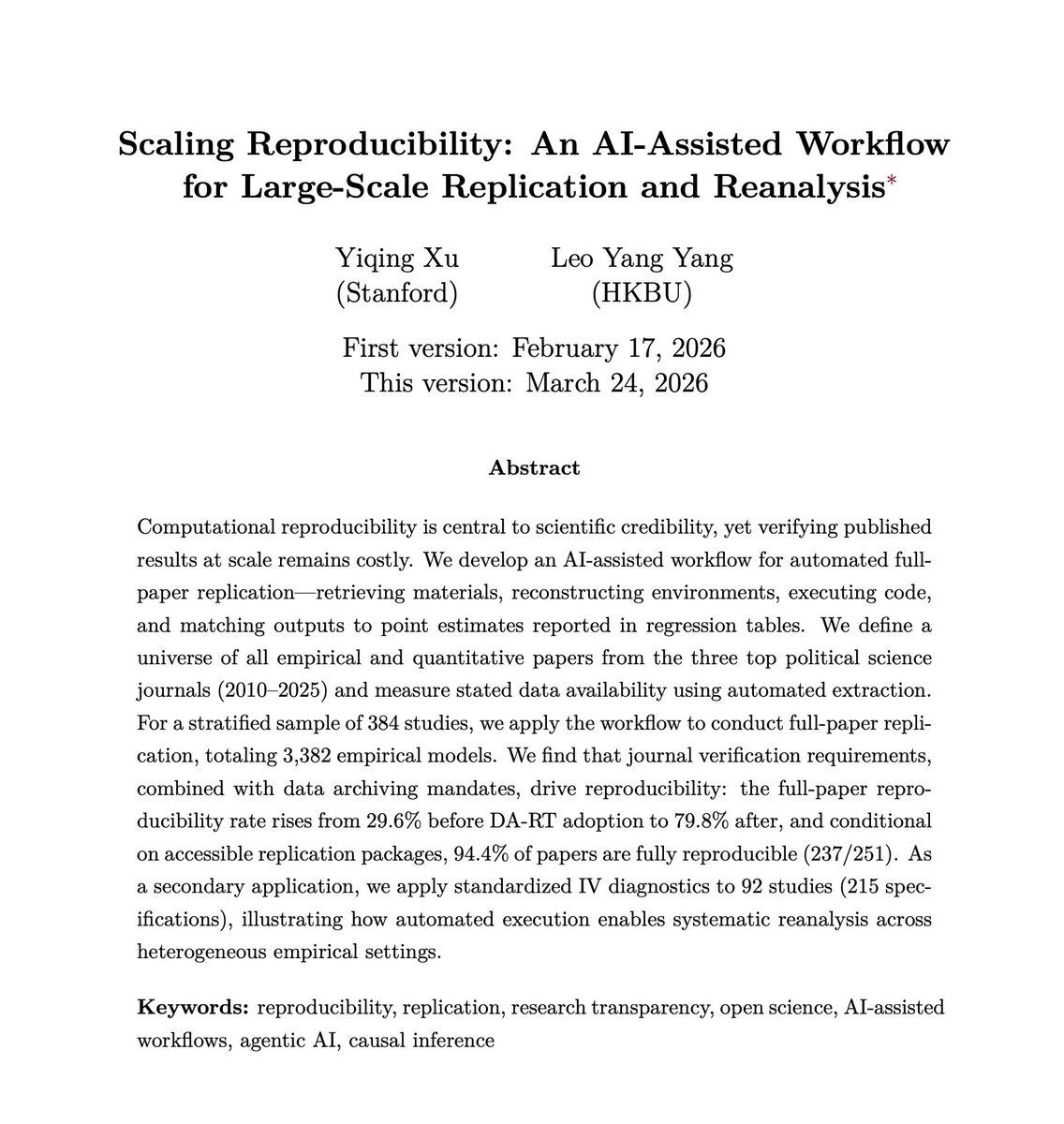
1/🧵 A major update to our paper: "Scaling Reproducibility" w/ @YangYang_Leo.
We move beyond reanalyzing a single design to (almost) full-paper replication!
Paper: https://t.co/fslLN0zTQO
I am a big fan of this paper. When I discussed this at a NBER conference, I discussed the economics of superships. Such large container ships (that China is heavily subsidizing to mass produce) offer economies of scale for shipping goods from high yield to low yield places. 1/3
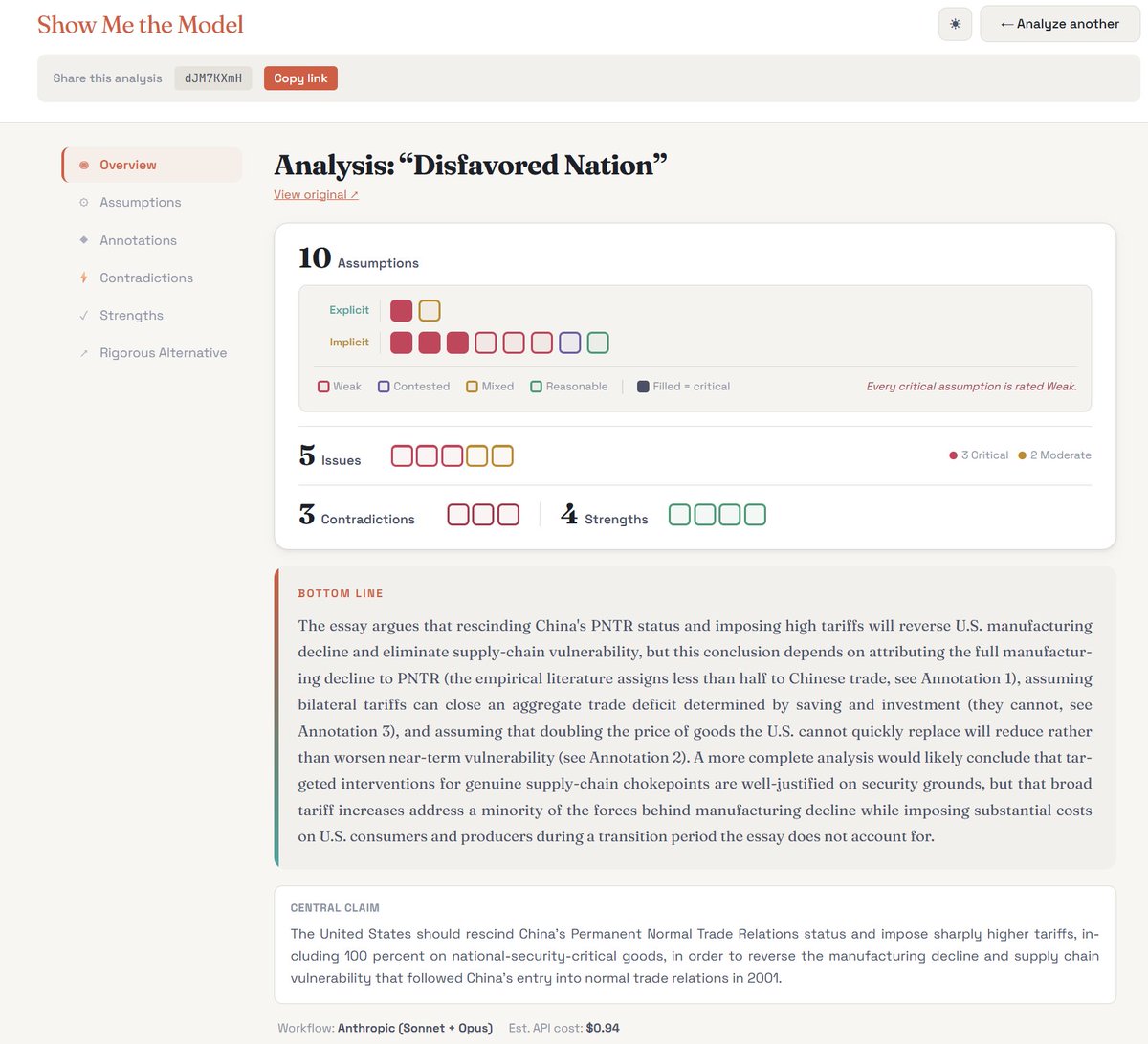
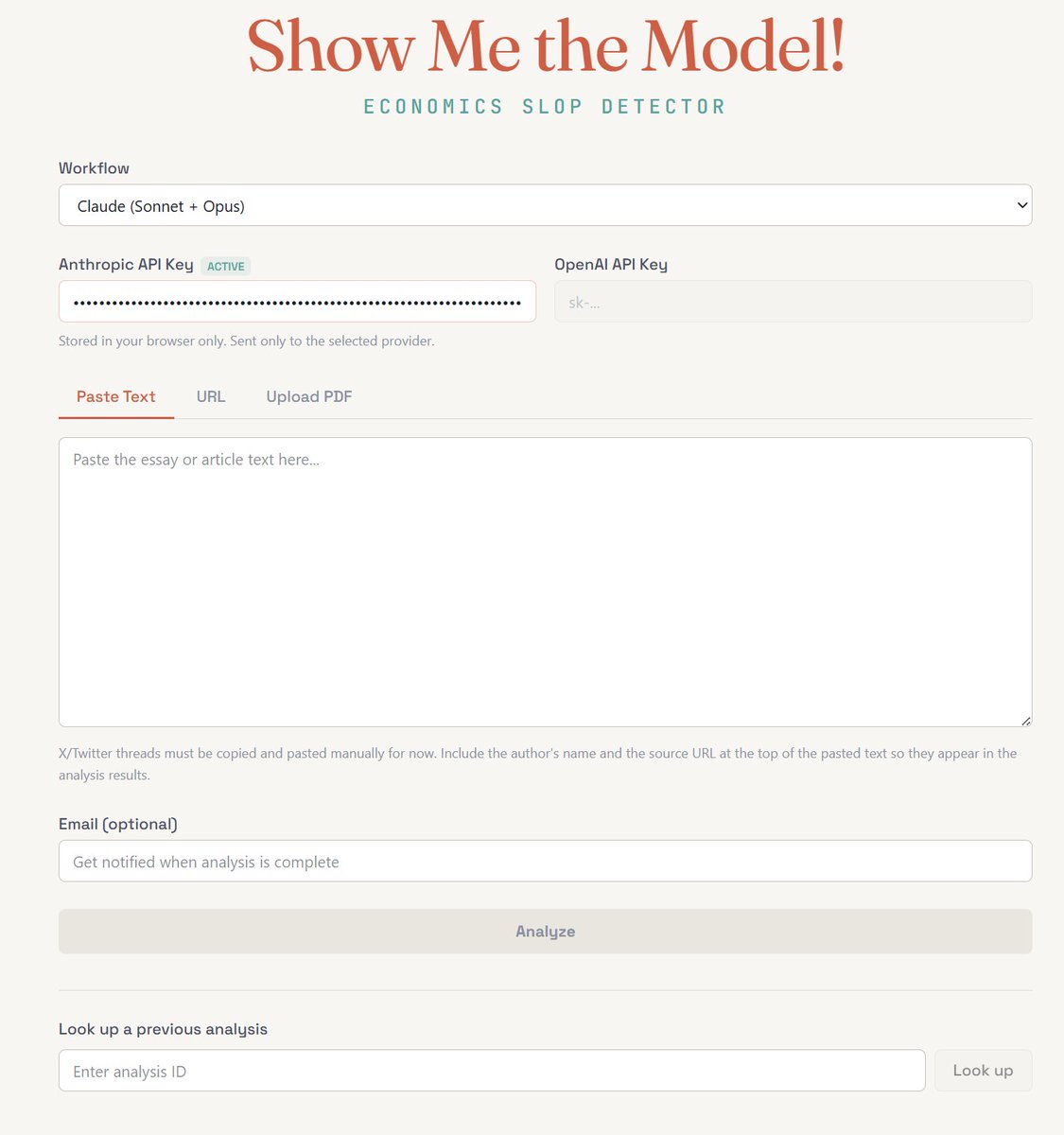
I spend way too much time on social media debunking "economic slop" promulgated by lawyers pretending to be economists, so I built Show Me the Model: a tool that uses AI to check whether the economic reasoning in an essay actually holds up.
https://t.co/cfhWs6MI27
Give it a URL or paste some plain text, and the tool flags hidden assumptions, internal inconsistencies, and other problem areas, and tells you how a real economist would think through the issue.
Right now, it has 4 "personas:" macro, trade, IO/price theory, and labor. The tool first figures out which persona is right for the job, and then uses a parallelized prompt scaffold specific to that persona to process the source text.
Here are some example outputs based on some essays that triggered me hard:
Citrini Research's viral essay on how AI could trigger a self-reinforcing financial crisis rivaling the GFC:
https://t.co/ZNUFHqyEFT
American Compass on the harms of trade deficits:
https://t.co/Nasfvr36iY
@oren_cass on why Built-to-Rent should be banned:
https://t.co/niie7bVRoK
American Compass on the "China Shock:"
https://t.co/nZvoEaTdTv
@michaelxpettis on why China's trade surplus reduces global output:
https://t.co/LqocDslRrH
Try it yourself at https://t.co/cfhWs6MI27. You'll need to bring your own API key (OpenAI or Anthropic), and a typical analysis costs $0.50–$1.50.
It's super preliminary and will probably break on you. I'd love feedback about both the functionality as well as the quality of the output.
What happens when you invite 150 AI economists (Claude Code) to a research conference, give them the exact same data, and ask them to test the same hypotheses?
We did just that. The results reveal a new phenomenon: Nonstandard Errors in AI Agents. 🧵👇
Mainstream trade economists have recently been passing around this NBER Working Paper that, perhaps not surprisingly, reinforces the mainstream academic view of trade intervention. The paper argues that trade generally raises welfare by enabling specialization and exchange, that tariffs distort this system and so reduce welfare, and that while large countries may gain slightly through terms-of-trade manipulation, global retaliation and trade wars quickly eliminate those gains.
While this may sound pretty conclusive, and seems to support the almost universal assumption by academic economists that trade intervention under any conditions always reduces welfare for the country that intervenes, it is important to understand the assumptions behind the model.
A model is circular. It does not create new "truths" but rather restates the underlying assumptions in a logical (some would say "circular") way. Among other things this means that if the assumptions underlying a model are not fully consistent with real conditions, the conclusions of the model have no validity in the "real" world. Models can be very useful when widely accepted assumptions lead logically to a seemingly counterintuitive conclusion, but this is incredibly rare. Otherwise the role of economic models is mostly to create an air of scientific rigor for a decidedly non-scientific discipline.
It turns out that this particular model depends on several strong assumptions. It assumes that firms are price takers, that there is free entry and exit in the global trading system, and that prices equal marginal cost (which means, among other things, that production isn't subsidized to an extent that significantly changes trading patterns). Most importantly, the model assumes that global trade is broadly balanced, i.e. that a change in exports by any country is matched by an equivalent chnage in imports.
These are all very typical assumptions in a lot of academic trade models, not because they describe reality, but because they make it much easier to model, but not one of them is a reasonable description of the real world. They assume that we live and trade in the world of Econ 101, i.e. an idealized world of free and balanced trade, in which countries maximize global output by specializing in their areas of comparative advantage, and in which countries do not intervene in their external accounts.
Like most academic trade models, in other words, it assumes a global trading system that clearly does not reflect the actual global trading system. Every one of the assumptions listed above is regularly violated, most obviously the assumption of broadly balanced trade.
But based on this very unrealistic set of assumptions, it seems to suggest policy recommendations. Basically what this model (and most other mainstream trade models) tells us is that in a world of balanced and output-maximizing trade, if governments intervene to create trade imbalances, they will reduce total output.
But that should be obvious. I fully agree with the conclusion, in other words, and if you start with an existing system that already maximizes global output, it is no great insight that any distortion in that system will reduce global output.
The problem is that because the underlying assumptions are not clearly stated, and because there is no attempt to judge the validity of the conclusions under more realistic conditions, it is easy to conclude that even in the highly distorted, unbalanced global trading system of the real world, in which major economies use massive trade intervention to externalize the cost of domestic policy distortions, this paper implies that countries with open external accounts always benefit by keeping them open.
But if we do in fact live in a global trading system in which some major governments already intervene heavily through trade and industrial policies, distorting trade in ways that create trade imbalances and reduce total output, wouldn't it follow that other governments that haven't done the same could subsequently implement trade and industrial policies designed to reverse these imbalances, in which case they would raise global output?
I recognize that it is very hard to compose publishable papers on complex topics based on models that assume deep, persistent trade imbalances, firms that are not price takers, massive intervention on the part of major economies in their external accounts, trade patterns based not on comparative advantage but on competitive advantage, and the transmission of industrial policies from more closed economies to more open economies.
But that, in fact, is the world in which we live. The conclusions of models that are built on a completely different set of assumptions may on occasion be intellectually interesting, but they should have little to no bearing on actual policymaking.
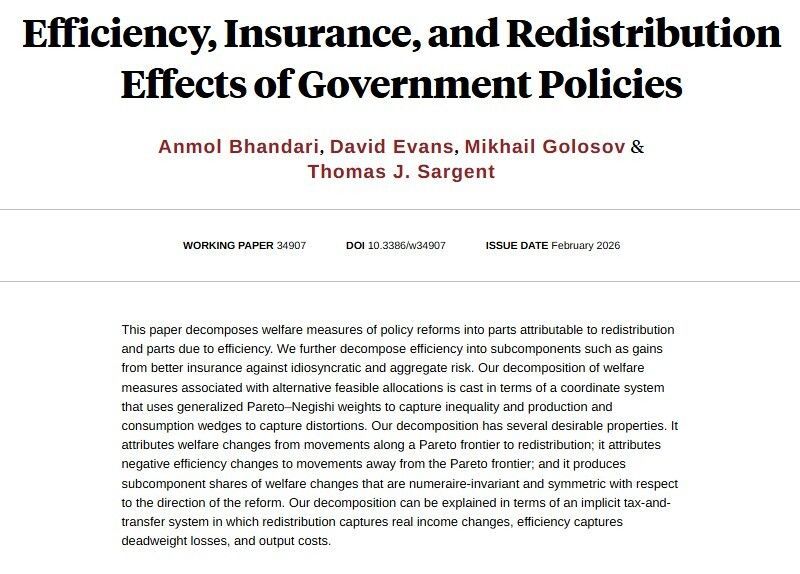
Decomposing welfare measures of policy reforms into parts attributable to redistribution and parts due to efficiency, from Anmol Bhandari, David Evans, Mikhail Golosov, and Thomas J. Sargent https://t.co/bBcbYQaWCY
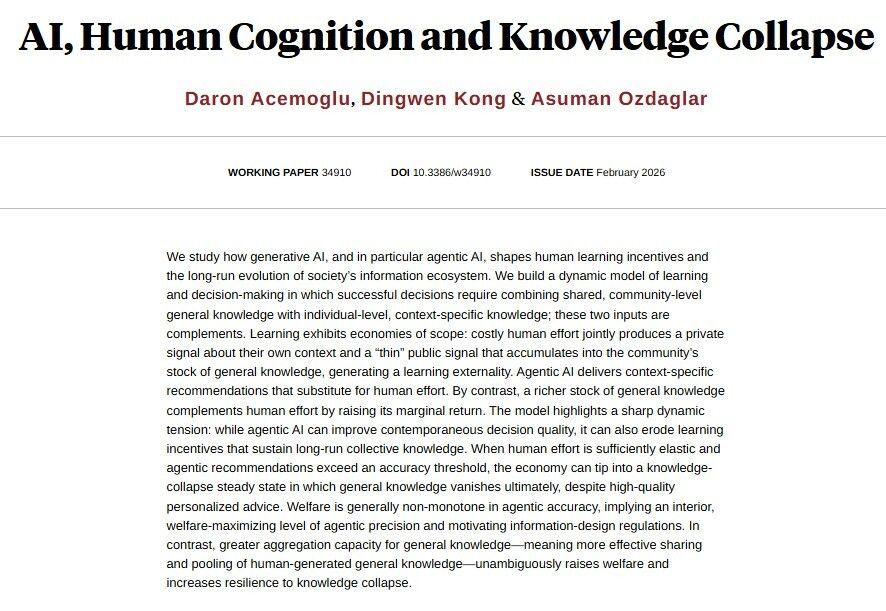
Studying how generative AI, and in particular agentic AI, shapes human learning incentives and the long-run evolution of society’s information ecosystem, from @DrDaronAcemoglu, Dingwen Kong, and Asuman Ozdaglar https://t.co/XTigJqLHat
Claude Cowork is set to revolutionize intellectual and academic work.
But most academics don't know how to use it.
Here's how to set up Claude Cowork as your research assistant:
(This workflow will take you only 15 min.)
看完这期播客我突然理解了:AI 这波最反常识的地方不是“模型多强”,而是技术已经不是瓶颈了,瓶颈在组织。
大多数人谈 AI 还停在“参数、算力、SOTA”,像在讨论发动机马力。但真实世界里,车跑不起来往往不是发动机不够大,而是:路权、规则、流程、责任边界、数据权限、以及“谁为结果负责”。
所以你会看到一种很荒诞的现实:
同样的模型,在 A 公司能把成本打穿,在 B 公司只能做 PPT。不是 AI 不行,是组织不允许它行。
更扎心的是,所谓“模型商品化”也不是输赢题。前沿会溢价,尾部会同质化,但真正把人绑住的从来不是模型本身,而是你把它塞进了多少流程、接了多少数据、改了多少 SOP,切换成本才是护城河。
最后你会发现:AI 时代最稀缺的不是更强的模型,而是能把 AI 落到流程里的人。
而这件事,往往比训练一个模型更难。
https://t.co/5XqgZ16Ppg
Recently accepted by #QJE: “Automation and Rent Dissipation: Implications for Wages, Inequality, and Productivity,” by Acemoglu (@DAcemogluMIT) and Restrepo: https://t.co/1E23YgMExo
Recently accepted by #QJE: “The Macroeconomic Impact of Climate Change: Global Versus Local Temperature,” by Bilal (@AdrienBilal) and Känzig (@drkaenzig): https://t.co/QRs0mFCKma
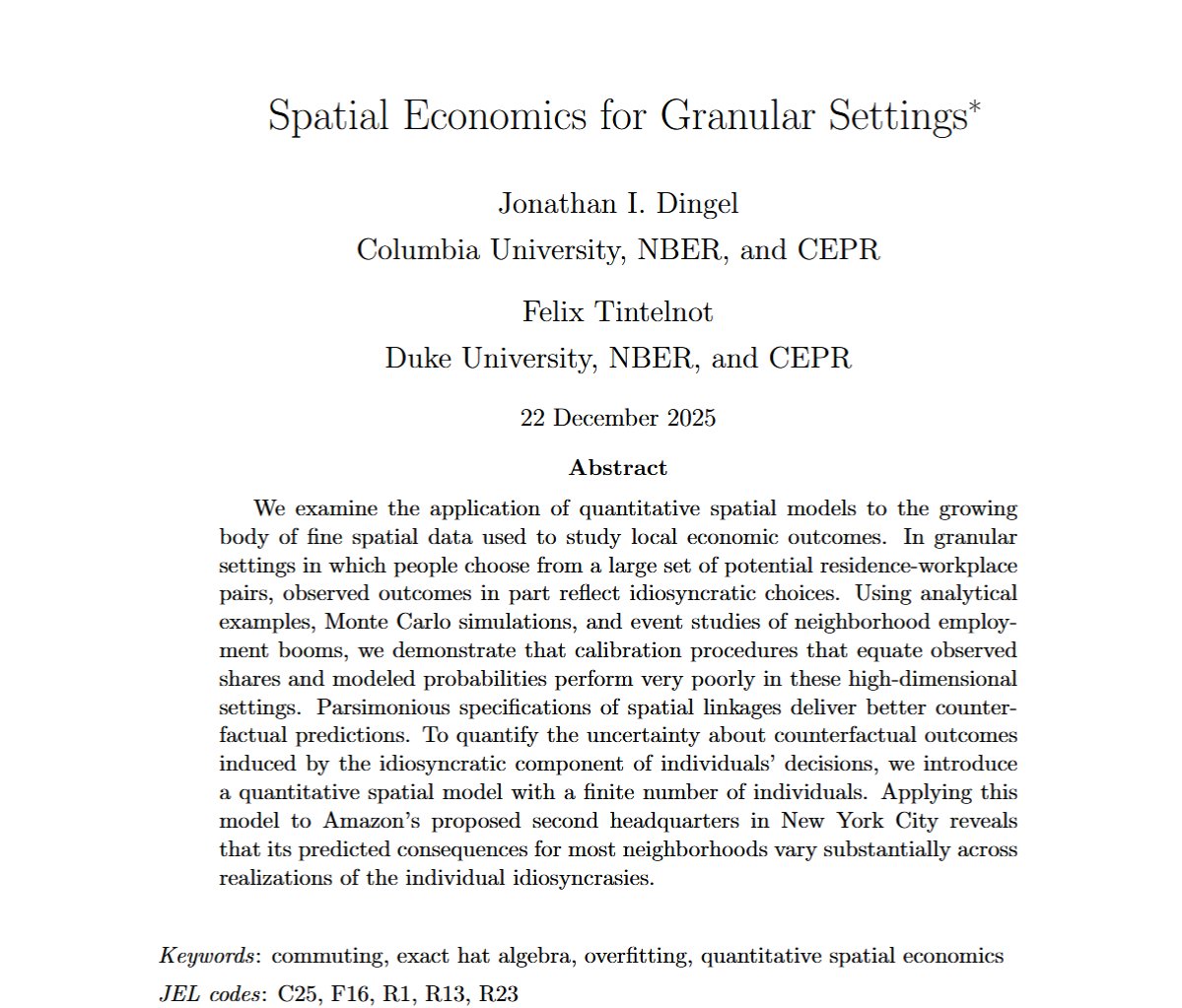
Spatial models calibrated to observed flows suffer overfitting problems in granular settings. @TradeDiversion & @FelixTintelnot diagnose the problem, show data smoothing performs better, and introduce a finite model to quantify counterfactual uncertainty. https://t.co/aBEUa6urEs
Food for thought!
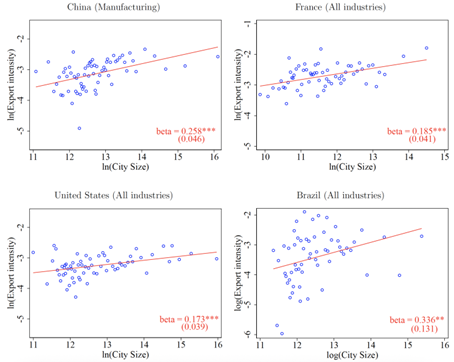
"Big cities and globalisation" by Jan David Bakker, Alvaro Garcia Marin, Mr Andrei Victor Potlogea, and Nico Voigtländer.
"Larger cities have higher ‘export intensity’ – they export more because they host more exporters, especially superstar firms, and are less sensitive to trade cost changes. Large cities ‘win’ from international trade, and growing urbanisation fuels globalisation."
https://t.co/cIB722aDgI