Whatever the worst interpretation of AI blowing up, AI displacing all the SaaS, $ORCL finishing its datacenters, not having enough data centers, needing more funding, not needing more funding, etc... is what the market is pricing for Oracle...
Bernstein last week explored how much $ORCL would be worth if their AI business failed.
So in other words, if their AI data center revenue disappeared, hardware inventory can't be monetized and the debt stays on the books.
They came up with a valuation of $133 per share, which is still over 30% above the current price of $101.
Bernstein are obviously not expecting this worst case scenario to play out, though, because they have a target price of $325, which represents potential upside of around 222%.
The company now trades on a forward P/E of just 10.9 for 2028, which is when they expect to be free cash flow positive, and 7.44 for 2029.
So I don't necessarily think that this $325 target is unrealistic either if they can hit these numbers.
How about you? Are you buying Oracle here?
Compute in space starts to pencil out with launch costs <$250/kg. Starship fuel costs are <$10/kg so betting against space compute is basically saying that Starship won't be reusable
https://t.co/yiHpukp79h
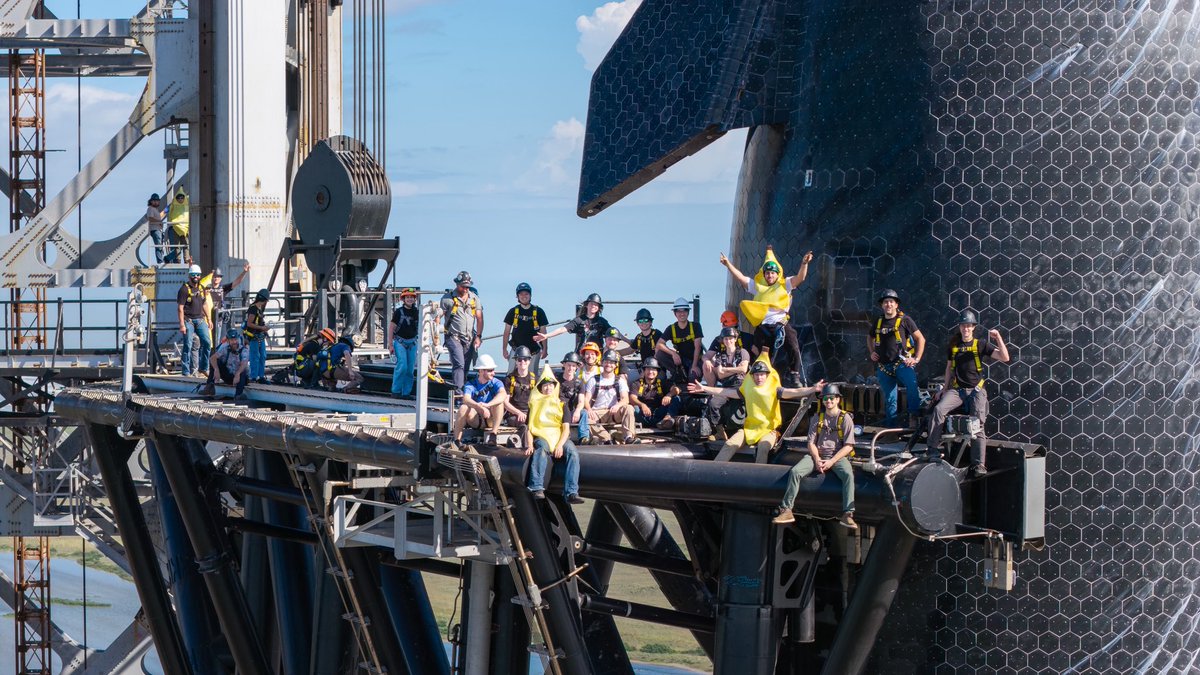
Remember when random smartarses all decided in unison they knew more about cooling spacecraft than every engineer at SpaceX?
“iTS jUsT bASic PHySiCS bRo!”
Yeah maybe cover the more advanced stuff before opening your mouth.
Ok, I’m going to be as polite as possible even though I’m tired of explaining this. Forward earnings are horrible for assessing valuations when we’re at the end of the cycle.
Analysts extrapolate recent growth and elevated profit margins instead of anticipating mean reversion or recessionary contractions. As a result, the denominator in forward price to earnings ratios stay artificially high while the business cycle is already turning, making valuations appear more reasonable than trailing or cyclically adjusted ratios.
Students of financial history understand this. During the GFC, actual earnings collapsed about 92%, yet consensus estimates only fell about 6%. This disconnect happens at the end of every cycle and the beginning of every recession (although the GFC is an extreme example). Downward revisions to estimates only come after the damage is already visible.
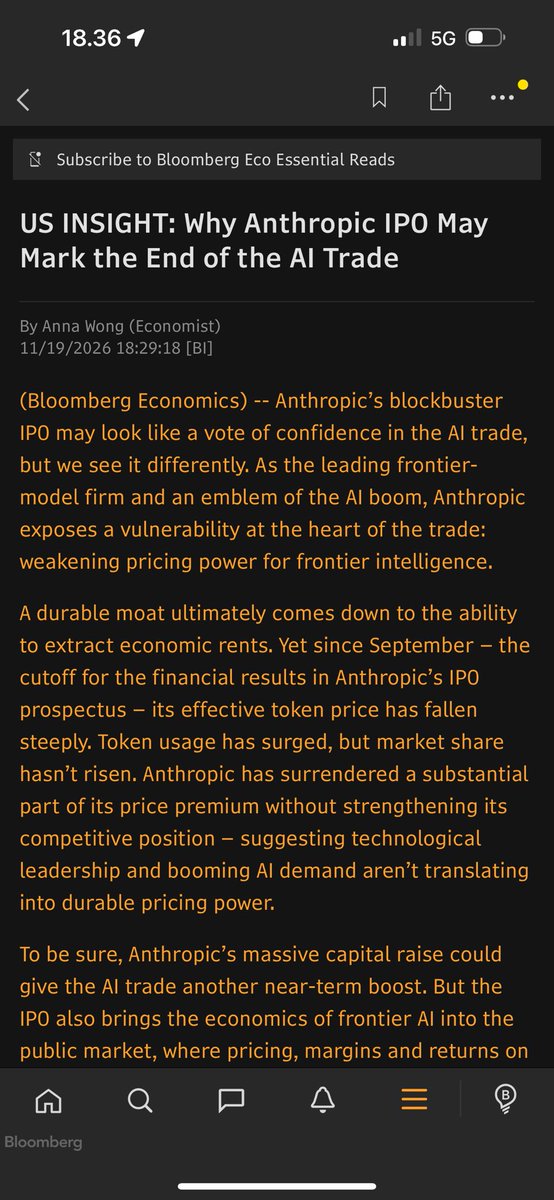
Margins have been *expanding* as token prices decline. As others have noted, falling transistor prices don't invalidate semi companies, they are the backbone of semiconductor progress...
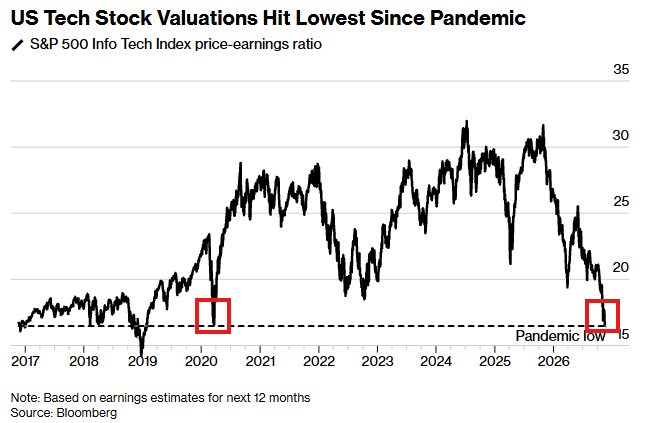
BREAKING: US technology stock valuations have hit their lowest level since March 2020 amid the market correction.
The S&P 500 Info Tech Index P/E ratio is now at its lowest since March 20th, 2020, at 16.4x.
Market is discounting just about every 2028 growth forecast right now and that discount will only disappear as companies prove themselves quarter after quarter.
But if management really believes market has it wrong then there's one way to prove it today.
Buy your own stock.
Arsenal ship makes sense, but you'd need to protect it constantly given the cost and scarcity of its munitions, and protecting properly requires making it a destroyer. Also we don't have enough munitions for the destroyers
@Schizointel Build a large arsenal ship with an insane number of VLS along more commercial lines and a 2nd ship along a warship plan for the railguns and other weapons, there were plans for an arsenal ship in the late 1980s or early 1990s
Short drama might be a huge threat to Netflix. $NFLX
Hongguo Short Drama, owned by TikTok's parent company ByteDance, launched in 2023 and has now surpassed 200M daily active users, up from 120M earlier this year.
So, what is short drama? It's basically TikTok on steroids.
If it's still hard to understand, think of all the clips from well-known series that you've watched on Reels/TikTok/YouTube Shorts.
Short drama is basically a series of clips from a series.
And since nowadays most people don't watch the boring context anymore, production houses have figured out that they only need to produce the "clips" that give people dopamine hits and save the cost of producing the context.
And that's short drama. It's just a compilation of clips from traditional series.
So it basically works like a 12-hour series, but takes out all the unstimulating parts, turning it into a 1–2-hour compilation.
It's next-level brain rot. I'm personally very pessimistic about human attention spans after learning about it.
You might think: So? Hongguo Short Drama only has 200M DAU. That doesn't seem like a lot.
But that's actually not the case. A huge portion of internet time is already dedicated to it. It's perhaps one of the biggest verticals on Douyin (China's TikTok) itself.
Hongguo is just one of the external apps that offer the whole experience. I personally have never downloaded a dedicated app, but I still consume plenty of short drama.
You can now watch short drama in every single e-commerce app in China, including Alibaba's Taobao, Pinduoduo, and JD. Or even WeChat itself.
Basically, every Chinese internet company has its own short drama strategy. It's just insane.
The biggest e-commerce app in Southeast Asia (Shopee), with 400M active buyers, has now also introduced short drama into its app.
In 2026 Q1, according to Sensor Tower, 6 of the top 40 apps by downloads outside China were short drama apps. It's becoming insanely popular in Southeast Asia, LATAM, and India.
It's not just something in China anymore. And most importantly, most of the videos are from China, so they're naturally translated. People in all those countries are getting addicted despite the content not even being local.
And short drama, because it's built around short clips, is rather easy to produce with AI. Now in China, more than 95% of short dramas are already produced by AI. And the quality has been pretty decent and is improving insanely fast.
In 2026 Q1 alone, 128K shows were produced, and production is still doubling every few months. The cost is around 5K per show (depending on quality), and it's still dropping fast.
I believe the wealthy Western world will soon feel the pressure.
$NVDA Q3 FY27 off the call and not in the release or CFO commentary. Top 5 things the call added:
1. FY28 growth outlook: ~75%, from 70%. ~$741B by my math vs $692B street: BEAT.
2. Saturday I gave Jensen's return a very small chance. The board doesn't intend to reinstate him and hired a search firm.
3. Kress: business as usual. Not for capital: suppliers first, customer financing selective, new commitments "rigorously" evaluated.
4. Q4 is the margin bottom: NVIDIA absorbed supply cost increases on booked orders, new pricing next year. FY28 held at 72% to 73%.
5. In May I wanted a clearer picture of the Rubin ramp: ~$20B in its first shipping quarter, hyperscalers in production in about a month.
@nvidia
Voyager 1 spacecraft crosses milestones distance of one-light day from Earth 49 years after launch — now 16.09 billion miles away, signal takes full 24 hours to travel home https://t.co/64rqhOrFgD
They did it! SpaceX has just caught their Starship rocket for the first time ever, marking the first recovery of a conventional orbital rocket upper stage in history!
This is one of the greatest engineering achievements in history. Congrats to the entire @SpaceX team! 🚀
AI may fill the clinical pipeline faster but the expensive and time consuming part of drug development is clinical trials. Moderna started Intismeran clinical trials in 2017. It took 10 years to prove it was safe and effective, not to invent it
The pharma folks are right to call out Dario for making bold claims about curing all disease.
They are also right that most necessary bio data does not yet exist.
Still, pharma has two crucial blindspots:
1) The industry has never witnessed what a small, well capitalized, and well incentivized silicon valley team can do (no instagram, whatsapp, ARM, cursor in pharma). They grossly underestimate what's coming for them.
2) They don't yet see just how much the labs *need* to win in bio to double TAM (there simply is not other accessible market), and just how much all of tech's liquidity relies on this happening.
Pharma is a risk management industry: you get fired for failing in old ways, not for failing in new ways. The industry will be shocked at how fast automated labs, better models, etc can be stood up by small, well capitalized teams that have only 1x to lose and thousands of x to gain.
Pharma doesn't quite yet have a traditional innovator's dillema. Their capital and GTM moats are still deep, but not for much longer (drugs going d2c, dev costs decreasing). Pharma's window to win is open, but it will close fast if they fail to take ownership of the incoming infrastructure explosion.
Update: Some Nvidia board members favor appointing CFO Colette Kress as interim CEO if Jensen Huang is ousted, Semafor reports.
Apple hardware chief Johny Srouji is among those being considered for the permanent role, but the full board has not yet made a decision.
Just a reminder that real overnight rates are zero and fiscal spending is up nearly 15% in two years despite tax cuts, pushing the deficit/GDP to >7%. Add in tariffs and $100 oil and then remember that the Fed didn't even do a quarter point hike at the last meeting...