Extremely rare red sprites light up the sky over Tibet
Triggered by powerful lightning, these glowing red flashes appear high above thunderstorms and are among the rarest atmospheric phenomena on Earth
Hayek avait parfaitement compris que le problème central de l'économie n'est pas l'allocation des ressources mais la nature fondamentalement dispersée de l'information.
"Le socialisme suppose que toute la connaissance disponible peut être utilisée par une seule autorité centrale.
C’est une erreur fondamentale. La connaissance dans la société n’est pas concentrée chez un seul individu ou un groupe de planificateurs. Elle est dispersée parmi des millions de personnes. Chaque individu possède des morceaux de connaissance très spécifiques : des circonstances locales, des opportunités changeantes, des préférences personnelles, des savoir-faire techniques…
Dans une économie de marché, ce sont les prix qui agissent comme des signaux. Ils transmettent cette connaissance dispersée de manière efficace. Quand le prix d’un bien monte, cela indique une rareté ou une demande plus forte, et incite les gens à ajuster leur comportement sans qu’un planificateur ait besoin de tout savoir.
Le socialisme, en supprimant les prix libres et la propriété privée, détruit ces signaux. Les planificateurs sont alors aveugles. Ils ne peuvent pas allouer les ressources efficacement. C’est pourquoi, malgré toutes les bonnes intentions, le socialisme conduit inévitablement à l’inefficacité, aux pénuries, au gaspillage et, finalement, à la coercition pour faire fonctionner le système."
Todos os anos o governo brasileiro vai ao mercado pedir R$2 trilhões (ou ~$400 bilhões) emprestado a juros 4x maiores do que cobra o FMI.
Há quem diga que dever aos rentistas brasileiros pagando 4x mais é tranquilo, pois "a dívida é na nossa própria moeda"
Mas qual a diferença de dever na própria moeda?
Simples. Devendo na própria moeda, no pior cenário, você resolve a dívida via inflação. Em suma, roubando os mais pobres.
Este argumento de que "dever na própria moeda é bom", só serve pra quem esconde que tem pouco ou nenhum apreço pelo valor da moeda e que ainda que não se dê conta, considera OK voltarmos a tragédia que foi o Brasil de 1979 a 1994, quando a inflação bateu 13 trilhões de % e os pobres eram sistematicamente roubados em 6% do PIB ao ano.
O papel do FMI é estabilizar a moeda.
E a Argentina é historicamente uma tragédia neste quesito.
A única coisa que dever ao FMI indica é que você não tem controle sobre sua moeda. Quando Milei assumiu, o governo argentino tinha 18 taxas de câmbio. Controlava a entrada e saída de dólares de tal forma que, no câmbio oficial, estrangeiros poderiam ir a Argentina e viver como Reis com uma moeda fraca.
Durante a gestão Fernandez, chegou-se ao cúmulo de europeus comprarem produtos na Amazon com 30% de desconto ao selecionar a opção "Peso argentino", tudo subsidiado pelos pobres na argentina (que eram 38% do país em 2023 e 26% hoje).
Na prática, preocupe-se sempre com o que as pessoas FAZEM e não com o que DIZEM.
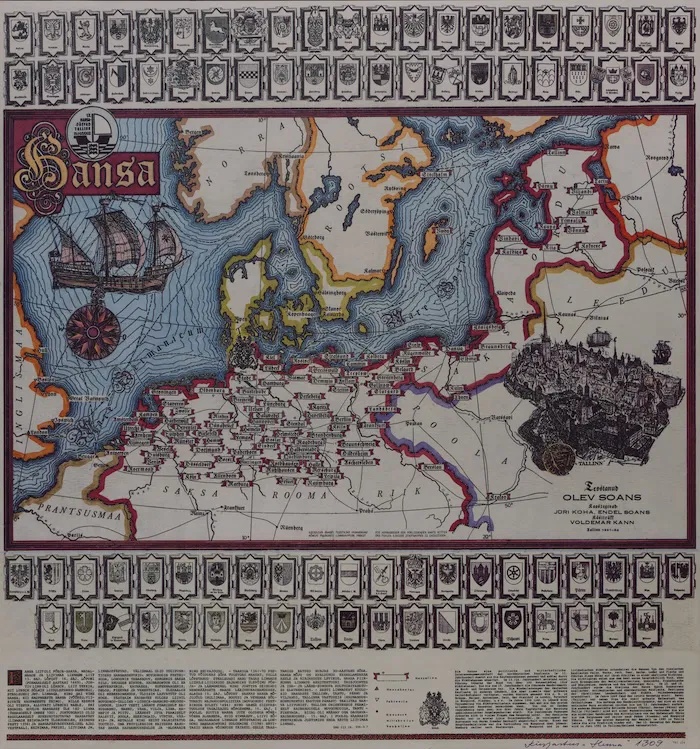
The Hanseatic League solved commercial disputes for 400 years without a single government court, police force, or regulatory agency—and they did it better than any modern state system.
From 1159 to 1669, German merchants spanning from London to Novgorod created the most sophisticated private arbitration network in history. When a Hamburg trader accused a Lübeck merchant of breach of contract, they didn't petition some distant king or wait months for bureaucratic tribunals. They brought their dispute before merchant courts staffed by actual businessmen who understood trade, contracts, and reputation. These arbitrators rendered decisions within days, not years.
The enforcement mechanism? Pure market discipline. The League maintained detailed records of every merchant's behavior and shared this information across all member cities. Cross a Hanseatic trader in Bergen, and you'd find yourself blacklisted from Riga to Bruges within weeks. No bailiffs, no jackbooted enforcers, no violence—just the inexorable power of reputation and voluntary association. And it worked spectacularly. The League dominated Northern European commerce for half a millennium precisely because merchants trusted their dispute resolution more than royal courts.
But here's what modern lawyers and judges will never tell you: the Hanseatic system resolved disputes faster, cheaper, and more accurately than contemporary government courts. Why? Because the arbitrators actually understood commerce and faced real consequences for bad decisions. Screw up a ruling as a Hanseatic arbitrator, and merchants would stop using your services. Screw up as a federal judge today, and you get lifetime tenure.
The League died when centralized nation-states crushed private governance with military force, not because their system failed. Every blockchain arbitration platform and private dispute resolution service today merely rediscovers what German merchants perfected 800 years ago.
I decided to do a deep dive to figure out what it would take for European voters to change the law to allow them to deport migrants. For instance, say the voters of Italy wanted to deport Syrian terrorists to Syria. What would they need to do, legally to get that outcome? 🧵
🚨🇺🇸 THE MOST UNCOMFORTABLE FACT IN CRIME DATA: VIOLENT CRIME IS NOT RANDOM
Violent crime in U.S. cities is not evenly spread. Not culturally. Not geographically. Not mathematically.
It’s concentrated - absurdly concentrated - in fractions of fractions of the population.
This isn’t ideology.
It’s decades of DOJ, PD, and academic data all pointing at the same tiny cluster:
• ~0.5% of residents linked to 50–70% of shootings
• Most homicide suspects have 8–12+ prior arrests
• Victims usually know their attackers
• Violence clusters block-to-block, not citywide
It blows apart the comforting narrative that crime is this vague atmospheric force that “just happens.”
It strips out the comforting “society failed them” story and forces a harsher question:
If 1% is driving the carnage, why is the entire system designed around treating it like a 100% problem?
Why?
Because it’s easier to redesign a city than to confront the handful of people actually pulling triggers.
It’s easier to blame “society” in general than acknowledge that a tiny network of repeat offenders is blowing holes in entire neighborhoods.
Crime is driven by a hyper-small group of chronic, high-risk individuals interacting with each other in micro-geographies the rest of the city rarely sees.
At some point, every major city will be forced to admit the truth:
You don’t need to fix everyone.
You need to fix (or isolate) the 1% doing the damage.
Source: DOJ, NIJ, Harvard, UCSB, Rutgers
Media: The New Yorker
Something Italian to spice up your weekend
This is ’Nduja, the most famous Calabrian food in the world, halfway between a cured meat and a spreadable sauce, with a sharp and delicious flavor, from the ancient tradition of preserving pork during the winter
The modern world uses math to create addictive social media algorithms. The old world used math to create timeless works of shocking beauty.
The most beautiful stained glass in the world
A thread 🧵
1. Sainte-Chapelle, Paris